Rare Melanistic Tiger and Lodha Tribe - Environment And Ecology | UPSC Learning
Topics
0 topics • 0 completed
🔍
No topics match your search
Rare Melanistic Tiger and Lodha Tribe
Medium⏱️ 6 min read
environment and ecology
📖 Introduction
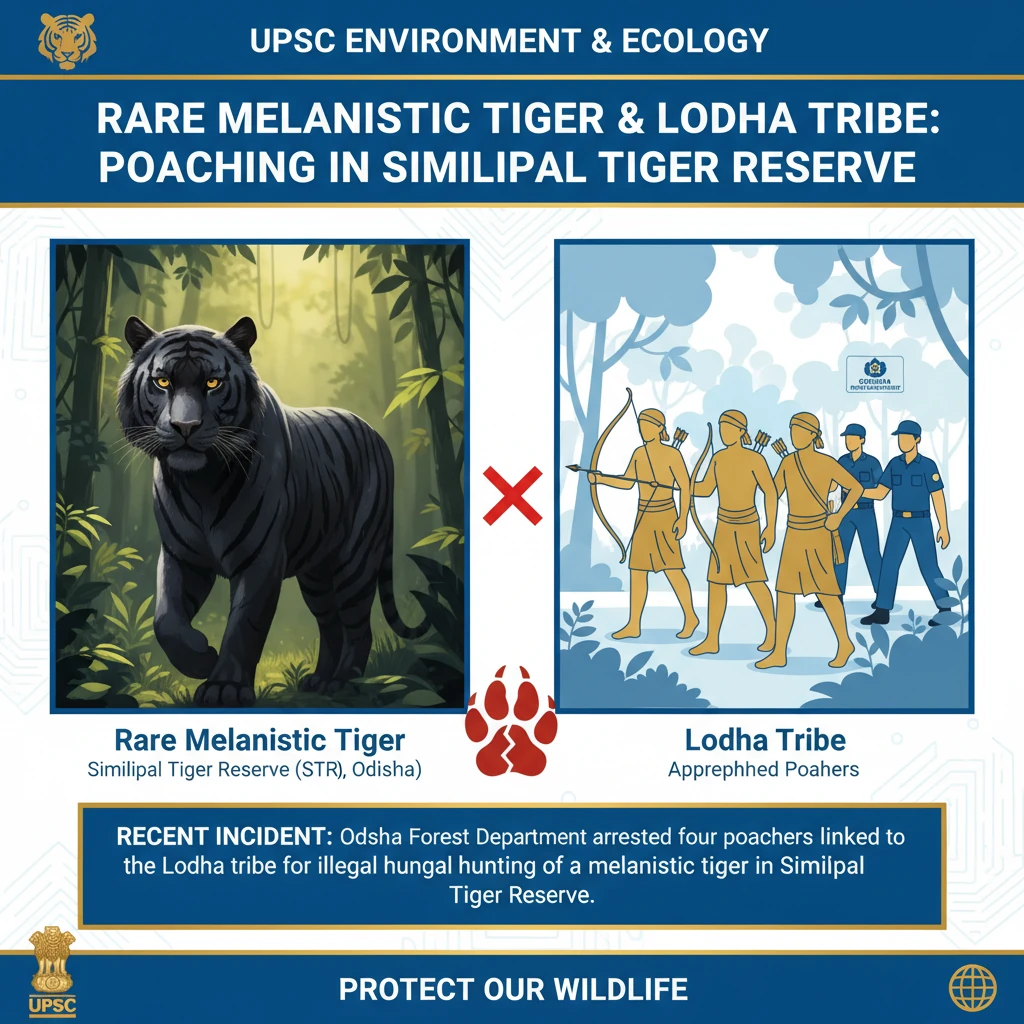
<h4>Recent Incident: Poaching in Similipal Tiger Reserve</h4><p>The <strong>Odisha Forest Department</strong> recently apprehended <strong>four poachers</strong> linked to the <strong>Lodha tribe</strong>. These arrests were made in connection with the illegal hunting of a rare <strong>melanistic tiger</strong>.</p><p>The incident occurred within the sensitive boundaries of the <strong>Similipal Tiger Reserve (STR)</strong> in <strong>Odisha</strong>, highlighting persistent threats to wildlife.</p><div class='info-box'><p>📍 <strong>Location of Incident:</strong> <strong>Similipal Tiger Reserve (STR)</strong>, <strong>Odisha</strong></p><p>🐅 <strong>Victim:</strong> A <strong>sub-adult melanistic tiger</strong></p><p>👥 <strong>Accused:</strong> <strong>Four poachers</strong> from the <strong>Lodha tribe</strong></p></div><h4>Understanding Melanism: A Genetic Phenomenon</h4><p><strong>Melanism</strong> is a unique <strong>genetic condition</strong> observed in various animal species. It results in an excessive production of <strong>melanin</strong>, which is the natural pigment responsible for color.</p><p>This overproduction leads to a distinctively darker or entirely black coloration of an animal's skin, fur, or feathers, making them appear strikingly different from their typical counterparts.</p><div class='key-point-box'><p>🧬 <strong>What is Melanism?</strong> A <strong>genetic mutation</strong> causing increased <strong>melanin</strong> production.</p><p>🎨 <strong>Effect:</strong> Darker or black pigmentation in skin, fur, or feathers.</p></div><h4>Melanistic Tigers: A Rare Global Species</h4><p>The tiger involved in the poaching incident was a <strong>melanistic tiger</strong>, an exceptionally rare variant of the species. These tigers are characterized by their prominent black stripes, which are much wider and closer together, often obscuring their orange background.</p><p>Globally, the population of these unique big cats is critically low. It is estimated that only around <strong>20 melanistic tigers</strong> remain in the wild, making each individual's loss a significant blow to biodiversity.</p><div class='info-box'><p>🌍 <strong>Global Population:</strong> Estimated <strong>20 melanistic tigers</strong> worldwide.</p><p>🐅 <strong>Distinguishing Feature:</strong> Wider, fused black stripes on an orange background, often appearing almost entirely black.</p></div><div class='exam-tip-box'><p>💡 <strong>UPSC Insight:</strong> Questions often link rare species conservation with specific geographical locations (e.g., <strong>Similipal Tiger Reserve</strong>) and human-wildlife interaction issues (e.g., tribal involvement in poaching, conservation efforts).</p></div>
💡 Key Takeaways
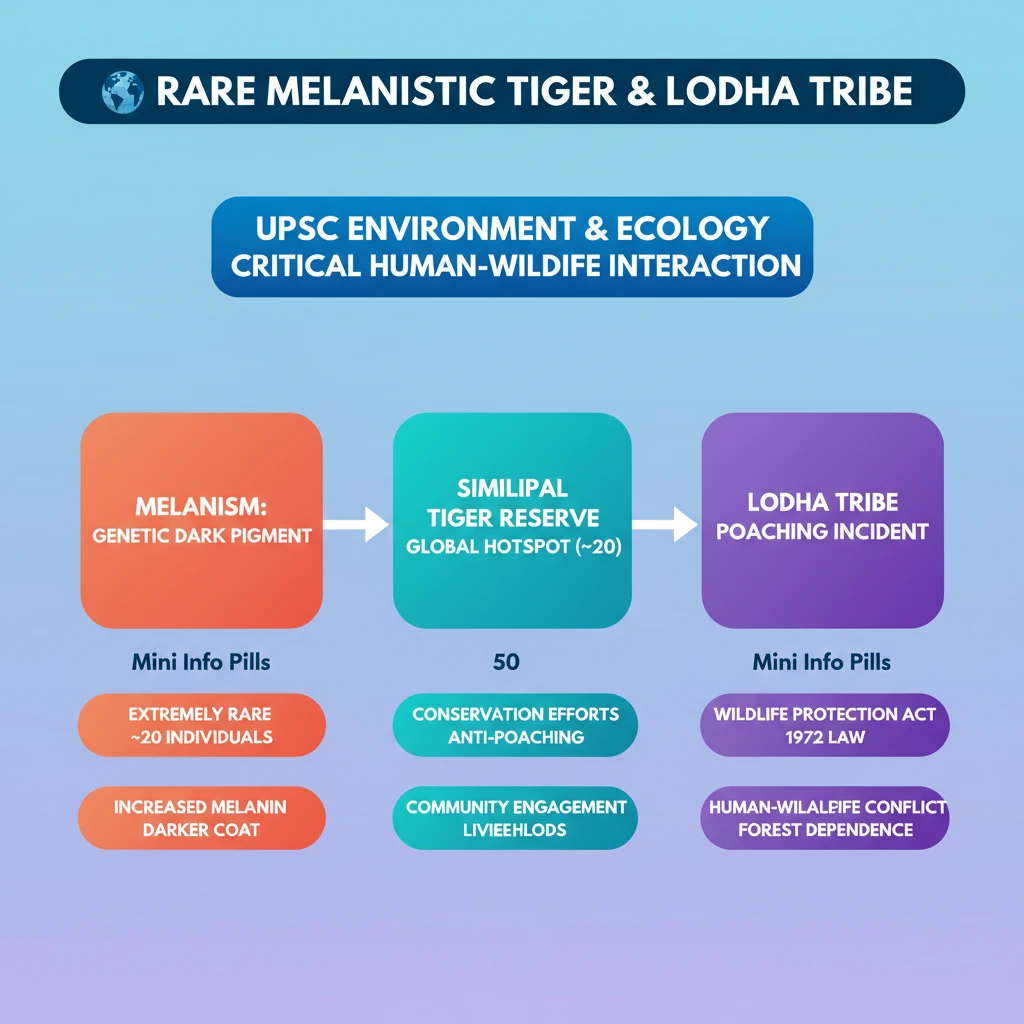
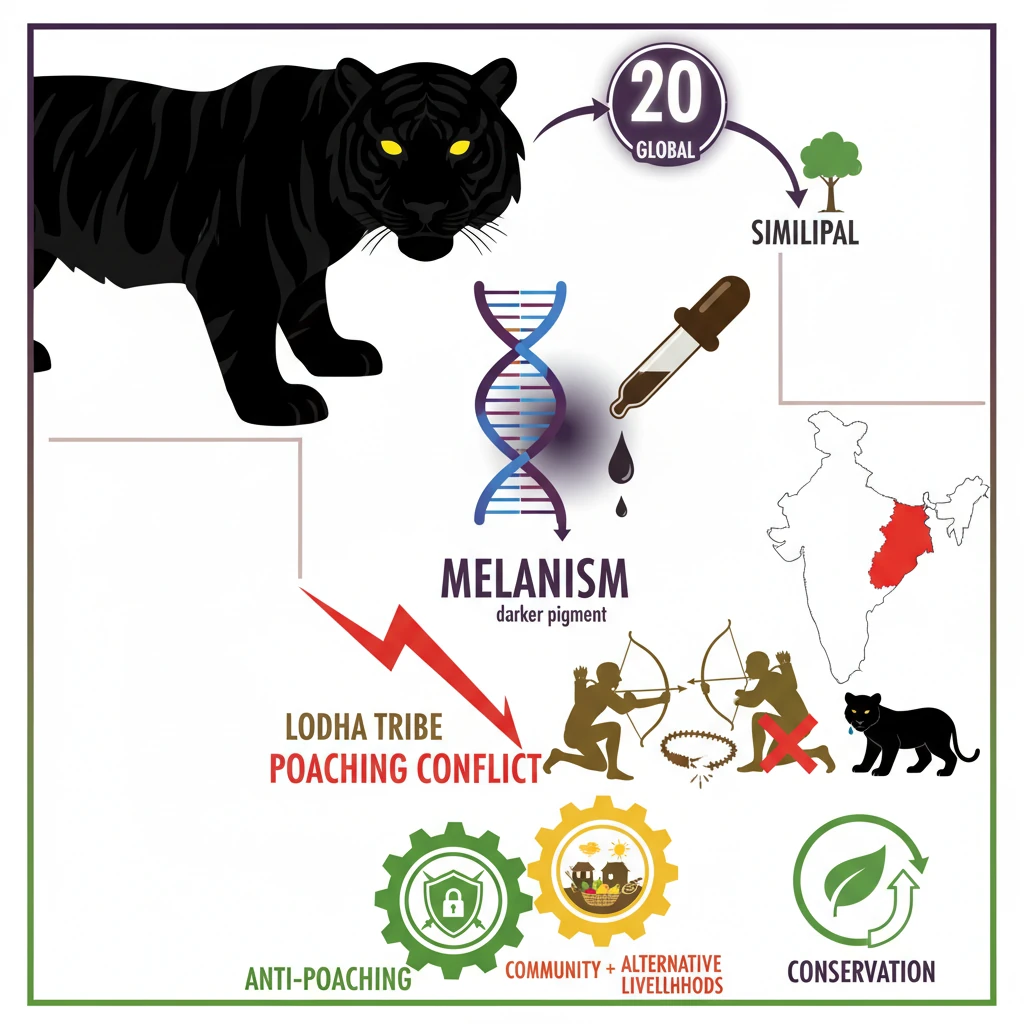
- •Melanistic tigers are extremely rare, with only ~20 individuals globally, primarily found in Similipal Tiger Reserve.
- •Melanism is a genetic condition causing increased melanin, leading to darker pigmentation.
- •A recent poaching incident in Similipal involved members of the Lodha tribe, highlighting human-wildlife conflict.
- •Conservation efforts require strong anti-poaching measures combined with community engagement and alternative livelihoods.
- •The Wildlife Protection Act, 1972, is crucial for combating wildlife crime in India.
🧠 Memory Techniques
95% Verified Content