Decrease in Ice Cover - Environment And Ecology | UPSC Learning
Topics
0 topics • 0 completed
🔍
No topics match your search
Decrease in Ice Cover
Medium⏱️ 8 min read
environment and ecology
📖 Introduction
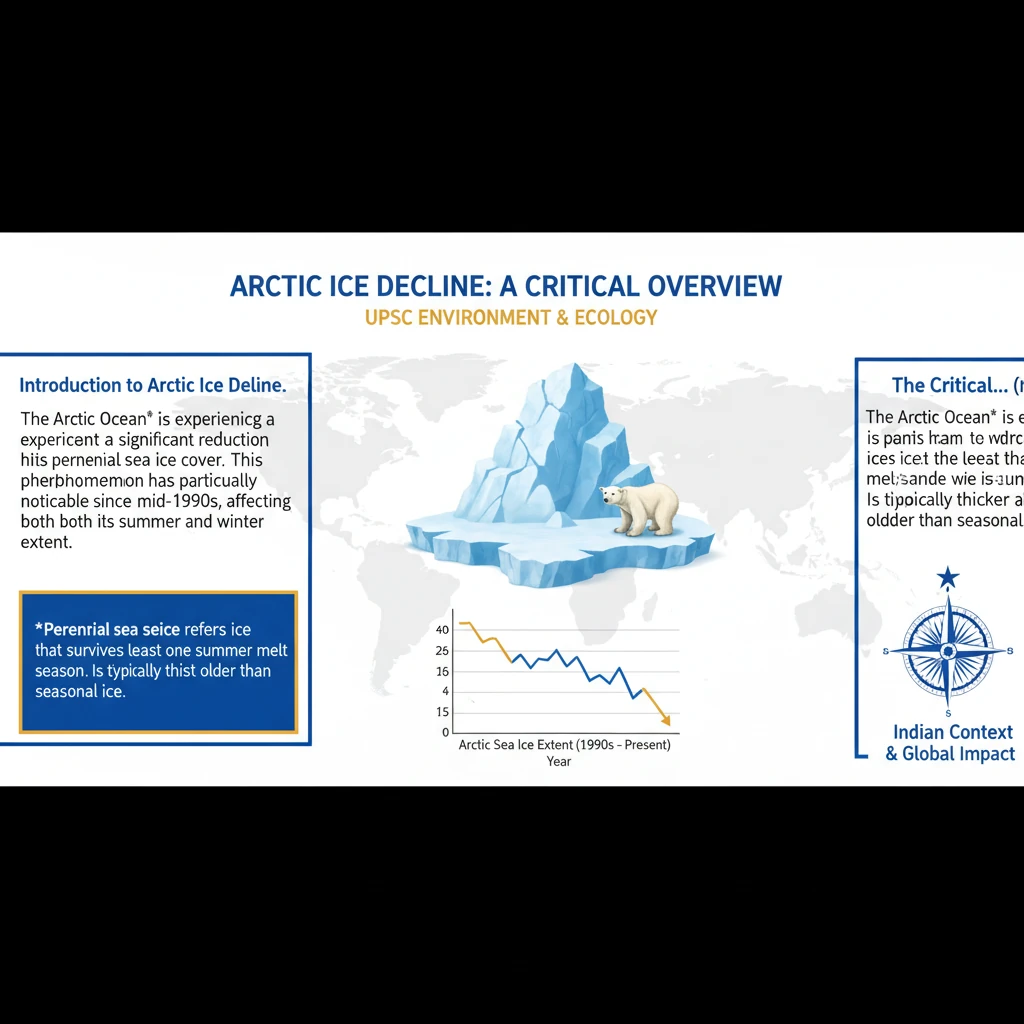
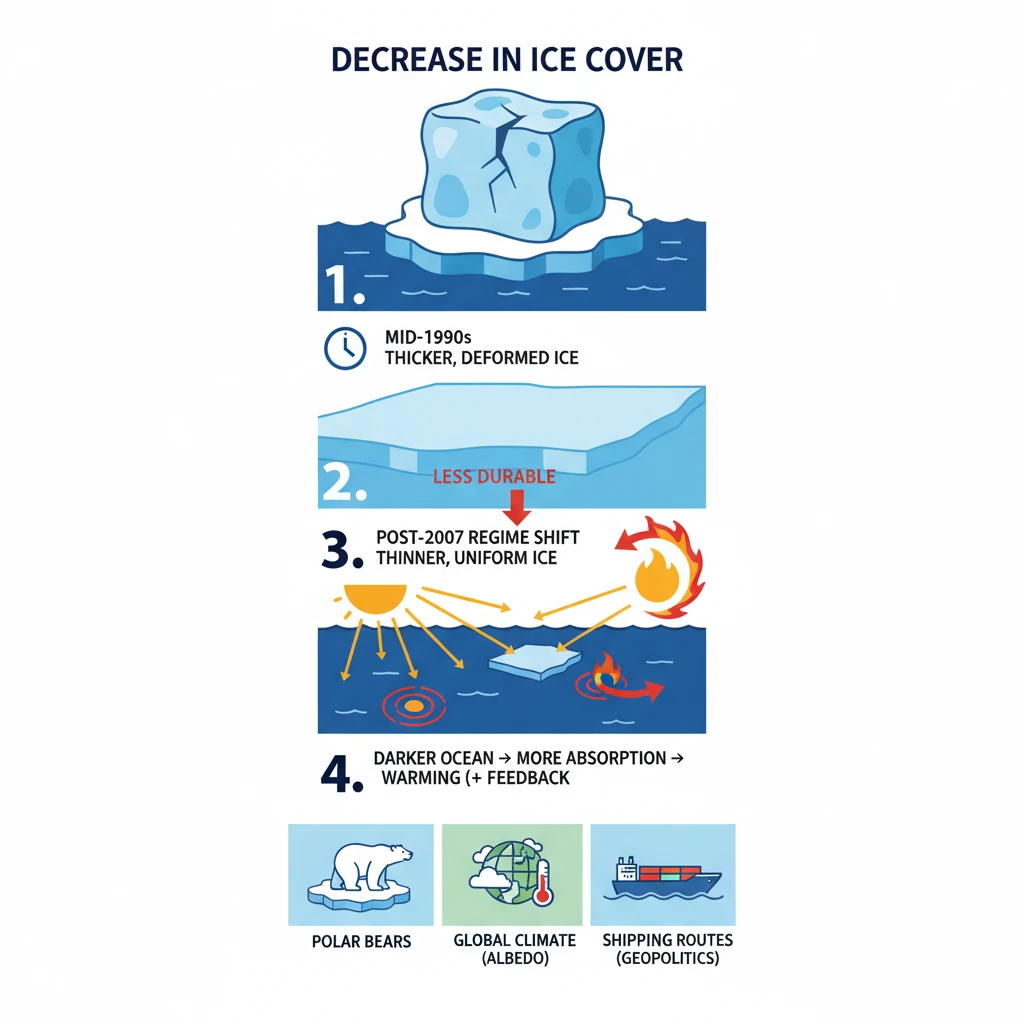
<h4>Introduction to Arctic Ice Decline</h4><p>The <strong>Arctic Ocean</strong> is experiencing a significant reduction in its <strong>perennial sea ice cover</strong>. This phenomenon has been particularly noticeable since the <strong>mid-1990s</strong>, affecting both its summer and winter extent.</p><div class='info-box'><p><strong>Perennial sea ice</strong> refers to ice that survives at least one summer melt season. It is typically thicker and older than seasonal ice.</p></div><h4>The Critical Role of Arctic Sea Ice</h4><p><strong>Arctic sea ice</strong> plays a crucial role in regulating Earth's climate. Its bright, white surface is highly effective at reflecting incoming <strong>solar radiation</strong> back into space, a process known as the <strong>albedo effect</strong>.</p><div class='key-point-box'><p>The <strong>albedo effect</strong> helps to keep the polar regions cool and influences global weather patterns. A decrease in ice cover means less reflection and more absorption of heat.</p></div><h4>Timeline and Magnitude of Decrease</h4><p>A marked decrease in ice cover has been observed consistently since the <strong>mid-1990s</strong>. This decline is evident across all seasons, highlighting a systemic change in the Arctic environment.</p><p>The rate and characteristics of this decline underwent a significant shift around <strong>2007</strong>, indicating an acceleration of the melting process.</p><h4>Pronounced Regime Shift</h4><p>Since <strong>2007</strong>, the Arctic has witnessed a profound <strong>regime shift</strong> in its sea ice characteristics. The ice cover has transitioned from being predominantly <strong>thicker and deformed</strong> to becoming <strong>thinner and more uniform</strong>.</p><div class='info-box'><p>A <strong>regime shift</strong> in ecology refers to a large, persistent, and often abrupt change in the structure and function of an ecosystem.</p></div><h4>Consequences of Thinner Ice</h4><p>The emergence of <strong>thinner ice</strong> has critical implications for the Arctic environment. Such ice is inherently <strong>less durable</strong> and therefore more susceptible to rapid melting.</p><p>When this thinner ice melts, it exposes the darker ocean surface beneath. This darker water then absorbs significantly more <strong>incoming solar radiation</strong>, leading to further warming of the water and accelerating the overall melting process.</p><div class='exam-tip-box'><p>This positive feedback loop (less ice -> darker ocean -> more heat absorption -> more melt) is a critical concept for <strong>UPSC Mains GS-III</strong>, particularly in questions related to <strong>climate change impacts</strong> and <strong>feedback mechanisms</strong>.</p></div>
💡 Key Takeaways
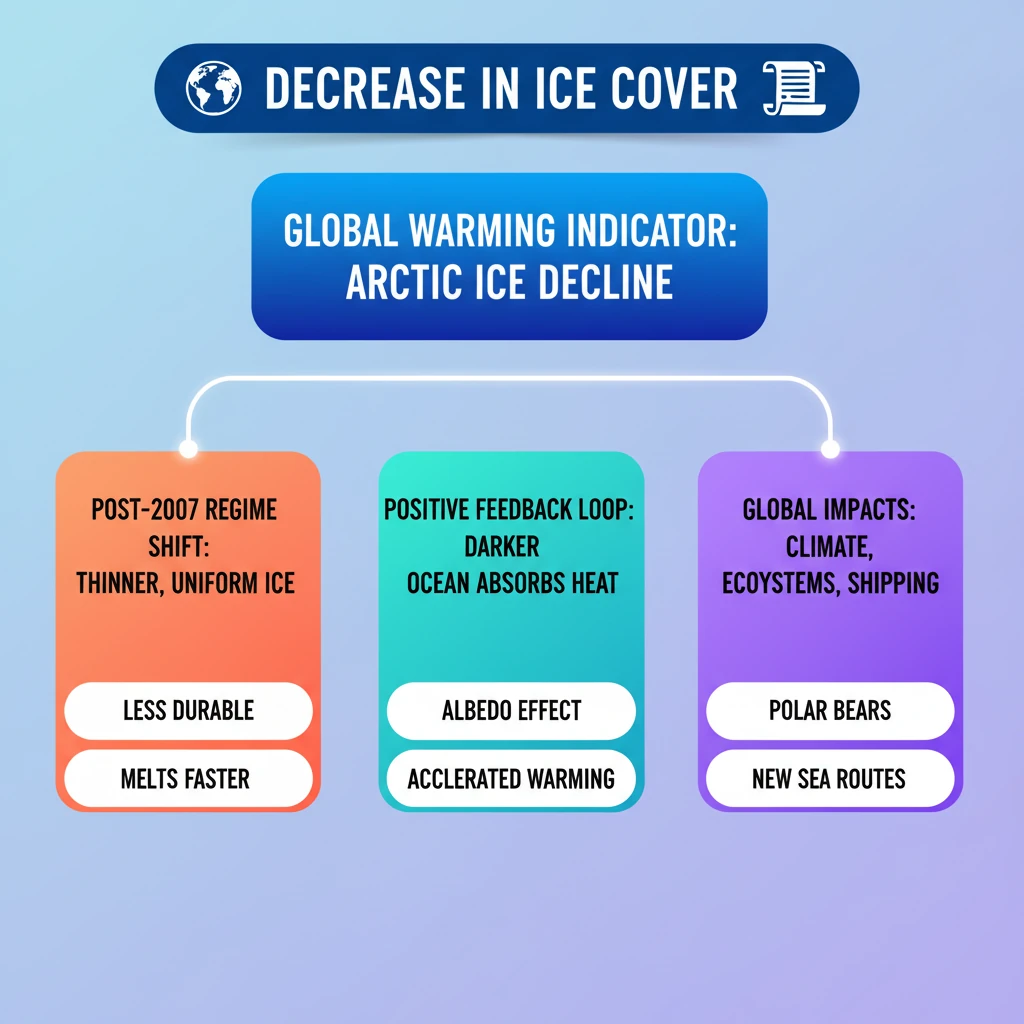
- •Arctic perennial sea ice has seen a marked decrease in both summer and winter since the mid-1990s.
- •A significant 'regime shift' occurred post-2007, transitioning from thicker, deformed ice to thinner, more uniform ice.
- •Thinner ice is less durable, melts faster, and exposes the darker ocean, leading to increased absorption of solar radiation and accelerated warming (positive feedback loop).
- •This decline has critical implications for global climate regulation (albedo effect), Arctic ecosystems (e.g., polar bears), and international geopolitics (e.g., shipping routes).
- •The decrease in ice cover is a key indicator of global warming and a central concern for climate change studies and policy.
🧠 Memory Techniques
95% Verified Content
📚 Reference Sources
•Intergovernmental Panel on Climate Change (IPCC) Assessment Reports
•National Aeronautics and Space Administration (NASA) – Arctic Sea Ice Data
•National Oceanic and Atmospheric Administration (NOAA) – Arctic Program
•Arctic Council publications and reports