Sundarban: Conservation Efforts, Designations & Agreements - Environment And Ecology | UPSC Learning
Topics
0 topics • 0 completed
🔍
No topics match your search
Sundarban: Conservation Efforts, Designations & Agreements
Medium⏱️ 6 min read
environment and ecology
📖 Introduction
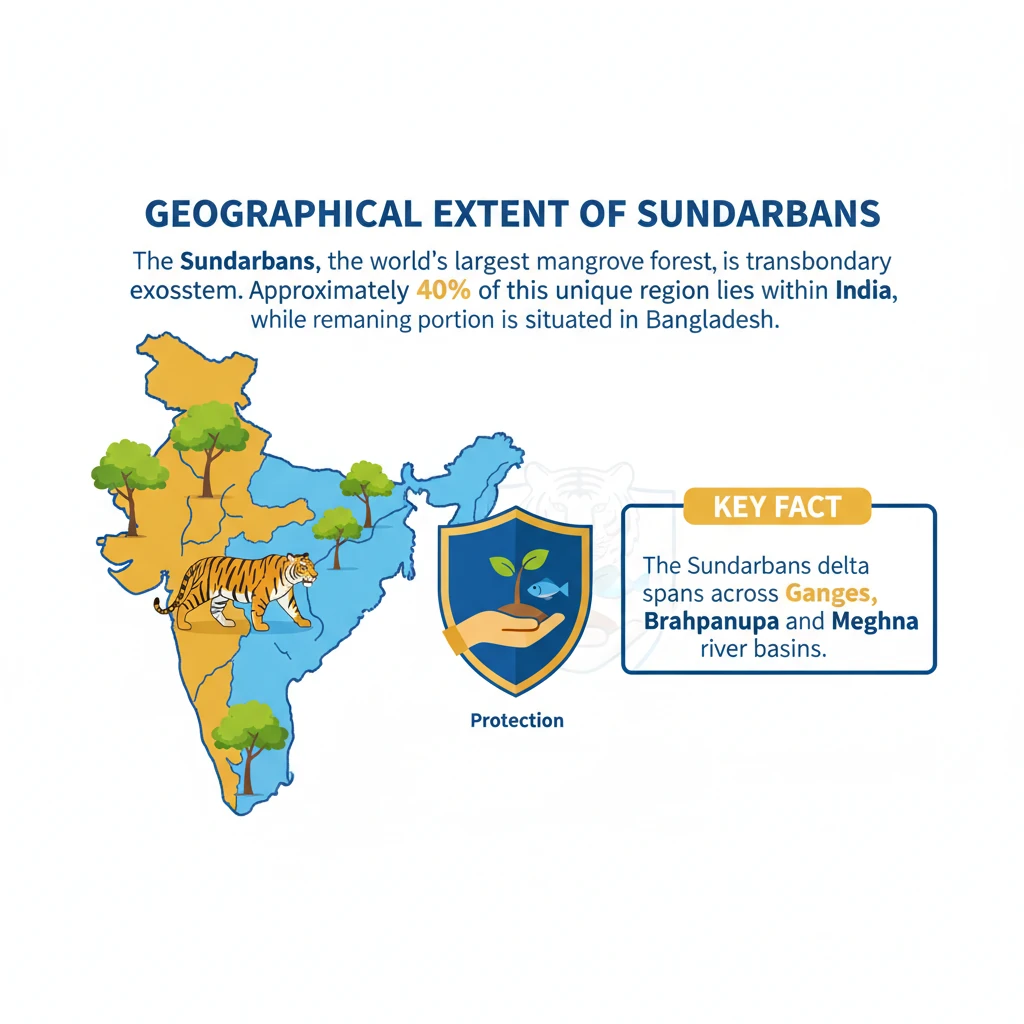
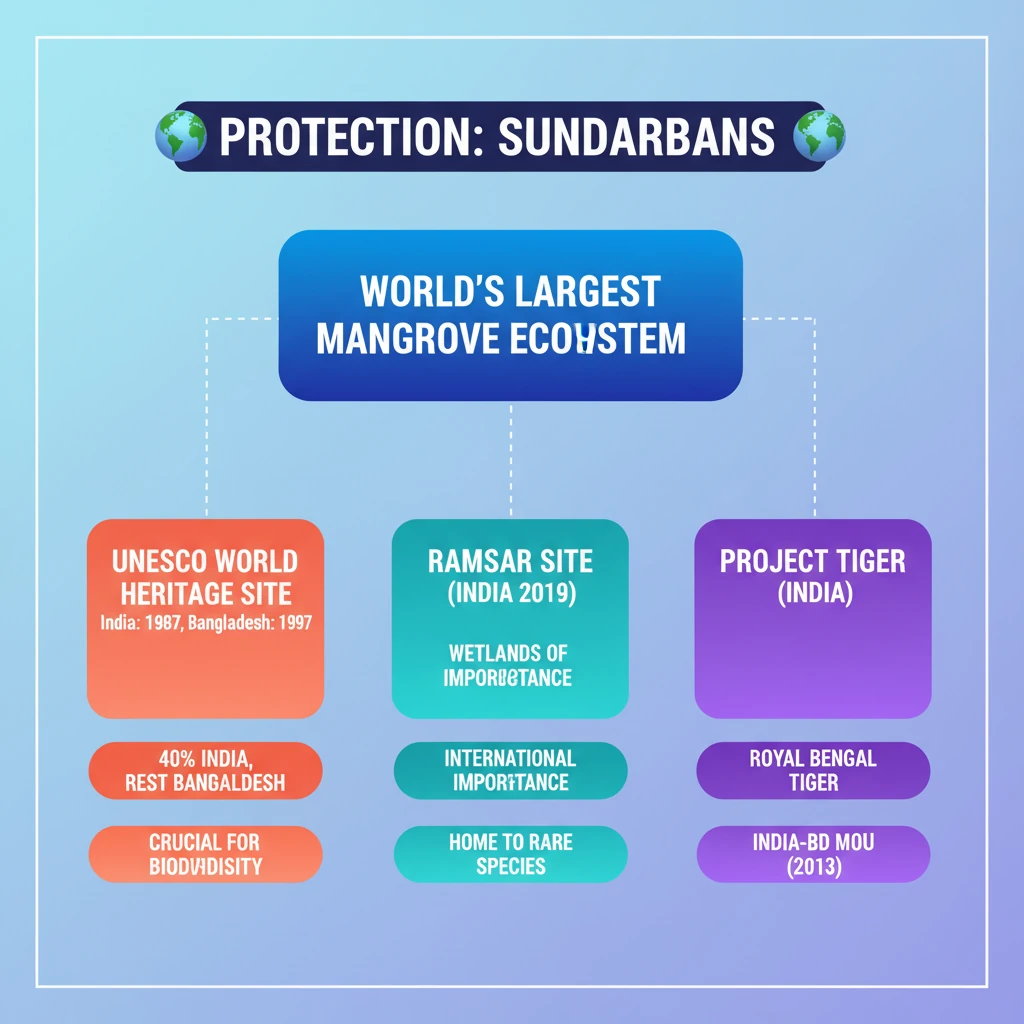
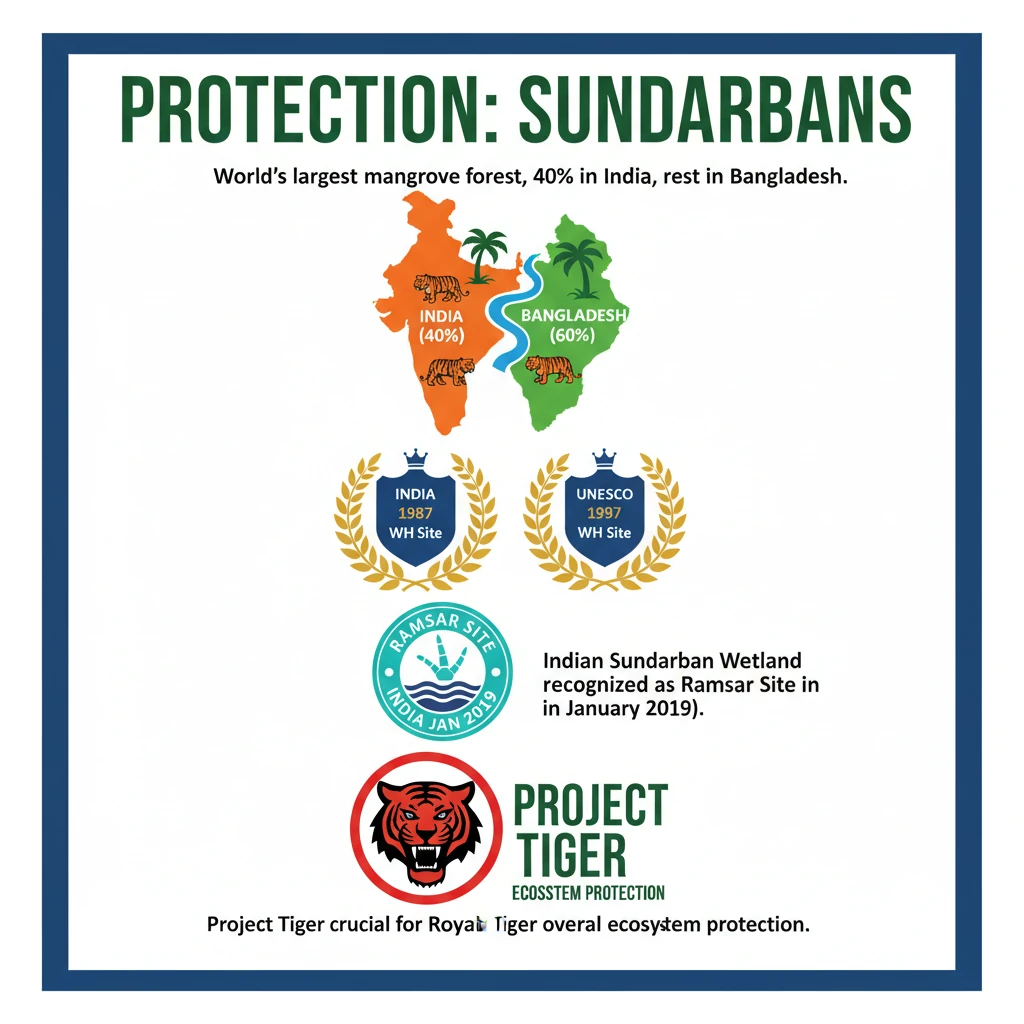
<h4>Geographical Extent of Sundarbans</h4><p>The <strong>Sundarbans</strong>, the world's largest mangrove forest, is a transboundary ecosystem. Approximately <strong>40%</strong> of this unique region lies within <strong>India</strong>, while the remaining portion is situated in <strong>Bangladesh</strong>.</p><div class='info-box'><p><strong>Key Fact:</strong> The Sundarbans delta spans across the <strong>Ganges</strong>, <strong>Brahmaputra</strong>, and <strong>Meghna</strong> river basins.</p></div><h4>UNESCO World Heritage Site Status</h4><p>The Sundarbans has received international recognition for its outstanding universal value. It was designated a <strong>UNESCO World Heritage Site</strong> in two phases, reflecting its transboundary nature.</p><ul><li>The <strong>Indian Sundarbans</strong> received this prestigious status in <strong>1987</strong>.</li><li>The <strong>Bangladesh Sundarbans</strong> was recognized as a UNESCO World Heritage Site in <strong>1997</strong>.</li></ul><h4>Ramsar Site Recognition</h4><p>Further bolstering its protected status, the <strong>Sundarban Wetland, India</strong>, was acknowledged under the <strong>Ramsar Convention</strong>.</p><div class='info-box'><p><strong>Date of Recognition:</strong> The Indian Sundarban Wetland was declared a <strong>'Wetland of International Importance'</strong> in <strong>January 2019</strong>.</p></div><h4>Project Tiger's Impact on Sundarbans</h4><p><strong>Project Tiger</strong> stands as a pivotal conservation initiative for the Sundarbans. Its primary objective was to safeguard the habitat of the iconic <strong>Royal Bengal Tiger</strong>.</p><div class='key-point-box'><p><strong>Significance:</strong> By protecting the <strong>Royal Bengal Tiger</strong> population, <strong>Project Tiger</strong> effectively extended protection to the entire, unique <strong>Sundarbans ecosystem</strong>.</p></div><h4>India-Bangladesh Memorandum of Understanding (MoU)</h4><p>Recognizing the shared responsibility for this vital ecosystem, <strong>India</strong> and <strong>Bangladesh</strong> formalized their cooperation.</p><div class='info-box'><p><strong>Agreement:</strong> In <strong>2013</strong>, both nations signed an <strong>MoU on the Conservation of the Sundarbans</strong>. This agreement underscored the mutual need for monitoring and conserving the region.</p></div><h4>Biosphere Reserve and Protected Areas</h4><p>The Sundarbans is also designated as a <strong>Biosphere Reserve (BR)</strong>, a recognition by <strong>UNESCO's Man and the Biosphere (MAB) Programme</strong>. This status emphasizes sustainable development alongside conservation.</p><p>Within the broader Biosphere Reserve, several specific <strong>protected areas</strong> exist, including national parks and wildlife sanctuaries, ensuring stringent conservation measures.</p><ul><li><strong>Sundarbans National Park</strong> (India)</li><li><strong>Sundarbans East Wildlife Sanctuary</strong> (India)</li><li><strong>Sundarbans West Wildlife Sanctuary</strong> (India)</li><li><strong>Sundarbans South Wildlife Sanctuary</strong> (India)</li><li><strong>Sundarbans Reserve Forest</strong> (Bangladesh)</li></ul><div class='exam-tip-box'><p><strong>UPSC Insight:</strong> Understanding the multi-layered protection (UNESCO, Ramsar, Project Tiger, Biosphere Reserve, Bilateral MoUs) of the <strong>Sundarbans</strong> is crucial for Mains answers on conservation models and international cooperation in environment.</p></div>
💡 Key Takeaways
- •Sundarbans: World's largest mangrove forest, 40% in India, rest in Bangladesh.
- •Designated UNESCO World Heritage Site (India 1987, Bangladesh 1997).
- •Indian Sundarban Wetland recognized as Ramsar Site in January 2019.
- •Project Tiger crucial for Royal Bengal Tiger and overall ecosystem protection.
- •India and Bangladesh signed MoU in 2013 for joint conservation.
- •Sundarbans is a Biosphere Reserve, containing multiple National Parks and Wildlife Sanctuaries.
🧠 Memory Techniques
95% Verified Content
📚 Reference Sources
•UNESCO World Heritage Centre official website
•Ramsar Convention Secretariat official website
•Project Tiger official website (National Tiger Conservation Authority, NTCA)
•Ministry of Environment, Forest and Climate Change (MoEFCC), Government of India