What is Ground Level Ozone Pollution? - Environment And Ecology | UPSC Learning
Topics
0 topics • 0 completed
🔍
No topics match your search
What is Ground Level Ozone Pollution?
Medium⏱️ 7 min read
environment and ecology
📖 Introduction
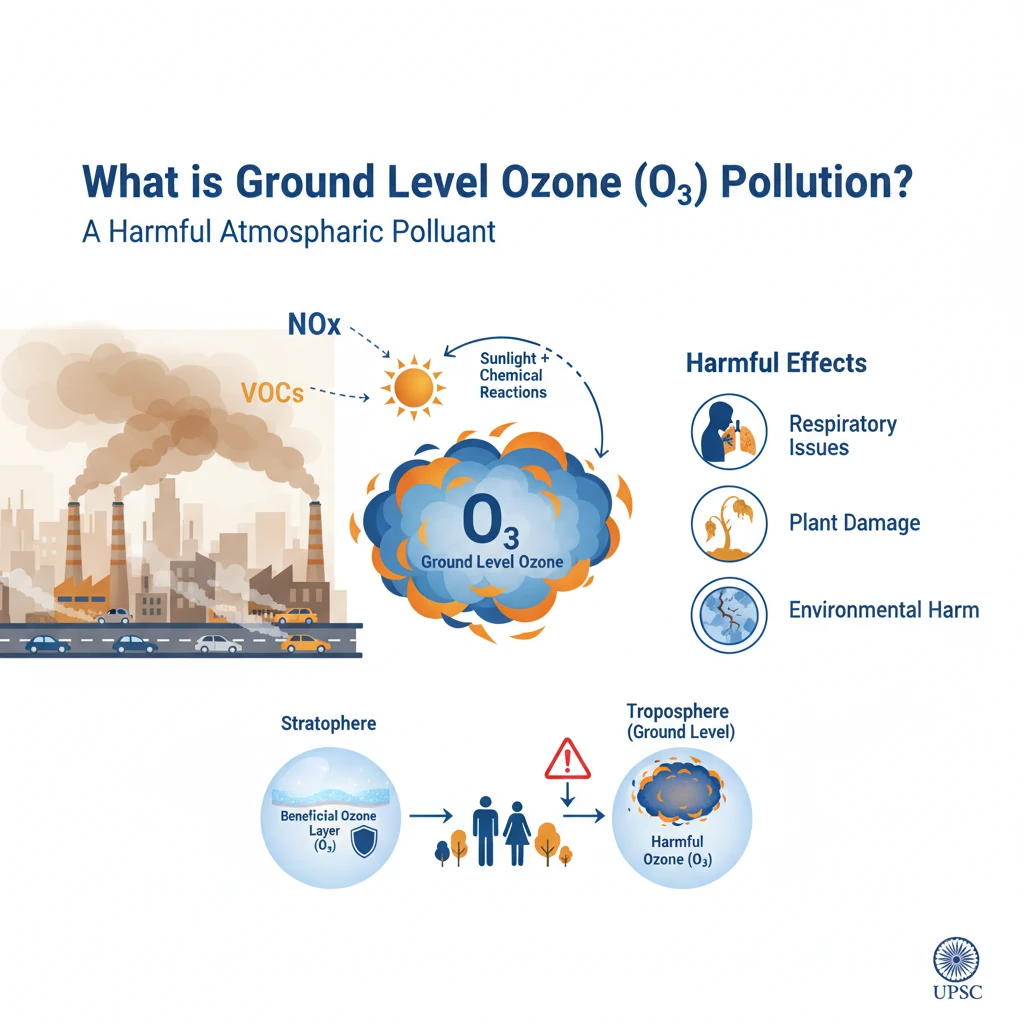
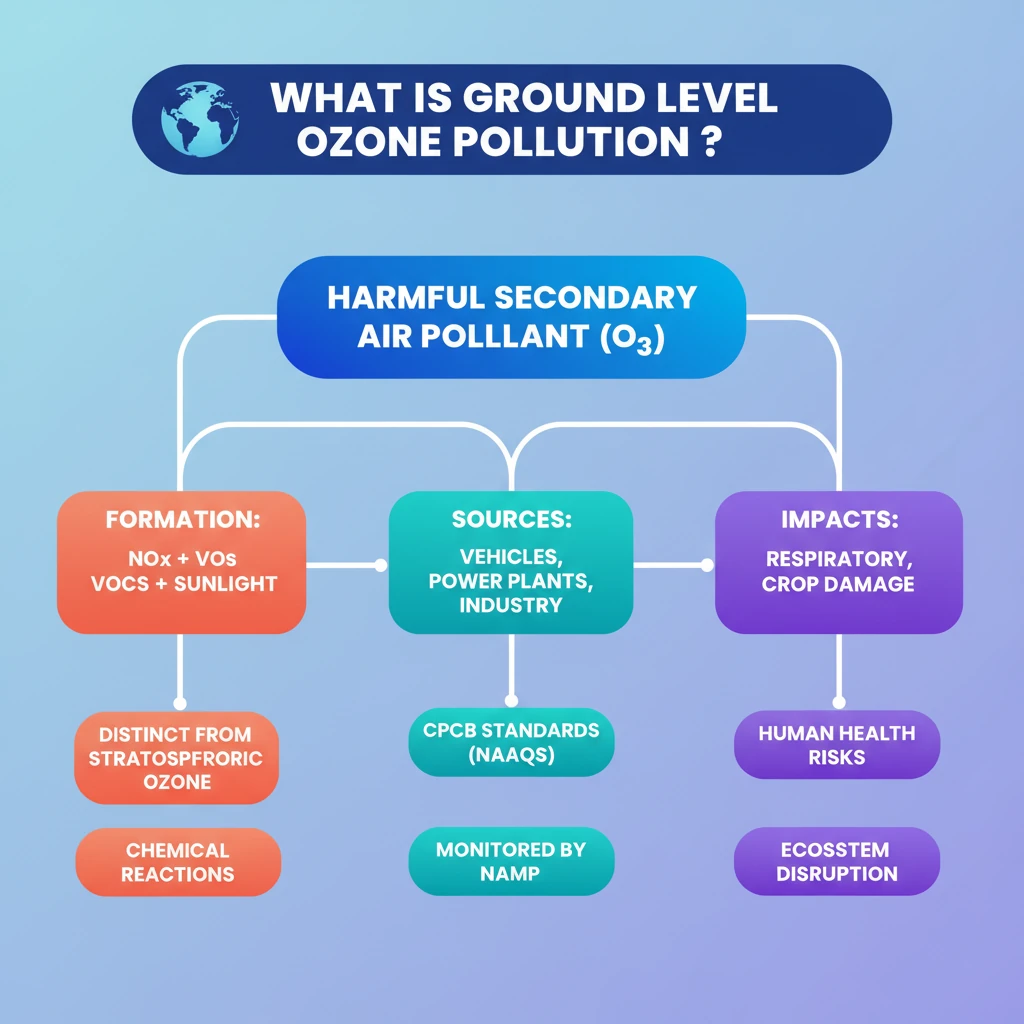
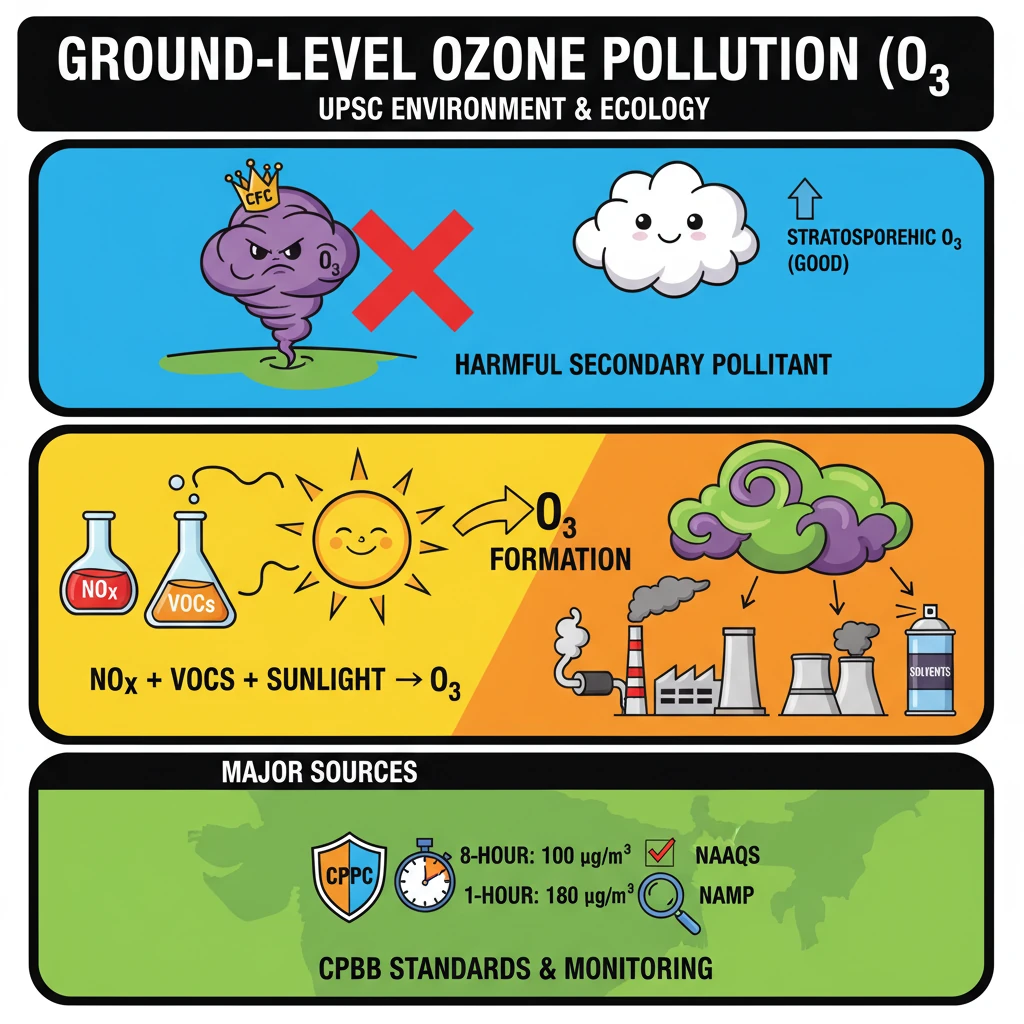
<h4>What is Ground Level Ozone (O3) Pollution?</h4><p><strong>Ground-level ozone (O3) pollution</strong> refers to the excess presence of <strong>ozone</strong> at the Earth’s surface. It is a harmful atmospheric pollutant that forms through complex chemical reactions.</p><p>Unlike the beneficial <strong>ozone layer</strong> in the stratosphere, which shields life from harmful ultraviolet radiation, ground-level ozone poses significant health risks and environmental damage.</p><div class='key-point-box'><p><strong>Key Distinction:</strong> Stratospheric ozone is protective; Ground-level ozone is a pollutant.</p></div><h4>Formation of Ground Level Ozone</h4><p><strong>Ground-level ozone</strong> is classified as a <strong>secondary pollutant</strong>. This means it is not directly emitted into the atmosphere from a source. Instead, it forms through chemical reactions involving other precursor pollutants.</p><div class='info-box'><p><strong>Primary Precursors:</strong></p><ul><li><strong>Nitrogen Oxides (NOx):</strong> Emitted primarily by vehicles, power plants, and various industrial processes.</li><li><strong>Volatile Organic Compounds (VOCs):</strong> Released from sources such as vehicles, petrol pumps, industrial solvents, and waste burning.</li></ul></div><p>These chemical reactions that form ozone occur specifically in the presence of <strong>sunlight</strong>. Consequently, ozone formation is significantly more pronounced during sunny days and warmer seasons.</p><h4>Regulation and Monitoring in India</h4><p>In India, the <strong>Central Pollution Control Board (CPCB)</strong> is responsible for setting and enforcing environmental standards. It has established <strong>National Ambient Air Quality Standards (NAAQS)</strong> for ozone.</p><div class='info-box'><p><strong>NAAQS for Ozone:</strong></p><ul><li><strong>8-hour average limit:</strong> 100 µg/m³</li><li><strong>1-hour average limit:</strong> 180 µg/m³</li></ul></div><p>Monitoring of ground-level ozone is conducted under the <strong>National Air Quality Monitoring Programme (NAMP)</strong>. This program is managed by the <strong>CPCB</strong> in collaboration with various <strong>State Pollution Control Boards (SPCBs)</strong> and the <strong>National Environmental Engineering Research Institute (NEERI)</strong>.</p><div class='exam-tip-box'><p><strong>UPSC Insight:</strong> Understanding the difference between stratospheric and ground-level ozone is crucial. Also, remember the key precursors (<strong>NOx, VOCs</strong>) and the role of <strong>sunlight</strong> in its formation. The regulatory bodies and standards (<strong>CPCB, NAAQS, NAMP</strong>) are important for GS-III.</p></div>
💡 Key Takeaways
- •Ground-level ozone (O3) is a harmful secondary air pollutant, distinct from stratospheric ozone.
- •It forms from chemical reactions between Nitrogen Oxides (NOx) and Volatile Organic Compounds (VOCs) in the presence of sunlight.
- •Major sources of NOx and VOCs include vehicles, power plants, industries, and solvents.
- •CPCB sets NAAQS for ozone (100 µg/m³ for 8-hour, 180 µg/m³ for 1-hour average) and monitors it under NAMP.
- •Ground-level ozone poses significant risks to human health (respiratory issues) and the environment (crop damage, ecosystem disruption).
🧠 Memory Techniques
98% Verified Content
📚 Reference Sources
•Central Pollution Control Board (CPCB) official website (for NAAQS details, inferred general knowledge)
•Environmental Protection Agency (EPA) resources (for general ozone chemistry, inferred general knowledge)