What is Nitrogen Use Efficiency (NUE)? - Environment And Ecology | UPSC Learning
Topics
0 topics • 0 completed
🔍
No topics match your search
What is Nitrogen Use Efficiency (NUE)?
Medium⏱️ 8 min read
environment and ecology
📖 Introduction
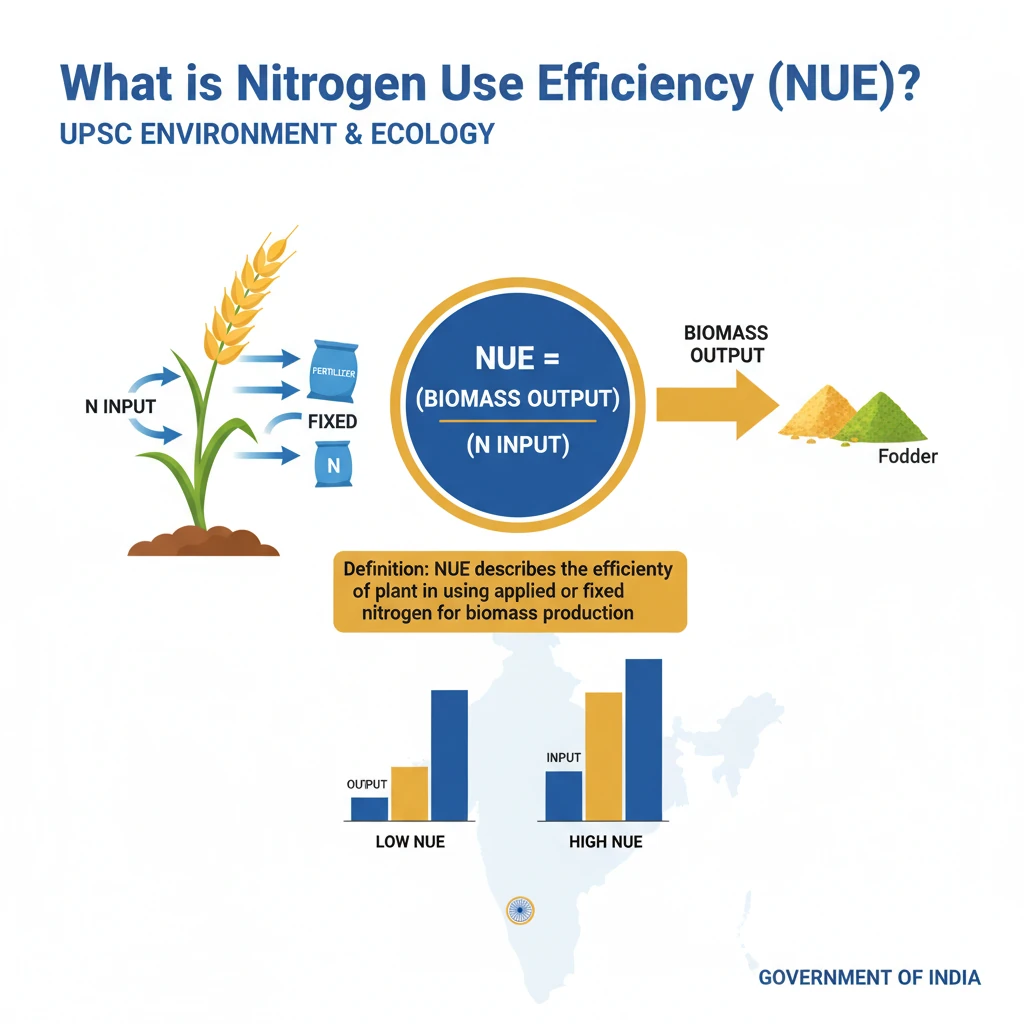
<h4>What is Nitrogen Use Efficiency (NUE)?</h4><p><strong>Nitrogen Use Efficiency (NUE)</strong> is a critical metric in agriculture. It quantifies how effectively a plant utilizes available nitrogen for producing biomass, such as grain, fodder, or other plant material.</p><div class='info-box'><p><strong>Definition:</strong> <strong>NUE</strong> describes the efficiency of a plant in using applied or fixed nitrogen for <strong>biomass production</strong>.</p></div><p>Essentially, NUE is a ratio. It measures the amount of crop yield produced relative to the nitrogen absorbed from the soil or fixed by beneficial bacteria in the plant's root system.</p><div class='info-box'><p><strong>Formula:</strong> <strong>NUE</strong> = Crop Yield / Nitrogen Absorbed (or Fixed)</p></div><h4>Understanding Poor NUE</h4><p><strong>Poor NUE</strong> signifies an inefficient use of nitrogen in agricultural systems. This inefficiency leads to a significant portion of applied nitrogen being lost from the farm, rather than being taken up by crops.</p><div class='key-point-box'><p><strong>Key Characteristic:</strong> In <strong>poor NUE</strong> scenarios, much of the nitrogen is lost to the environment, resulting in both environmental pollution and reduced agricultural productivity.</p></div><h4>Impacts of Poor NUE</h4><p>The inefficient use of nitrogen has substantial economic and environmental consequences. These impacts are felt globally and particularly acutely in countries with large agricultural sectors.</p><ul><li><strong>Economic Loss:</strong> <strong>Poor NUE</strong> leads to a massive wastage of nitrogen fertilizers. In India, this amounts to approximately <strong>Rs 1 trillion annually</strong>. Globally, the economic loss exceeds <strong>USD 170 billion per year</strong>.</li><li><strong>Environmental Pollution:</strong> Lost nitrogen can leach into groundwater, causing eutrophication of water bodies. It can also volatilize into the atmosphere as various nitrogenous gases.</li><li><strong>Greenhouse Gas Emissions:</strong> A major concern is the emission of <strong>nitrous oxide (N₂O)</strong>. This gas is a potent greenhouse gas, warming the atmosphere significantly more than carbon dioxide.</li></ul><div class='info-box'><p><strong>India's Contribution to N₂O Emissions:</strong></p><ul><li>India is the <strong>largest source of nitrous oxide (N₂O)</strong> emissions from anthropogenic activities.</li><li>In <strong>2020</strong>, India contributed nearly <strong>11% of global anthropogenic N₂O emissions</strong>.</li><li>This placed India second only to <strong>China</strong>, which accounted for <strong>16%</strong> of global emissions in the same year.</li></ul></div><div class='exam-tip-box'><p><strong>UPSC Insight:</strong> Understanding <strong>NUE</strong> is crucial for topics like <strong>sustainable agriculture</strong>, <strong>climate change mitigation</strong>, and <strong>environmental pollution</strong> in <strong>GS-III</strong>. Data points on economic loss and N₂O emissions are valuable for enriching answers.</p></div>
💡 Key Takeaways
- •Nitrogen Use Efficiency (NUE) measures how effectively plants convert applied/fixed nitrogen into biomass.
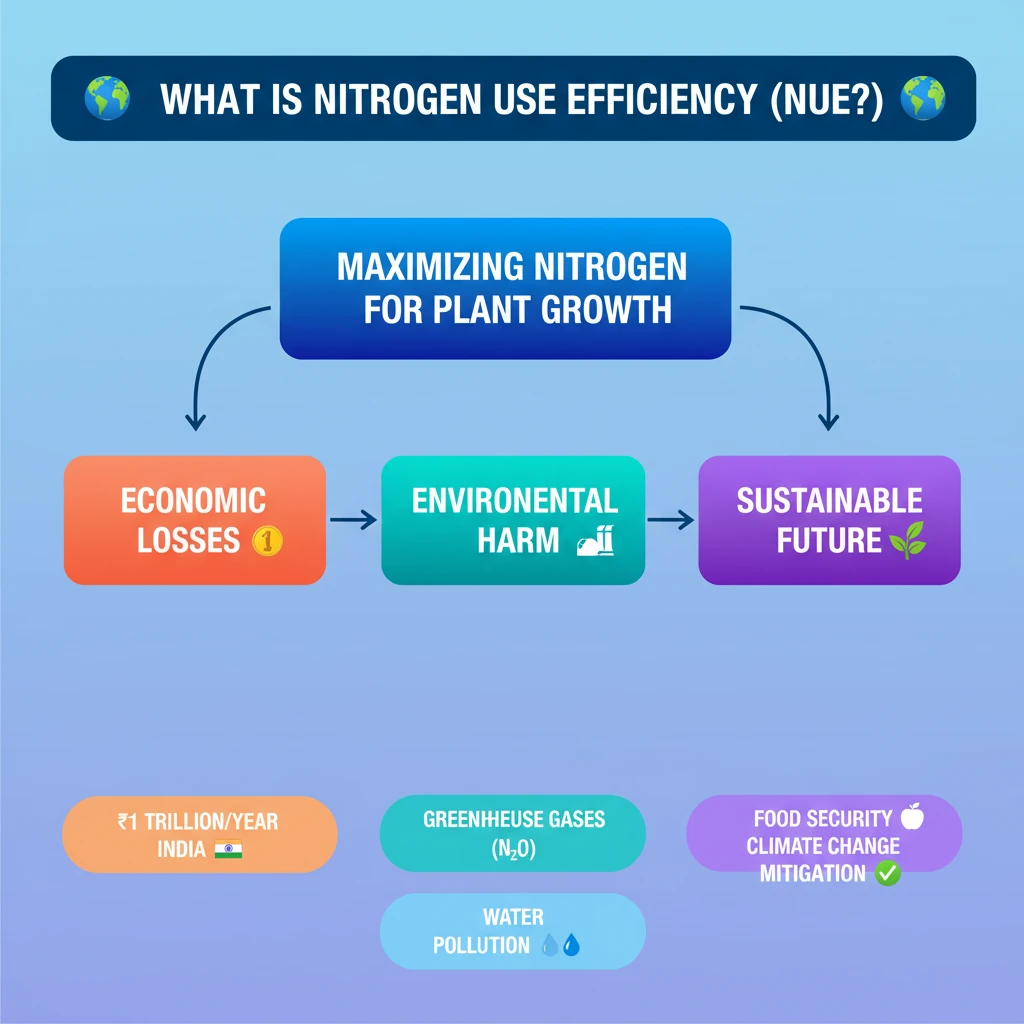
- •Poor NUE leads to significant economic losses (Rs 1 trillion/year in India, $170 billion/year globally) due to wasted fertilizers.
- •India is the largest anthropogenic source of nitrous oxide (N₂O), a potent greenhouse gas, contributing 11% of global emissions in 2020.
- •Inefficient nitrogen use causes environmental pollution, including water contamination and increased greenhouse gas emissions.
- •Improving NUE is crucial for sustainable agriculture, climate change mitigation, and enhancing food security.
- •Initiatives like Neem-Coated Urea and Soil Health Cards aim to improve NUE in India.
🧠 Memory Techniques

95% Verified Content