What is Enhanced Vegetation Index (EVI)? - Environment And Ecology | UPSC Learning
Topics
0 topics • 0 completed
🔍
No topics match your search
What is Enhanced Vegetation Index (EVI)?
Medium⏱️ 7 min read
environment and ecology
📖 Introduction
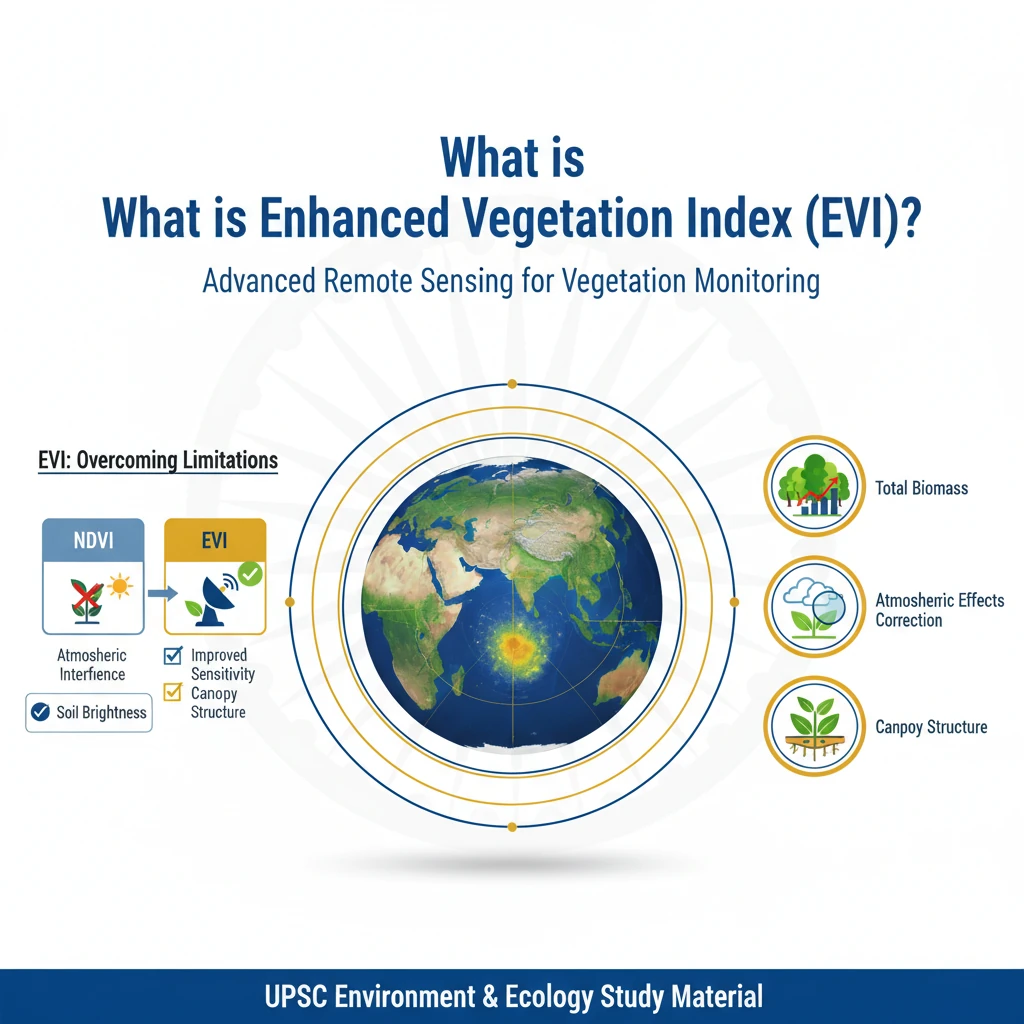
<h4>What is Enhanced Vegetation Index (EVI)?</h4><p>The <strong>Enhanced Vegetation Index (EVI)</strong> is an advanced remote sensing tool used for monitoring vegetation health and density. It was developed to overcome certain limitations of its predecessor, the <strong>Normalized Difference Vegetation Index (NDVI)</strong>.</p><p>EVI offers higher sensitivity to various environmental factors. These include the total <strong>biomass</strong> of vegetation, the effects of the <strong>atmospheric background</strong>, and the underlying <strong>soil condition</strong>. This makes it a more robust indicator for diverse ecological settings.</p><div class='key-point-box'><p><strong>Key Concept: EVI as a Refined Index</strong></p><p>EVI is essentially a modified and improved version of the <strong>Normalized Difference Vegetation Index (NDVI)</strong>. Its primary advantage lies in its enhanced capability for <strong>vegetation monitoring</strong> by actively correcting for <strong>external noises</strong>.</p></div><h4>EVI Value Range and Interpretation</h4><p>The values generated by the <strong>Enhanced Vegetation Index (EVI)</strong> typically range from <strong>0 to 1</strong>. This standardized scale allows for consistent comparison across different regions and time periods.</p><div class='info-box'><p><strong>Interpreting EVI Values:</strong></p><ul><li>Values <strong>closer to 1</strong> indicate very <strong>healthy and dense vegetation</strong>, often associated with high photosynthetic activity.</li><li>Values <strong>closer to 0</strong> suggest <strong>unhealthy or sparse vegetation</strong>, bare soil, or non-vegetated areas.</li></ul></div><p>This range provides a clear and intuitive metric for assessing vegetation vigor, making it invaluable for environmental scientists and policymakers.</p>
💡 Key Takeaways
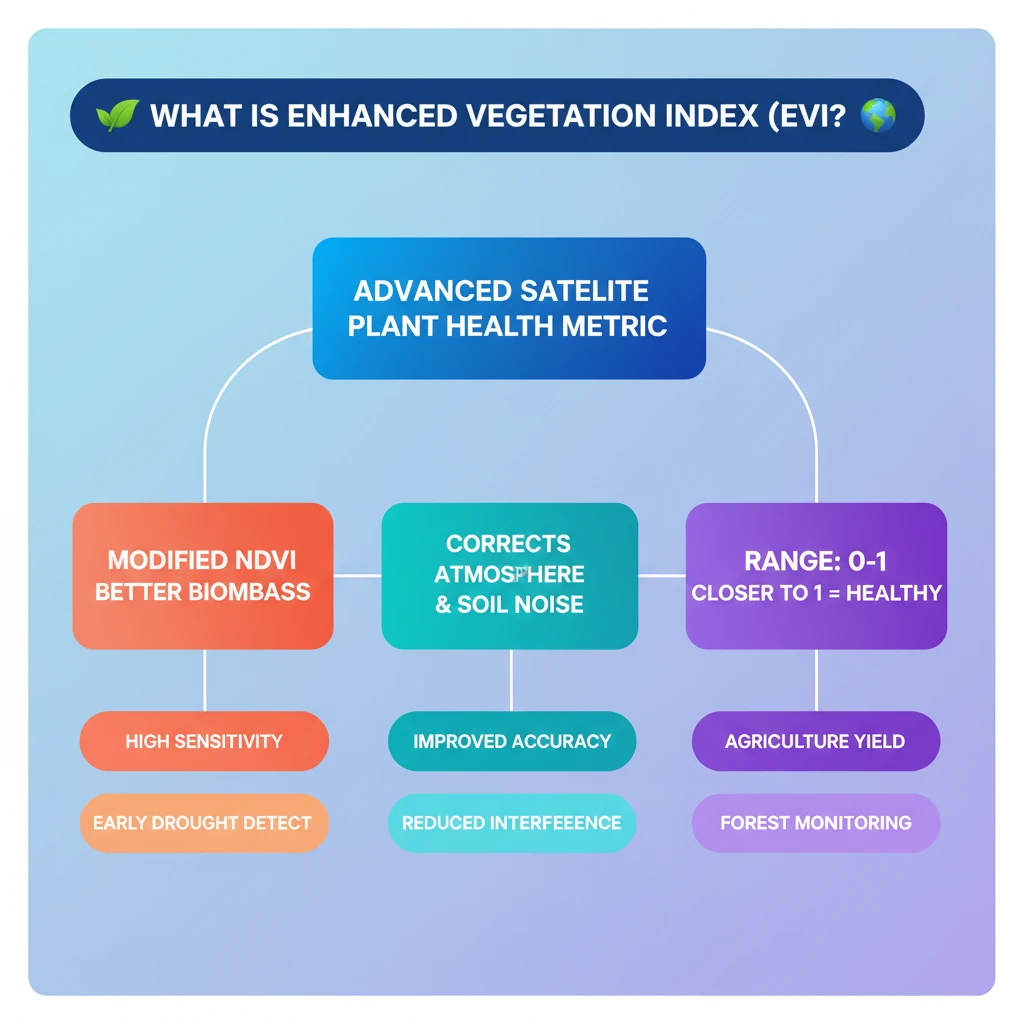
- •Enhanced Vegetation Index (EVI) is an advanced vegetation index for monitoring health and density.
- •EVI is a modified version of NDVI, offering higher sensitivity to biomass, atmospheric, and soil conditions.
- •It corrects for 'external noises' like atmospheric effects and soil background, which affect NDVI.
- •EVI values range from 0 to 1; closer to 1 indicates healthy vegetation, closer to 0 indicates unhealthy/sparse.
- •Used in agriculture for yield prediction, forest monitoring, and drought assessment.
🧠 Memory Techniques
95% Verified Content
📚 Reference Sources
•NASA Earth Observatory - EVI Explained
•USGS - Vegetation Indices
•MODIS Vegetation Index Product User's Guide