Kaziranga National Park - Environment And Ecology | UPSC Learning
Topics
0 topics • 0 completed
🔍
No topics match your search
Kaziranga National Park
Medium⏱️ 7 min read
environment and ecology
📖 Introduction
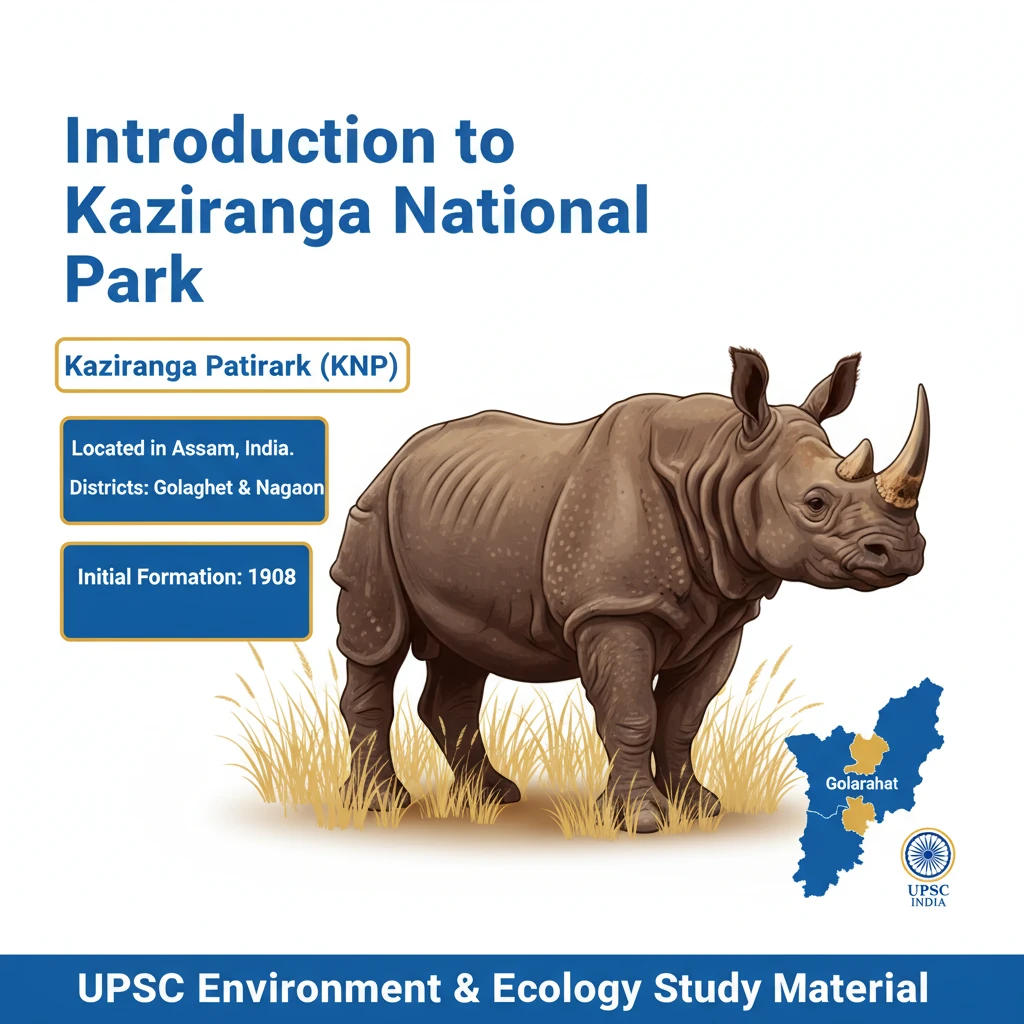
<h4>Introduction to Kaziranga National Park</h4><p><strong>Kaziranga National Park (KNP)</strong> is a renowned wildlife sanctuary located in the northeastern part of India. It spans across the districts of <strong>Golaghat</strong> and <strong>Nagaon</strong> in the state of <strong>Assam</strong>.</p><p>The park was initially formed in <strong>1908</strong>, marking the beginning of its journey as a protected area.</p><div class='info-box'>Initial Formation: <strong>Kaziranga National Park</strong> was established in <strong>1908</strong>.</div><h4>Key Declarations and Status</h4><p>Over the years, <strong>KNP</strong> has received several significant designations, highlighting its global importance for conservation.</p><p>It was officially declared a <strong>National Park</strong> in <strong>1974</strong>, granting it a higher level of protection under Indian law.</p><div class='info-box'>National Park Status: Declared a <strong>National Park</strong> in <strong>1974</strong>.</div><p>Further international recognition came in <strong>1985</strong> when the park was designated a <strong>World Heritage Site</strong> by <strong>UNESCO</strong>, acknowledging its outstanding universal value.</p><div class='info-box'>International Recognition: Declared a <strong>UNESCO World Heritage Site</strong> in <strong>1985</strong>.</div><p>In <strong>2006</strong>, <strong>Kaziranga</strong> was also declared a <strong>Tiger Reserve</strong>, underscoring its role in the conservation of the endangered big cat population.</p><div class='info-box'>Tiger Conservation: Declared a <strong>Tiger Reserve</strong> in <strong>2006</strong>.</div><h4>Geographical Significance</h4><p><strong>Kaziranga National Park</strong> holds a unique ecological position as the <strong>single largest undisturbed and representative area</strong> in the <strong>Brahmaputra Valley floodplain</strong>.</p><div class='key-point-box'>Ecological Importance: <strong>KNP</strong> is the most extensive and untouched representative area within the dynamic <strong>Brahmaputra Valley floodplain</strong> ecosystem.</div><h4>Diverse Vegetation Types</h4><p>The park's diverse landscape supports a variety of vegetation types, which are crucial for its rich biodiversity.</p><ul><li><strong>Alluvial inundated grasslands</strong></li><li><strong>Alluvial savanna woodlands</strong></li><li><strong>Tropical moist mixed deciduous forests</strong></li><li><strong>Tropical semi-evergreen forests</strong></li></ul><h4>Home to the Indian One-Horned Rhinoceros</h4><p><strong>Kaziranga National Park</strong> is world-renowned as the primary stronghold for the <strong>Indian one-horned rhinoceros</strong>.</p><p>It is home to more than <strong>2200 Indian one-horned rhinoceros</strong>, which constitutes approximately <strong>2/3rd</strong> of their total global population.</p><div class='highlight-box'>Flagship Species: <strong>KNP</strong> protects over <strong>2200 Indian one-horned rhinoceros</strong>, representing about <strong>2/3rd</strong> of the world's population.</div>
💡 Key Takeaways
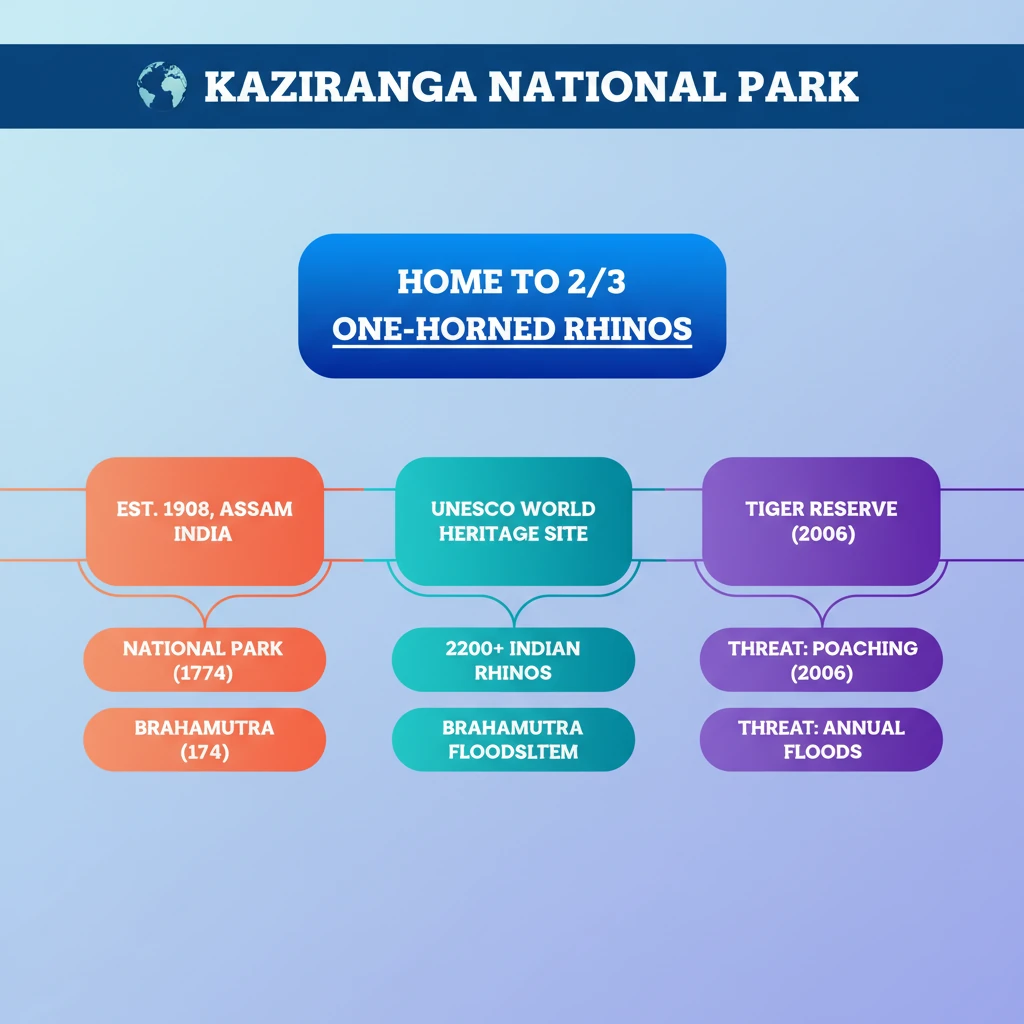
- •Kaziranga National Park (KNP) is located in Assam, established in 1908.
- •It holds multiple protected statuses: National Park (1974), UNESCO World Heritage Site (1985), and Tiger Reserve (2006).
- •KNP is the primary habitat for over 2200 Indian One-Horned Rhinoceros, representing ~2/3rd of the global population.
- •It is a unique ecosystem within the Brahmaputra Valley floodplain, supporting diverse vegetation.
- •The park faces significant threats from poaching and increasingly intense annual floods due to climate change.
- •KNP is crucial for eco-tourism and local livelihoods, balancing conservation with community benefits.
🧠 Memory Techniques

98% Verified Content