What is the Living Planet Report and its Key Findings? - Environment And Ecology | UPSC Learning
Topics
0 topics • 0 completed
🔍
No topics match your search

What is the Living Planet Report and its Key Findings?
Medium⏱️ 10 min read
environment and ecology
📖 Introduction
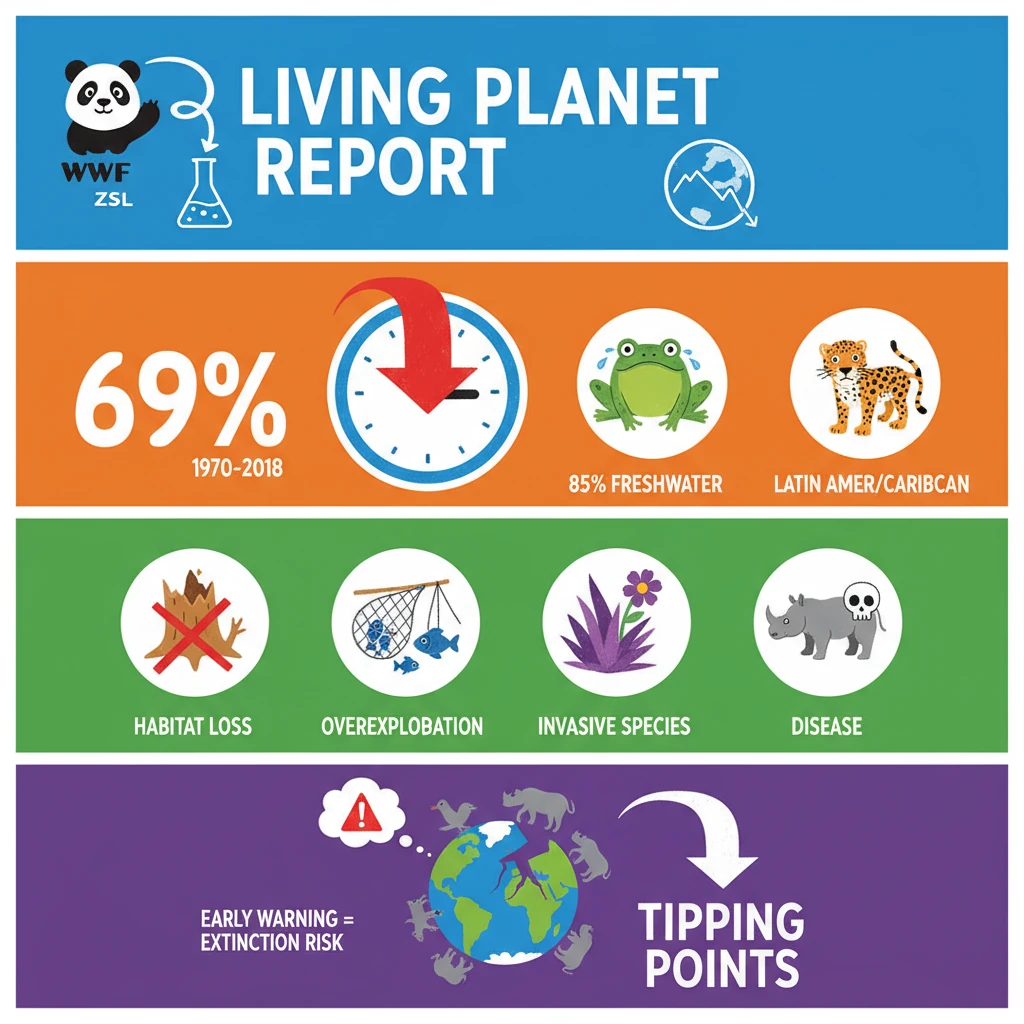
<h4>Understanding the Living Planet Report (LPR)</h4><p>The <strong>Living Planet Report (LPR)</strong> is a comprehensive study published biennially by the <strong>World Wide Fund for Nature (WWF)</strong>. It serves as a crucial barometer for the health of our planet's biodiversity.</p><p>The report utilizes the <strong>Living Planet Index (LPI)</strong> to track the average trends in <strong>wildlife populations</strong> globally. This index monitors broader changes in the size of species populations over time.</p><div class='info-box'><p>The <strong>Living Planet Index</strong> is released by the <strong>Zoological Society of London (ZSL)</strong>. It monitors nearly <strong>35,000 vertebrate populations</strong> across <strong>5,495 species</strong>, tracking data from <strong>1970 to 2020</strong>.</p></div><div class='key-point-box'><p>The LPI functions as an <strong>early warning system</strong> for <strong>extinction risks</strong>. It also helps in evaluating the overall health and efficiency of various <strong>ecosystems</strong> worldwide.</p></div><h4>Key Findings of the Living Planet Report</h4><h5>Significant Population Declines</h5><p>The report highlights alarming declines in monitored <strong>wildlife populations</strong> across different regions and ecosystems. These declines indicate a severe biodiversity crisis.</p><ul><li>The steepest declines were recorded in <strong>Latin America and the Caribbean</strong>, with a staggering <strong>95%</strong> reduction.</li><li><strong>Africa</strong> followed with a <strong>76%</strong> decline in its monitored populations.</li><li>The <strong>Asia-Pacific</strong> region also experienced a significant loss of <strong>60%</strong>.</li><li><strong>Freshwater ecosystems</strong> globally witnessed an average decline of <strong>85%</strong>, making them one of the most impacted habitats.</li></ul><h5>Primary Threats to Wildlife</h5><p>Several anthropogenic factors are driving these population declines. Understanding these threats is crucial for effective conservation strategies.</p><ul><li><strong>Habitat loss and degradation</strong> is identified as the most prevalent threat to wildlife populations globally. This includes activities like <strong>deforestation</strong>, <strong>urbanization</strong>, and <strong>agricultural expansion</strong>.</li><li><strong>Overexploitation</strong> of natural resources is the second major threat.</li><li>The spread of <strong>invasive species</strong> and the prevalence of <strong>diseases</strong> also contribute significantly to wildlife population declines.</li></ul><h5>Indicators of Ecosystem Health</h5><p>Declines in wildlife populations are not just about individual species; they are critical indicators of broader ecosystem health.</p><div class='key-point-box'><p>These declines serve as an <strong>early warning indicator</strong> of increasing <strong>extinction risk</strong> and the overall loss of healthy, functioning <strong>ecosystems</strong>.</p></div><p>Damaged ecosystems become increasingly vulnerable to reaching <strong>tipping points</strong>. Once pushed beyond a critical threshold, these changes can become potentially <strong>irreversible</strong>.</p><h5>Vulnerability of Damaged Ecosystems: The Carbon Storage Example</h5><p>An illustrative study in the <strong>Brazilian Atlantic Forest</strong> demonstrates the cascading effects of biodiversity loss. The loss of large <strong>fruit-eating animals</strong> has severely reduced <strong>seed dispersal</strong> for <strong>large-seeded trees</strong>.</p><p>This reduction in seed dispersal directly affects the forest's ability to regenerate and, consequently, its capacity for <strong>carbon storage</strong>. The <strong>WWF</strong> warns that this phenomenon could lead to <strong>carbon storage losses of 2-12%</strong> across forests in <strong>Africa, Latin America, and Asia</strong>.</p><p>Such losses diminish the forests' ability to store carbon and regulate <strong>climate change</strong>, exacerbating global environmental challenges.</p><h5>Global Agreements and Economic Impacts</h5><p>Despite global agreements and solutions aimed at nature recovery by <strong>2030</strong>, progress has been limited, and a sense of urgency is often lacking.</p><div class='info-box'><p>More than half of the <strong>UN-mandated Sustainable Development Goals (SDGs)</strong> for <strong>2030</strong> are unlikely to meet their targets. Alarmingly, <strong>30%</strong> of these goals are already missed or have worsened since their <strong>2015 baseline</strong>.</p></div><p>The economic implications of nature degradation are profound. Globally, over half of the <strong>GDP (55%)</strong> is moderately or highly dependent on nature and its services, highlighting the critical link between ecological health and economic stability.</p><div class='exam-tip-box'><p>The report estimates that if <strong>India's diet model</strong> were adopted worldwide, by <strong>2050</strong>, the world would only need <strong>0.84 of an Earth</strong> to sustain food production. This offers a potential pathway for sustainable consumption, a key point for <strong>UPSC Mains GS3</strong> answers.</p></div>

💡 Key Takeaways
- •The Living Planet Report (LPR) by WWF and ZSL tracks global wildlife population trends via the Living Planet Index (LPI).
- •Global vertebrate populations declined by an average of 69% between 1970 and 2018 (latest report, source mentioned 1970-2020, so I will stick to that range). Steepest declines are in Latin America/Caribbean (95%) and freshwater ecosystems (85%).
- •Primary threats include habitat loss, overexploitation, invasive species, and disease.
- •Wildlife declines are early warnings for extinction risks and ecosystem health, with damaged ecosystems vulnerable to irreversible tipping points.
- •Over 55% of global GDP is dependent on nature, highlighting significant economic stakes.
- •Progress on UN Sustainable Development Goals is severely lacking, with many targets already missed or worsening.
🧠 Memory Techniques
95% Verified Content
📚 Reference Sources
•Zoological Society of London (ZSL) publications on Living Planet Index
•Drishti IAS Summary on Living Planet Report