What are Welfare Schemes the Government Initiated for Salt Workers? - Environment And Ecology | UPSC Learning
Topics
0 topics • 0 completed
🔍
No topics match your search
What are Welfare Schemes the Government Initiated for Salt Workers?
Easy⏱️ 6 min read
environment and ecology
📖 Introduction
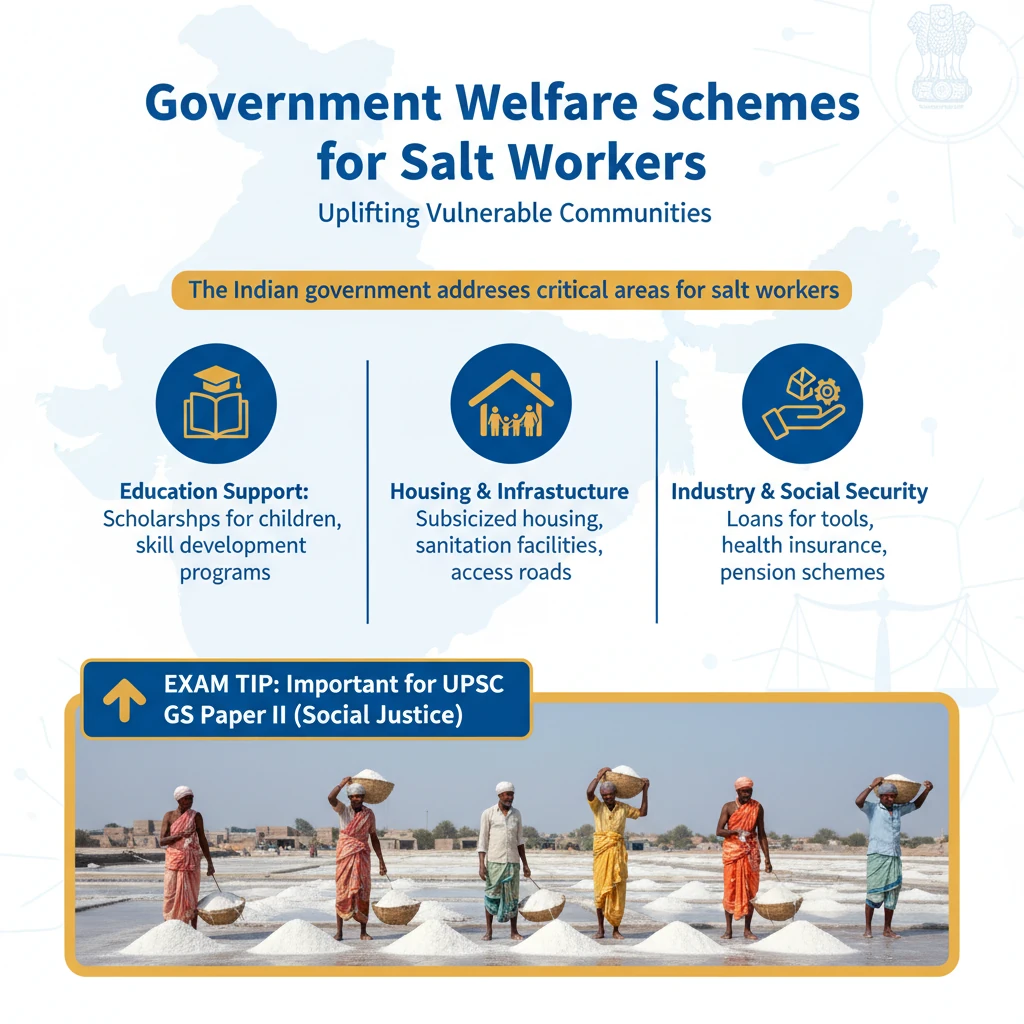
<h4>Government Welfare Schemes for Salt Workers</h4><p>The Indian government has initiated several welfare schemes specifically designed to uplift and support <strong>salt workers</strong>, who often belong to vulnerable sections of society. These schemes address critical areas such as education, housing, and overall industry development.</p><div class='exam-tip-box'><p>Understanding these targeted welfare programs is important for <strong>UPSC GS Paper II</strong>, particularly topics related to <strong>social justice</strong> and <strong>vulnerable groups</strong>.</p></div><h4>Scheme for Grant of Rewards to the Children of Salt Labourers</h4><p>The <strong>Scheme for Grant of Rewards to the Children of Salt Labourers</strong> is a crucial initiative aimed at supporting the educational journey of children from salt worker families.</p><div class='info-box'><p>This scheme provides <strong>financial rewards</strong> to eligible students at various stages of their academic development.</p></div><div class='key-point-box'><p>Its primary objective is to foster the <strong>educational development</strong> and overall upliftment of the next generation, breaking the cycle of poverty.</p></div><h4>Nanak Chandor Navas Yojana (NMAY)</h4><p>The <strong>Nanak Chandor Navas Yojana (NMAY)</strong> focuses on improving the living conditions of salt workers by addressing their fundamental housing needs.</p><div class='info-box'><p>It specifically provides for the <strong>construction of houses</strong> for salt workers, ensuring access to safe and dignified shelter.</p></div><p>Beyond housing, <strong>NMAY</strong> also plays a vital role in promoting the formation and strengthening of <strong>cooperative societies</strong> within the salt industry.</p><div class='key-point-box'><p>This cooperative aspect aims to empower workers through collective action, improved bargaining power, and enhanced economic opportunities.</p></div><h4>Salt Commissioner’s Organization (SCO)</h4><p>The <strong>Salt Commissioner’s Organization (SCO)</strong> serves as a pivotal body responsible for the overall development and regulation of the Indian salt industry.</p><div class='info-box'><p>Its mandate includes comprehensive <strong>monitoring</strong> of the industry's growth and addressing various sectoral challenges.</p></div><p>Key functions of the <strong>SCO</strong> involve strategic <strong>planning</strong> for industry advancement, facilitating <strong>technology upgradation</strong> to enhance productivity and efficiency, and conducting essential <strong>training programs</strong> for salt workers.</p><div class='key-point-box'><p>These activities collectively aim to modernize the industry, improve the skills of its workforce, and ensure sustainable livelihoods.</p></div>
💡 Key Takeaways
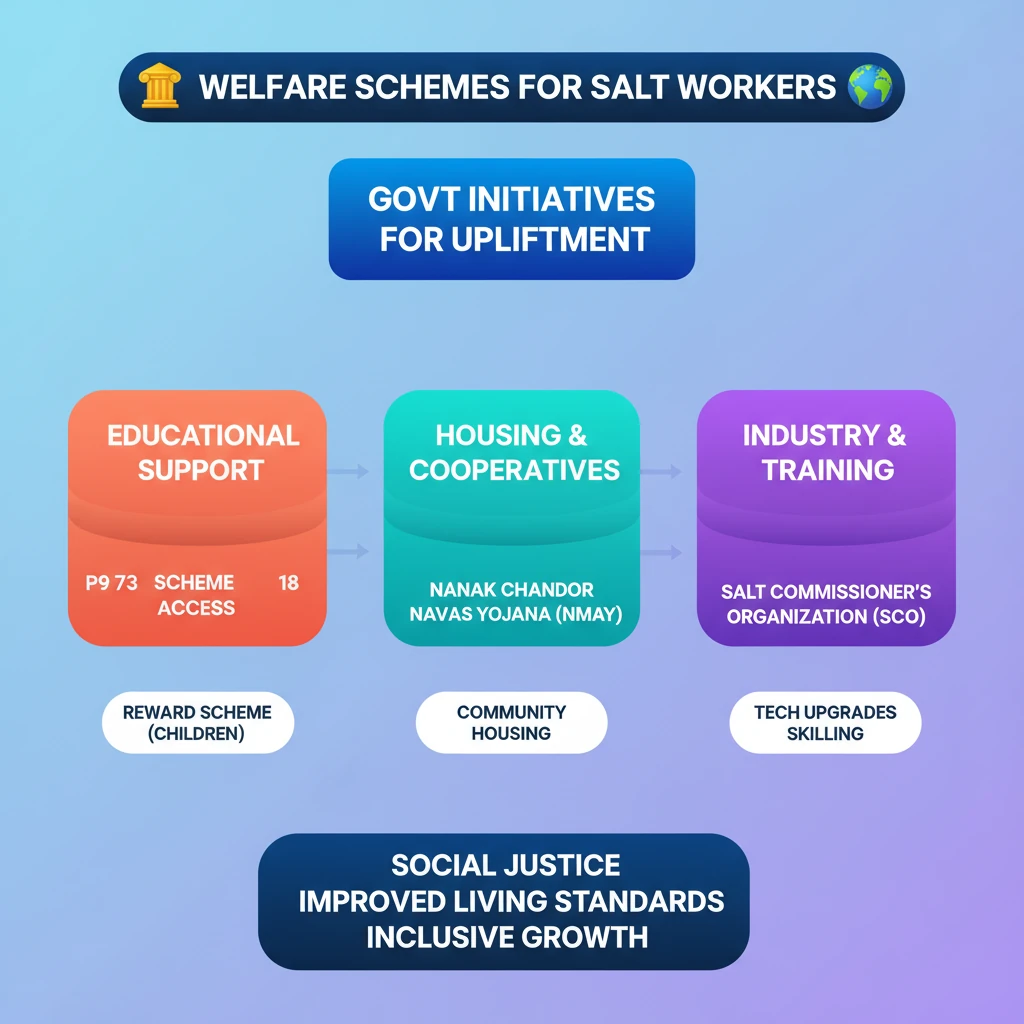
- •Government has specific welfare schemes for salt workers focusing on their upliftment.
- •The 'Scheme for Grant of Rewards' supports educational development of children of salt laborers.
- •The 'Nanak Chandor Navas Yojana (NMAY)' provides housing and promotes cooperative societies.
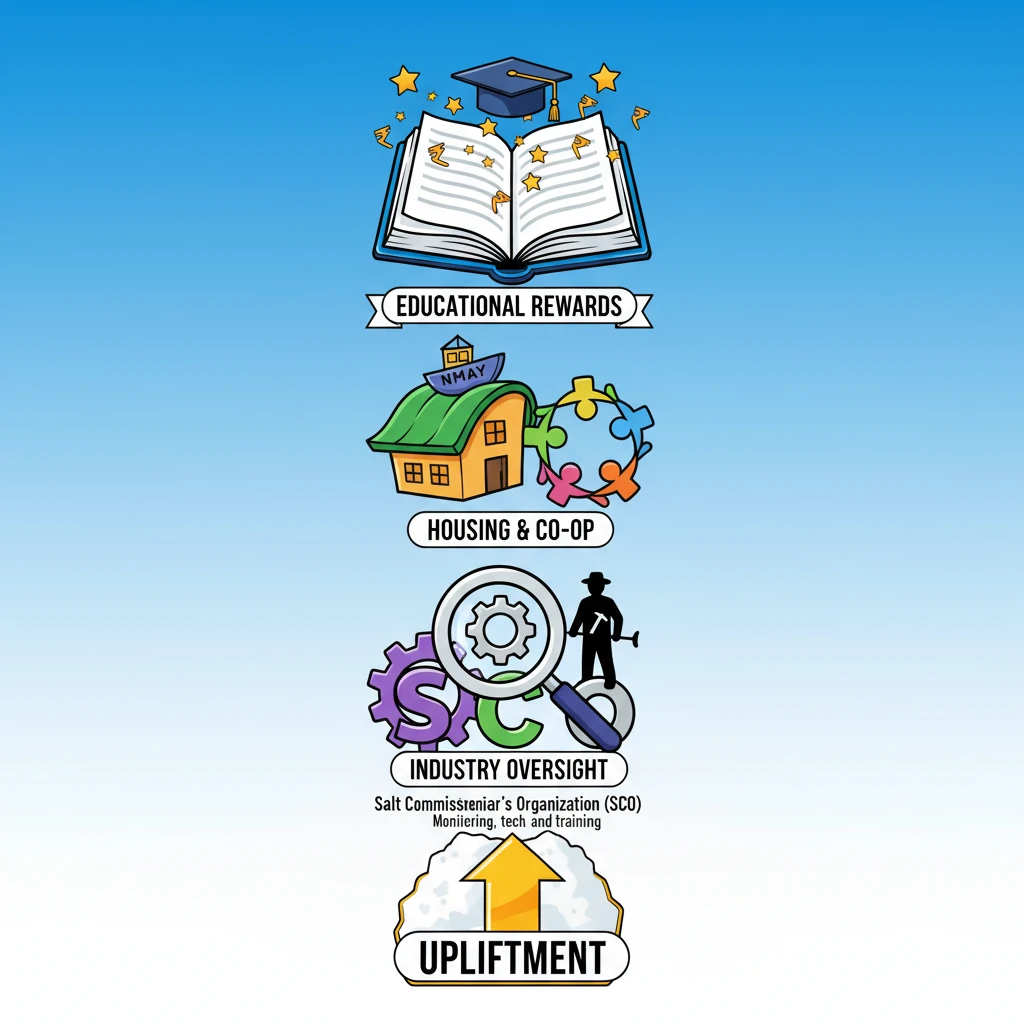
- •The 'Salt Commissioner’s Organization (SCO)' monitors industry development, tech upgradation, and worker training.
- •These schemes are vital for ensuring social justice, improving living standards, and fostering inclusive growth for a vulnerable community.
🧠 Memory Techniques
95% Verified Content
📚 Reference Sources
•Ministry of Commerce & Industry, Department of Salt, Government of India official website
•Reports and publications on labor welfare and social justice in India