What are Eight Sections Containing Guidelines for OECMs? - Environment And Ecology | UPSC Learning
Topics
0 topics • 0 completed
🔍
No topics match your search
What are Eight Sections Containing Guidelines for OECMs?
Medium⏱️ 7 min read
environment and ecology
📖 Introduction
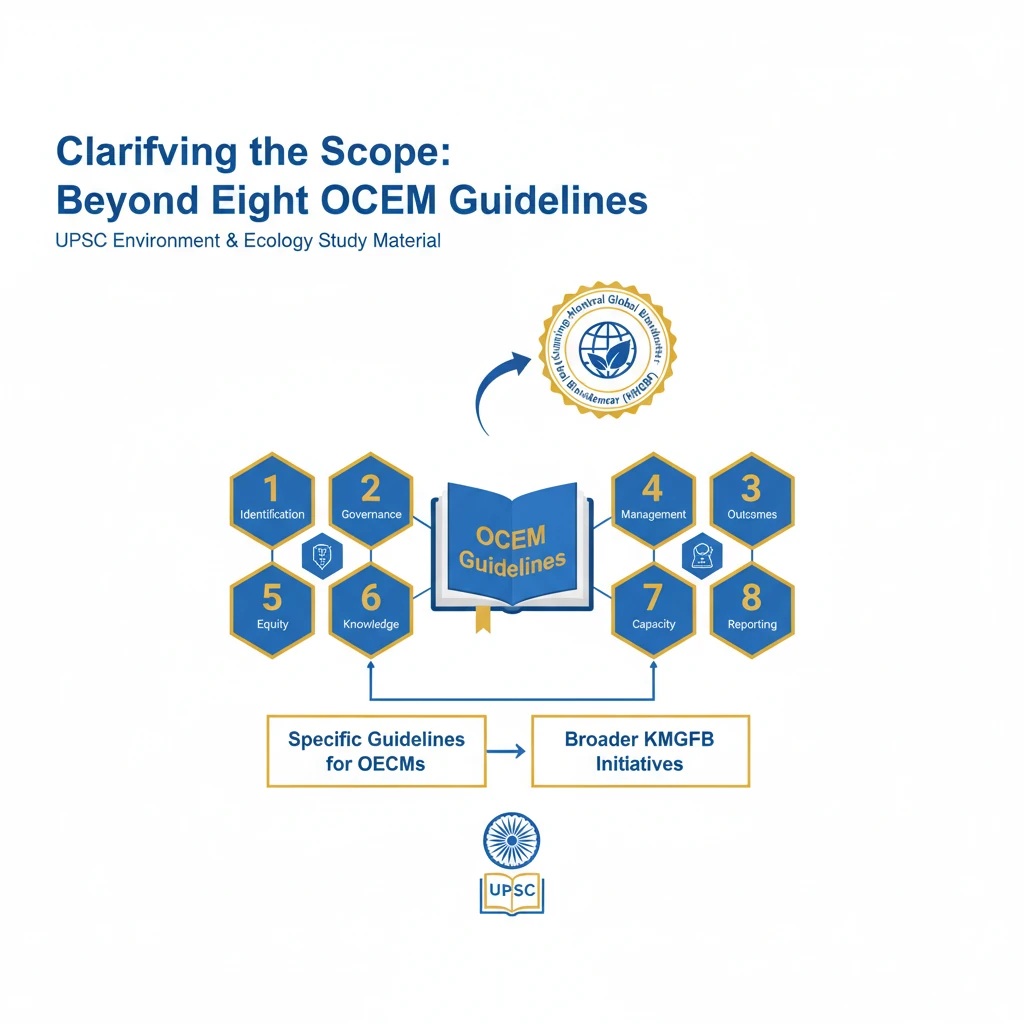
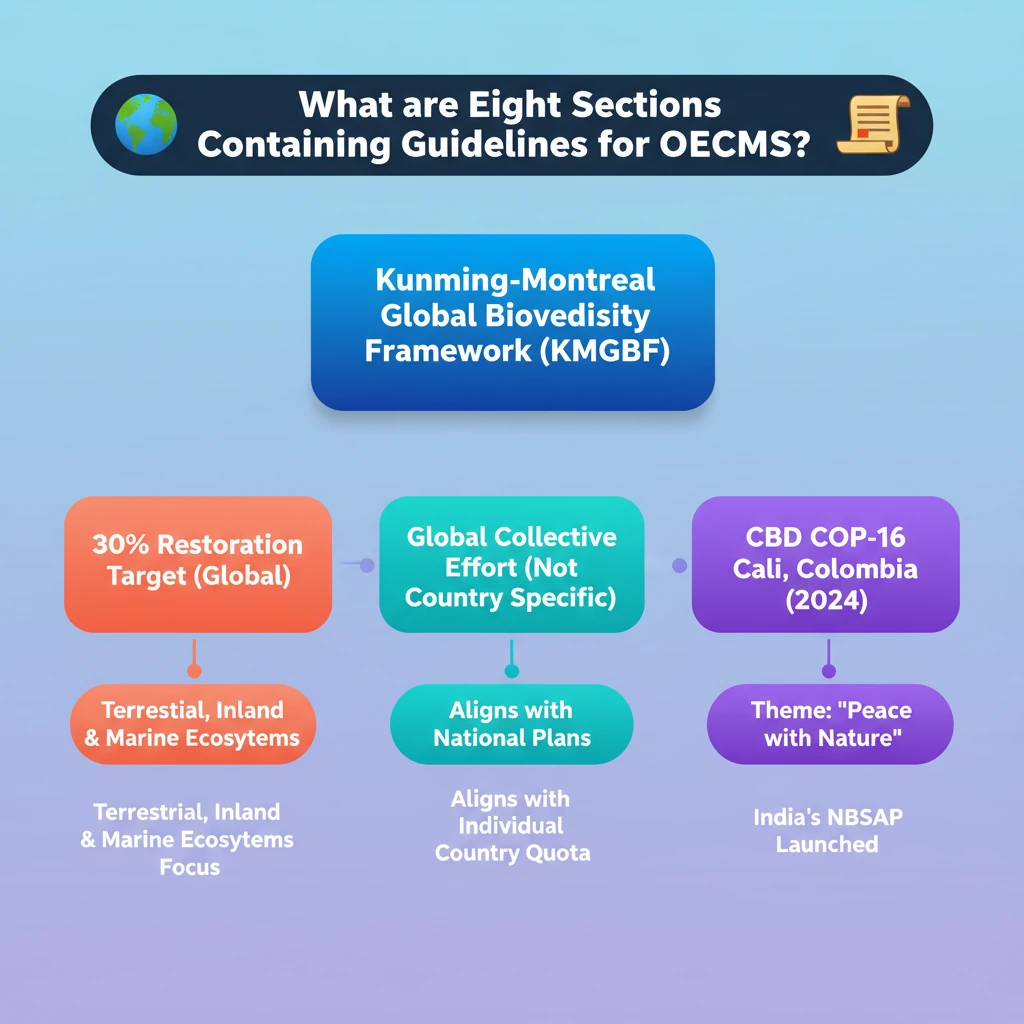
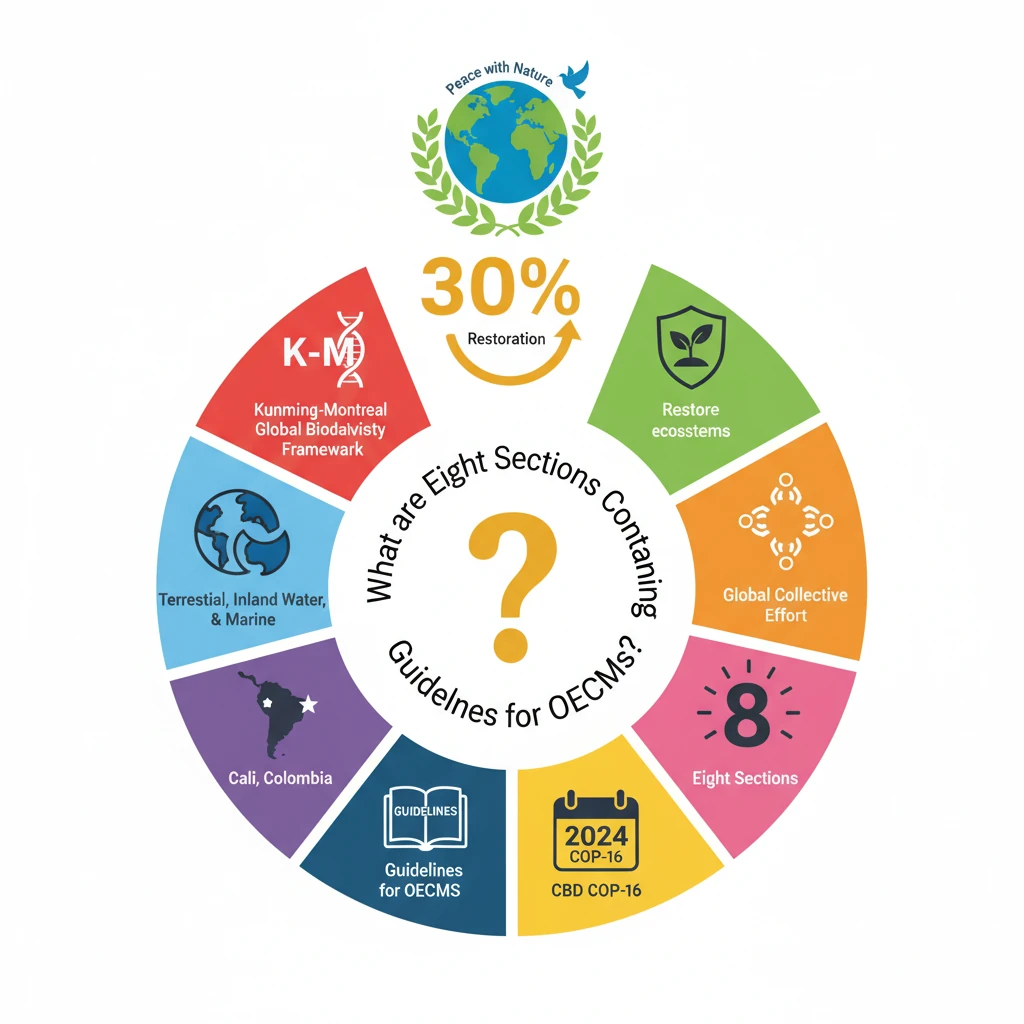
<h4>Clarifying the Scope: Beyond Eight OECM Guidelines</h4><p>While the topic heading refers to "Eight Sections Containing Guidelines for <strong>Other Effective Area-Based Conservation Measures (OECMs)</strong>", the provided source content primarily elaborates on key aspects of the <strong>Kunming-Montreal Global Biodiversity Framework (KMGBF)</strong> and related biodiversity initiatives.</p><p>It is important for UPSC aspirants to distinguish between the specific guidelines for <strong>OECMs</strong> and the broader global biodiversity targets and frameworks like the <strong>KMGBF</strong>, which often incorporate <strong>OECMs</strong> as a tool for achieving conservation goals.</p><div class='key-point-box'><p>This explanation will therefore focus on the details provided regarding the <strong>KMGBF</strong>, its targets, and recent developments, which are directly present in the source material.</p></div><h4>Key Biodiversity Targets under KMGBF</h4><p>A significant target within the <strong>Kunming-Montreal Global Biodiversity Framework (KMGBF)</strong> is the commitment to restore <strong>at least 30% of degraded terrestrial, inland water, and marine ecosystems</strong>.</p><div class='info-box'><p>This <strong>30% restoration target</strong> refers to a <strong>global effort</strong>. It is not a requirement for each individual country to allocate 30% of its own land and water for restoration.</p></div><p>The framework encourages collective action and shared responsibility among nations to achieve this ambitious goal.</p><h4>Future Outlook and Vision 2050</h4><p>The <strong>KMGBF</strong> envisions a long-term future where humanity lives in <strong>harmony with nature by 2050</strong>.</p><p>This overarching vision guides current actions and policies focused on <strong>biodiversity conservation</strong> and <strong>sustainable use</strong> of natural resources.</p><h4>CBD COP-16: Recent Developments</h4><p>The <strong>Convention on Biological Diversity (CBD) Conference of the Parties (COP-16)</strong> was a recent and significant international event for biodiversity.</p><div class='info-box'><p><strong>Location:</strong> <strong>Cali, Colombia</strong></p><p><strong>Year:</strong> <strong>2024</strong></p><p><strong>Theme:</strong> "<strong>Peace with Nature</strong>"</p></div><p>These conferences are crucial for reviewing progress, addressing challenges, and setting future agendas for global biodiversity protection.</p><h4>India's Commitment: Updated NBSAP</h4><p>At <strong>CBD COP-16</strong>, <strong>India</strong> demonstrated its strong commitment to global biodiversity goals.</p><p>The nation launched its updated <strong>National Biodiversity Strategy and Action Plan (NBSAP)</strong>, specifically designed to align with the objectives of the <strong>Kunming-Montreal Global Biodiversity Framework (KMGBF)</strong>.</p><h4>Addressing Digital Sequence Information (DSI)</h4><p>A critical and evolving area of discussion within biodiversity governance is the need for careful work to ensure <strong>fair and equitable sharing of benefits</strong>.</p><p>This applies particularly to benefits derived from the use of <strong>Digital Sequence Information (DSI)</strong> on genetic resources.</p><div class='exam-tip-box'><p>The issue of <strong>DSI</strong> benefit sharing is complex and remains a key point of negotiation under the <strong>CBD</strong>, often appearing in <strong>UPSC Mains GS-III</strong> questions related to intellectual property, biotechnology, and biodiversity governance.</p></div>
💡 Key Takeaways
- •The Kunming-Montreal Global Biodiversity Framework (KMGBF) is the current global blueprint for biodiversity action.
- •A key KMGBF target is to restore at least 30% of degraded terrestrial, inland water, and marine ecosystems globally.
- •This 30% target is a global collective effort, not a country-specific mandate.
- •CBD COP-16 took place in Cali, Colombia in 2024 with the theme "Peace with Nature."
- •India launched its updated National Biodiversity Strategy and Action Plan (NBSAP) at COP-16, aligning with KMGBF.
- •Fair and equitable benefit sharing from Digital Sequence Information (DSI) on genetic resources is a critical and ongoing discussion point.
🧠 Memory Techniques
95% Verified Content
📚 Reference Sources
•Official Website of the Convention on Biological Diversity (CBD)
•United Nations Environment Programme (UNEP) reports on KMGBF