Conservation Breeding Programme - Environment And Ecology | UPSC Learning
Topics
0 topics • 0 completed
🔍
No topics match your search
Conservation Breeding Programme
Medium⏱️ 7 min read
environment and ecology
📖 Introduction
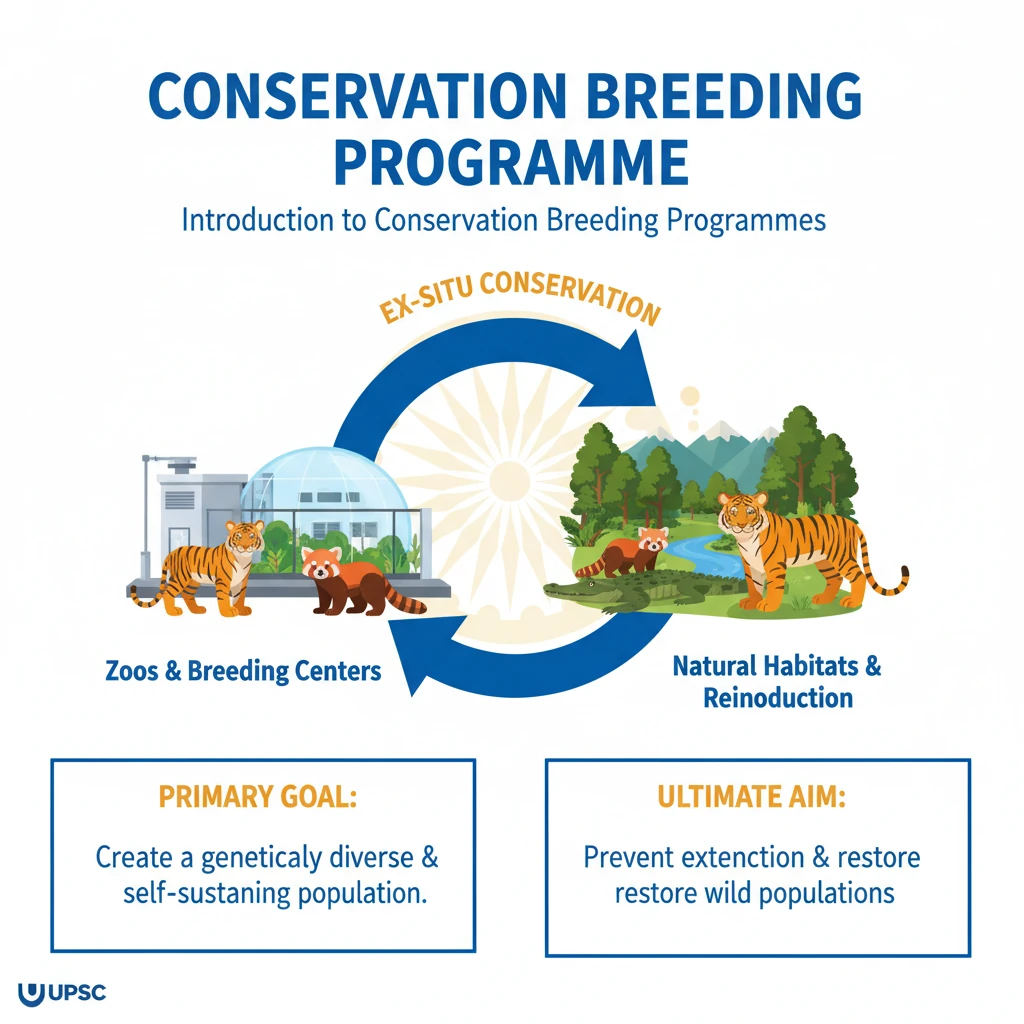
<h4>Introduction to Conservation Breeding Programmes</h4><p>A <strong>Conservation Breeding Programme</strong> is a crucial strategy within <strong>ex-situ conservation</strong>, focusing on maintaining and increasing populations of endangered species in controlled environments, such as zoos or specialized breeding centers.</p><p>The primary goal is to create a genetically diverse and self-sustaining population that can eventually be reintroduced into their natural habitats, thereby preventing extinction.</p><div class='key-point-box'><p><strong>Ex-situ conservation</strong> means 'off-site conservation', where species are protected outside their natural habitats. This complements <strong>in-situ conservation</strong> (on-site) efforts.</p></div><h4>Pioneering Efforts: Snow Leopard Conservation</h4><p>India's first <strong>ex-situ conservation breeding programme</strong> was initiated in <strong>1986</strong>. This landmark project focused on the majestic <strong>Snow Leopard</strong>.</p><div class='info-box'><p><strong>First Programme:</strong> <strong>Snow Leopard conservation breeding project</strong></p><p><strong>Initiation Year:</strong> <strong>1986</strong></p></div><p>The <strong>Conservation Breeding Centre (CBC)</strong> at the <strong>Padmaja Naidu Himalayan Zoological Park</strong>, commonly known as <strong>Darjeeling Zoo</strong>, played a pivotal role in this initiative.</p><h4>Milestones and Achievements at Darjeeling Zoo</h4><p>The <strong>Darjeeling Zoo</strong> achieved a significant milestone by recording the first birth of a <strong>Snow Leopard</strong> in <strong>1989</strong> under this programme.</p><div class='info-box'><p><strong>First Birth:</strong> <strong>Snow Leopard</strong> in <strong>1989</strong></p><p><strong>Total Births:</strong> <strong>77 Snow Leopards</strong> born at <strong>Darjeeling Zoo</strong> since 1989</p></div><p>This remarkable success highlights the effectiveness of dedicated conservation efforts and specialized breeding techniques. The programme stands as a testament to wildlife conservation achievements.</p><h4>Key Factors for Breeding Success</h4><p>The success of the <strong>Darjeeling Zoo's Snow Leopard</strong> breeding programme can be attributed to several carefully implemented strategies:</p><ul><li><strong>Careful Pairing:</strong> Meticulous selection and pairing of male and female <strong>Snow Leopards</strong> to ensure compatibility.</li><li><strong>Natural Environment:</strong> Creation of a simulated natural habitat within the enclosures to reduce stress and encourage natural behaviors.</li><li><strong>Genetic Diversity:</strong> Utilization of a wide <strong>genetic pool</strong> to prevent <strong>inbreeding</strong>, which is crucial for the long-term health and viability of the captive population.</li></ul><h4>Breeding Protocols and Animal Care</h4><p>Specific protocols are followed to ensure successful breeding and the well-being of the animals:</p><ol><li><strong>Courtship Development:</strong> Before pairing, <strong>Snow Leopards</strong> are kept in adjoining enclosures, allowing them to develop courtship behaviors and assess compatibility.</li><li><strong>Pairing:</strong> Once compatibility is observed, the male and female are paired and housed in the same enclosure.</li><li><strong>Maternity Care:</strong> Pregnant female <strong>Snow Leopards</strong> are separated and kept under <strong>24x7 CCTV surveillance</strong>.</li><li><strong>Health Monitoring:</strong> Regular <strong>blood tests</strong> and monitoring of <strong>body weight</strong> are conducted for pregnant females to ensure their health and the health of their offspring.</li></ol><h4>Advanced Biosecurity and Veterinary Facilities</h4><p>The <strong>Darjeeling Zoo</strong> maintains the highest <strong>biosecurity protocols</strong> for all its captive animals. This is vital for preventing disease outbreaks and ensuring animal health.</p><ul><li><strong>Regular Screening:</strong> All animals undergo regular screening for <strong>parasites</strong>.</li><li><strong>Deworming:</strong> Consistent <strong>deworming</strong> schedules are followed.</li><li><strong>Veterinary Facilities:</strong> The zoo is equipped with advanced <strong>veterinary facilities</strong> to provide prompt and effective medical care.</li></ul><div class='exam-tip-box'><p>For <strong>UPSC Prelims</strong>, remember key facts like the year of the first programme (<strong>1986</strong>) and the first birth (<strong>1989</strong>). For <strong>UPSC Mains (GS-III)</strong>, this programme serves as an excellent case study for <strong>ex-situ conservation</strong> and the role of zoos.</p></div>
💡 Key Takeaways
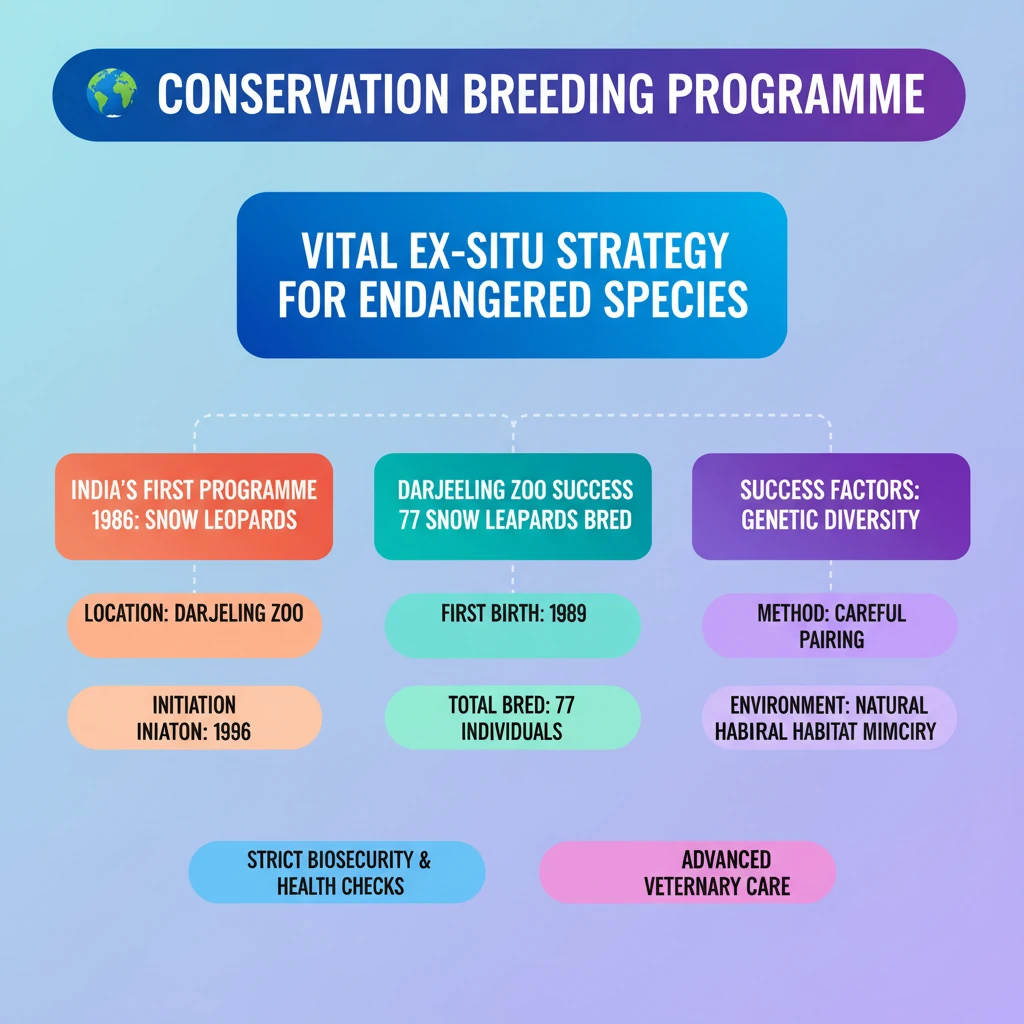
- •Conservation Breeding Programmes are vital ex-situ strategies for endangered species.
- •India's first programme began in 1986 for Snow Leopards at Darjeeling Zoo.
- •Darjeeling Zoo recorded the first Snow Leopard birth in 1989 and has since bred 77 individuals.
- •Success factors include careful pairing, natural environments, and maintaining a wide genetic pool.
- •Strict biosecurity, regular health checks, and advanced veterinary care are crucial for captive animals.
🧠 Memory Techniques
95% Verified Content
📚 Reference Sources
•Official reports and publications of Padmaja Naidu Himalayan Zoological Park (Darjeeling Zoo)
•Ministry of Environment, Forest and Climate Change (MoEFCC) documents on ex-situ conservation
•Wildlife Institute of India (WII) publications on conservation breeding