Golden Langur: Distribution, Characteristics, and Conservation Status - Environment And Ecology | UPSC Learning
Topics
0 topics • 0 completed
🔍
No topics match your search
Golden Langur: Distribution, Characteristics, and Conservation Status
Medium⏱️ 7 min read
environment and ecology
📖 Introduction
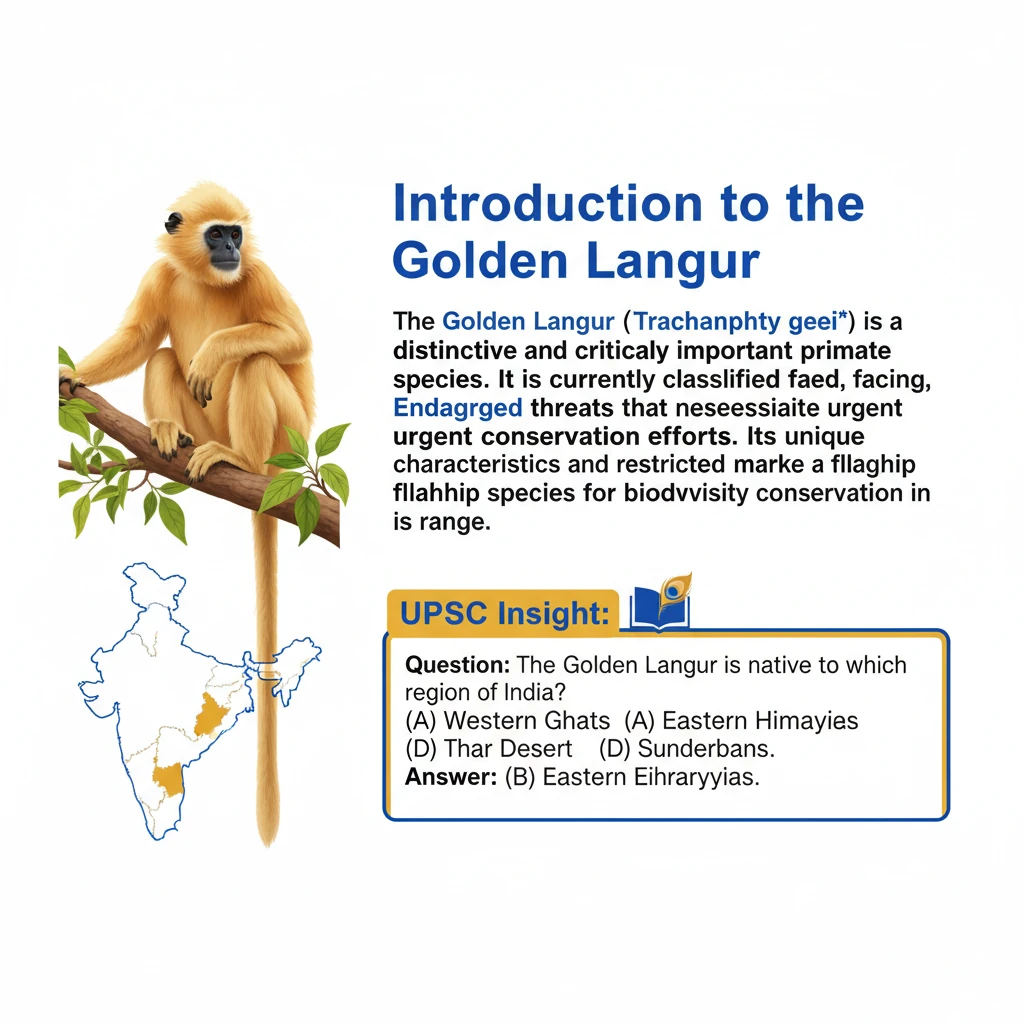
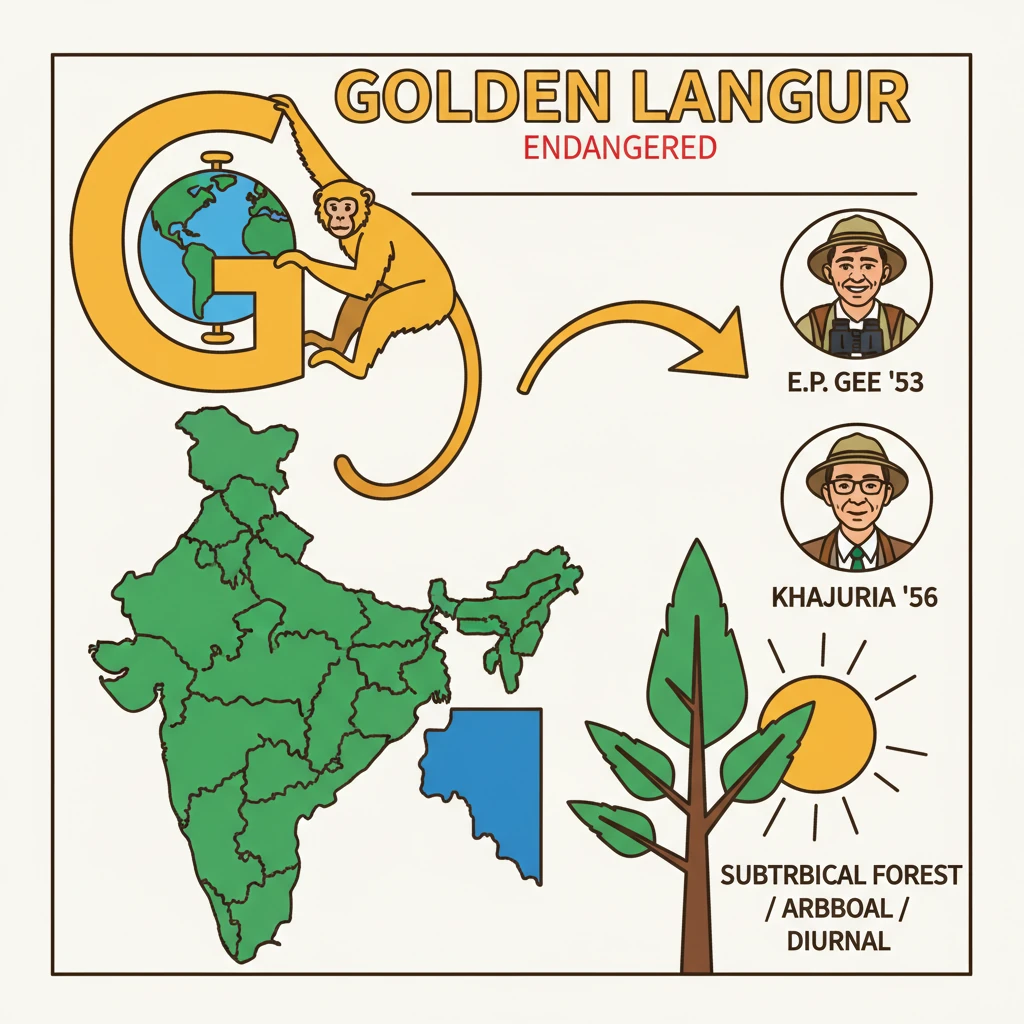
<h4>Introduction to the Golden Langur</h4><p>The <strong>Golden Langur</strong> (<em>Trachypithecus geei</em>) is a highly distinctive and critically important primate species. It is currently classified as <strong>Endangered</strong>, facing escalating threats that necessitate urgent conservation efforts. Its unique characteristics and restricted habitat make it a flagship species for biodiversity conservation in its range.</p><div class='exam-tip-box'><p><strong>UPSC Insight:</strong> Questions on <strong>endangered species</strong> often focus on their habitat, unique features, and conservation status. The <strong>Golden Langur</strong> is a prime example for <strong>GS3 Environment & Ecology</strong>.</p></div><h4>Taxonomy and Discovery</h4><p>The <strong>Golden Langur</strong> belongs to the family <strong>Cercopithecidae</strong>, commonly known as <strong>Old World Monkeys</strong>. Within this family, it falls under the subfamily <strong>Colobinae</strong>, which are typically <strong>leaf-eating monkeys</strong>.</p><div class='info-box'><p><strong>Species Name:</strong> <em><strong>Trachypithecus geei</strong></em><br><strong>Family:</strong> <strong>Cercopithecidae</strong> (Old World Monkeys)<br><strong>Subfamily:</strong> <strong>Colobinae</strong> (Leaf-eating monkeys)</p></div><p>The species was first brought to scientific attention by <strong>E.P. Gee</strong> in <strong>1953</strong>. It was subsequently formally described by <strong>Khajuria</strong> in <strong>1956</strong>, solidifying its place in the scientific record.</p><h4>Geographic Range</h4><p>The distribution of the <strong>Golden Langur</strong> is remarkably restricted. It is found exclusively in specific regions of <strong>Assam, India</strong>, and the neighboring country of <strong>Bhutan</strong>. This limited range makes it particularly vulnerable to habitat changes.</p><div class='info-box'><p><strong>Exclusive Range:</strong> Parts of <strong>Assam, India</strong> and <strong>Bhutan</strong>.<br><strong>Bordered by:</strong><br><ul><li><strong>North:</strong> Foothills of <strong>Bhutan</strong></li><li><strong>East:</strong> <strong>Manas River</strong></li><li><strong>West:</strong> <strong>Sankosh River</strong></li><li><strong>South:</strong> <strong>Brahmaputra River</strong></li></ul></p></div><h4>Habitat</h4><p>These primates thrive in specific forest types across a considerable elevation range. Their preferred habitat consists of <strong>subtropical and temperate broadleaf forests</strong>.</p><p>They can be found at various altitudes, from areas near sea level up to elevations exceeding <strong>3,000 meters</strong>. This adaptability to different elevations within their forest type is notable.</p><h4>Physical Characteristics</h4><p>The <strong>Golden Langur</strong> is easily recognizable by its striking appearance. Its most prominent feature is its distinctive fur color.</p><div class='info-box'><p><strong>Coat Color:</strong> Primarily <strong>golden-orange fur</strong>.<br><strong>Seasonal Variation:</strong> Fur color changes with seasons, appearing <strong>cream in summer</strong> and a darker <strong>golden in winter</strong>.<br><strong>Facial Features:</strong> A characteristic <strong>black hairless face</strong>, complemented by a <strong>pale beard</strong>. A unique <strong>protective hair whorl</strong> is present on the crown of its head.</p></div><p>The species also exhibits <strong>sexual dimorphism</strong>. <strong>Males</strong> are generally larger and possess a more robust build compared to <strong>females</strong>.</p><h4>Behavior</h4><p><strong>Golden Langurs</strong> display typical primate behaviors. They are <strong>diurnal</strong>, meaning they are active primarily during the daytime. Their lives are predominantly spent in trees, classifying them as highly <strong>arboreal</strong> species.</p>
💡 Key Takeaways
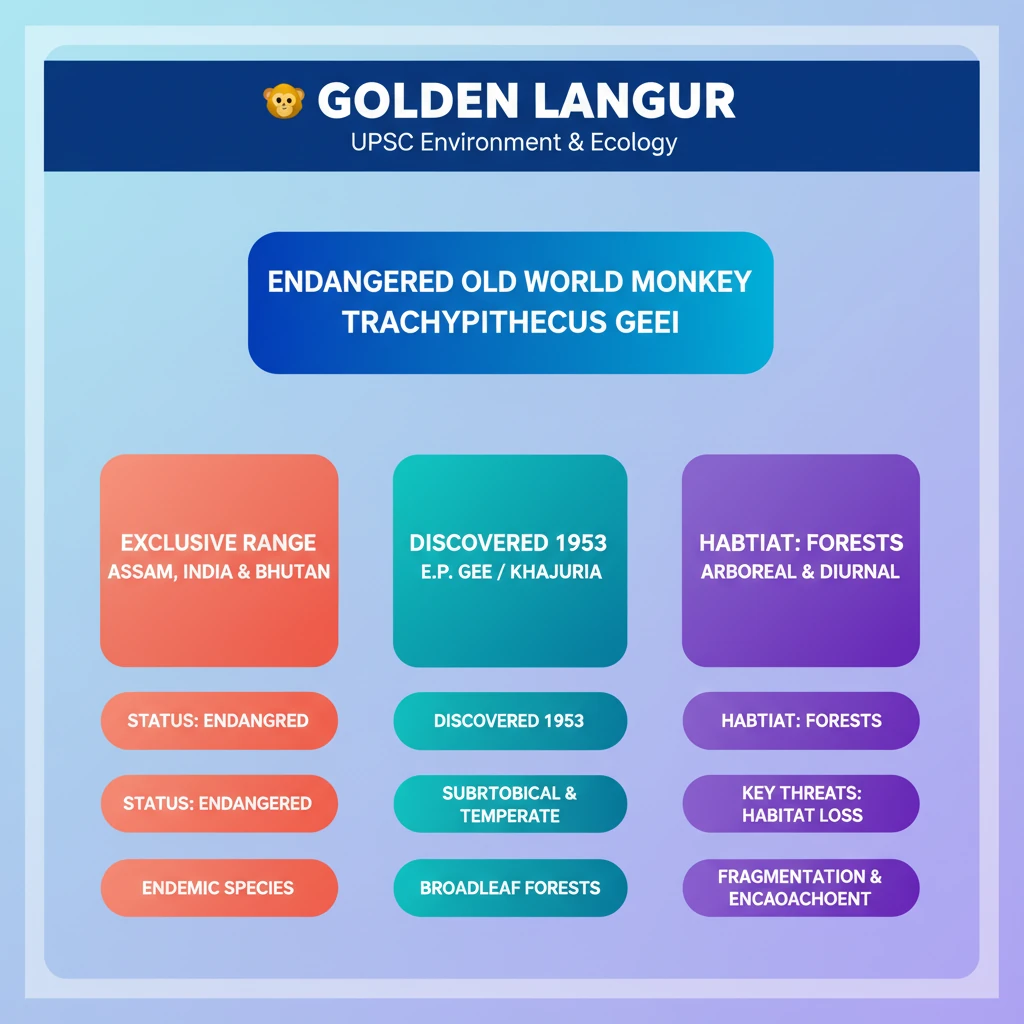
- •Golden Langur (Trachypithecus geei) is an endangered Old World Monkey.
- •Found exclusively in a restricted range in Assam, India, and Bhutan.
- •Discovered by E.P. Gee in 1953, formally described by Khajuria in 1956.
- •Habitat: Subtropical and temperate broadleaf forests; arboreal and diurnal.
- •Key threats include habitat fragmentation, deforestation, and human encroachment.
- •Conservation requires transboundary cooperation and effective implementation of wildlife protection laws.
🧠 Memory Techniques
98% Verified Content
📚 Reference Sources
•IUCN Red List of Threatened Species (for conservation status)
•Wildlife Protection Act, 1972 (for legal protection in India)
•General knowledge on primate taxonomy and geographical distribution