Methane Emissions and Global Warming - Environment And Ecology | UPSC Learning
Topics
0 topics • 0 completed
🔍
No topics match your search
Methane Emissions and Global Warming
Medium⏱️ 8 min read
environment and ecology
📖 Introduction
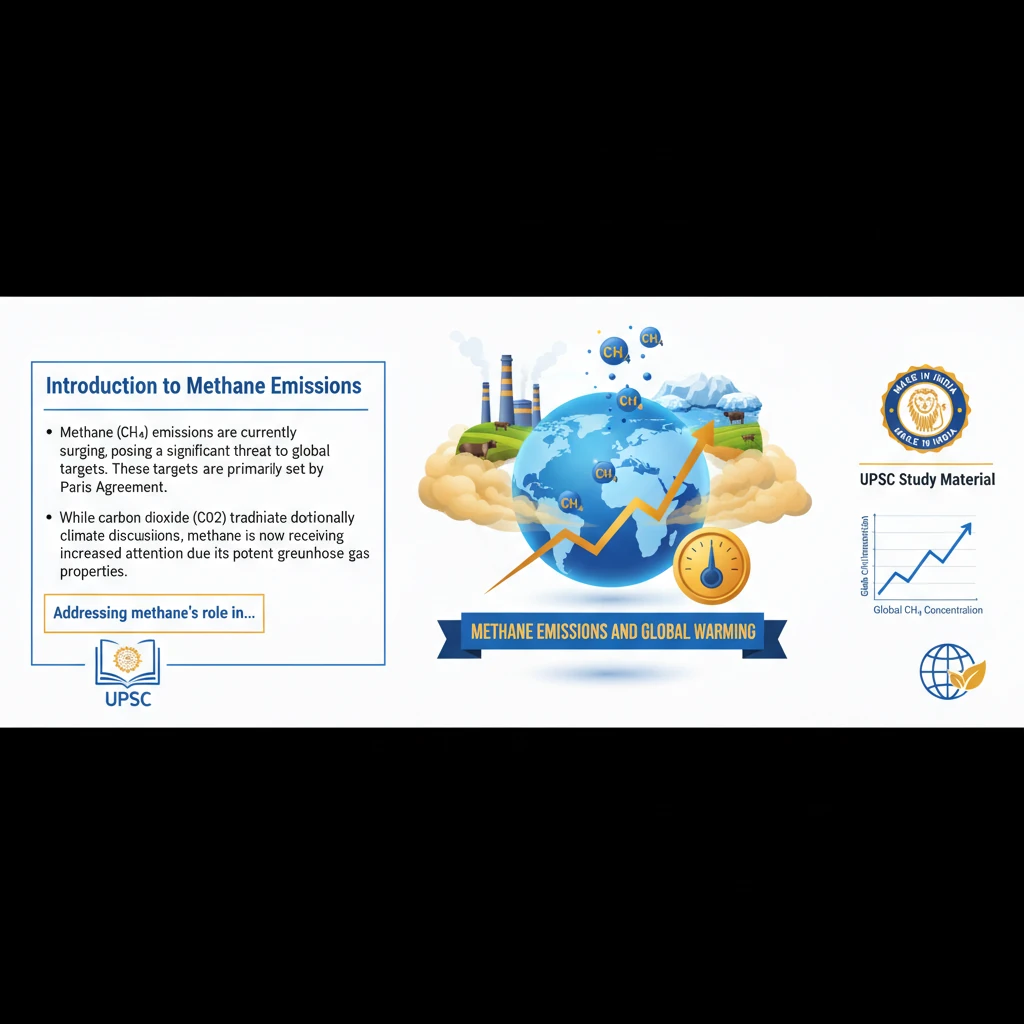
<h4>Introduction to Methane Emissions</h4><p><strong>Methane (CH4)</strong> emissions are currently surging, posing a significant threat to global climate targets. These targets are primarily set by the <strong>Paris Agreement</strong>.</p><p>While <strong>carbon dioxide (CO2)</strong> traditionally dominates climate discussions, <strong>methane</strong> is now receiving increased attention due to its potent greenhouse gas properties.</p><div class='key-point-box'><p>Addressing methane's role in global warming presents a crucial opportunity for achieving rapid progress in climate change mitigation.</p></div><h4>Defining Methane</h4><div class='info-box'><ul><li><strong>Methane</strong> is the simplest hydrocarbon, composed of <strong>one carbon atom</strong> and <strong>four hydrogen atoms (CH4)</strong>.</li><li>It is the primary component of <strong>natural gas</strong>.</li><li>Key characteristics include being an <strong>odourless, colourless, and tasteless gas</strong>, and it is <strong>lighter than air</strong>.</li><li>In complete combustion, it burns with a <strong>blue flame</strong>, producing <strong>carbon dioxide (CO2)</strong> and <strong>water (H2O)</strong>.</li></ul></div><h4>Climate Impact of Methane Emissions</h4><p><strong>Methane</strong> is an exceptionally potent <strong>greenhouse gas (GHG)</strong>, approximately <strong>80 times more potent than CO2</strong> over a 20-year period.</p><p>It has contributed to around <strong>30% of global warming</strong> since the <strong>Industrial Revolution</strong>, highlighting its significant role in climate change.</p><div class='info-box'><p>Despite its high potency, methane has a relatively short atmospheric lifespan, remaining in the atmosphere for only about <strong>7 to 12 years</strong>.</p></div><div class='key-point-box'><p>This shorter lifespan means that reducing <strong>methane emissions</strong> or enhancing its natural sinks can have a significant and rapid impact on mitigating climate change in the short term. This buys valuable time to address the more complex challenge of reducing reliance on fossil fuels and associated <strong>CO2 emissions</strong>.</p></div><p>A targeted reduction of <strong>methane emissions by 45% by 2030</strong> is projected to help achieve the <strong>Paris Agreement's goal</strong> of limiting global warming to <strong>1.5°C</strong>.</p><h4>Methane and Air Quality Issues</h4><p>Beyond its direct warming effect, controlling <strong>methane emissions</strong> is also vital for improving <strong>air quality</strong>.</p><p><strong>Methane</strong> contributes to the formation of <strong>ground-level (tropospheric) ozone</strong>, which is a harmful air pollutant.</p><div class='info-box'><p><strong>Ground-level ozone</strong> negatively impacts <strong>respiratory health</strong>, making methane abatement a dual-benefit strategy for both climate and public health.</p></div><h4>Sources of Methane Emissions</h4><p>Global methane emissions are estimated at approximately <strong>580 million tonnes annually</strong>.</p><p>These emissions are split between natural and human-induced sources:</p><ul><li>About <strong>40%</strong> originates from <strong>natural sources</strong>.</li><li>Approximately <strong>60%</strong> comes from <strong>human activities (anthropogenic emissions)</strong>.</li></ul><div class='key-point-box'><p>Mitigating anthropogenic methane emissions is considered a relatively achievable climate solution compared to other greenhouse gases.</p></div><p>Key sectors responsible for anthropogenic methane emissions include:</p><ul><li><strong>Agriculture:</strong> This is the largest anthropogenic source, accounting for about <strong>25% of emissions</strong>, primarily from <strong>livestock (enteric fermentation)</strong> and <strong>rice cultivation</strong>.</li><li><strong>Energy:</strong> Closely follows agriculture, encompassing emissions from <strong>oil, gas, and coal production</strong>, as well as <strong>biofuels</strong>.</li><li><strong>Waste Management:</strong> Emissions from <strong>landfills</strong> are a significant contributor.</li></ul><h4>Global Warming Potential (GWP) of Methane</h4><div class='info-box'><p><strong>Global Warming Potential (GWP)</strong> is a measure of how much energy the emissions of one tonne of a gas will absorb over a given period, relative to the emissions of one tonne of <strong>carbon dioxide</strong>.</p><p><strong>Methane</strong> has a GWP of <strong>28</strong>, meaning it is <strong>28 times more potent than carbon dioxide</strong> over a 100-year period.</p></div><div class='exam-tip-box'><p>UPSC often tests the difference in potency and atmospheric lifespan between <strong>methane</strong> and <strong>carbon dioxide</strong>. Understand that methane's short lifespan offers a quicker mitigation opportunity.</p></div>
💡 Key Takeaways
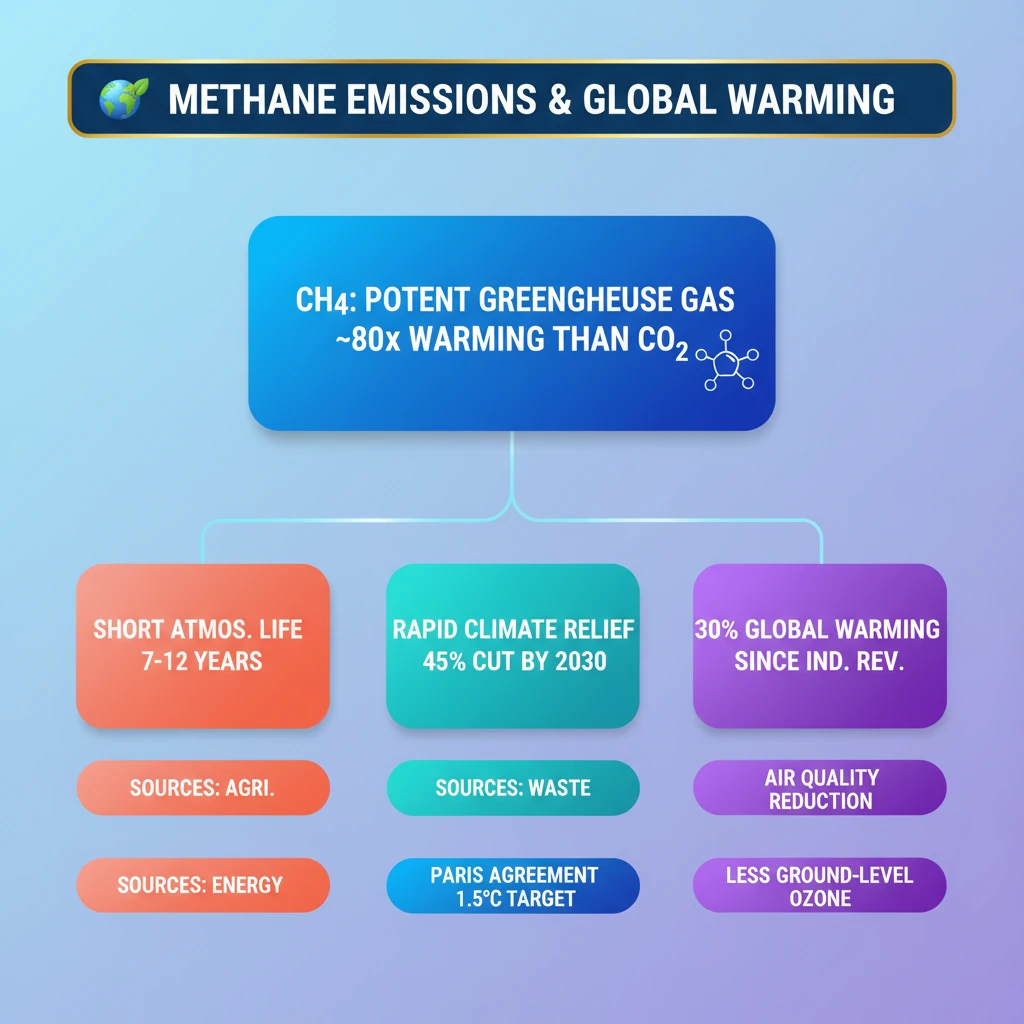
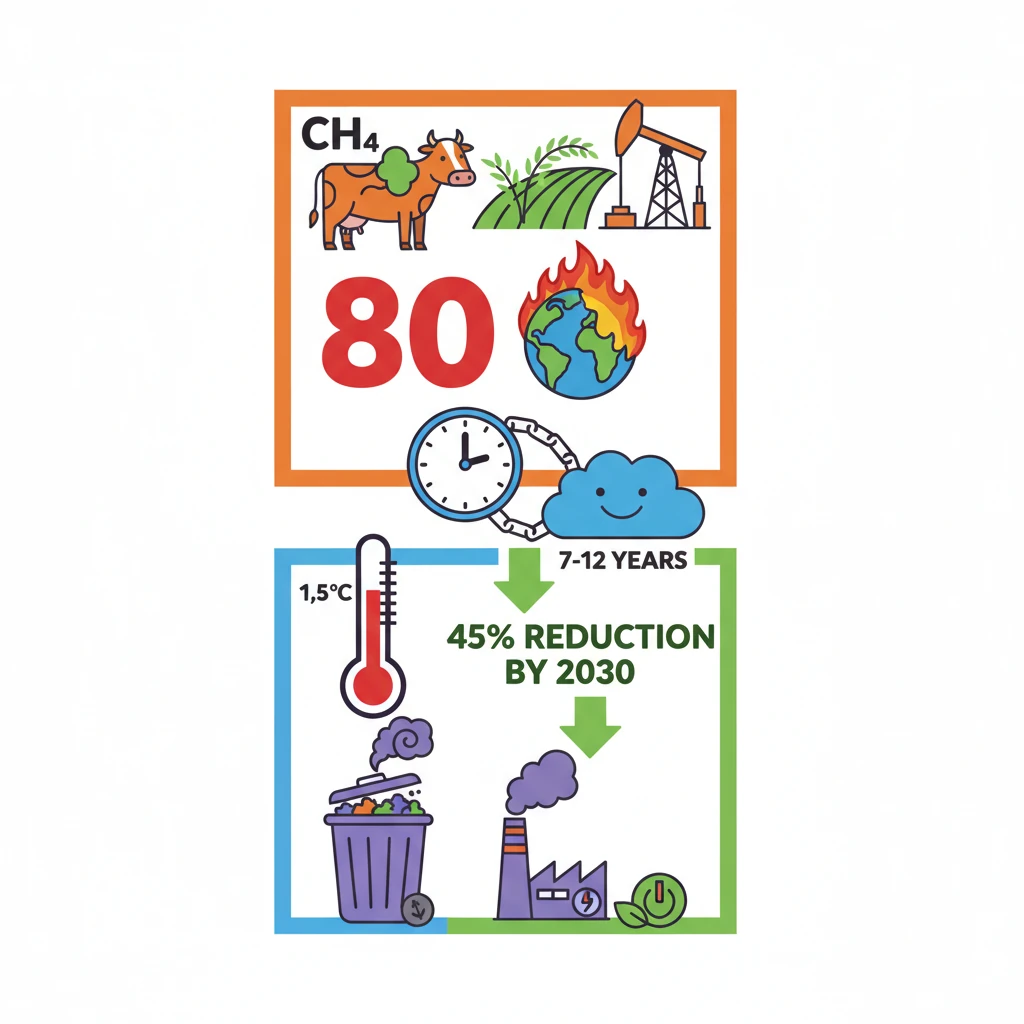
- •Methane (CH4) is a potent greenhouse gas, ~80 times more powerful than CO2 over 20 years, contributing 30% to global warming since the Industrial Revolution.
- •It has a short atmospheric lifespan (7-12 years), making its reduction a rapid and effective climate mitigation strategy.
- •Reducing methane by 45% by 2030 is crucial for achieving the Paris Agreement's 1.5°C target.
- •Major anthropogenic sources are agriculture (livestock, rice), energy (oil, gas, coal), and waste (landfills).
- •Methane abatement also improves air quality by reducing ground-level ozone.
- •Global initiatives like the Global Methane Pledge, UNEP's IMEO, and IEA's Methane Tracker aim to reduce emissions, though India has not signed the GMP.
🧠 Memory Techniques
95% Verified Content
📚 Reference Sources
•Paris Agreement
•UN Environment Programme (UNEP)
•International Energy Agency (IEA)
•Intergovernmental Panel on Climate Change (IPCC)
•Climate and Clean Air Coalition (CCAC)