India’s Geographical Indication Landscape - Economy | UPSC Learning
Topics
0 topics • 0 completed
🔍
No topics match your search
India’s Geographical Indication Landscape
Medium⏱️ 7 min read
economy
📖 Introduction
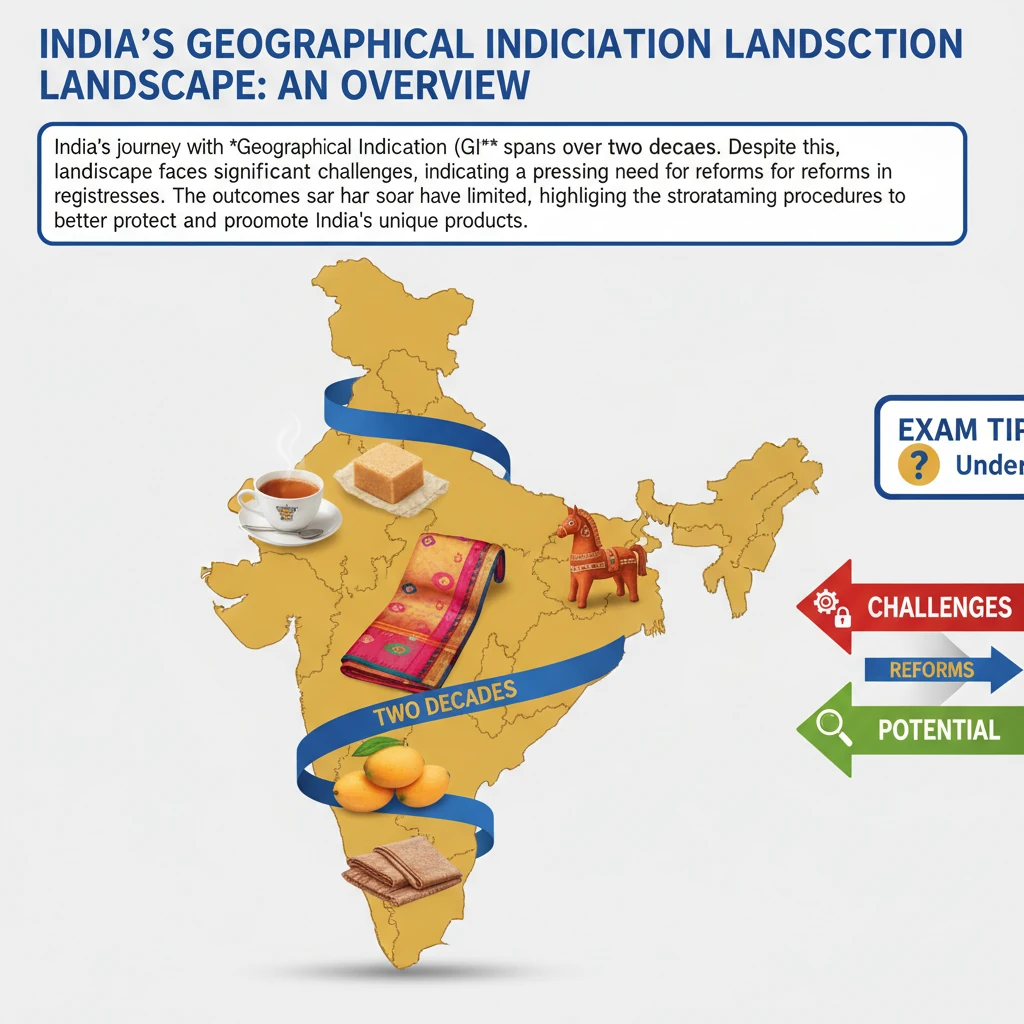
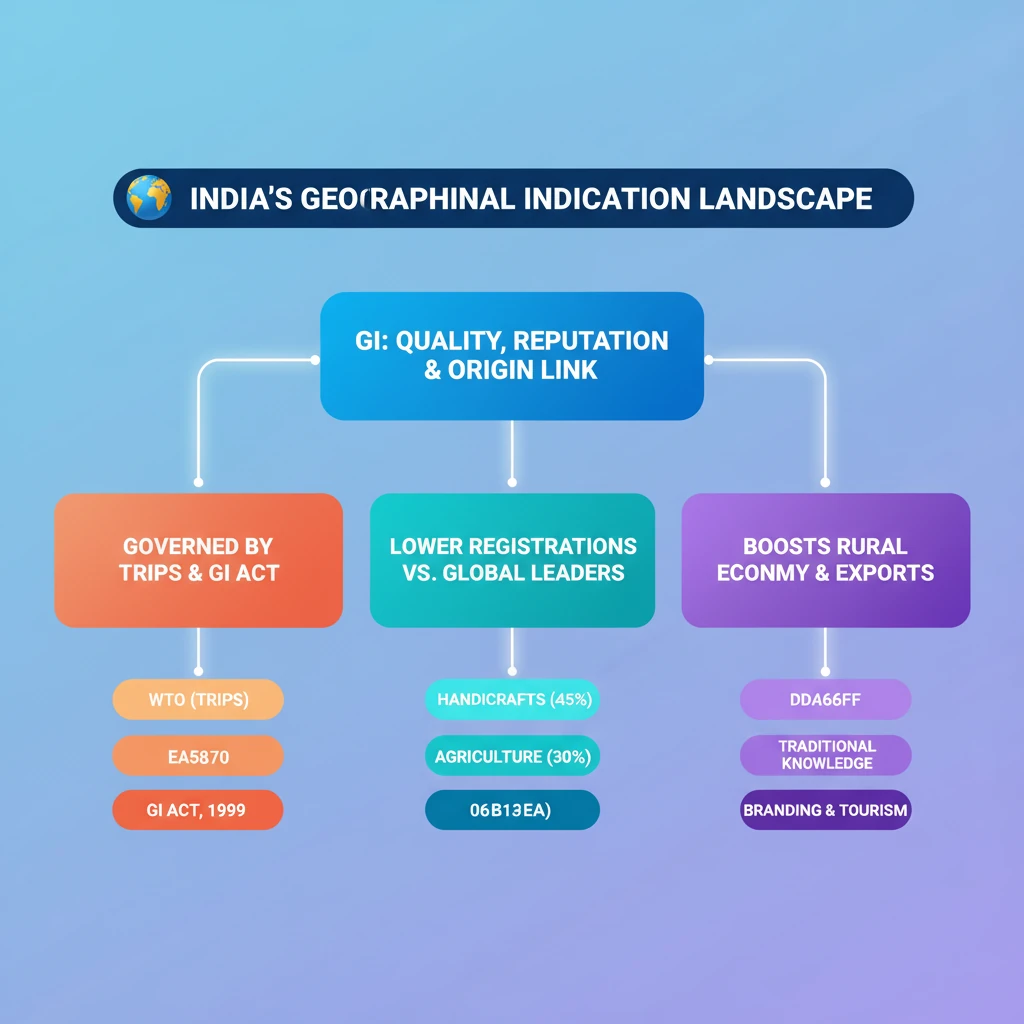
<h4>India's Geographical Indication Landscape: An Overview</h4><p>India's journey with <strong>Geographical Indication (GI)</strong> tags spans over <strong>two decades</strong>. Despite this, the landscape faces significant challenges, indicating a pressing need for reforms in the registration processes.</p><p>The outcomes so far have been limited, highlighting the importance of streamlining procedures to better protect and promote India's unique products.</p><div class='exam-tip-box'><p>Understanding the <strong>challenges and reforms</strong> in India's GI system is crucial for <strong>UPSC Mains GS-III (Economy)</strong>, especially topics related to <strong>Intellectual Property Rights</strong> and <strong>economic development</strong>.</p></div><h4>What is a Geographical Indication (GI)?</h4><div class='info-box'><p>A <strong>Geographical Indication (GI)</strong> is a designation applied to products that originate from a <strong>specific geographical area</strong>. It signifies that the qualities, characteristics, or reputation of these products are inherently linked to that particular origin.</p></div><p>The concept extends beyond agricultural goods. It also covers <strong>non-agricultural products</strong> such as handicrafts, which are unique due to human skills, specific materials, and resources available in certain areas.</p><div class='info-box'><p><strong>TRIPS Agreement Definition:</strong> <strong>Article 22 (1)</strong> of the <strong>Trade-Related Aspects of Intellectual Property Rights (TRIPS)</strong> defines GIs as “indications which identify a good as originating in the territory of a member, or a region or locality in that territory.”</p></div><h4>Legal Framework Governing GIs</h4><p>The protection of Geographical Indications is rooted in both international agreements and national legislation, providing a robust framework for safeguarding unique products.</p><ul><li><strong>International Framework:</strong><ul><li><strong>TRIPS Agreement (WTO):</strong> GIs are governed under the <strong>Agreement on TRIPS</strong> at the <strong>World Trade Organization (WTO)</strong>, making it a multilateral agreement for IPR protection.</li><li><strong>Paris Convention:</strong> The <strong>Paris Convention for the Protection of Industrial Property</strong> (1883) also emphasizes protecting <strong>industrial property</strong> and <strong>geographical indications</strong> in its <strong>Articles 1(2) and 10</strong>.</li></ul></li><li><strong>National Framework (India):</strong><ul><li><strong>Geographical Indications of Goods (Registration and Protection) Act, 1999:</strong> This Indian Act provides for the <strong>registration and better protection</strong> of geographical indications relating to goods within India.</li></ul></li></ul><h4>Status of GI Tag Registrations in India</h4><p>Despite the legal framework, India's progress in GI registration lags significantly when compared to other nations globally.</p><div class='info-box'><p><strong>Registration Data (as of December 2023):</strong> Intellectual Property India received <strong>1,167 applications</strong>, out of which only <strong>547 products</strong> have been successfully registered.</p></div><p>This indicates a relatively low success rate and volume compared to global leaders in GI registrations.</p><div class='key-point-box'><p><strong>Global Comparison (2020 WIPO data):</strong><ul><li><strong>Germany:</strong> Leads with <strong>15,566</strong> registered products.</li><li><strong>China:</strong> Follows with <strong>7,247</strong> registered products.</li></ul>India's numbers are considerably lower, suggesting a need for accelerated efforts.</p></div><p>In India, the majority of registered GI products fall into two primary categories:</p><ul><li><strong>Handicrafts:</strong> Comprise approximately <strong>45%</strong> of all GI products.</li><li><strong>Agriculture:</strong> Account for about <strong>30%</strong> of the total GI products.</li></ul>
💡 Key Takeaways
- •Geographical Indication (GI) links product quality/reputation to its specific geographical origin.
- •India's GI protection is governed by the TRIPS Agreement (WTO) and the national GI Act, 1999.
- •India's GI registration numbers are significantly lower than global leaders like Germany and China.
- •Handicrafts (45%) and Agriculture (30%) constitute the majority of India's GI products.
- •GIs are crucial for rural economic development, preserving traditional knowledge, and boosting exports.
- •Challenges in India's GI landscape include limited outcomes and a need for registration process reforms.
🧠 Memory Techniques

95% Verified Content
📚 Reference Sources
•World Intellectual Property Organization (WIPO) data (for global comparison)
•Intellectual Property India (for national registration data)