Reasons for Revising the Base Year - Economy | UPSC Learning
Topics
0 topics • 0 completed
🔍
No topics match your search
Reasons for Revising the Base Year
Medium⏱️ 7 min read
economy
📖 Introduction
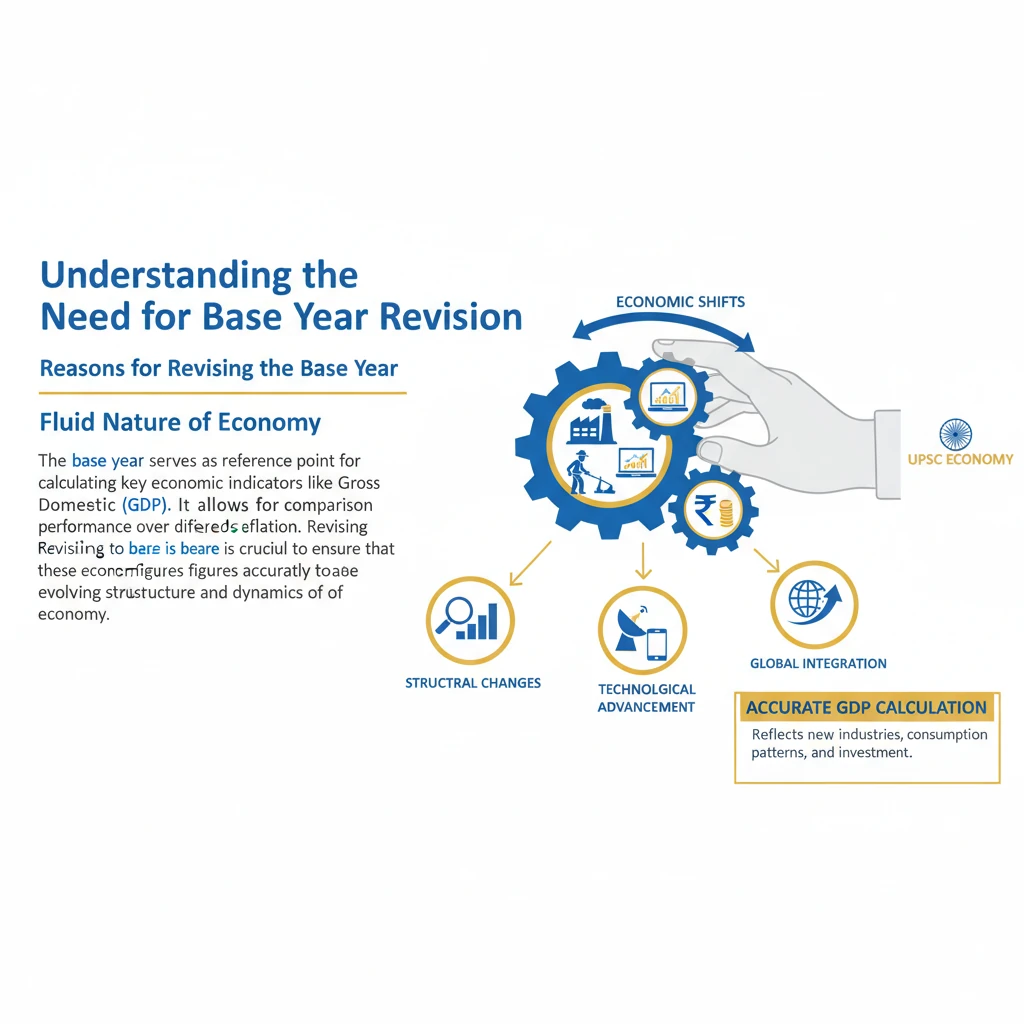
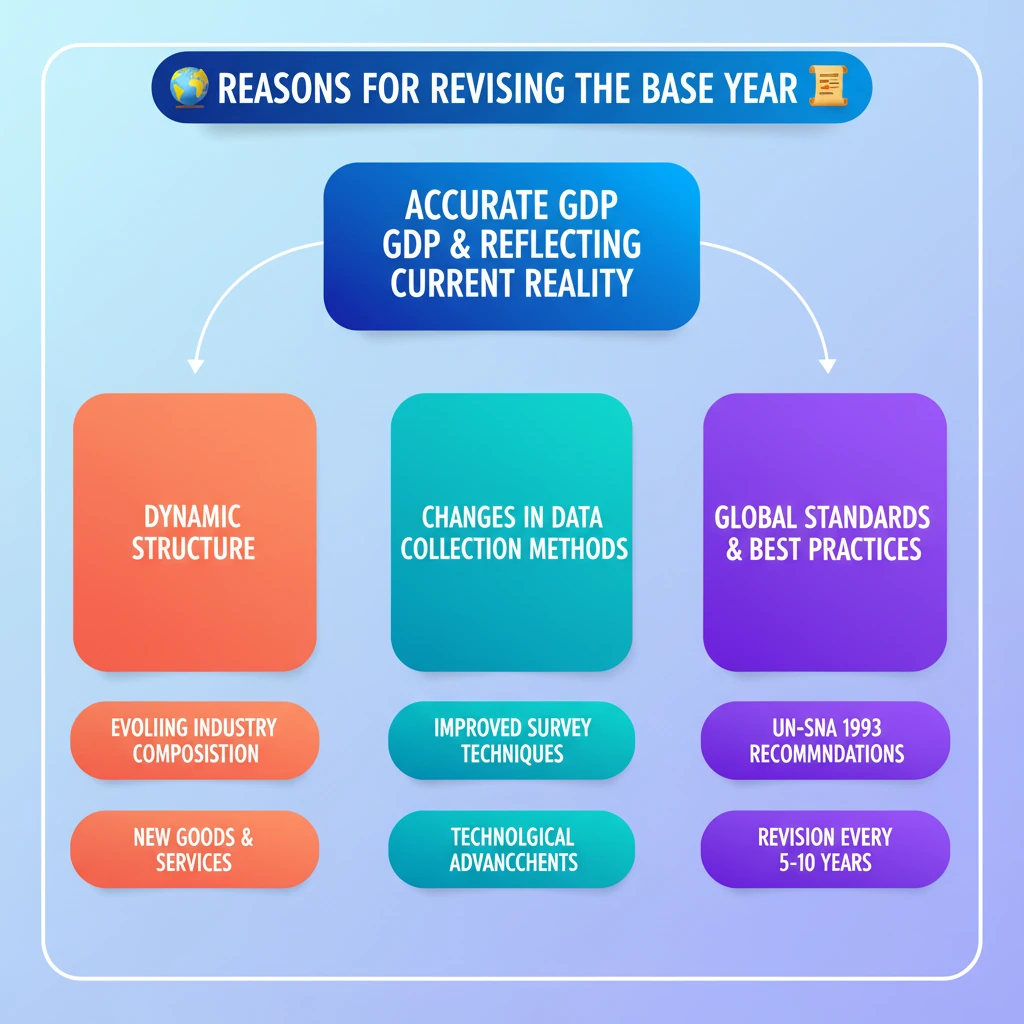
<h4>Understanding the Need for Base Year Revision</h4><p>The <strong>base year</strong> serves as a reference point for calculating key economic indicators like <strong>Gross Domestic Product (GDP)</strong>. It allows for the comparison of economic performance over different periods, adjusting for inflation.</p><p>Revising the <strong>base year</strong> is crucial to ensure that these economic figures accurately represent the evolving structure and dynamics of an economy.</p><h4>Fluid Nature of Economic Indicators</h4><p>The <strong>indicators</strong> used for computing <strong>GDP</strong> are inherently dynamic. They constantly change due to shifts in various economic factors.</p><p>These shifts include changes in <strong>consumer behaviour</strong>, the overall <strong>economic structure</strong>, and the <strong>composition of commodities</strong> produced and consumed within the economy.</p><p>Furthermore, <strong>data compilation methods</strong> evolve over time. This necessitates the incorporation of new <strong>classification systems</strong> and updated <strong>data sources</strong> to maintain accuracy.</p><div class='key-point-box'><p><strong>Key Point:</strong> Regular revisions ensure that the reported <strong>GDP figures</strong> truly reflect the <strong>current economic reality</strong> and are not skewed by outdated parameters.</p></div><h4>Impact on Broader Economic Indicators</h4><p>When new <strong>data sets</strong> are incorporated through <strong>base year revisions</strong>, it can lead to significant adjustments in overall <strong>GDP levels</strong>. This is a direct consequence of updated methodologies and data.</p><p>These changes have a profound <strong>ripple effect</strong> across a wide array of other crucial <strong>economic indicators</strong>. This includes trends in <strong>public expenditure</strong>, patterns of <strong>taxation</strong>, and the overall level of <strong>public sector debt</strong>.</p><h4>International Standard Practice</h4><div class='info-box'><p>The <strong>United Nations-System of National Accounts 1993 (UN-SNA 1993)</strong>, an internationally recognized framework, mandates countries to revise their computation practices periodically. This ensures global consistency and comparability of economic data.</p></div><h4>Recommended Frequency of Revisions</h4><p>Ideally, the <strong>base year</strong> for national accounts should be revised every <strong>5 to 10 years</strong>. This timeframe is considered optimal for keeping economic statistics relevant.</p><div class='key-point-box'><p><strong>Key Point:</strong> This regular revision schedule helps in aligning <strong>national accounts</strong> with the <strong>latest available data</strong> and reflecting structural changes promptly.</p></div><h4>History of Base Year Revisions in India</h4><p>India's journey with <strong>national income estimates</strong> began with their first publication in <strong>1956</strong>. At that time, the designated <strong>base year</strong> was <strong>FY 1949</strong>.</p><p>Since then, India has undertaken a total of <strong>seven revisions</strong> to its <strong>base year</strong>, demonstrating a commitment to updating its economic statistics.</p><div class='info-box'><p><strong>Recent Revision:</strong> The <strong>most recent revision</strong> saw the <strong>base year</strong> changed from <strong>FY 2005</strong> to <strong>FY 2012</strong>. This significant update aimed to capture recent structural changes in the Indian economy.</p></div>
💡 Key Takeaways
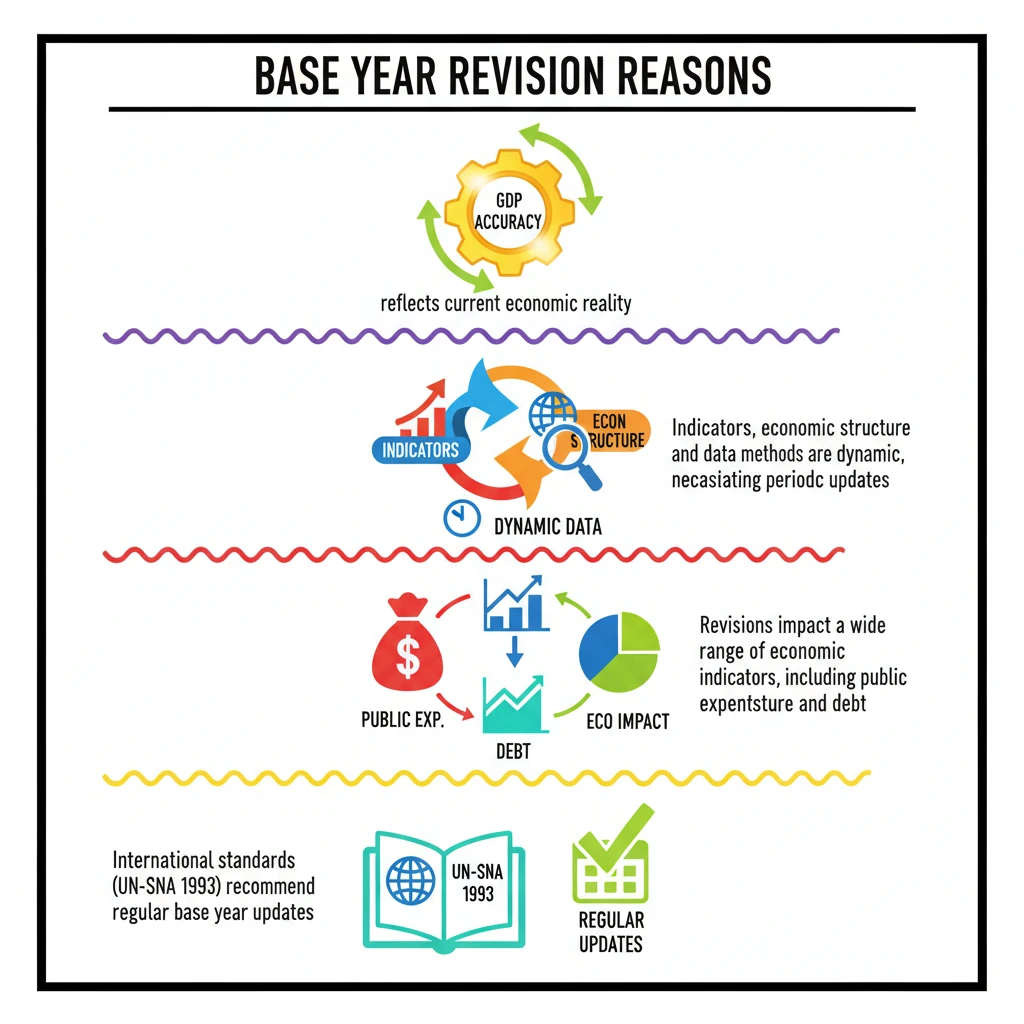
- •Base year revision is essential for accurate GDP calculation and reflects current economic reality.
- •Indicators, economic structure, and data methods are dynamic, necessitating periodic updates.
- •Revisions impact a wide range of economic indicators, including public expenditure and debt.
- •International standards (UN-SNA 1993) recommend regular base year updates.
- •Ideally, base years should be revised every 5-10 years to ensure data relevance.
- •India has revised its base year seven times, most recently from FY 2005 to FY 2012.
🧠 Memory Techniques
98% Verified Content
📚 Reference Sources
•Ministry of Statistics and Programme Implementation (MOSPI) publications on National Accounts Statistics
•United Nations System of National Accounts (UN-SNA) guidelines