Why Coal is Important for India’s Energy Security? - Economy | UPSC Learning
Topics
0 topics • 0 completed
🔍
No topics match your search
Why Coal is Important for India’s Energy Security?
Medium⏱️ 7 min read
economy
📖 Introduction
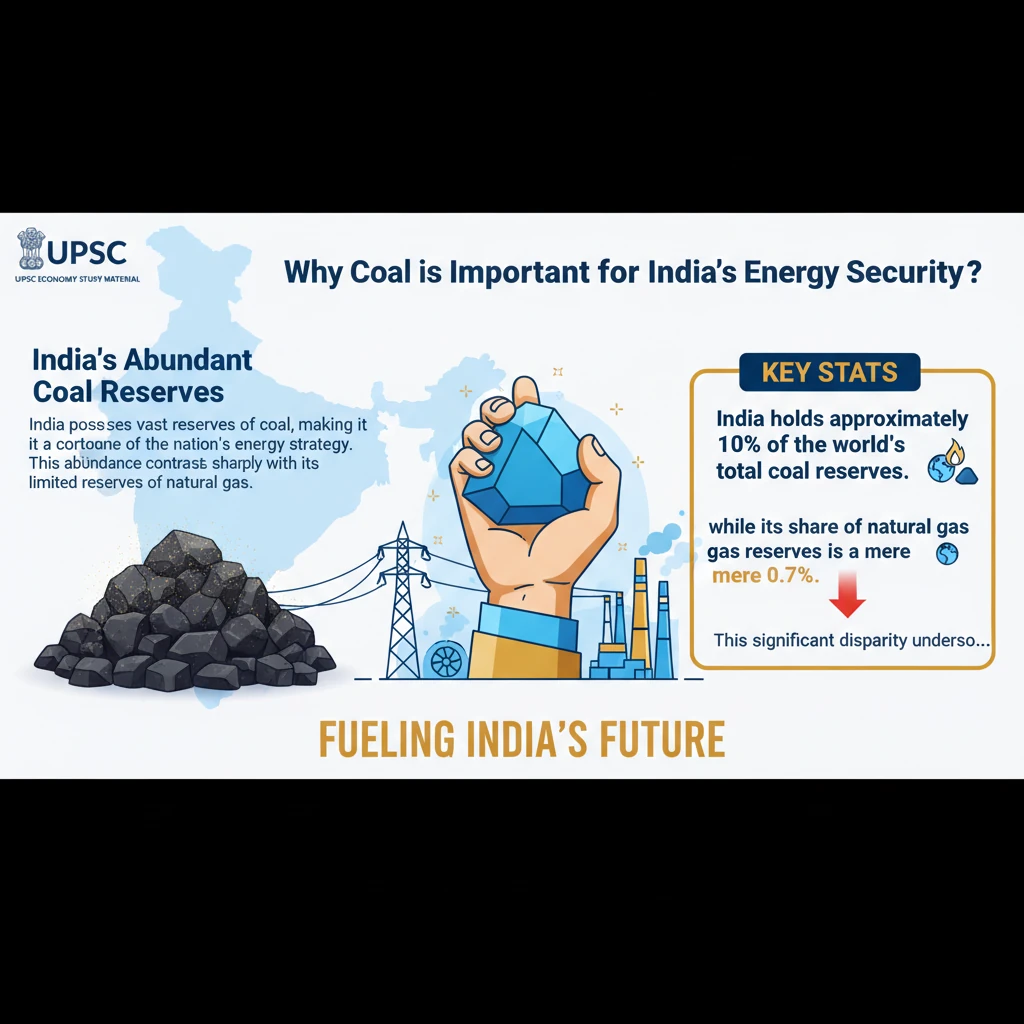
<h4>India's Abundant Coal Reserves</h4><p>India possesses vast reserves of <strong>coal</strong>, making it a cornerstone of the nation's energy strategy. This abundance contrasts sharply with its limited reserves of <strong>natural gas</strong>.</p><div class='info-box'><p>India holds approximately <strong>10%</strong> of the world’s total <strong>coal reserves</strong>, while its share of <strong>natural gas reserves</strong> is a mere <strong>0.7%</strong>. This significant disparity underscores coal's foundational role.</p></div><div class='key-point-box'><p>The sheer scale of domestic <strong>coal reserves</strong> positions it as India's most <strong>reliable</strong> and <strong>affordable energy source</strong>, crucial for meeting the country's growing power demands.</p></div><h4>Economic Viability and Stranded Assets</h4><p>Substantial <strong>investments</strong> have been channeled into <strong>coal-based power plants</strong>, particularly since the <strong>2010s</strong>. These investments represent significant capital outlay in the energy infrastructure.</p><p>Premature decommissioning of these plants would result in <strong>stranded investments</strong>, leading to substantial economic losses and <strong>underutilised assets</strong>. This presents a major economic dilemma for policymakers.</p><h4>Challenges in Climate Financing</h4><p>International commitments for <strong>climate finance</strong> often fall short of the actual requirements for developing nations like India to transition away from fossil fuels.</p><div class='info-box'><p>At <strong>UNFCCC COP 28</strong> in <strong>Baku, Azerbaijan</strong>, developed countries pledged only <strong>USD 300 billion</strong> in annual <strong>climate finance</strong>, significantly less than the estimated <strong>USD 1 trillion</strong> needed globally.</p></div><p>This shortfall may compel India to maintain its reliance on <strong>coal</strong> and potentially necessitate adjustments to its ambitious <strong>climate targets</strong>, balancing economic development with environmental goals.</p><h4>Limitations of Renewable Energy Sources</h4><p>While India is rapidly expanding its <strong>renewable energy</strong> capacity, sources like <strong>solar</strong> and <strong>wind</strong> power face several inherent challenges that hinder their complete dominance.</p><ul><li><strong>High investments</strong> are required for robust <strong>grid integration</strong> to handle variable power generation.</li><li>Significant challenges persist with <strong>battery storage</strong> solutions needed to manage the <strong>intermittency</strong> of renewable power.</li><li>There is <strong>limited land availability</strong> in densely populated regions for large-scale renewable installations.</li><li>India lacks abundance in many of the <strong>critical minerals</strong> essential for manufacturing advanced renewable technologies.</li></ul><h4>Geopolitical Risks and Energy Independence</h4><p>Many advanced <strong>renewable energy technologies</strong> and their components rely heavily on <strong>imported materials</strong> and specialized expertise from other nations.</p><p>This dependence increases India’s <strong>vulnerability</strong> to <strong>external geopolitical risks</strong>, supply chain disruptions, and price volatility, potentially compromising its <strong>energy independence</strong>.</p><div class='key-point-box'><p>Continued utilization of domestic <strong>coal reserves</strong> strengthens India's <strong>energy independence</strong>, reducing reliance on foreign imports and bolstering <strong>national security</strong> in the energy sector.</p></div><h4>Historical Energy Transitions: A Global Perspective</h4><p>A review of historical energy transitions in <strong>developed nations</strong> reveals a crucial insight. These transitions were primarily driven by evolving <strong>commercial interests</strong> and technological advancements.</p><div class='exam-tip-box'><p>Unlike current global efforts, past transitions were not solely motivated by a desire to limit <strong>emissions</strong>. This historical context offers a pragmatic lens through which to view India's own energy transition challenges for <strong>UPSC Mains GS-III</strong> answers.</p></div>
💡 Key Takeaways
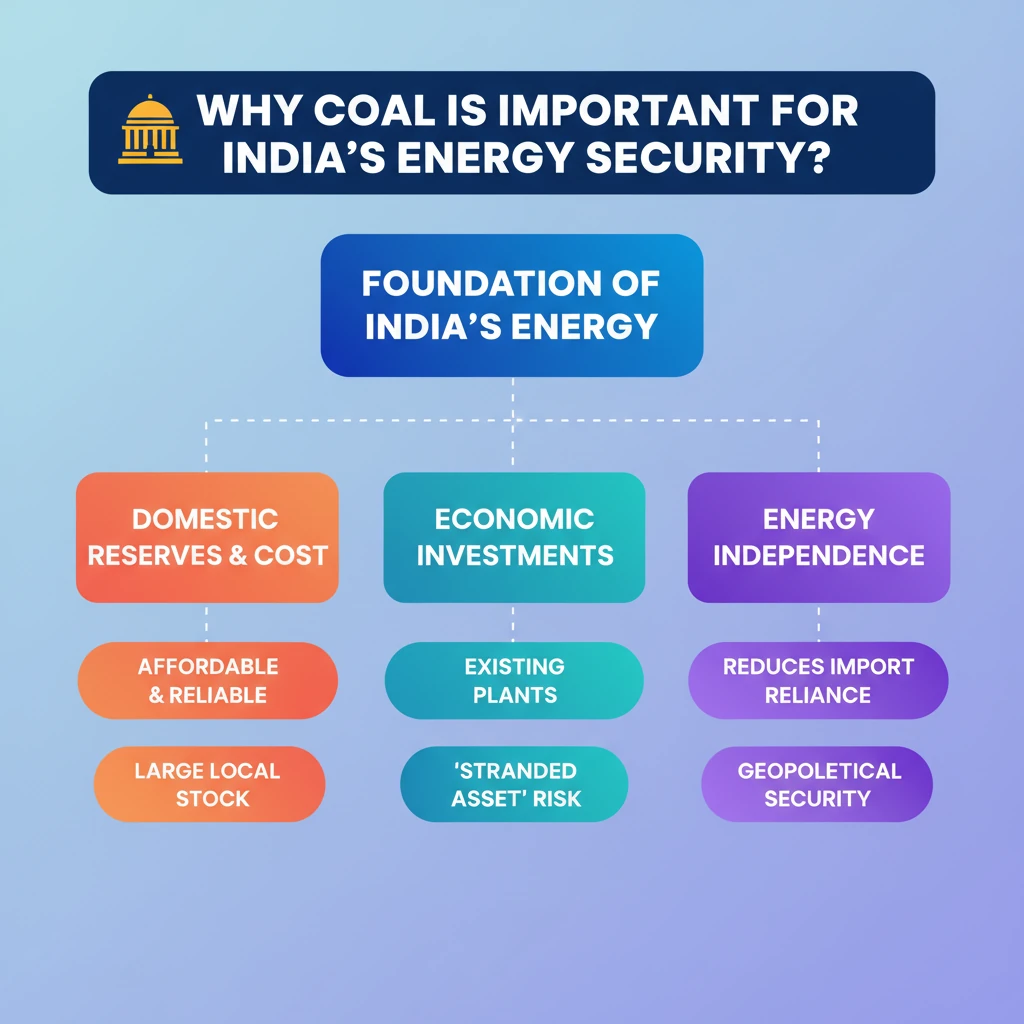
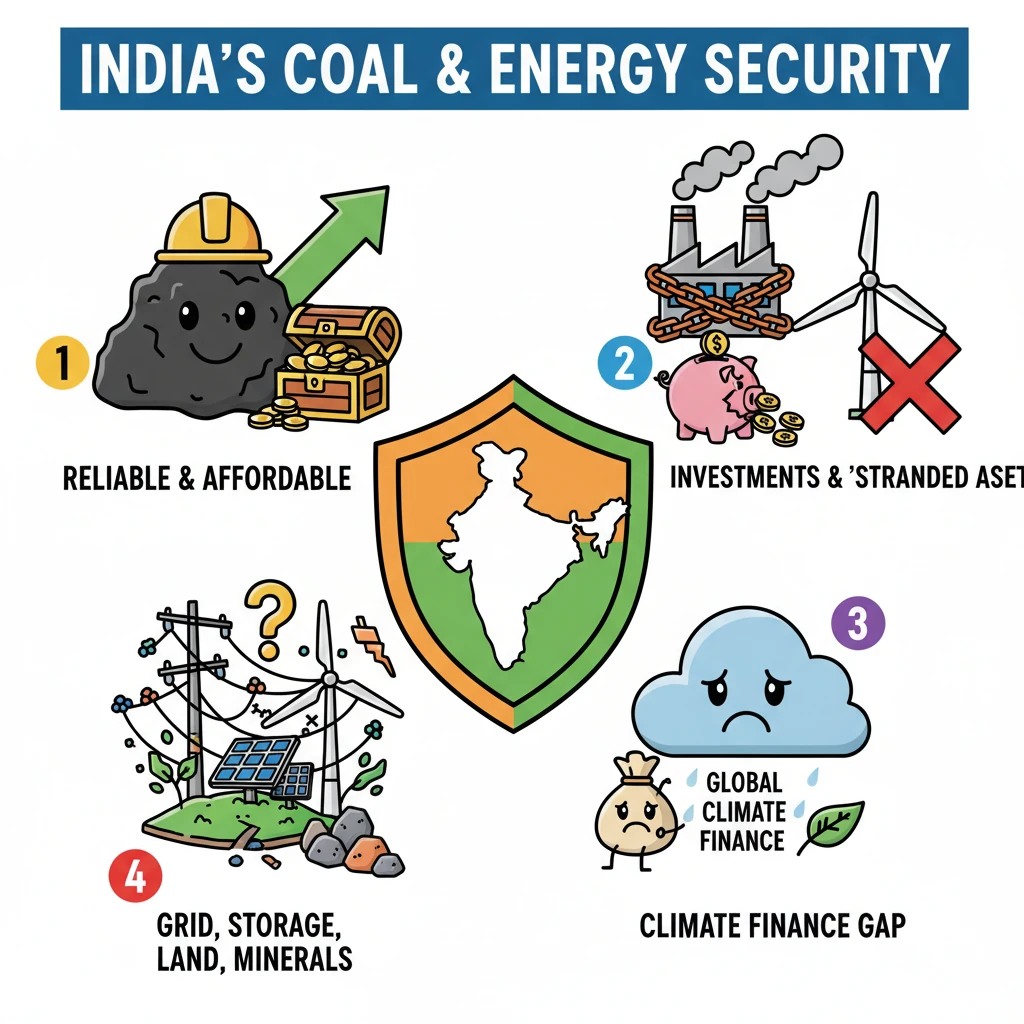
- •India's large domestic coal reserves make it the most reliable and affordable energy source.
- •Significant past investments in coal plants create economic viability and 'stranded asset' concerns.
- •Insufficient global climate finance hinders India's rapid transition away from coal.
- •Renewable energy faces challenges like grid integration, storage, land availability, and critical mineral dependence.
- •Reliance on imported renewable technologies increases geopolitical vulnerabilities, while coal supports energy independence.
- •Historical energy transitions in developed nations were commercially driven, offering a pragmatic lesson for India.
🧠 Memory Techniques
95% Verified Content
📚 Reference Sources
•NITI Aayog Energy Statistics
•International Energy Agency (IEA) Reports on India
•UNFCCC COP 28 Outcome Documents and Reports
•Economic Survey of India (various editions)