The 2023 amendment to the Offshore Areas Mineral (Development and Regulation) Act (OAMDR), 2002 - Economy | UPSC Learning
Topics
0 topics • 0 completed
🔍
No topics match your search

The 2023 amendment to the Offshore Areas Mineral (Development and Regulation) Act (OAMDR), 2002
Medium⏱️ 6 min read
economy
📖 Introduction
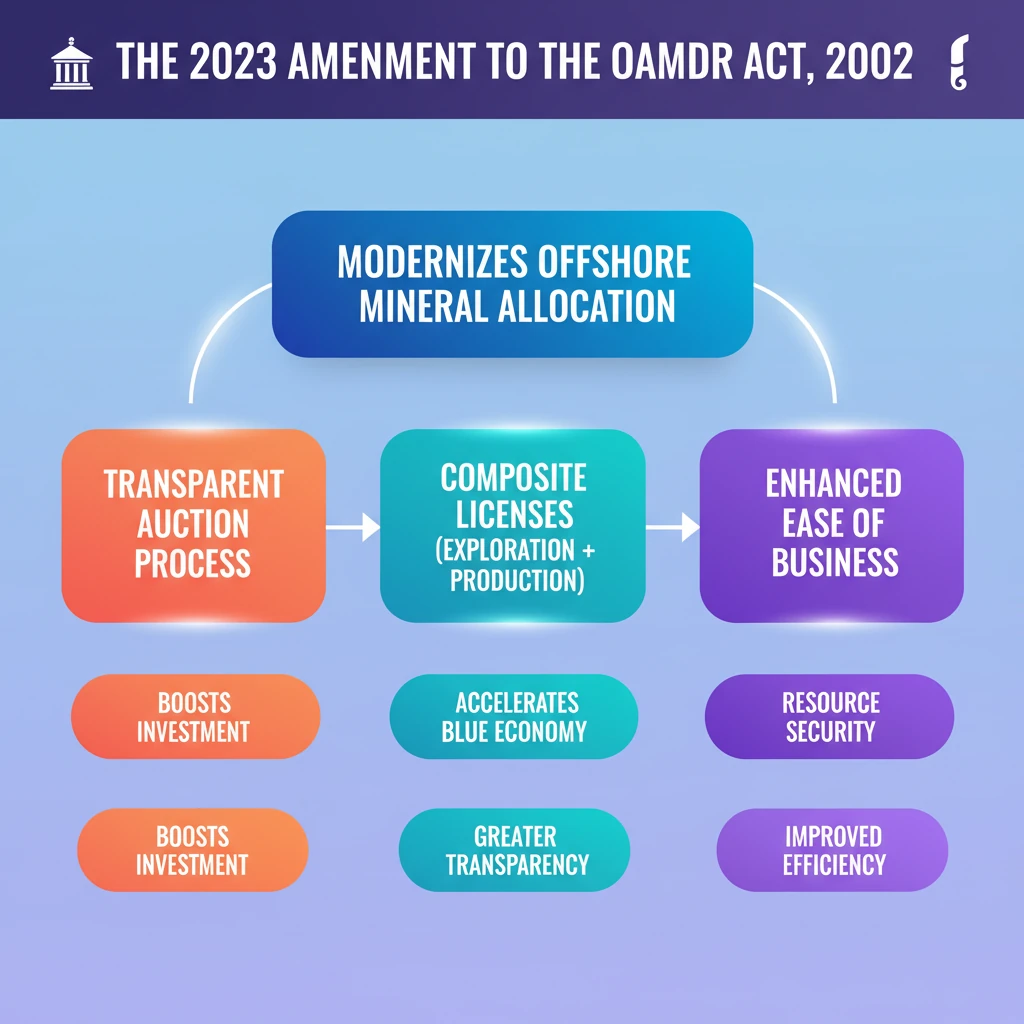
<h4>Introduction to the OAMDR Amendment, 2023</h4><p>The <strong>Offshore Areas Mineral (Development and Regulation) Act (OAMDR), 2002</strong>, has undergone a significant revision with the <strong>2023 amendment</strong>. This legislative change aims to modernize and streamline the process of allocating <strong>offshore mineral rights</strong> in India's exclusive economic zone and continental shelf.</p><div class='key-point-box'><p>The core objective of the <strong>2023 amendment</strong> is to foster greater transparency and efficiency in the <strong>offshore mining sector</strong>, attracting more investment and ensuring sustainable resource utilization.</p></div><h4>Transparent Auction Process</h4><p>A pivotal feature of the <strong>2023 amendment</strong> is the introduction of a <strong>transparent auction process</strong> for granting <strong>offshore mineral rights</strong>. This moves away from previous discretionary allocation methods, promoting fairness and competition.</p><p>The new system ensures that all eligible entities have an equal opportunity to bid for <strong>mineral blocks</strong>, thereby maximizing revenue for the government and minimizing scope for arbitrary decisions.</p><div class='info-box'><p>The <strong>auction process</strong> is designed to be online and time-bound, ensuring a level playing field for both domestic and international bidders.</p></div><h4>Incorporation of Composite Licenses</h4><p>Another crucial aspect of the <strong>2023 amendment</strong> is the provision for <strong>composite licenses</strong>. These licenses combine the stages of <strong>exploration</strong> and <strong>production</strong> into a single grant.</p><p>Previously, separate licenses were required for <strong>exploration</strong> and subsequent <strong>production</strong>, which often led to delays and increased procedural complexities. The new integrated approach simplifies the regulatory framework.</p><div class='key-point-box'><p><strong>Composite licenses</strong> are expected to significantly reduce bureaucratic hurdles, accelerate project timelines, and enhance the overall ease of doing business in the <strong>offshore mining sector</strong>.</p></div><h4>Benefits of the Amendment</h4><p>The <strong>2023 amendment</strong> is anticipated to bring multiple benefits. It will likely boost investment in <strong>offshore mineral exploration and production</strong>, contributing to India's resource security.</p><p>Enhanced transparency through auctions will also improve governance and reduce potential for corruption. The simplified licensing regime makes India a more attractive destination for global mining companies.</p><div class='exam-tip-box'><p>For UPSC Mains, understand how this amendment aligns with India's broader economic reforms, 'Ease of Doing Business' initiatives, and resource management strategies. Relate it to <strong>GS Paper III: Economy</strong> and <strong>Environment</strong>.</p></div>
💡 Key Takeaways
- •The 2023 amendment to the OAMDR Act, 2002, modernizes offshore mineral allocation.
- •It introduces a transparent auction process for offshore mineral rights.
- •The amendment incorporates composite licenses, combining exploration and production.
- •Aims to enhance transparency, efficiency, and ease of doing business in offshore mining.
- •Expected to boost investment, accelerate project timelines, and contribute to India's Blue Economy and resource security.
🧠 Memory Techniques
95% Verified Content
📚 Reference Sources
•The Offshore Areas Mineral (Development and Regulation) Amendment Act, 2023 (Official Gazette)
•Press Information Bureau (PIB) releases on the amendment