Chennai-Vladivostok Maritime Corridor - Economy | UPSC Learning
Topics
0 topics • 0 completed
🔍
No topics match your search
Chennai-Vladivostok Maritime Corridor
Medium⏱️ 8 min read
economy
📖 Introduction
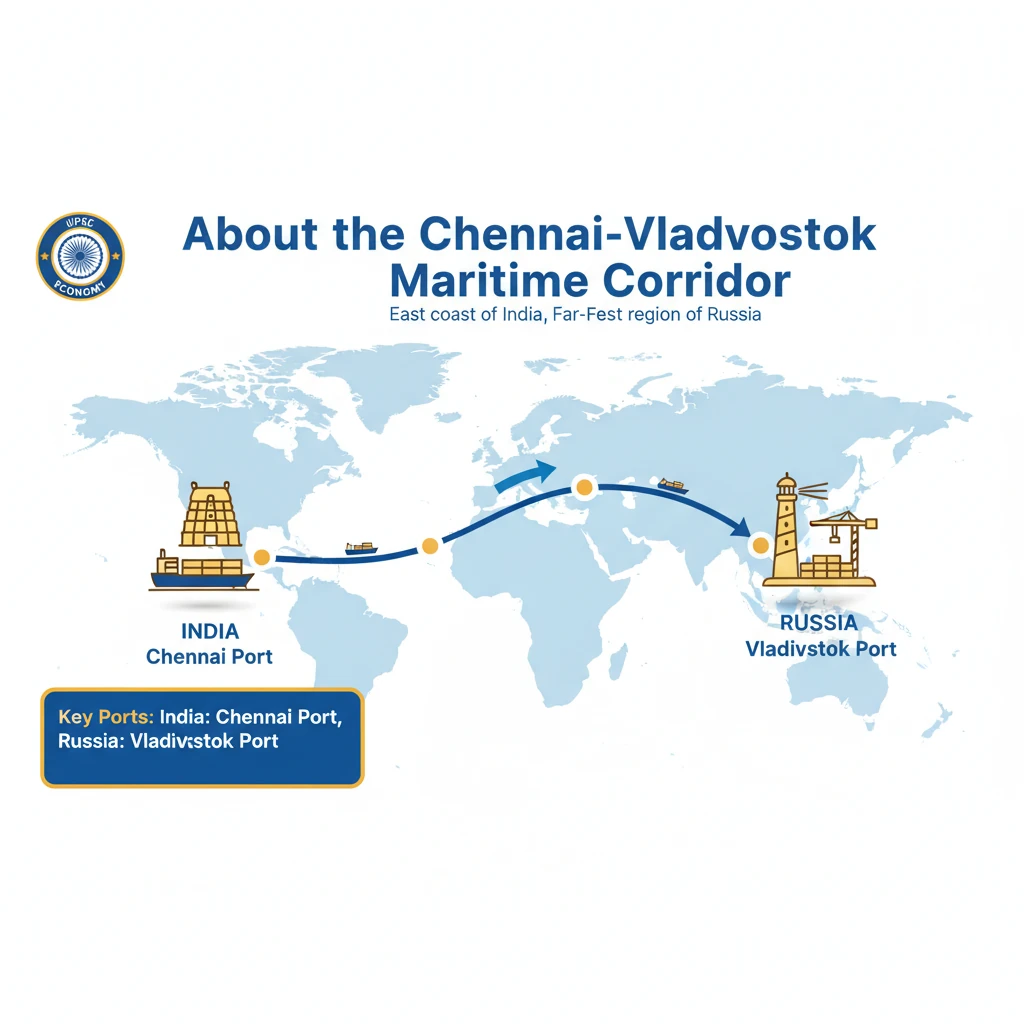
<h4>About the Chennai-Vladivostok Maritime Corridor</h4><p>The <strong>Chennai-Vladivostok Maritime Corridor</strong> is a crucial sea link. It connects the <strong>east coast of India</strong> with ports in the <strong>Far-East region of Russia</strong>. Specifically, it links the <strong>Chennai Port</strong> in India with the <strong>Vladivostok Port</strong> in Russia.</p><div class='info-box'><p><strong>Key Ports:</strong></p><ul><li><strong>India:</strong> Chennai Port</li><li><strong>Russia:</strong> Vladivostok Port</li></ul></div><h4>Distance and Time Reduction</h4><p>This new maritime route significantly reduces both the distance and time required for transport. The previous route, often via Europe, was much longer and more time-consuming.</p><div class='info-box'><p><strong>Route Efficiency:</strong></p><ul><li><strong>Distance Reduced:</strong> From <strong>8,675 nautical miles</strong> (via Europe) to approximately <strong>5,600 nautical miles</strong>.</li><li><strong>Time Reduced:</strong> From <strong>40 days</strong> to just <strong>24 days</strong>, a saving of up to <strong>16 days</strong>.</li></ul></div><h4>Strategic Importance of Vladivostok</h4><p><strong>Vladivostok</strong> holds immense strategic importance for Russia. It is the largest Russian port situated on the <strong>Pacific Coast</strong>, providing Russia with a vital gateway to the Asia-Pacific region.</p><p>Its geographical location further enhances its strategic value. <strong>Vladivostok</strong> is positioned approximately <strong>50 kilometers</strong> from the <strong>China-Russia border</strong>, making it a key logistical hub in the region.</p><h4>Trade Potential and Economic Opportunities</h4><p>A comprehensive feasibility study has highlighted significant potential for bilateral trade through this corridor. It aims to facilitate the exchange of various essential commodities between India and Russia.</p><div class='info-box'><p><strong>Potential Commodities for Trade:</strong></p><ul><li><strong>Coking coal</strong></li><li><strong>Oil</strong></li><li><strong>Fertilisers</strong></li><li><strong>Containers</strong></li><li><strong>Liquefied Natural Gas (LNG)</strong></li></ul></div><h4>Complementary Connectivity Initiatives</h4><p>The <strong>Chennai-Vladivostok Maritime Corridor</strong> is not an isolated initiative. It aligns strategically with other major connectivity projects aimed at enhancing trade and geopolitical influence.</p><p>This corridor complements the objectives of both the <strong>Northern Sea Route</strong> and the <strong>International North-South Transport Corridor (INSTC)</strong>, creating a multi-modal network for Eurasian connectivity.</p><div class='key-point-box'><p><strong>Overall Significance:</strong> The corridor enhances <strong>India's connectivity</strong> to Russia's Far East, diversifies trade routes, and strengthens strategic partnerships, particularly in energy and resources.</p></div>
💡 Key Takeaways
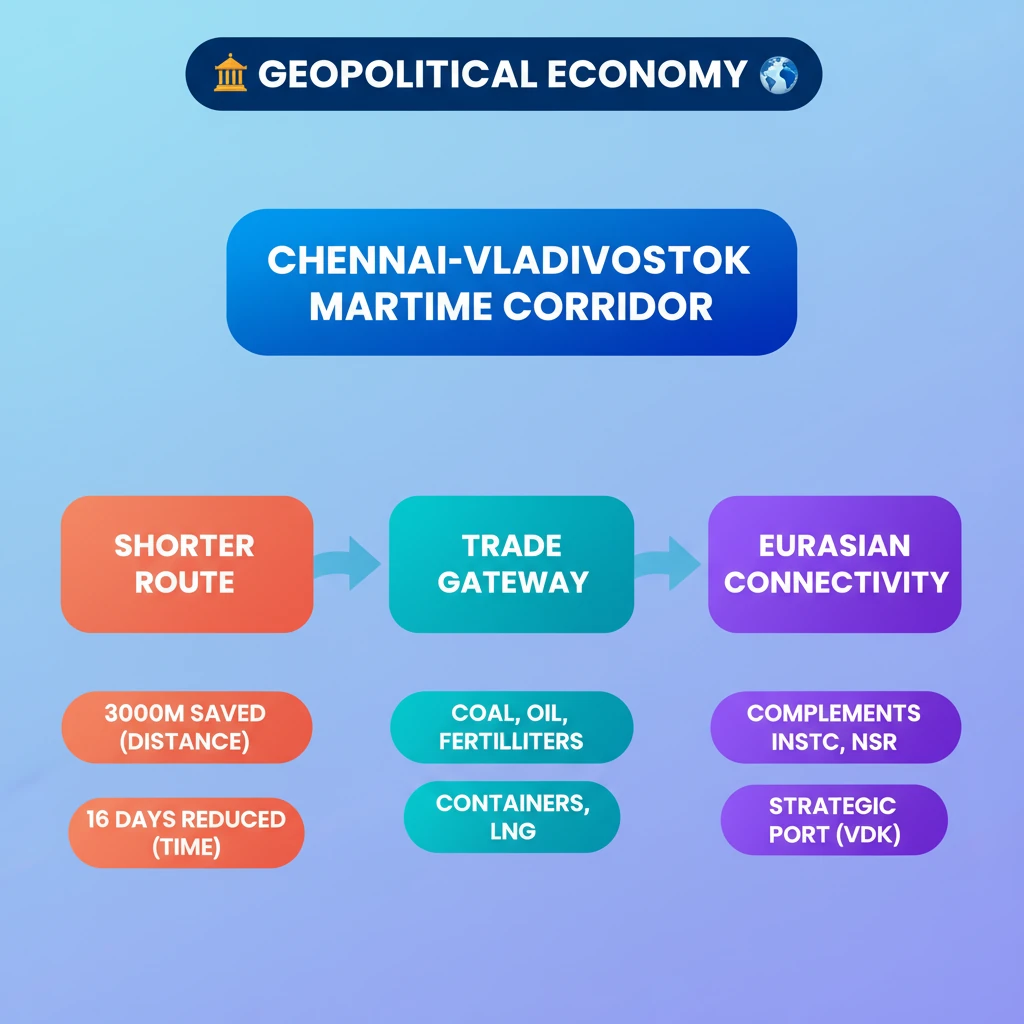
- •The Chennai-Vladivostok Maritime Corridor links India's east coast (Chennai) with Russia's Far East (Vladivostok).
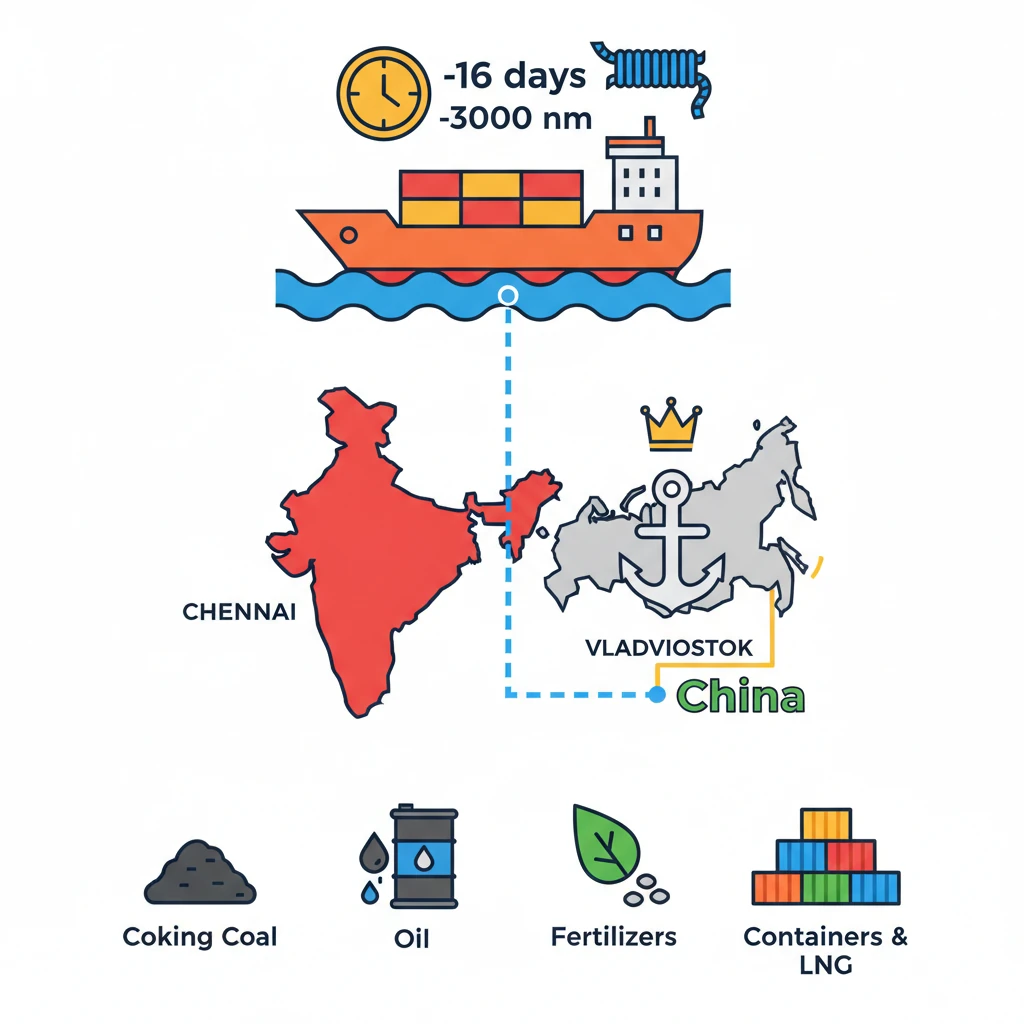
- •It significantly reduces transit distance (by ~3,000 nautical miles) and time (by ~16 days) compared to traditional routes.
- •Vladivostok is Russia's largest Pacific port, strategically located near the China-Russia border.
- •The corridor has high potential for trade in coking coal, oil, fertilisers, containers, and LNG.
- •It complements other major connectivity initiatives like the Northern Sea Route and INSTC, enhancing Eurasian connectivity.
🧠 Memory Techniques
95% Verified Content
📚 Reference Sources
•Ministry of External Affairs (MEA) official statements (hypothetical)
•Press Information Bureau (PIB) releases (hypothetical)
•Reports from maritime industry analysts (hypothetical)