What is the Open Market Sale Scheme (Domestic) Policy? - Economy | UPSC Learning
Topics
0 topics • 0 completed
🔍
No topics match your search
What is the Open Market Sale Scheme (Domestic) Policy?
Medium⏱️ 7 min read
economy
📖 Introduction
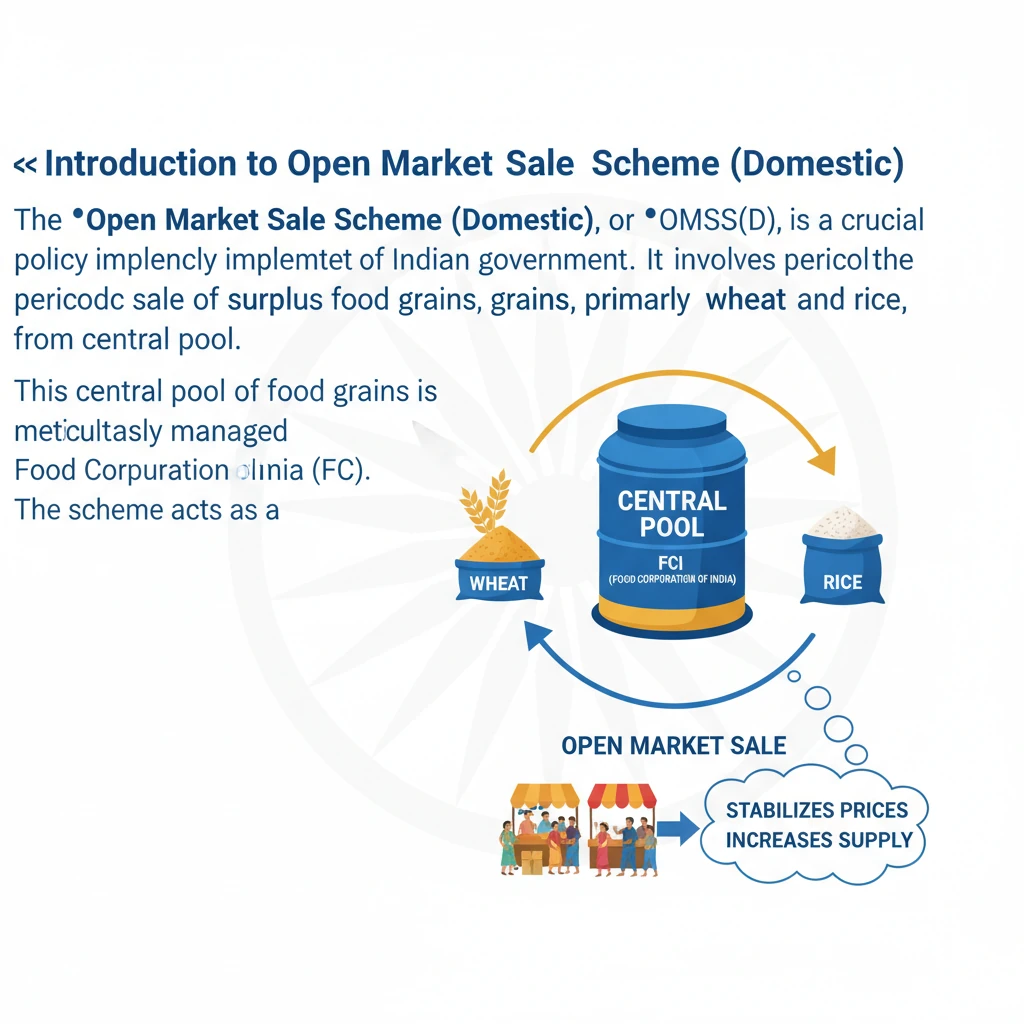
<h4>Introduction to Open Market Sale Scheme (Domestic)</h4><p>The <strong>Open Market Sale Scheme (Domestic)</strong>, or <strong>OMSS(D)</strong>, is a crucial policy implemented by the Indian government. It involves the periodic sale of <strong>surplus food grains</strong>, primarily <strong>wheat</strong> and <strong>rice</strong>, from the central pool.</p><p>This central pool of food grains is meticulously managed by the <strong>Food Corporation of India (FCI)</strong>. The scheme acts as a vital tool for market intervention.</p><div class='key-point-box'><p><strong>Key Objectives of OMSS(D):</strong><ul><li>To <strong>curb inflation</strong> by increasing market supply.</li><li>To <strong>stabilize food grain prices</strong>, ensuring affordability for consumers.</li><li>To meet the specific needs of the <strong>Targeted Public Distribution System (TPDS)</strong> and various <strong>Other Welfare Schemes</strong>.</li></ul></p></div><h4>Eligible Buyers and Procurement Process</h4><p>Under the OMSS(D), different types of buyers are eligible to procure food grains. The scheme distinguishes between buyers for wheat and rice.</p><div class='info-box'><p><strong>Eligible Buyers:</strong><ul><li><strong>Wheat:</strong> Primarily sold to <strong>Processors</strong>, <strong>Atta Chaklis</strong>, and <strong>Flour Millers</strong>. These entities convert wheat into flour for wider distribution.</li><li><strong>Rice:</strong> Typically sold to <strong>traders</strong>, who then distribute it further into the market.</li></ul></p></div><p>States also have the option to procure food grains through the OMSS(D). This procurement can be done <strong>beyond their National Food Security Act (NFSA), 2013 allocation</strong>. Importantly, states can do this <strong>without participating in the e-auctions</strong>, providing a direct channel for additional stock.</p><h4>Auction Process Details</h4><p>The primary method for bidders to procure food grains under OMSS(D) is through <strong>e-auctions</strong>. This ensures transparency and a competitive environment for sales.</p><div class='info-box'><p><strong>Auction Specifications:</strong><ul><li><strong>Wheat:</strong> Bidders can participate for a minimum quantity of <strong>10 metric tons (MT)</strong> and a maximum of <strong>100 MT</strong>.</li><li><strong>Rice:</strong> Bidders can participate for a minimum quantity of <strong>10 MT</strong> and a maximum of <strong>1000 MT</strong>.</li></ul></p></div><h4>Recent Revisions to OMSS(D)</h4><p>The Centre periodically revises the terms of the OMSS(D) to address evolving market conditions and policy objectives. A significant recent revision was made to the reserve price of rice.</p><div class='info-box'><p>The Centre reduced the reserve price of <strong>FCI rice</strong> under OMSS(D) by <strong>Rs 550</strong>. This brought the price down to <strong>Rs 2,250 per quintal</strong> for states and <strong>ethanol producers</strong>.</p></div><p>This revision aimed to achieve multiple goals: to <strong>boost sales</strong> of surplus rice, to <strong>support ethanol production</strong> (as rice can be used for ethanol), and to <strong>enhance overall food security</strong> by ensuring better availability and utilization of stocks.</p><h4>Role of Food Corporation of India (FCI)</h4><p>The <strong>Food Corporation of India (FCI)</strong> is the backbone of India's food security system and plays a central role in the OMSS(D).</p><div class='info-box'><p><strong>Establishment:</strong> The <strong>FCI</strong> is a <strong>statutory body</strong>. It was established under the <strong>Food Corporations Act, 1964</strong>, highlighting its legislative mandate and importance.</p></div><div class='key-point-box'><p><strong>Key Roles of FCI:</strong><ul><li><strong>National Food Security Act (NFSA):</strong> FCI is responsible for procuring grains to fulfill the requirements of the <strong>NFSA, 2013</strong>. It then distributes these grains at <strong>Central Issue Prices</strong> to economically vulnerable sections of society.</li><li><strong>Public Distribution System (PDS):</strong> FCI delivers food grains to State Governments and their agencies. These grains are then distributed through a network of <strong>Fair Price Shops</strong> across the country.</li><li><strong>Nutritional Security:</strong> Beyond basic food provision, FCI actively promotes <strong>nutritional security</strong>, for instance, through the distribution of <strong>fortified rice</strong>.</li><li><strong>Market Interventions:</strong> FCI plays a critical role in <strong>stabilizing food prices</strong> and <strong>mitigating inflation</strong>. This is achieved through strategic procurement and the implementation of schemes like the <strong>OMSS (Open Market Sale Scheme)</strong>.</li><li><strong>Farmer Welfare:</strong> FCI provides a crucial <strong>safety net for farmers</strong> by ensuring that they receive <strong>Minimum Support Prices (MSP)</strong> for their produce, thereby protecting them from market fluctuations.</li></ul></p></div><div class='exam-tip-box'><p><strong>UPSC Insight:</strong> Understanding the multifaceted role of <strong>FCI</strong>, especially its connection to <strong>NFSA</strong>, <strong>PDS</strong>, <strong>MSP</strong>, and <strong>OMSS</strong>, is vital for both Prelims and Mains. Questions often link these concepts to food security, agricultural policy, and inflation management.</p></div>
💡 Key Takeaways
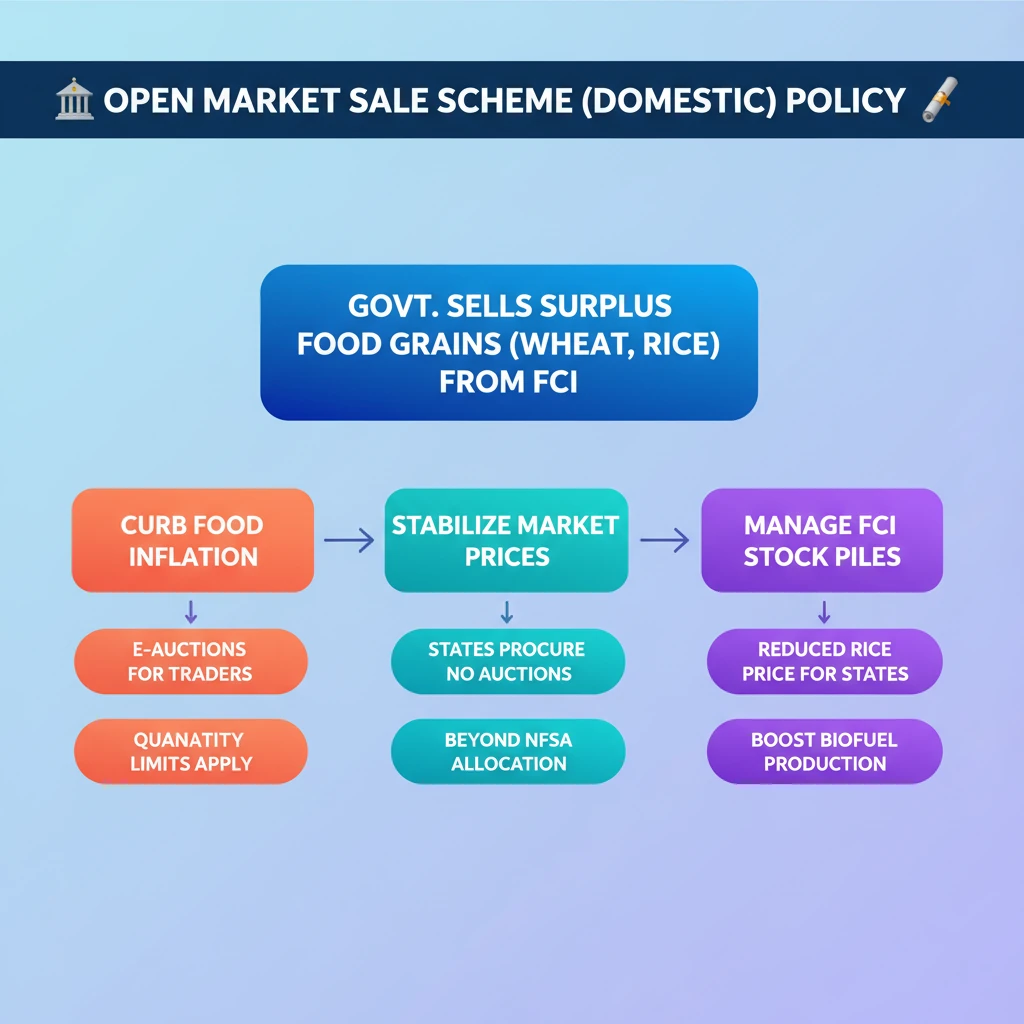
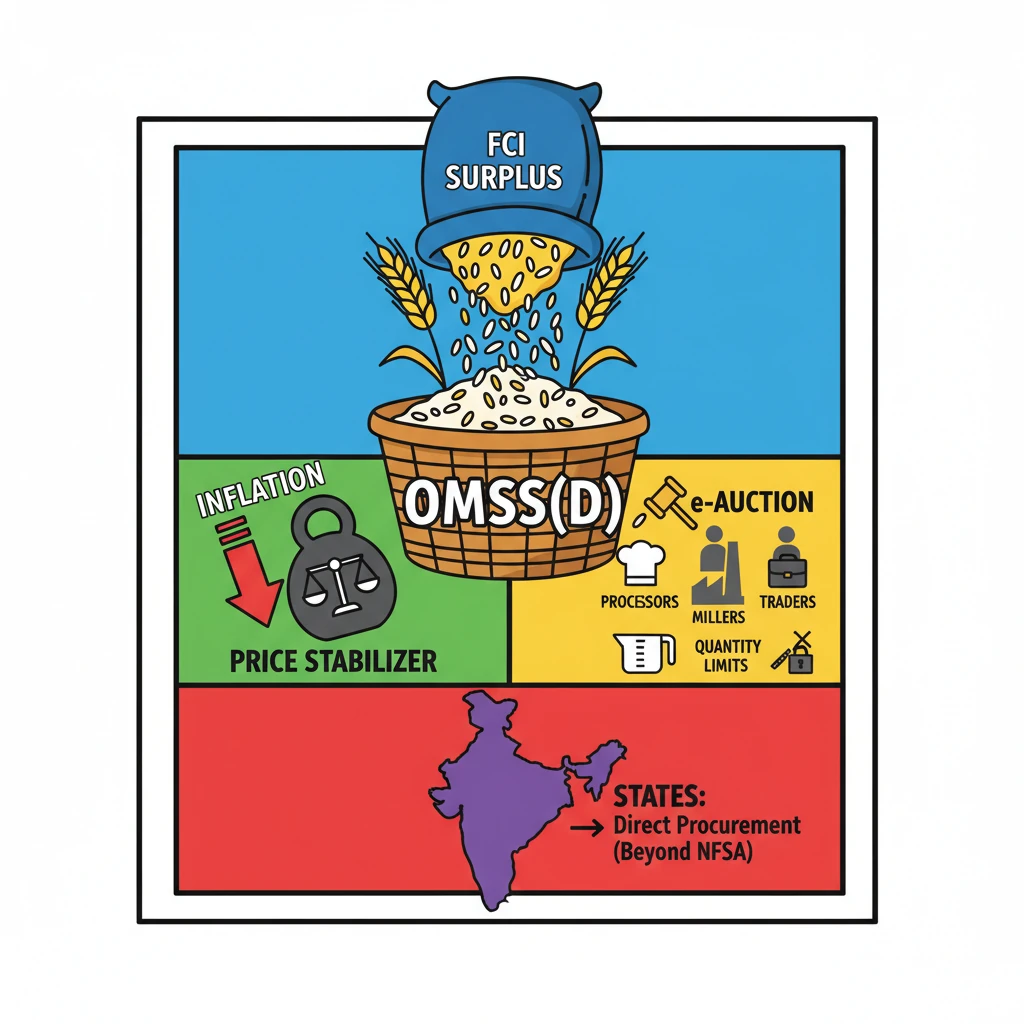
- •OMSS(D) is a government scheme for selling surplus food grains (wheat, rice) from FCI's central pool.
- •Its primary goals are to curb food inflation and stabilize market prices of essential food grains.
- •FCI conducts e-auctions for processors, millers, and traders, with specific quantity limits.
- •States can procure grains beyond NFSA allocation directly from OMSS without auctions.
- •Recent revisions include reduced rice prices for states and ethanol producers to boost sales and support biofuel production.
- •FCI, established in 1965, is crucial for NFSA, PDS, MSP operations, and market interventions like OMSS(D).
🧠 Memory Techniques
98% Verified Content
📚 Reference Sources
•Food Corporation of India (FCI) Official Website
•Ministry of Consumer Affairs, Food & Public Distribution, Government of India
•Press Information Bureau (PIB) releases regarding OMSS(D) revisions