Make in India Celebrates 10 Years - Economy | UPSC Learning
Topics
0 topics • 0 completed
🔍
No topics match your search

Make in India Celebrates 10 Years
Medium⏱️ 8 min read
economy
📖 Introduction
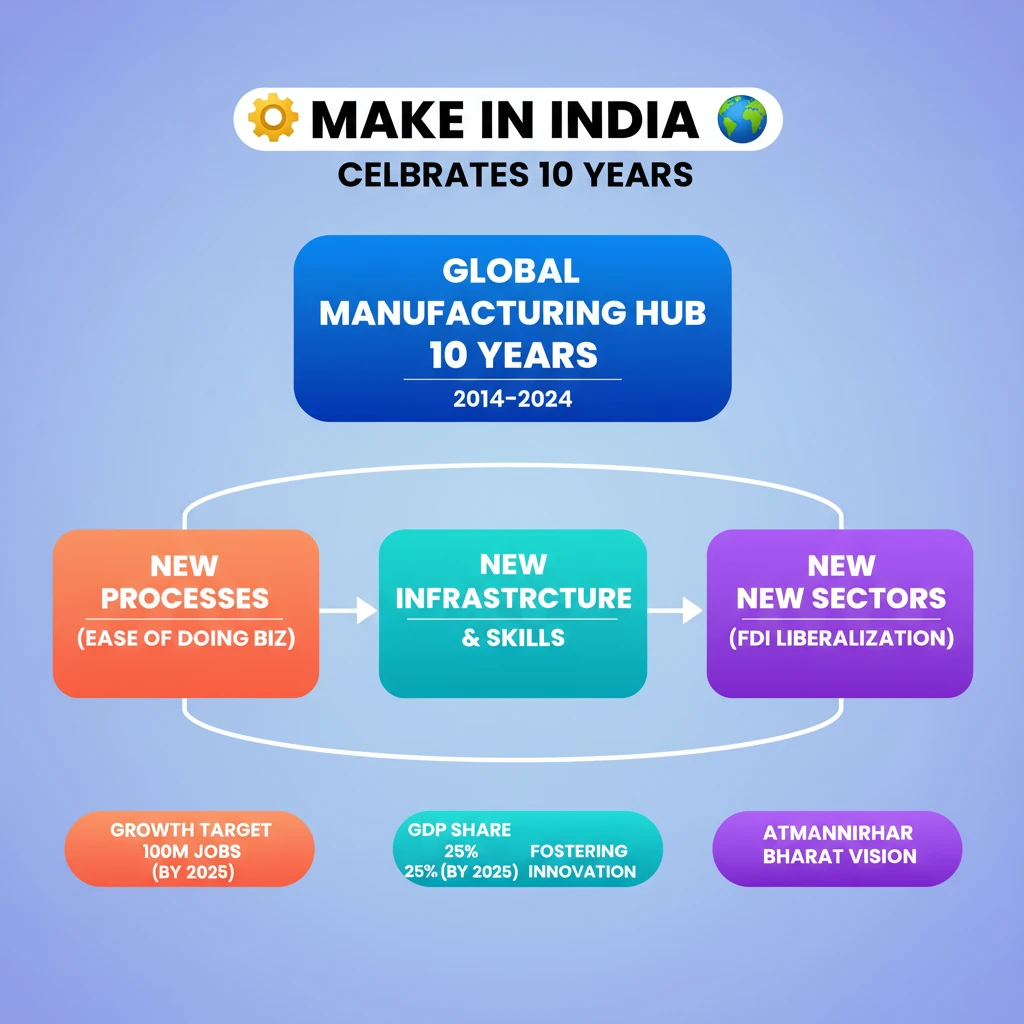
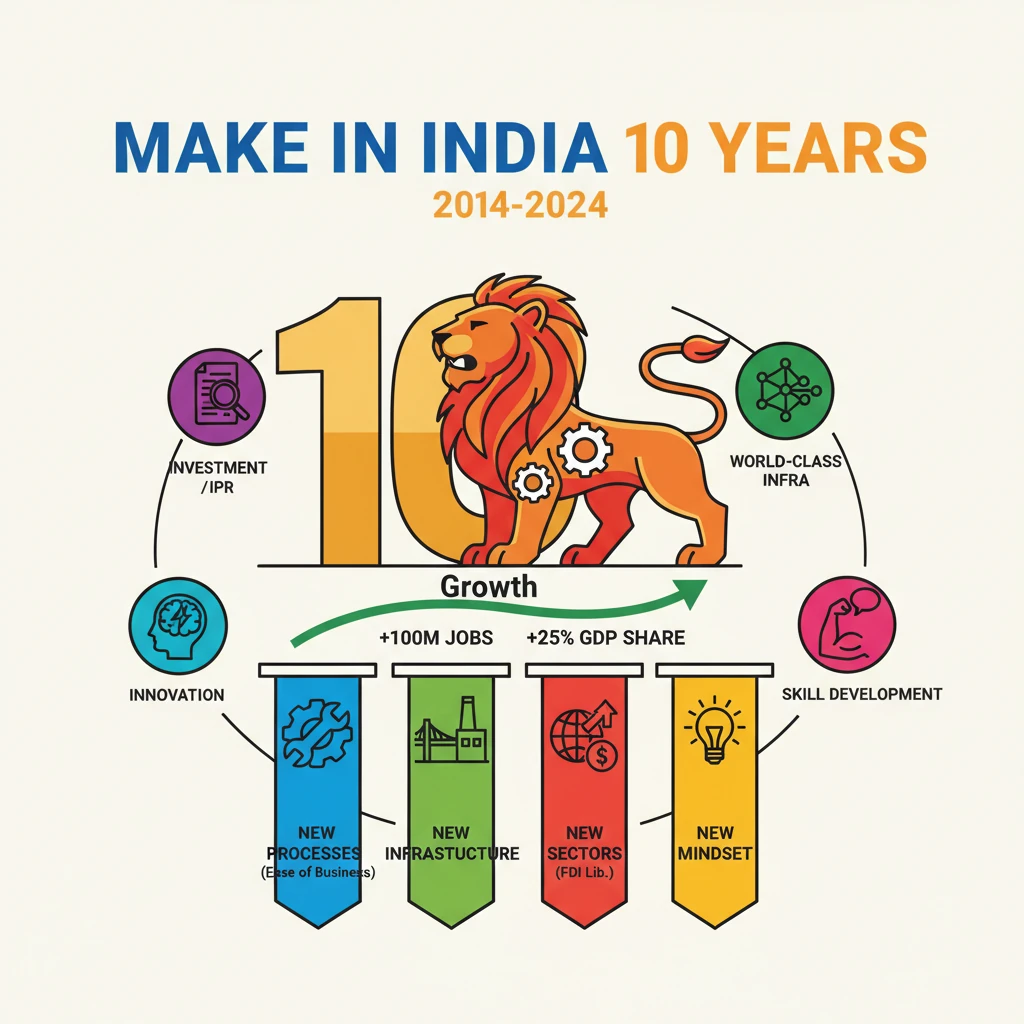
<h4>Introduction: Celebrating a Decade of Make in India</h4><p>The <strong>'Make in India' Initiative</strong>, launched on <strong>25th September 2014</strong>, has successfully completed <strong>ten years</strong>, marking a significant milestone in India's journey towards becoming a global manufacturing powerhouse.</p><p>This flagship program was envisioned to transform India into a hub for manufacturing, attracting both domestic and foreign investment and fostering a robust industrial ecosystem.</p><h4>Core Mandate of the Initiative</h4><p>The <strong>'Make in India' campaign</strong> was established with a multi-faceted approach aimed at invigorating the country's manufacturing sector.</p><div class='info-box'><p>Key areas of focus included facilitating <strong>investment</strong>, fostering <strong>innovation</strong>, enhancing <strong>skill development</strong>, protecting <strong>intellectual property (IP)</strong>, and building <strong>best-in-class manufacturing infrastructure</strong>.</p></div><h4>Ambitious Objectives Set</h4><p>The initiative laid down clear, quantifiable targets to measure its success and impact on the Indian economy.</p><ul><li>Increase the <strong>growth rate of the manufacturing sector</strong> to <strong>12-14% per annum</strong>.</li><li>Create <strong>100 million additional manufacturing jobs</strong> by <strong>2022</strong> (subsequently revised to <strong>2025</strong>).</li><li>Increase the <strong>manufacturing sector's contribution to GDP</strong> to <strong>25% by 2025</strong>.</li></ul><h4>Four Pillars of Make in India</h4><p>The strategy of <strong>'Make in India'</strong> is built upon four foundational pillars designed to create a conducive environment for manufacturing growth.</p><h5>New Processes: Enhancing Ease of Doing Business</h5><p>Recognizing that a streamlined regulatory environment is crucial, this pillar focuses on improving the <strong>ease of doing business</strong>.</p><div class='key-point-box'><p>Measures have been implemented to simplify procedures and create a more favorable business environment for both <strong>startups</strong> and established <strong>enterprises</strong>.</p></div><h5>New Infrastructure: Building World-Class Capabilities</h5><p>The government prioritized the development of robust physical infrastructure to support industrial growth.</p><p>This includes establishing <strong>industrial corridors</strong> and developing <strong>smart cities</strong> to provide state-of-the-art facilities and connectivity.</p><p>Furthermore, efforts were made to enhance <strong>innovation and research</strong> through streamlined registration systems and improved <strong>intellectual property rights (IPR) infrastructure</strong>.</p><h5>New Sectors: Opening Avenues for Investment</h5><p>A significant aspect of the initiative was the strategic opening up of various sectors to attract greater <strong>Foreign Direct Investment (FDI)</strong>.</p><div class='info-box'><p>Sectors where <strong>FDI</strong> was liberalized include <strong>Defence Production</strong>, <strong>Insurance</strong>, <strong>Medical Devices</strong>, <strong>Construction</strong>, and <strong>Railway infrastructure</strong>, among others.</p></div><h5>New Mindset: Fostering Entrepreneurship and Partnership</h5><p>While not explicitly mentioned as a 'pillar' in the source, the spirit of 'Make in India' inherently promotes a <strong>new mindset</strong> of entrepreneurship and collaboration between government and industry.</p><div class='exam-tip-box'><p>When discussing <strong>Make in India</strong> in <strong>UPSC Mains (GS3)</strong>, remember to elaborate on these four pillars as they form the strategic backbone of the initiative. Mentioning the <strong>'New Mindset'</strong> aspect can add depth to your answer.</p></div>
💡 Key Takeaways
- •Launched on 25th September 2014, completing 10 years, aiming to make India a global manufacturing hub.
- •Key objectives: Increase manufacturing growth (12-14%), create 100M jobs (by 2025), and boost manufacturing's GDP share to 25% (by 2025).
- •Built on four foundational pillars: New Processes (Ease of Doing Business), New Infrastructure, New Sectors (FDI liberalization), and a New Mindset.
- •Focuses on facilitating investment, fostering innovation, enhancing skill development, protecting IPR, and building world-class infrastructure.
- •Integral to India's 'Atmanirbhar Bharat' vision and crucial for sustained economic growth and employment generation.
🧠 Memory Techniques
95% Verified Content
📚 Reference Sources
•Official Make in India website (Department for Promotion of Industry and Internal Trade - DPIIT, Ministry of Commerce & Industry, Government of India)