What is the State of the Sugar Industry in India? - Economy | UPSC Learning
Topics
0 topics • 0 completed
🔍
No topics match your search
What is the State of the Sugar Industry in India?
Medium⏱️ 6 min read
economy
📖 Introduction
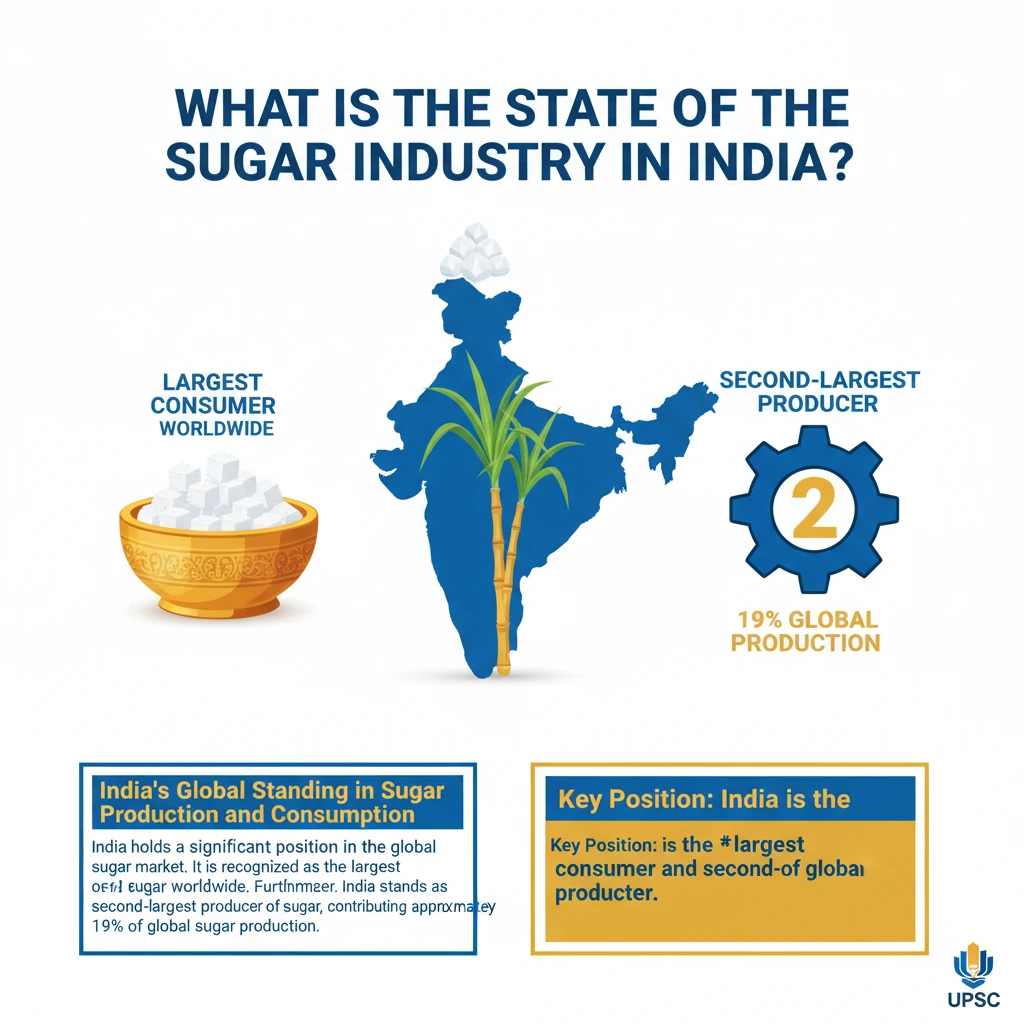
<h4>India's Global Standing in Sugar Production and Consumption</h4><p>India holds a significant position in the global sugar market. It is recognized as the <strong>largest consumer</strong> of sugar worldwide. Furthermore, India stands as the <strong>second-largest producer</strong> of sugar, contributing approximately <strong>19%</strong> of global sugar production.</p><div class='key-point-box'><p><strong>Key Position:</strong> India is the <strong>largest consumer</strong> and <strong>second-largest producer</strong> of sugar globally.</p></div><h4>Current Production and Stock Estimates (SY 2024)</h4><p>The <strong>Indian Sugar Mills Association (ISMA)</strong> provides projections for the current <strong>Sugar Year (SY) 2024</strong>. Gross sugar production is estimated at <strong>34.0 million MT</strong>. After accounting for ethanol diversion and an export ban, the net production is projected to be <strong>32.3 million MT</strong>.</p><div class='info-box'><p><strong>SY 2024 Production Estimates:</strong><ul><li><strong>Gross Production:</strong> 34.0 million MT</li><li><strong>Net Production:</strong> 32.3 million MT (after ethanol diversion and export ban)</li></ul></p></div><p>Domestic consumption for SY 2024 is estimated at <strong>28.5 million MT</strong>. This consumption, coupled with production, is expected to result in a closing stock of <strong>9.4 million MT</strong> by September 2024, which is a significant increase from <strong>5.6 million MT</strong> in the previous year.</p><h4>Global Comparison: India vs. Brazil</h4><p>According to the <strong>US Department of Agriculture (USDA)</strong>, <strong>Brazil</strong> remains the world’s top sugar producer for <strong>2023-24</strong>. Brazil's production is recorded at <strong>45.54 million MT</strong>, accounting for about <strong>25%</strong> of the total global output.</p><div class='info-box'><p><strong>Global Leader:</strong> <strong>Brazil</strong> is the world’s top sugar producer for <strong>2023-24</strong> with <strong>45.54 million MT</strong>, representing <strong>25%</strong> of global output.</p></div><h4>The Role of Ethanol Production in the Sugar Industry</h4><p>Ethanol production from sugarcane by-products has become a crucial aspect of the Indian sugar industry. For the first half of <strong>Ethanol Supply Year (ESY) 2024</strong>, a target of <strong>320 crore liters</strong> of ethanol was set.</p><p>By March 2024, approximately <strong>224 crore liters</strong> of ethanol had been supplied. This achievement contributed to an <strong>11.96% blending ratio</strong>, signifying progress towards India's biofuel goals.</p><div class='info-box'><p><strong>Ethanol Production (ESY 2024 H1):</strong><ul><li><strong>Target:</strong> 320 crore liters</li><li><strong>Supplied (by March 2024):</strong> 224 crore liters</li><li><strong>Blending Ratio Achieved:</strong> 11.96%</li></ul></p></div><h4>Geographical Distribution and Regional Characteristics</h4><p>The sugar industry in India is primarily distributed across two major regions. These include the northern states of <strong>Uttar Pradesh</strong>, <strong>Bihar</strong>, <strong>Haryana</strong>, and <strong>Punjab</strong>, and the southern states of <strong>Maharashtra</strong>, <strong>Karnataka</strong>, <strong>Tamil Nadu</strong>, and <strong>Andhra Pradesh</strong>.</p><p>A notable difference exists between these regions. The <strong>tropical climate</strong> prevalent in <strong>South India</strong> is particularly suitable for sugarcane cultivation. This climate supports a <strong>higher sucrose content</strong> in the cane, leading to a significantly <strong>higher yield per unit area</strong> compared to North India.</p><div class='key-point-box'><p><strong>Regional Advantage:</strong> <strong>South India's tropical climate</strong> ensures <strong>higher sucrose content</strong> and thus <strong>greater yield per unit area</strong> for sugarcane.</p></div><h4>Optimal Geographical Conditions for Sugarcane Cultivation</h4><p>Specific geographical conditions are essential for the healthy growth and high yield of sugarcane. These factors influence the quality and quantity of sugar produced.</p><div class='info-box'><p><strong>Ideal Conditions for Sugarcane Growth:</strong><ul><li><strong>Temperature:</strong> Between <strong>21-27°C</strong>, requiring a <strong>hot and humid climate</strong>.</li><li><strong>Rainfall:</strong> Approximately <strong>75-100 cm</strong>.</li><li><strong>Soil Type:</strong> Deep rich <strong>loamy soil</strong> is most suitable.</li></ul></p></div>
💡 Key Takeaways
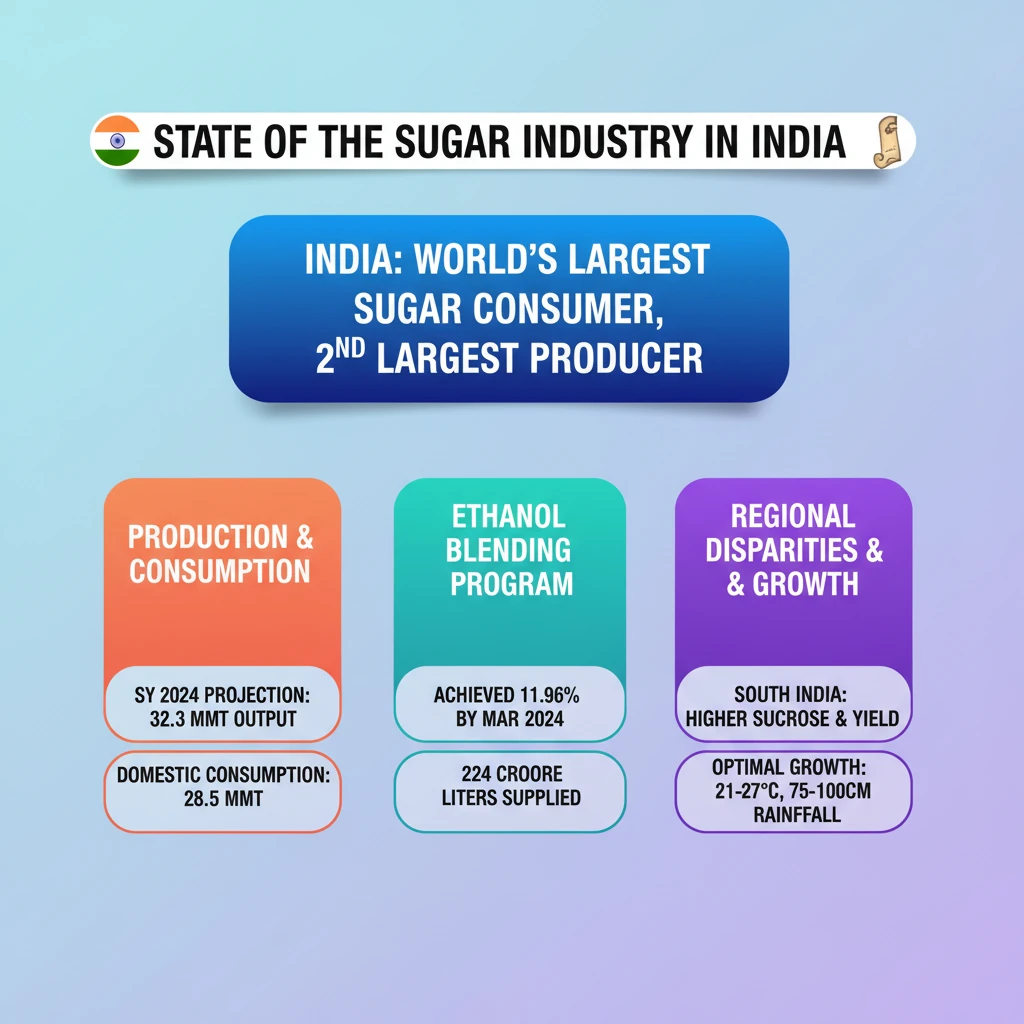
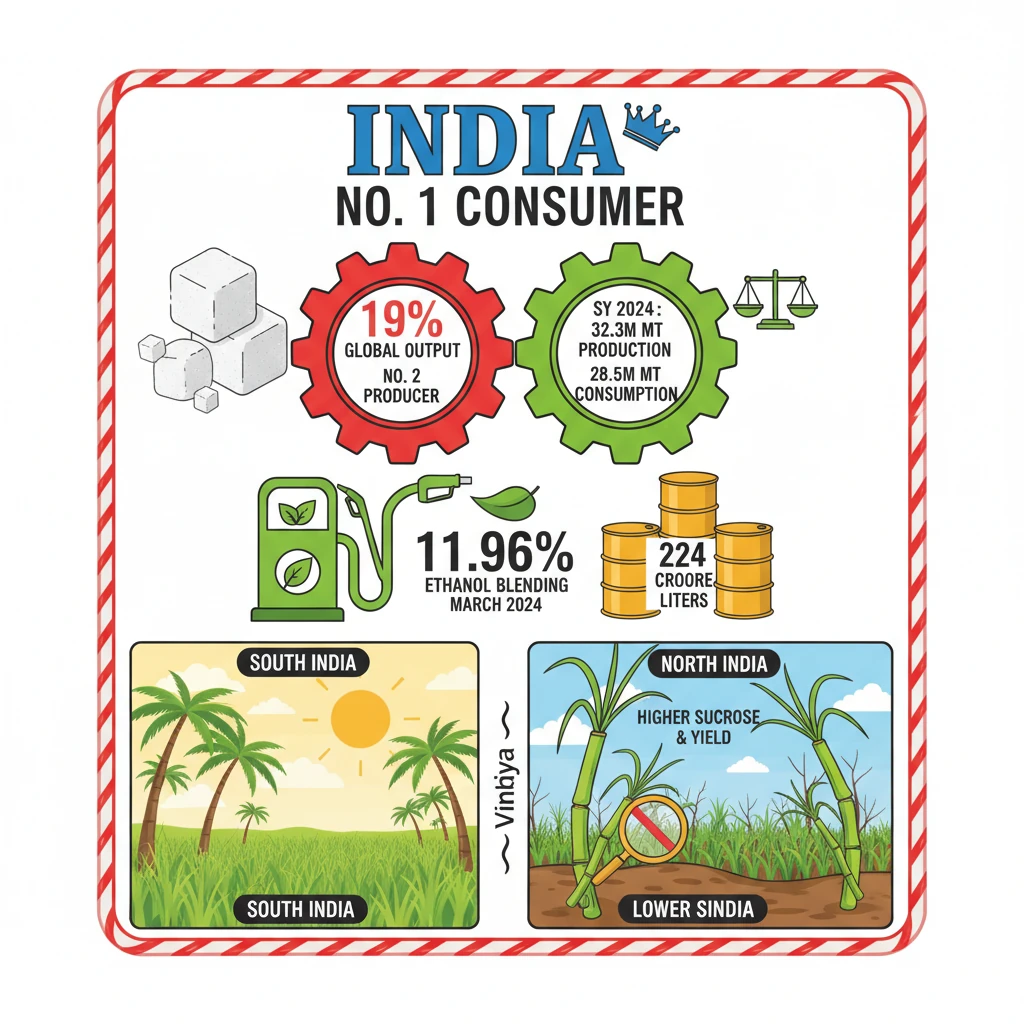
- •India is the world's largest sugar consumer and second-largest producer, contributing 19% of global output.
- •Net sugar production for SY 2024 is projected at 32.3 million MT, with domestic consumption at 28.5 million MT.
- •The Ethanol Blending Program achieved an 11.96% blending ratio by March 2024, with 224 crore liters supplied.
- •South India's tropical climate provides higher sucrose content and yield per unit area compared to North India.
- •Optimal sugarcane growth requires 21-27°C temperature, 75-100 cm rainfall, and deep rich loamy soil.
🧠 Memory Techniques
95% Verified Content
📚 Reference Sources
•Indian Sugar Mills Association (ISMA) (as cited by Drishti IAS)
•US Department of Agriculture (USDA) (as cited by Drishti IAS)