Comparison of Ease of Doing Business and the B-READY Index - Economy | UPSC Learning
Topics
0 topics • 0 completed
🔍
No topics match your search
Comparison of Ease of Doing Business and the B-READY Index
Medium⏱️ 10 min read
economy
📖 Introduction
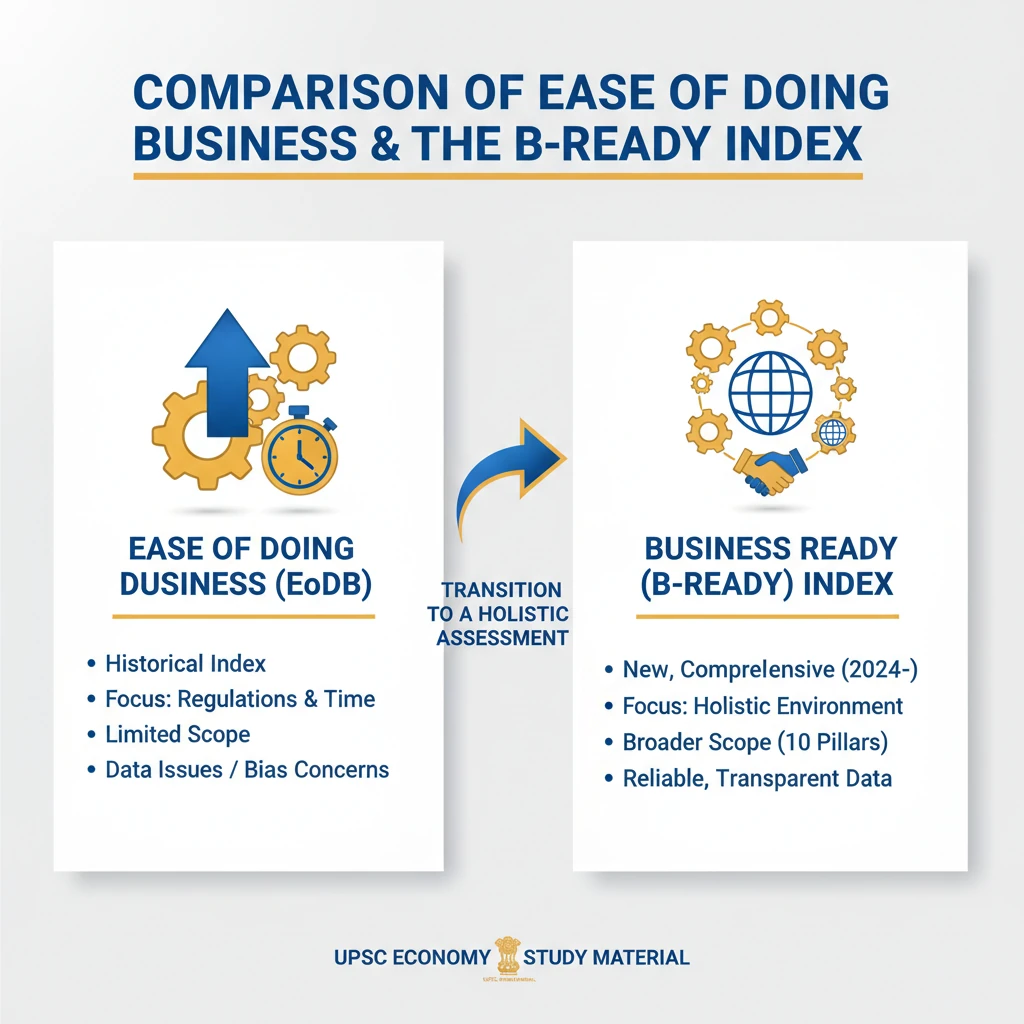
<h4>Introduction to Business Environment Indices</h4><p>Understanding the regulatory environment is crucial for both businesses and policymakers. Historically, the <strong>Ease of Doing Business (EoDB)</strong> report provided insights into this. However, it has been replaced by the more comprehensive <strong>Business Ready (B-READY) Index</strong>.</p><p>This transition marks a significant evolution in how global institutions assess the private sector landscape, moving towards a more holistic and nuanced evaluation.</p><div class='exam-tip-box'><p><strong>UPSC Insight:</strong> The shift from <strong>EoDB</strong> to <strong>B-READY</strong> is a critical development for Mains GS-III (Economy) and GS-II (Governance). Focus on the 'why' behind the change and the implications for India's policy reforms.</p></div><h4>Comparative Analysis: EoDB vs. B-READY Index</h4><p>The following table outlines the key differences between the defunct <strong>Ease of Doing Business (EoDB)</strong> report and the new <strong>B-READY Index</strong>, highlighting the evolution in assessment methodology and scope.</p><table class='info-table'><tr><th>Aspect</th><th>Ease of Doing Business (EoDB)</th><th>B-READY Index</th></tr><tr><td><strong>Objective</strong></td><td>Focused on evaluating the <strong>regulatory environment</strong> for <strong>Small and Medium-sized Enterprises (SMEs)</strong>.</td><td>Holistic evaluation of <strong>private sector development</strong>, including <strong>SMEs</strong>, <strong>workers</strong>, and <strong>consumers</strong>.</td></tr><tr><td><strong>Scope</strong></td><td>Primarily focused on <strong>regulatory burden</strong>.</td><td>Covers <strong>regulatory burden</strong>, <strong>quality of regulations</strong>, and <strong>public services</strong>.</td></tr><tr><td><strong>Topics Covered</strong></td><td>Limited to a few key topics like <strong>starting a business</strong>, <strong>getting credit</strong>, and <strong>paying taxes</strong>.</td><td>Comprehensive: Covers <strong>10 topics</strong> spanning a firm’s lifecycle, including <strong>business entry</strong>, <strong>utility services</strong>, <strong>labor</strong>, and <strong>market competition</strong>.</td></tr><tr><td><strong>Framework</strong></td><td>Focused mainly on <strong>ease of doing business</strong> for firms.</td><td>Includes <strong>firm flexibility</strong> (ease of business) and <strong>social benefits</strong> (impact on society).</td></tr></tr><tr><td><strong>Data Collection</strong></td><td>Relied on <strong>expert consultations</strong> and <strong>case studies</strong>.</td><td>Combines <strong>expert consultations</strong> and <strong>firm-level surveys</strong> for a balanced <strong>de jure</strong> and <strong>de facto</strong> perspective.</td></tr><tr><td><strong>Indicators Used</strong></td><td>Used around <strong>11 questionnaires</strong> covering a limited number of indicators.</td><td>Uses <strong>21 questionnaires</strong> and nearly <strong>1,200 indicators</strong> for detailed insights.</td></tr><tr><td><strong>Scoring and Ranking</strong></td><td>Produced <strong>aggregate rankings</strong> and scores, often criticized for <strong>oversimplification</strong>.</td><td>Provides <strong>disaggregated scores</strong> by topic and pillar, encouraging <strong>targeted reforms</strong> rather than overall rankings.</td></tr><tr><td><strong>Geographic Coverage</strong></td><td>Covered the main business city in <strong>191 economies</strong>.</td><td>Plans to expand to <strong>180 economies</strong> by <strong>2026</strong>, with a focus on <strong>national and local regulations</strong>.</td></tr><tr><td><strong>Public Services</strong></td><td>Limited attention to <strong>public services</strong>.</td><td>Explicitly evaluates <strong>public services</strong> and their <strong>operational efficiency</strong>.</td></tr><tr><td><strong>Cross-Cutting Themes</strong></td><td>Did not include specific themes.</td><td>Focuses on <strong>digital adoption</strong>, <strong>environmental sustainability</strong>, and <strong>gender equality</strong>.</td></tr><tr><td><strong>Use of Results</strong></td><td>Primarily for <strong>regulatory benchmarking</strong> and <strong>reform motivation</strong>.</td><td>Provides <strong>actionable insights</strong> for reforms, <strong>transparency</strong>, and <strong>data reproducibility</strong>.</td></tr><tr><td><strong>Methodology Updates</strong></td><td><strong>Static methodology</strong> with minor updates over time.</td><td><strong>Dynamic methodology</strong> that evolves based on feedback and lessons from rollouts.</td></tr></table><div class='key-point-box'><p><strong>Key Point:</strong> The <strong>B-READY Index</strong> represents a paradigm shift from simple 'ease' to a more comprehensive 'readiness' for sustainable and inclusive private sector development.</p></div>

💡 Key Takeaways
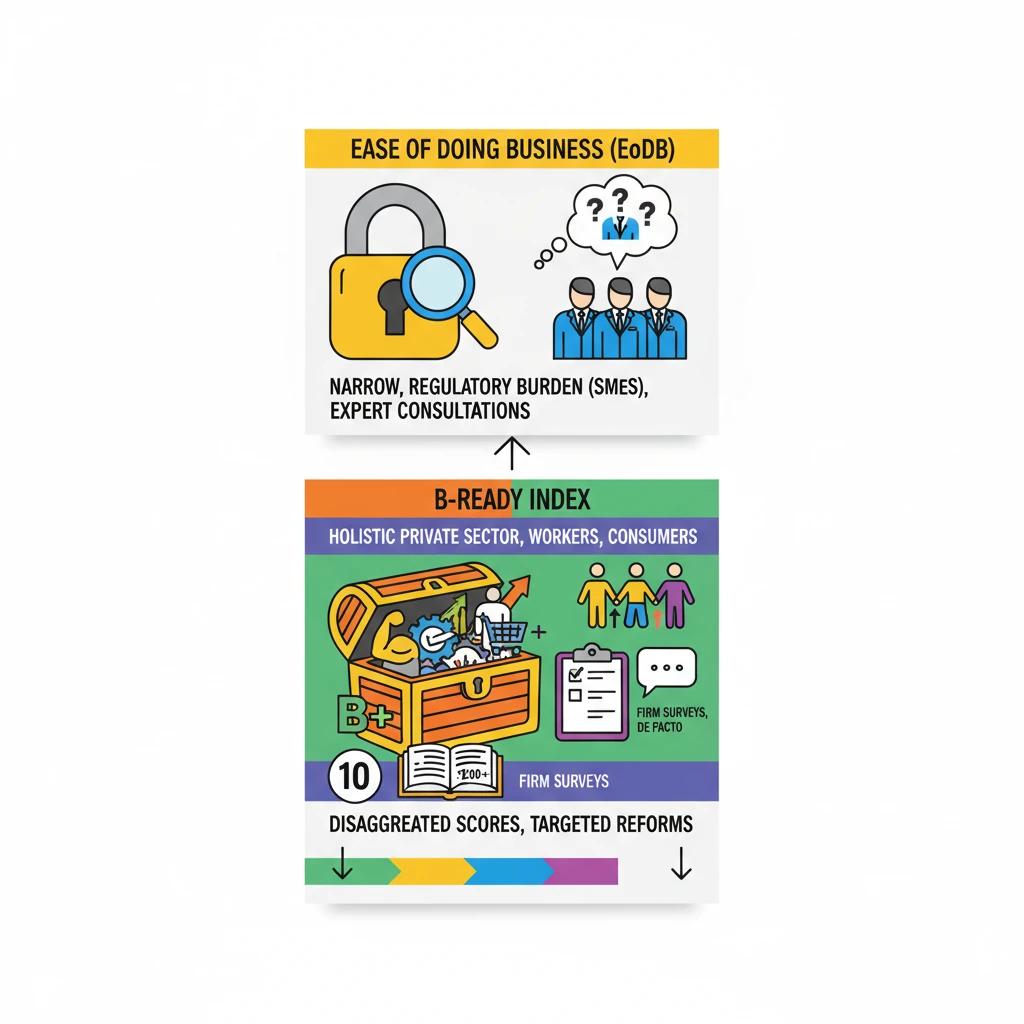
- •EoDB focused narrowly on regulatory burden for SMEs, using expert consultations.
- •B-READY is a comprehensive successor, evaluating private sector development holistically, including workers and consumers.
- •B-READY covers 10 topics, nearly 1,200 indicators, and includes firm-level surveys for de facto insights.
- •It provides disaggregated scores, promoting targeted reforms over aggregate rankings.
- •Key cross-cutting themes in B-READY are digital adoption, environmental sustainability, and gender equality.
- •The shift reflects a global move towards more sustainable, inclusive, and transparent business environment assessments.
🧠 Memory Techniques
98% Verified Content
📚 Reference Sources
•World Bank Group: Doing Business reports (archived information)
•World Bank Group: Business Ready (B-READY) project official documentation and announcements