What is Online Gaming? - Economy | UPSC Learning
Topics
0 topics • 0 completed
🔍
No topics match your search
What is Online Gaming?
Easy⏱️ 4 min read
economy
📖 Introduction
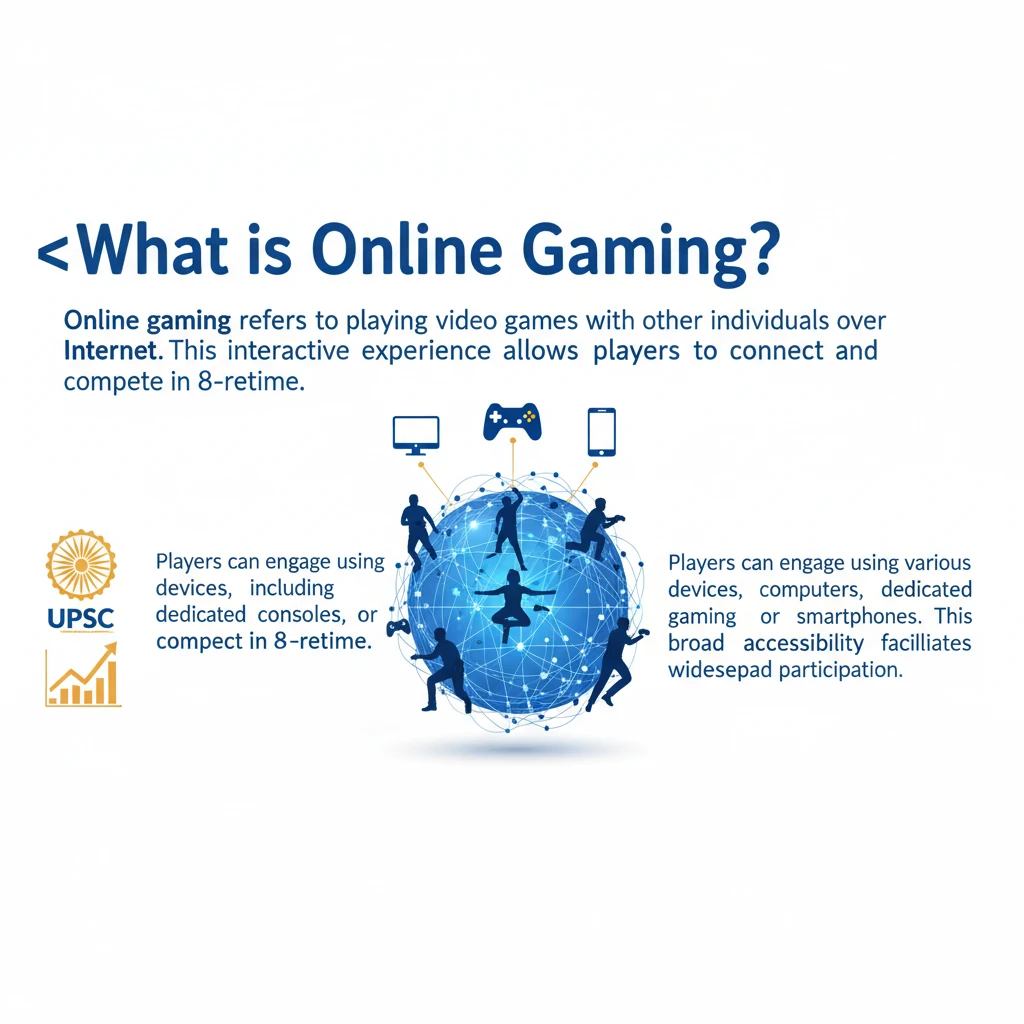
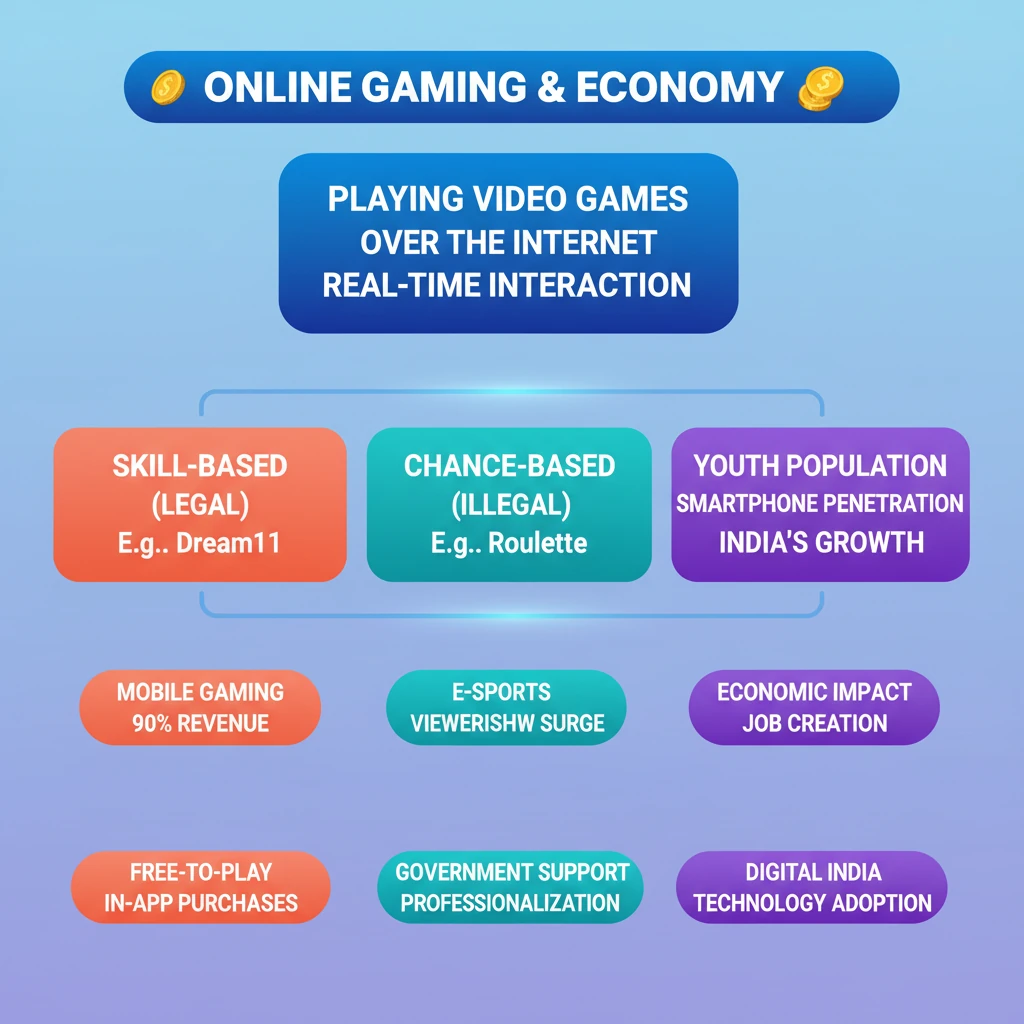
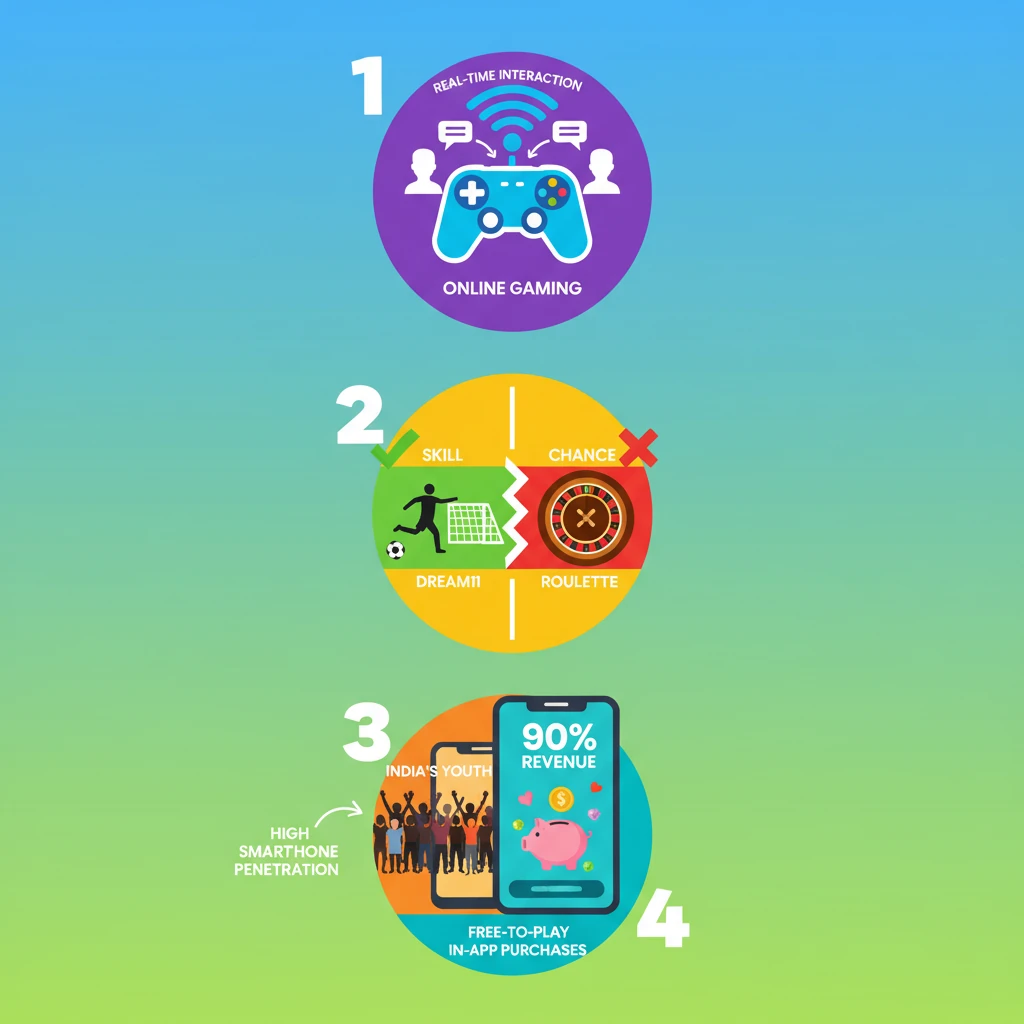
<h4>What is Online Gaming?</h4><p><strong>Online gaming</strong> refers to playing <strong>video games</strong> with other individuals over the <strong>Internet</strong>. This interactive experience allows players to connect and compete in real-time.</p><p>Players can engage using various devices, including <strong>computers</strong>, dedicated <strong>gaming consoles</strong>, or <strong>smartphones</strong>. This broad accessibility facilitates widespread participation.</p><p>The core characteristic of online gaming is its ability to enable <strong>real-time interaction</strong> and <strong>competition</strong> among participants, irrespective of their physical locations.</p><div class='info-box'><p><strong>Definition:</strong> <strong>Online gaming</strong> involves interactive digital entertainment played over a network, primarily the Internet, allowing multiplayer engagement.</p></div><h4>Classification of Online Games</h4><p>Online games in India are primarily classified based on the dominance of <strong>skill</strong> versus <strong>chance</strong> in determining the outcome. This distinction has significant legal implications.</p><h5>Skill-Based Games</h5><p>These games are considered <strong>legal in India</strong>. Their legality hinges on the premise that the outcome is predominantly determined by a player's <strong>skill</strong>, knowledge, or strategy, rather than random chance.</p><div class='info-box'><p><strong>Examples of Skill-Based Games:</strong> Platforms like <strong>Game 24x7</strong>, <strong>Dream11</strong>, and <strong>Mobile Premier League (MPL)</strong> are prominent examples where strategic thinking and player expertise are crucial.</p></div><h5>Games of Chance</h5><p>Conversely, games where the outcome is primarily influenced by <strong>random chance</strong> are generally deemed <strong>illegal</strong>. These games often attract players due to the potential for significant monetary rewards, rather than intellectual challenge.</p><div class='info-box'><p><strong>Example of a Game of Chance:</strong> <strong>Roulette</strong> is a classic illustration, where the result is almost entirely dependent on luck, making it illegal in most jurisdictions in India.</p></div><div class='key-point-box'><p><strong>Key Distinction:</strong> The legal status of an online game in India largely depends on whether <strong>skill</strong> or <strong>chance</strong> is the dominant factor in determining the game's outcome.</p></div><h4>Current Scenario of Online Gaming in India</h4><p>The Indian online gaming industry is experiencing rapid growth, driven by several demographic and technological factors.</p><h5>Youth Demographics</h5><p>India possesses a vast and youthful population. Over <strong>600 million people</strong> are under the age of <strong>35</strong>, constituting approximately <strong>45% of the total population</strong>. This demographic dividend fuels the demand for online entertainment.</p><h5>Smartphone Penetration</h5><p>The widespread adoption of smartphones has significantly boosted access to online gaming. <strong>Smartphone usage</strong> has reached an impressive <strong>75%</strong> across the country, making gaming readily available to a large segment of the population.</p><h5>Mobile Gaming Dominance</h5><p><strong>Mobile gaming</strong> is the powerhouse of the Indian online gaming market. It accounts for a staggering <strong>90% of the total gaming revenue</strong>. This revenue is primarily generated through <strong>free-to-play games</strong> and various <strong>in-app purchases</strong>.</p><h5>E-sports Growth</h5><p>The <strong>e-sports sector</strong> in India is witnessing exponential growth. Viewership has surged to over <strong>80 million</strong>, indicating a strong and engaged audience base.</p><div class='exam-tip-box'><p>The growth of <strong>e-sports</strong> is further bolstered by <strong>government backing</strong> and a rising number of professional gamers, signaling its potential as a recognized sport and industry.</p></div>
💡 Key Takeaways
- •Online gaming involves playing video games over the Internet, enabling real-time interaction.
- •Games are classified as 'skill-based' (legal, e.g., Dream11) or 'chance-based' (illegal, e.g., Roulette).
- •India's large youth population and high smartphone penetration drive gaming industry growth.
- •Mobile gaming accounts for 90% of revenue, primarily from free-to-play and in-app purchases.
- •E-sports viewership is surging, with increasing government support and professionalization.
🧠 Memory Techniques
95% Verified Content