What are the Major Initiatives Taken to Enable Make in India? - Economy | UPSC Learning
Topics
0 topics • 0 completed
🔍
No topics match your search
What are the Major Initiatives Taken to Enable Make in India?
Medium⏱️ 7 min read
economy
📖 Introduction
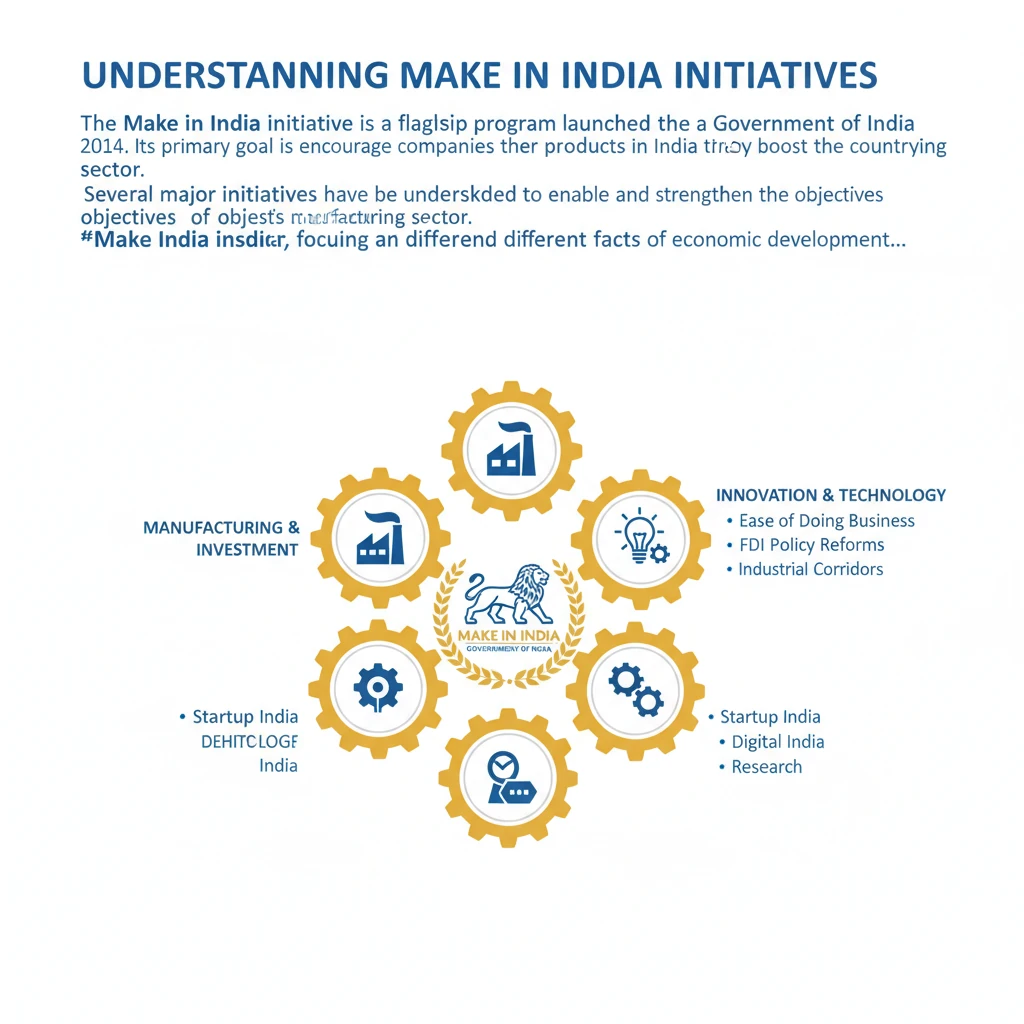
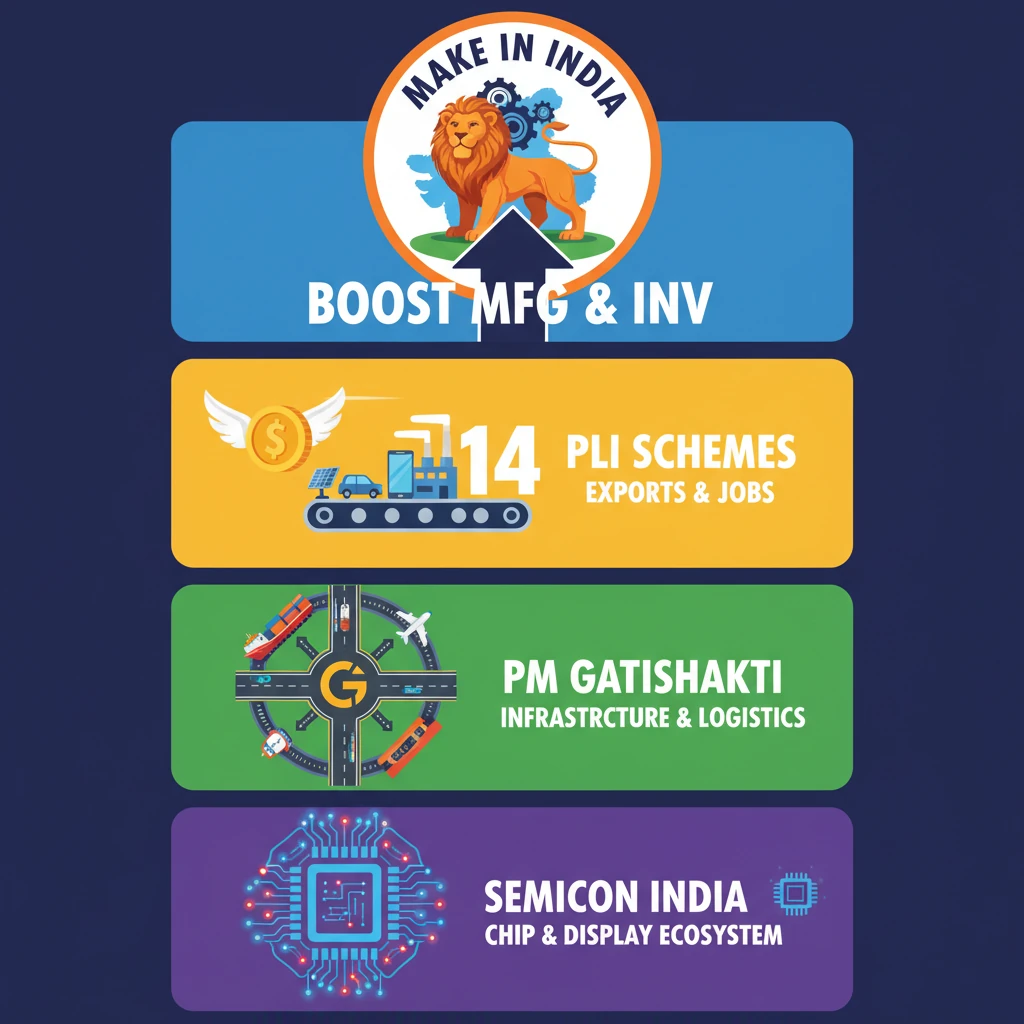
<h4>Understanding Make in India Initiatives</h4><p>The <strong>Make in India</strong> initiative is a flagship program launched by the Government of India in <strong>2014</strong>. Its primary goal is to encourage companies to manufacture their products in India and thereby boost the country's manufacturing sector.</p><p>Several major initiatives have been undertaken to enable and strengthen the objectives of <strong>Make in India</strong>, focusing on different facets of economic development and industrial growth.</p><h4>Production Linked Incentive (PLI) Schemes</h4><p>The <strong>Production Linked Incentive (PLI) Schemes</strong> are a crucial component designed to enhance domestic manufacturing capabilities. These schemes aim to boost both production and exports across various sectors.</p><p>The PLI framework covers <strong>14 key sectors</strong>, providing incentives on incremental sales from products manufactured in India. This encourages companies to expand their production base within the country.</p><div class='info-box'><p><strong>Progress as of July 2024:</strong></p><ul><li>Total investment attracted: <strong>Rs 1.23 lakh crore</strong></li><li>Jobs generated: Approximately <strong>8 lakh</strong></li></ul></div><div class='key-point-box'><p>The PLI schemes are instrumental in making Indian manufacturing globally competitive and reducing import dependence.</p></div><h4>PM GatiShakti National Master Plan</h4><p>The <strong>PM GatiShakti National Master Plan</strong> was launched with an ambitious vision to transform India's infrastructure landscape. Its core objective is to achieve a <strong>USD 5 trillion economy by 2025</strong>.</p><p>This initiative focuses on establishing comprehensive <strong>multimodal and last-mile connectivity infrastructure</strong>. Improved logistics are vital for reducing costs and enhancing the efficiency of the manufacturing sector.</p><div class='info-box'><p><strong>Seven Primary Engines of PM GatiShakti:</strong></p><ul><li><strong>Railways</strong></li><li><strong>Roads</strong></li><li><strong>Ports</strong></li><li><strong>Waterways</strong></li><li><strong>Airports</strong></li><li><strong>Mass Transport</strong></li><li><strong>Logistics Infrastructure</strong></li></ul></div><div class='exam-tip-box'><p>When discussing infrastructure development in UPSC answers, always mention <strong>PM GatiShakti</strong> and its multimodal approach for a comprehensive perspective.</p></div><h4>Semiconductor Ecosystem Development</h4><p>Recognizing the strategic importance of electronics manufacturing, the government approved the <strong>Semicon India Programme</strong> in <strong>2021</strong>. This program is a significant step towards building self-reliance in high-tech sectors.</p><p>The initiative aims to develop a sustainable <strong>semiconductor and display ecosystem</strong> within India. This includes attracting investments in fabrication units, design, and packaging facilities.</p><div class='key-point-box'><p>Developing a robust semiconductor ecosystem is crucial for India's digital economy and national security, directly supporting the high-tech manufacturing aspect of <strong>Make in India</strong>.</p></div><h4>National Logistics Policy (NLP)</h4><p>The <strong>National Logistics Policy (NLP)</strong> was introduced to address the challenges in India's logistics sector. An efficient logistics network is fundamental for cost-effective manufacturing and timely delivery of goods.</p><p>The policy focuses on enhancing the sector through a combination of advanced technology, improved processes, and the development of skilled manpower. This holistic approach aims to reduce logistics costs as a percentage of GDP.</p><div class='info-box'><p><strong>Key Pillars of NLP:</strong></p><ul><li>Integration of Digital Systems (IDS)</li><li>Unified Logistics Interface Platform (ULIP)</li><li>Ease of Logistics Services (E-Logs)</li><li>System Improvement Group (SIG)</li></ul></div>

💡 Key Takeaways
- •Make in India aims to boost domestic manufacturing and attract investment.
- •PLI schemes incentivize production across 14 key sectors, boosting exports and jobs.
- •PM GatiShakti focuses on multimodal infrastructure for efficient logistics and economic growth.
- •Semicon India Programme is critical for developing a sustainable semiconductor and display ecosystem.
- •National Logistics Policy enhances logistics efficiency through technology and skilled manpower.
- •These initiatives collectively drive job creation, economic resilience, and technological advancement for a self-reliant India.
🧠 Memory Techniques
95% Verified Content
📚 Reference Sources
•Government of India official reports (e.g., Ministry of Commerce & Industry, NITI Aayog)