Looking ahead, the RBI Governor stressed the importance of leveraging technology over the next two decades to address the financial needs of underserved regions, highlighting the crucial role of fintech companies in bridging gaps and ensuring seamless access to financial services. - Economy | UPSC Learning
Topics
0 topics • 0 completed
🔍
No topics match your search
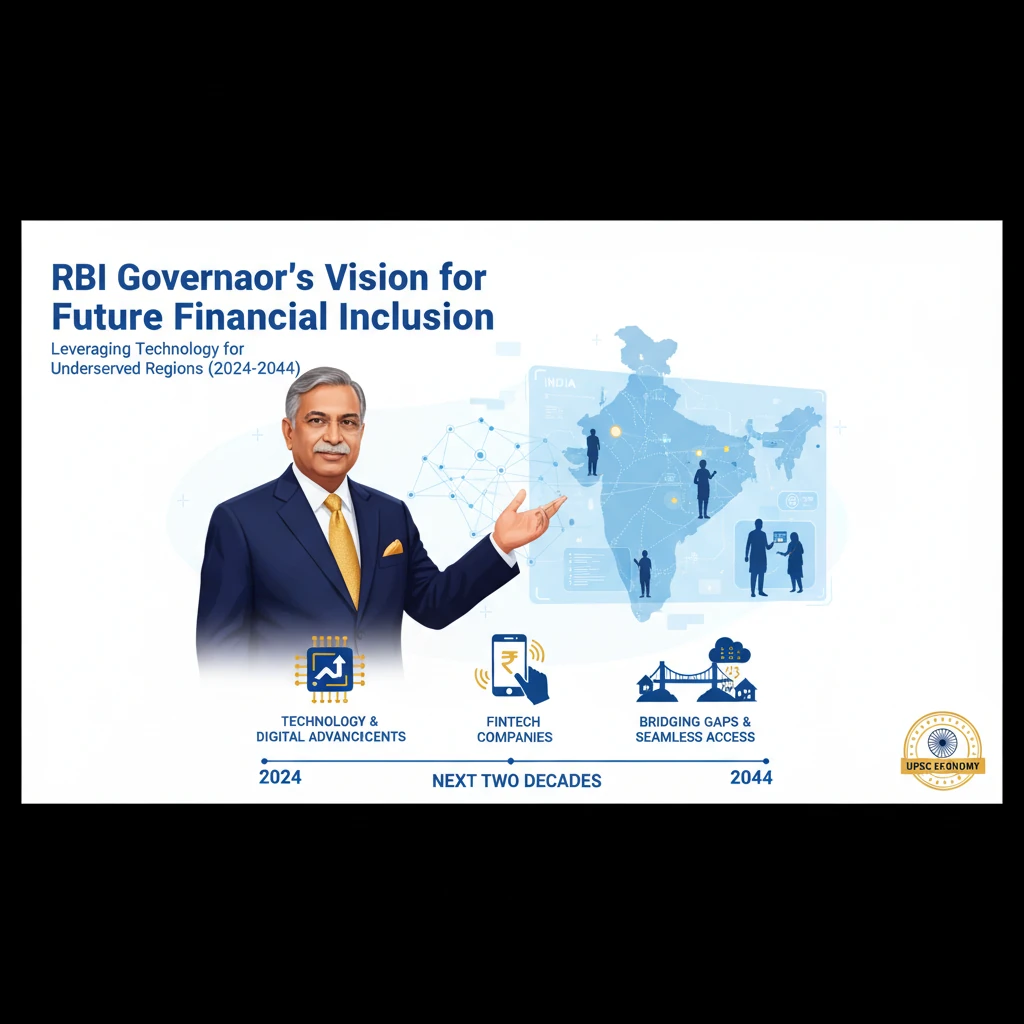
Looking ahead, the RBI Governor stressed the importance of leveraging technology over the next two decades to address the financial needs of underserved regions, highlighting the crucial role of fintech companies in bridging gaps and ensuring seamless access to financial services.
Medium⏱️ 8 min read
economy
📖 Introduction
<h4>RBI Governor's Vision for Future Financial Inclusion</h4><p>The <strong>RBI Governor</strong> has articulated a forward-looking strategy for India's financial sector, emphasizing the critical role of <strong>technology</strong>. This vision spans the <strong>next two decades</strong>, focusing on harnessing digital advancements to meet the evolving financial needs of the nation.</p><p>A primary objective of this long-term strategy is to address the persistent challenge of <strong>financial exclusion</strong>. The Governor specifically highlighted the imperative to cater to the <strong>financial needs of underserved regions</strong> across the country, ensuring equitable access to essential services.</p><div class='key-point-box'><p>The central theme of the <strong>RBI Governor's</strong> statement is the strategic deployment of <strong>technology</strong> to foster inclusive growth and bridge financial disparities over the coming <strong>20 years</strong>.</p></div><h4>Leveraging Technology for Underserved Regions</h4><p>The strategy underscores that <strong>technology</strong> is not merely an enabler but a fundamental pillar for achieving comprehensive <strong>financial inclusion</strong>. It involves deploying innovative digital solutions to reach populations that have historically been marginalized by traditional banking systems.</p><p>This approach aims to overcome geographical barriers, reduce operational costs, and enhance the efficiency of financial service delivery. By leveraging technological infrastructure, financial institutions can expand their footprint into remote and rural areas more effectively.</p><h4>The Pivotal Role of Fintech Companies</h4><p>Crucially, the <strong>RBI Governor</strong> specifically recognized the <strong>crucial role of fintech companies</strong> in this transformative journey. These innovative firms are seen as key players in developing and deploying solutions that can significantly bridge existing financial gaps.</p><p><strong>Fintech companies</strong>, with their agility and focus on digital-first solutions, are uniquely positioned to offer <strong>seamless access to financial services</strong>. This includes everything from digital payments and credit to insurance and investment products, tailored for diverse user segments.</p><div class='exam-tip-box'><p><strong>UPSC Mains (GS-III)</strong> often features questions on <strong>financial inclusion</strong>, <strong>digital economy</strong>, and the role of <strong>fintech</strong>. Understanding the RBI's forward-looking stance provides excellent material for introductory and concluding remarks in such answers.</p></div>
💡 Key Takeaways
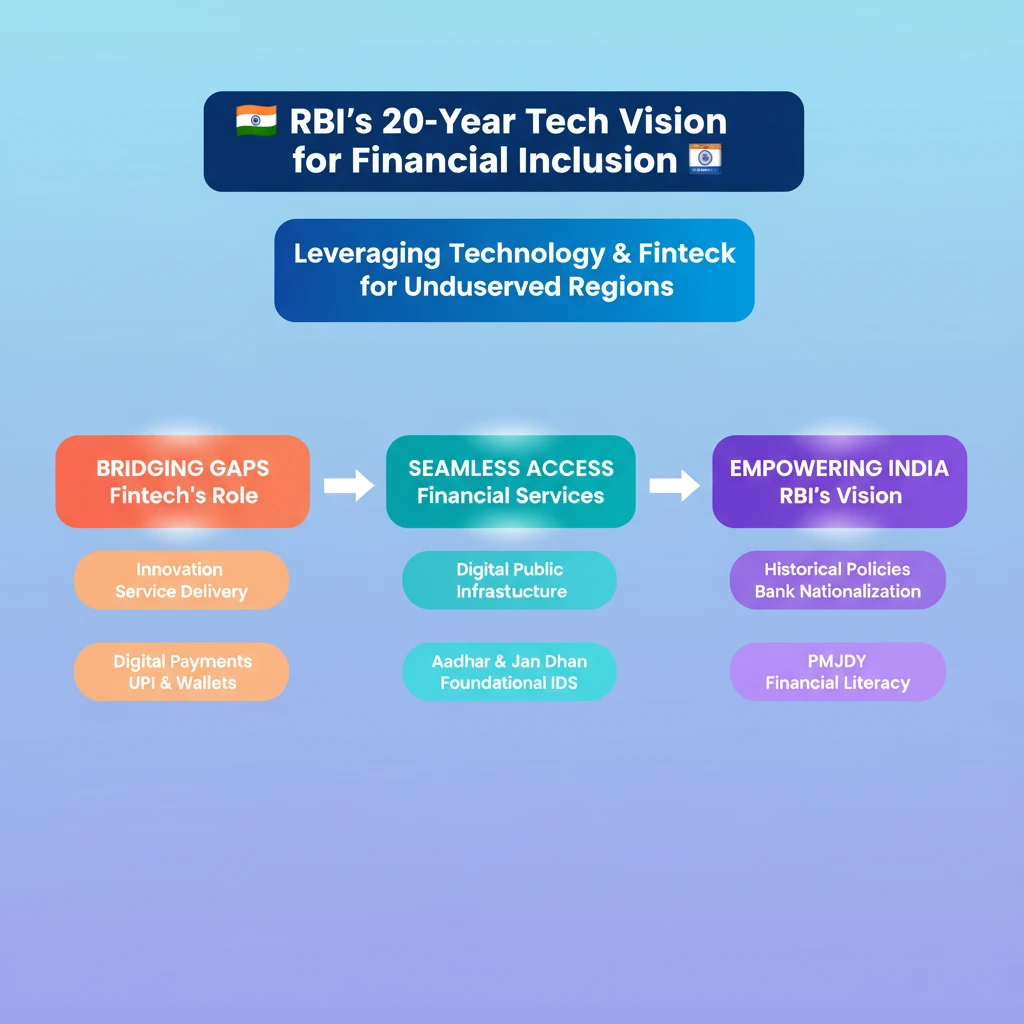
- •RBI Governor emphasizes technology and fintech for financial inclusion over the next two decades.
- •Goal is to address financial needs of underserved regions and ensure seamless access.
- •Fintech companies are crucial in bridging gaps and innovating service delivery.
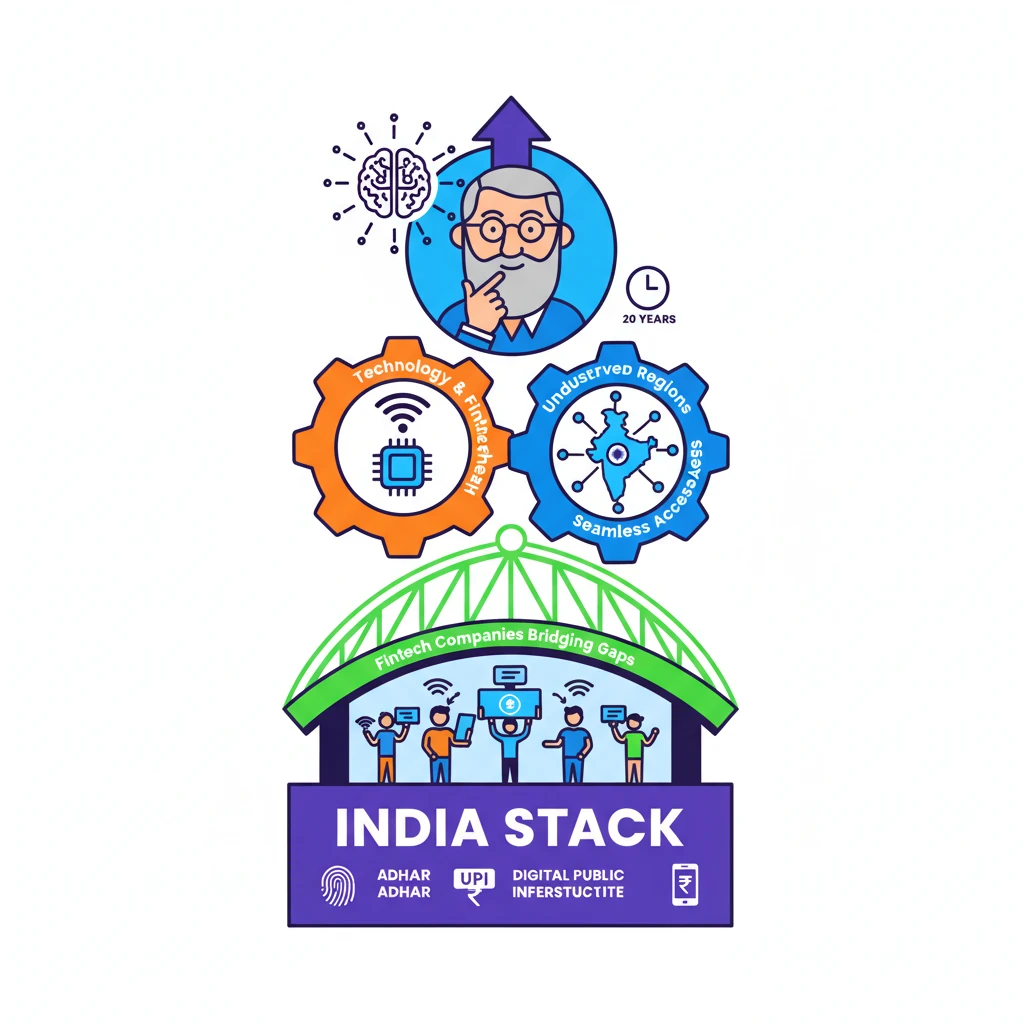
- •India's digital public infrastructure (like UPI, Aadhar) is foundational to this vision.
- •Historical policies (e.g., Bank Nationalization, PMJDY) paved the way for current tech-driven approach.
🧠 Memory Techniques
95% Verified Content
📚 Reference Sources
•NITI Aayog Reports on Digital Economy and Financial Inclusion
•Economic Survey of India (Various Editions)
•Ministry of Finance Publications
•National Payments Corporation of India (NPCI) Data