What are Government of India’s Initiatives to Promote EV Adoption? - Economy | UPSC Learning
Topics
0 topics • 0 completed
🔍
No topics match your search
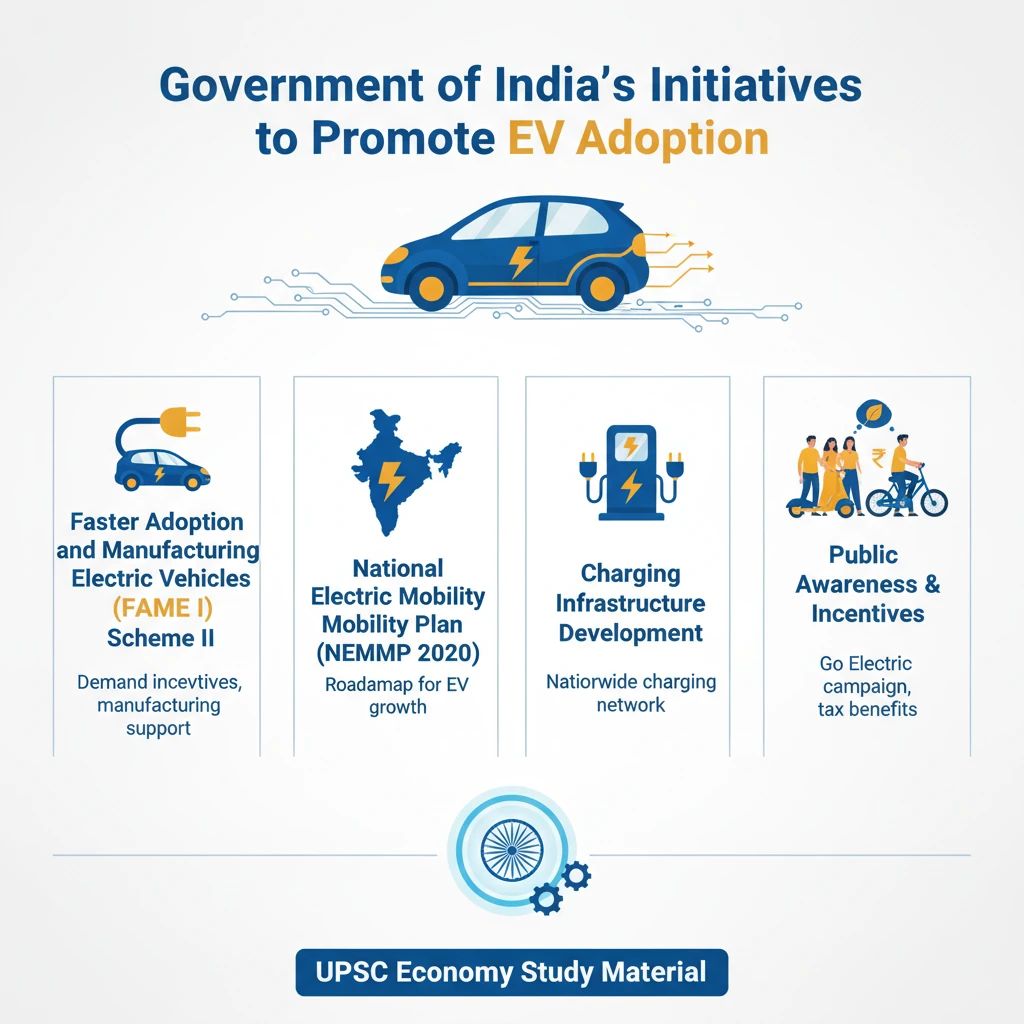
What are Government of India’s Initiatives to Promote EV Adoption?
Medium⏱️ 8 min read
economy
📖 Introduction
<h4>Government of India’s Initiatives to Promote EV Adoption</h4><p>The <strong>Government of India</strong> has launched a series of comprehensive initiatives to accelerate the adoption of <strong>Electric Vehicles (EVs)</strong> across the nation. These programs address various aspects, including demand incentives, manufacturing support, infrastructure development, and public awareness.</p><h4>Faster Adoption and Manufacturing of Electric Vehicles (FAME) Scheme II</h4><p>The <strong>Faster Adoption and Manufacturing of Electric Vehicles (FAME) Scheme</strong> is a flagship initiative by the <strong>Government of India</strong>. Its primary goal is to promote the adoption of <strong>electric vehicles (EVs)</strong> by offering upfront incentives and developing charging infrastructure.</p><p><strong>FAME India Scheme Phase II</strong>, launched on <strong>April 1, 2019</strong>, with a budget of <strong>INR 10,000 Crore</strong>, focuses on supporting <strong>electric and hybrid vehicles</strong> through demand incentives.</p><div class='key-point-box'><p>It specifically targets public and commercial transport, including <strong>e-buses, e-three wheelers, and e-two wheelers</strong>, along with establishing a robust charging network.</p></div><h4>National Electric Mobility Mission Plan (NEMMP)</h4><p>The <strong>National Electric Mobility Mission Plan (NEMMP) 2020</strong> was launched to ensure <strong>national fuel security</strong> and to promote <strong>hybrid and electric vehicles</strong> in India. It acts as a roadmap for the phased implementation of electric mobility in the country.</p><div class='info-box'><p>The plan envisioned achieving <strong>6-7 million hybrid and electric vehicle sales</strong> by <strong>2020</strong>, though actual adoption rates varied.</p></div><h4>National Mission on Transformative Mobility and Battery Storage</h4><p>This mission aims to drive <strong>clean, connected, and shared mobility solutions</strong> in India. A key focus is on developing a comprehensive strategy for <strong>battery manufacturing</strong>, a critical component for the EV ecosystem.</p><div class='info-box'><p>The mission works towards establishing a <strong>Gigafactory ecosystem</strong> for advanced cell manufacturing in India, reducing reliance on imports.</p></div><h4>Go Electric Campaign: Raising Awareness</h4><p>The <strong>Go Electric Campaign</strong> was initiated to spread awareness about the benefits of <strong>electric vehicles (EVs)</strong> and <strong>EV charging infrastructure</strong>. It highlights the environmental and economic advantages of shifting to electric mobility.</p><div class='info-box'><p>This campaign encourages consumers to choose EVs, promoting <strong>energy efficiency</strong> and a <strong>green future</strong>.</p></div><h4>Production Linked Incentive (PLI) Scheme for EVs and Components</h4><p>The <strong>Production Linked Incentive (PLI) Scheme</strong> is a significant step to boost domestic manufacturing of <strong>electric vehicles</strong> and their essential components. It provides financial incentives to companies based on their incremental sales from products manufactured in India.</p><div class='info-box'><p>Under the <strong>PLI scheme</strong>, incentives are offered for the manufacturing of <strong>Advanced Chemistry Cell (ACC) batteries</strong>, <strong>automobiles</strong>, and <strong>auto components</strong>, including those for EVs.</p></div><div class='key-point-box'><p>This scheme aims to make India a global manufacturing hub, reducing import dependence and creating jobs.</p></div><h4>Revised Guidelines for EV Charging Infrastructure</h4><p>The <strong>Ministry of Power</strong> has issued revised guidelines to accelerate the deployment of a robust <strong>EV charging network</strong> across the country. These guidelines aim to make charging accessible and convenient for EV users.</p><div class='info-box'><p>The guidelines mandate the installation of <strong>charging stations</strong> in a grid of <strong>3 km x 3 km</strong> in cities and at every <strong>25 km</strong> on both sides of highways/roads.</p></div><h4>Amendment to Model Building Bye-laws (MBBL) 2016</h4><p>The <strong>Ministry of Housing and Urban Affairs</strong> amended the <strong>Model Building Bye-laws (MBBL) 2016</strong> to integrate EV charging facilities into urban planning. This amendment ensures future readiness of buildings for electric mobility.</p><div class='info-box'><p>It makes it mandatory to set aside at least <strong>20% of the total parking capacity</strong> for <strong>EV charging infrastructure</strong> in all new residential and commercial buildings.</p></div><h4>India’s Support to Global EV30@30 Campaign</h4><p>India actively supports the global <strong>EV30@30 campaign</strong>, which aims for <strong>30% of new vehicle sales to be electric by 2030</strong>. This commitment aligns India with international efforts to combat climate change and promote sustainable transport.</p><div class='info-box'><p>The campaign is a collaborative effort by governments, businesses, and organizations to accelerate the transition to electric mobility worldwide.</p></div><div class='exam-tip-box'><p><strong>UPSC Insight:</strong> Understanding these initiatives is crucial for questions on <strong>sustainable development, infrastructure, government policies, and environmental conservation</strong> in <strong>GS Paper III</strong>.</p></div>
💡 Key Takeaways
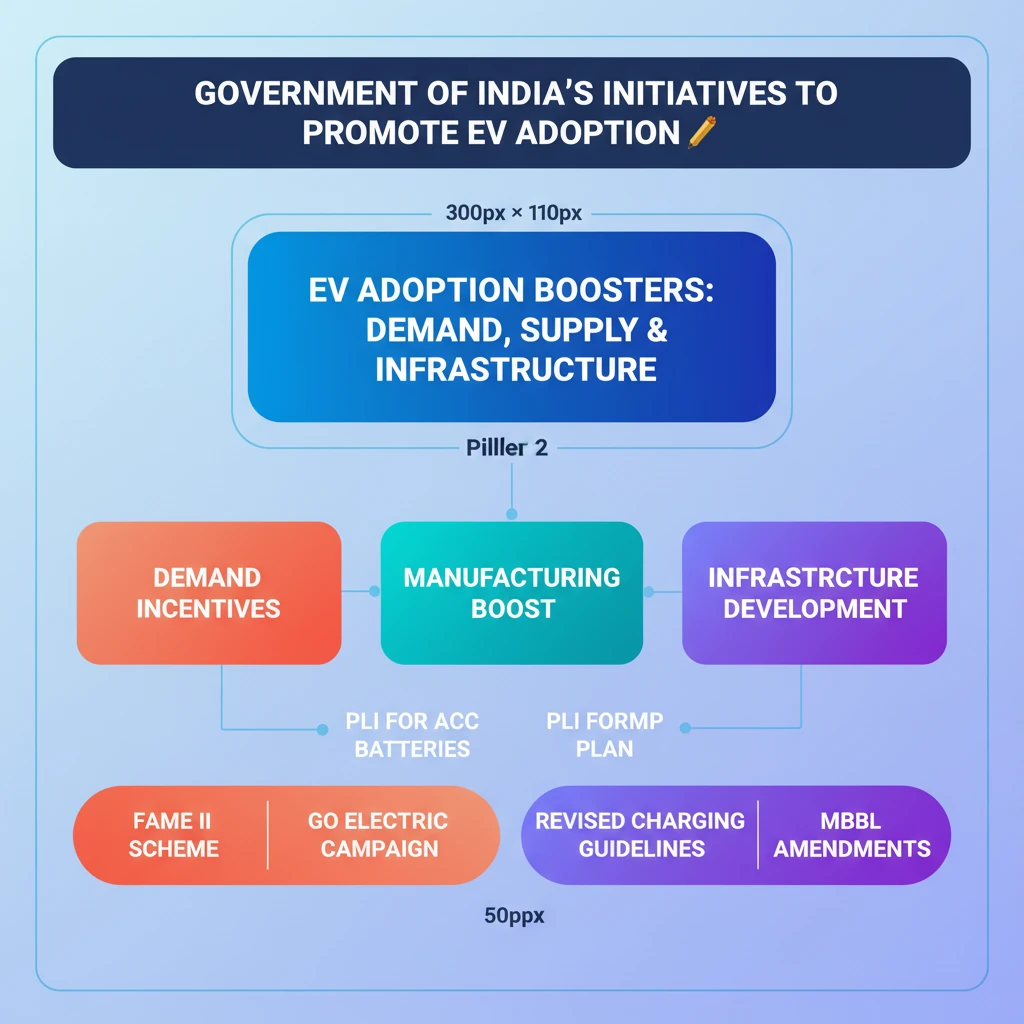
- •India's EV promotion involves demand incentives (FAME), manufacturing boosts (PLI), and infrastructure development.
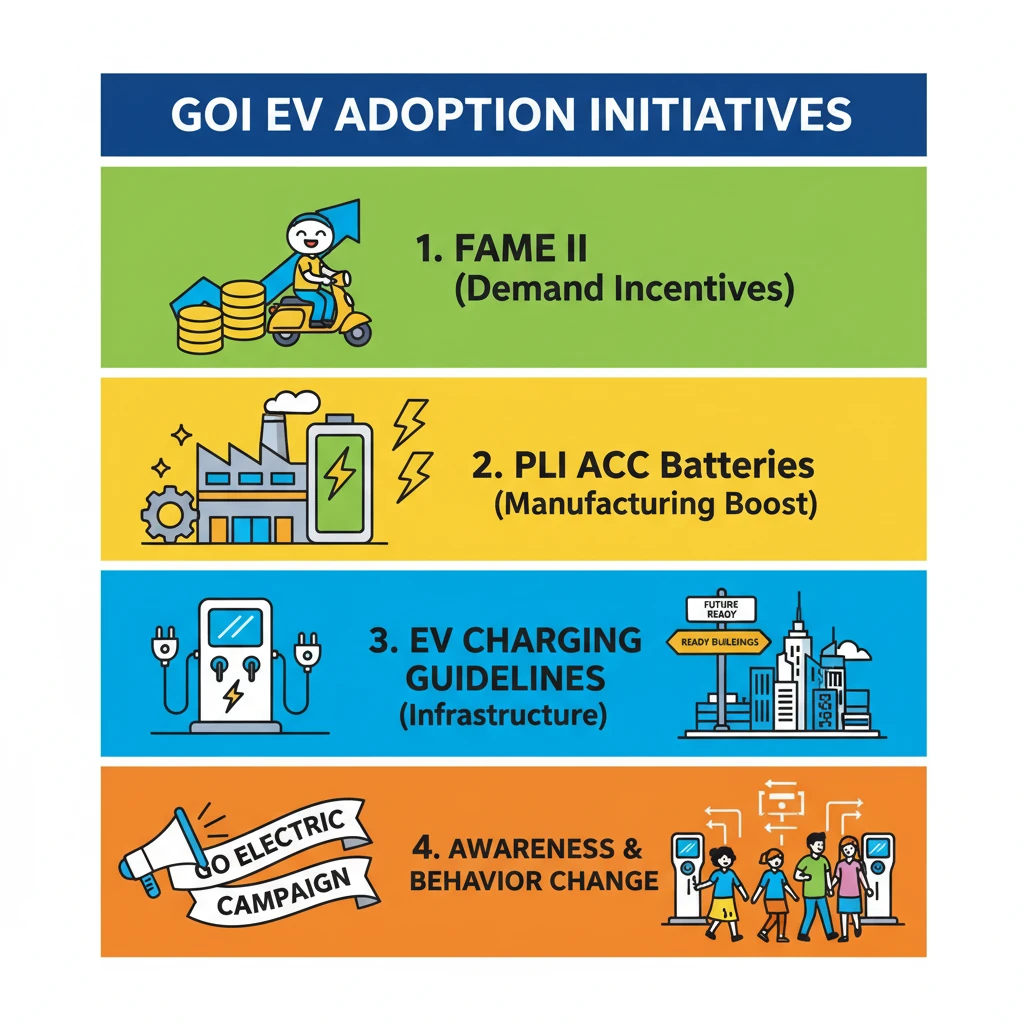
- •Key initiatives include FAME II, NEMMP, PLI for ACC batteries, and revised charging guidelines.
- •Regulatory changes like MBBL amendments ensure future-ready buildings for EV charging.
- •The 'Go Electric' campaign focuses on public awareness and behavioral change.
- •India supports global goals like EV30@30, aligning with climate commitments and energy security.
🧠 Memory Techniques
95% Verified Content
📚 Reference Sources
•Ministry of Heavy Industries (FAME India Scheme website)
•NITI Aayog reports on Electric Mobility
•Ministry of Power guidelines on EV Charging Infrastructure
•Press Information Bureau (PIB) releases on PLI schemes and Go Electric Campaign