How did Cooperatives Evolve in India? - Economy | UPSC Learning
Topics
0 topics • 0 completed
🔍
No topics match your search
How did Cooperatives Evolve in India?
Medium⏱️ 8 min read
economy
📖 Introduction
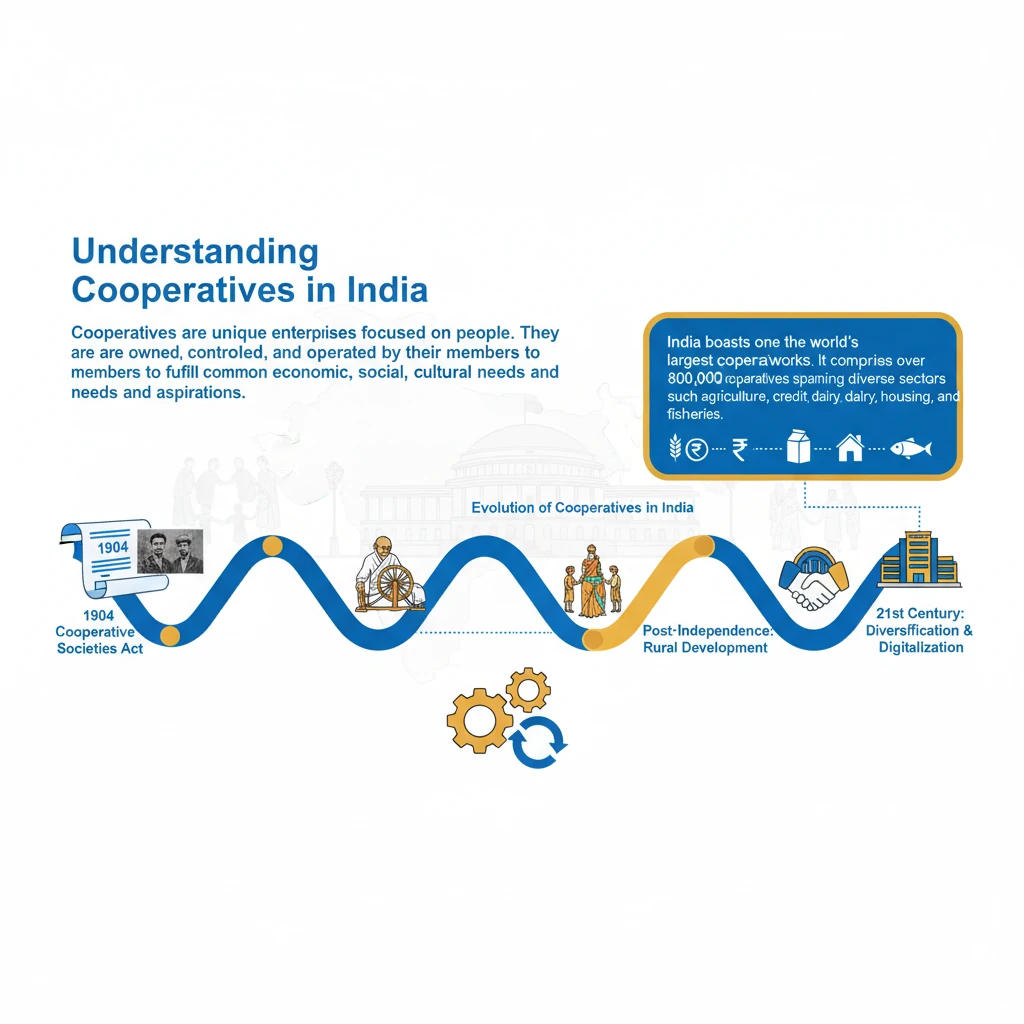
<h4>Understanding Cooperatives in India</h4><p><strong>Cooperatives</strong> are unique enterprises focused on people. They are owned, controlled, and operated by their members to fulfill common economic, social, and cultural needs and aspirations.</p><div class='info-box'><p>India boasts one of the world's <strong>largest cooperative networks</strong>. It comprises over <strong>800,000 cooperatives</strong> spanning diverse sectors such as agriculture, credit, dairy, housing, and fisheries.</p></div><div class='key-point-box'><p>The cooperative sector makes significant contributions to the Indian economy. Its involvement includes <strong>20% in agricultural loans</strong>, <strong>35% in fertilizer distribution</strong>, <strong>31% in sugar production</strong>, <strong>13% in wheat purchase</strong>, and <strong>20% in paddy purchase</strong>.</p></div><h4>Cooperatives in the Pre-Independence Era</h4><p>The foundation for cooperatives in India was laid in the early 20th century, driven by the need for rural credit and relief from indebtedness.</p><div class='info-box'><p>The <strong>Indian Famine Commission (1901)</strong> played a pivotal role. Its recommendations led to the enactment of the <strong>first Cooperative Credit Societies Act in 1904</strong>.</p></div><p>This initial act focused primarily on credit cooperatives. It was later followed by the more comprehensive <strong>Cooperative Societies Act, 1912</strong>, which expanded the scope to non-credit societies.</p><div class='info-box'><p>In <strong>1915</strong>, the government appointed the <strong>Maclagan Committee</strong>, headed by <strong>Sir Edward Maclagan</strong>. Its mandate was to assess the cooperative movement's economic and financial soundness.</p></div><p>The <strong>Montague-Chelmsford Reforms of 1919</strong> brought a significant change. They made <strong>'co-operation' a provincial subject</strong>, which provided a crucial impetus for the movement's growth and adaptation to local needs.</p><p>The economic downturn of the <strong>Poonam Committee Depression in 1929</strong> led to further scrutiny. Various committees were established in regions like <strong>Madras, Bombay, Travancore, Mysore, Gwalior, and Punjab</strong> to explore restructuring cooperative societies.</p><h4>Gandhian Philosophy and Cooperation</h4><p><strong>Mahatma Gandhi's socialist philosophy</strong> strongly advocated for cooperation. He viewed it as essential for creating a <strong>socialistic society</strong> and achieving complete <strong>decentralization of power</strong>.</p><div class='key-point-box'><p>Gandhi believed that cooperation was a vital tool for <strong>empowering people</strong>, fostering self-reliance, and promoting collective well-being.</p></div><p>A practical manifestation of his ideals was the establishment of the <strong>'Phoenix Settlement'</strong> in <strong>South Africa</strong>. He instituted it as a cooperative, embodying a socialistic pattern of living and working.</p>
💡 Key Takeaways
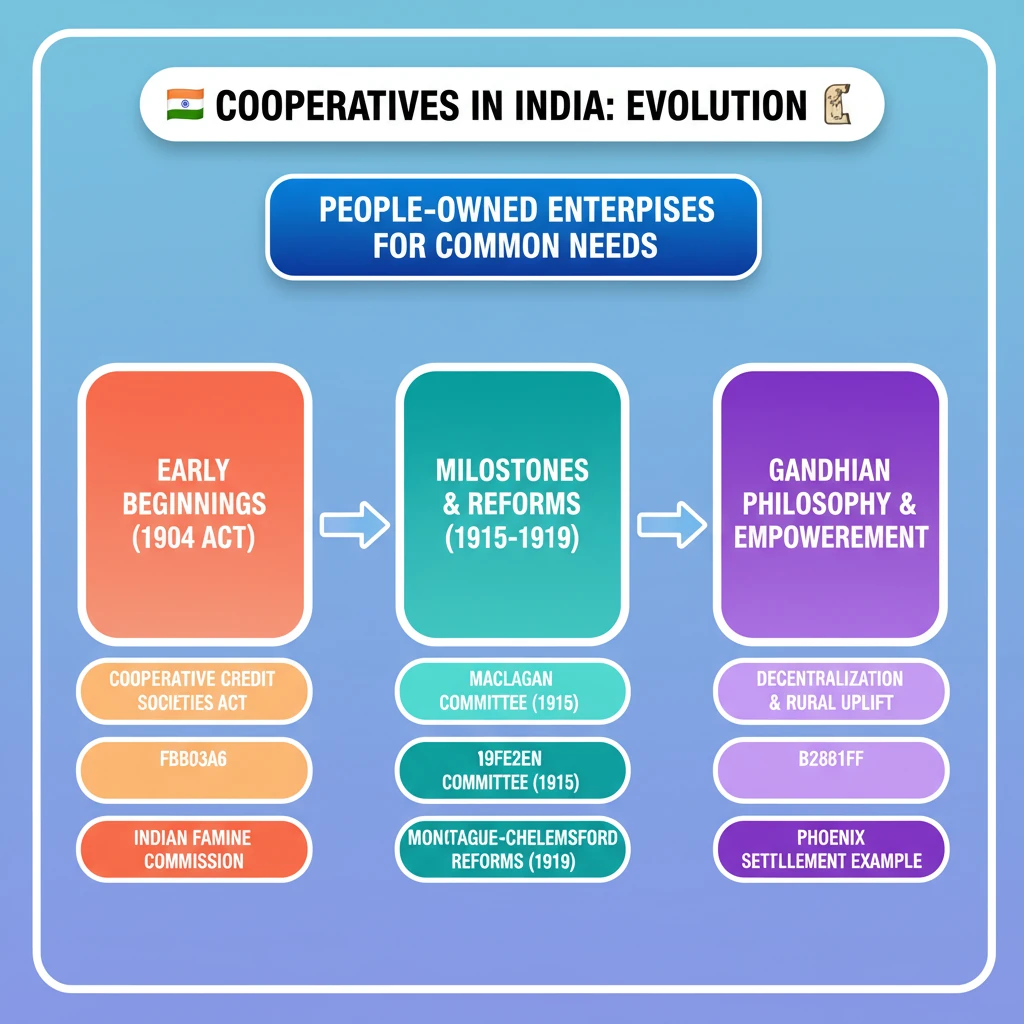
- •Cooperatives are people-centred, member-owned enterprises addressing common needs.
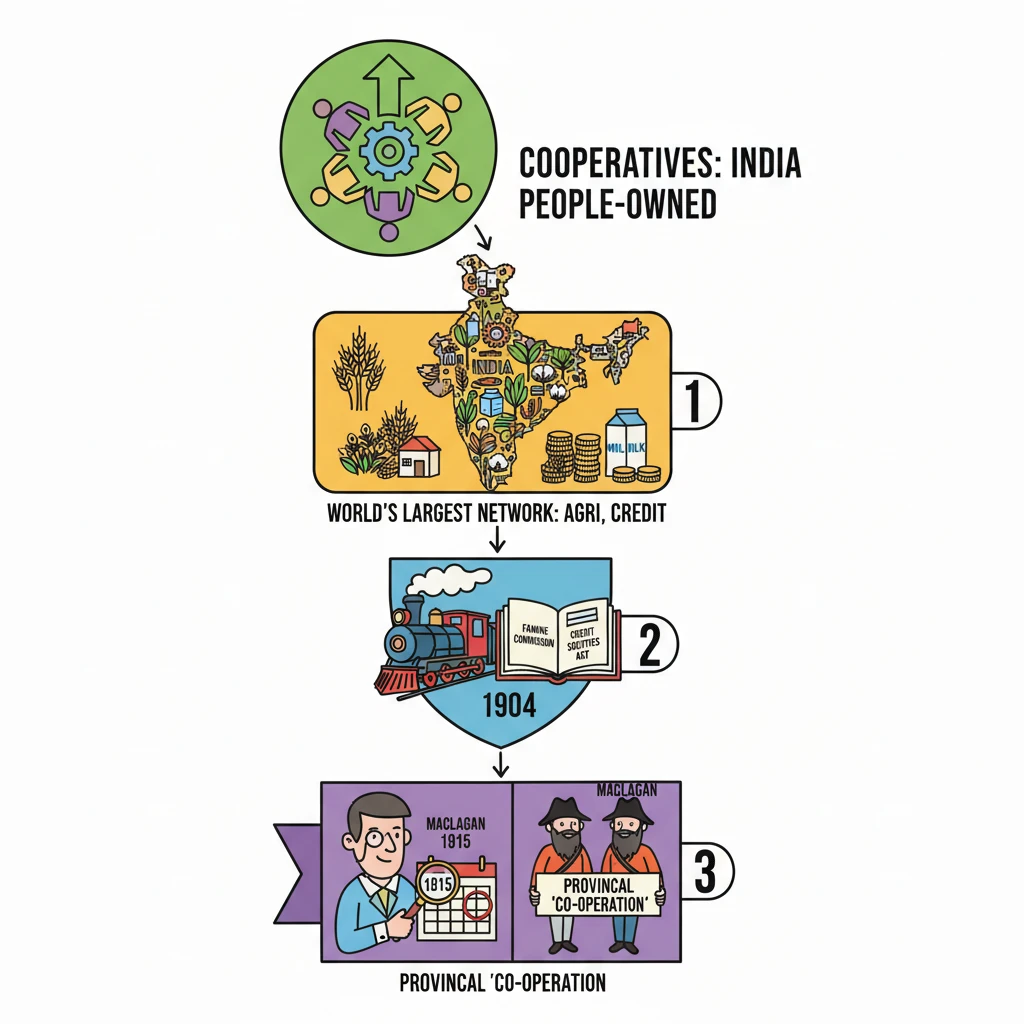
- •India has one of the world's largest cooperative networks, contributing significantly to agriculture, credit, and other sectors.
- •The movement began with the Cooperative Credit Societies Act of 1904, influenced by the Indian Famine Commission.
- •Key milestones include the Maclagan Committee (1915) and the provincialization of 'co-operation' by the Montague-Chelmsford Reforms (1919).
- •Gandhian philosophy championed cooperatives for decentralization and empowerment, exemplified by the Phoenix Settlement.
🧠 Memory Techniques
95% Verified Content