What are the Four Labour Codes? - Economy | UPSC Learning
Topics
0 topics • 0 completed
🔍
No topics match your search
What are the Four Labour Codes?
Medium⏱️ 7 min read
economy
📖 Introduction
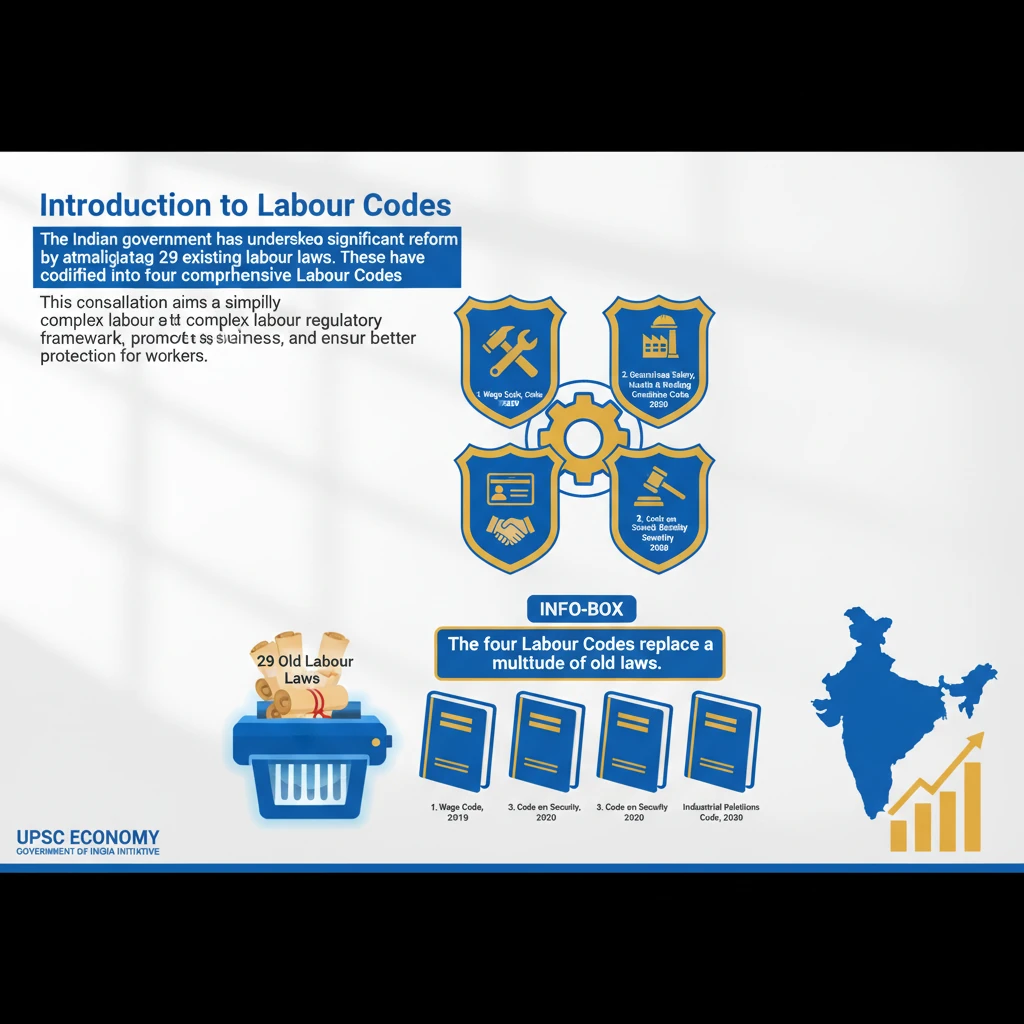
<h4>Introduction to Labour Codes</h4><p>The Indian government has undertaken a significant reform by <strong>amalgamating 29 existing labour laws</strong>. These have been codified into <strong>four comprehensive Labour Codes</strong>.</p><p>This consolidation aims to simplify the complex labour regulatory framework, promote <strong>ease of doing business</strong>, and ensure better protection for workers.</p><div class='info-box'>The <strong>four Labour Codes</strong> replace a multitude of older, often overlapping, and sometimes contradictory labour legislations.</div><h4>Code on Wages, 2019</h4><p>The <strong>Code on Wages, 2019</strong>, is designed to universalize the provisions related to <strong>minimum wages</strong> and <strong>timely payment</strong>. Its core objective is to ensure the <strong>“Right to Sustenance”</strong> for every worker in India.</p><p>It consolidates four existing laws: the <strong>Payment of Wages Act, 1936</strong>; the <strong>Minimum Wages Act, 1948</strong>; the <strong>Payment of Bonus Act, 1965</strong>; and the <strong>Equal Remuneration Act, 1976</strong>.</p><div class='key-point-box'>This Code mandates specific payment timelines: <strong>monthly salaried employees</strong> by the 7th of the following month, <strong>weekly wage workers</strong> by the week's end, and <strong>daily wage earners</strong> on the same day.</div><h4>Industrial Relations Code, 2020</h4><p>The <strong>Industrial Relations Code, 2020</strong>, provides a structured framework for managing industrial relations. It focuses on protecting workers' rights to form <strong>trade unions</strong>.</p><p>Furthermore, it seeks to reduce friction between employers and workers and establishes clear regulations for the <strong>settlement of industrial disputes</strong>.</p><div class='info-box'>This Code subsumes three key laws: the <strong>Trade Unions Act, 1926</strong>; the <strong>Industrial Employment (Standing Orders) Act, 1946</strong>; and the <strong>Industrial Disputes Act, 1947</strong>.</div><div class='key-point-box'>The primary aim is to foster <strong>industrial peace and harmony</strong> through effective and efficient resolution mechanisms for disputes.</div><h4>Code on Social Security, 2020</h4><p>The <strong>Code on Social Security, 2020</strong>, significantly expands the scope of social security benefits. It aims to include various categories of workers previously outside formal schemes.</p><p>This includes <strong>self-employed</strong>, <strong>home-based</strong>, <strong>wage workers</strong>, <strong>migrant workers</strong>, <strong>unorganised sector workers</strong>, and <strong>gig workers</strong>.</p><div class='info-box'>Key social security schemes covered include <strong>life and disability insurance</strong>, <strong>health and maternity benefits</strong>, and <strong>provident fund</strong> provisions.</div><div class='exam-tip-box'>UPSC often asks about the inclusion of <strong>gig workers</strong> and <strong>unorganised sector workers</strong> in social security nets, making this Code highly relevant for <strong>GS Paper II (Social Justice)</strong>.</div><h4>Occupational Safety, Health and Working Conditions Code, 2020</h4><p>The <strong>Occupational Safety, Health and Working Conditions Code, 2020</strong>, consolidates laws related to the health, safety, and welfare of workers. It emphasizes creating a safe working environment.</p><p>It applies to workers across diverse sectors such as <strong>industry</strong>, <strong>manufacturing</strong>, and <strong>factories</strong>.</p><div class='info-box'>This Code is specifically applicable to <strong>factories having 20 or more workers</strong> where the manufacturing process is carried on with the aid of power.</div><div class='key-point-box'>The Code aims to standardize and improve working conditions, preventing accidents and occupational diseases.</div>
💡 Key Takeaways
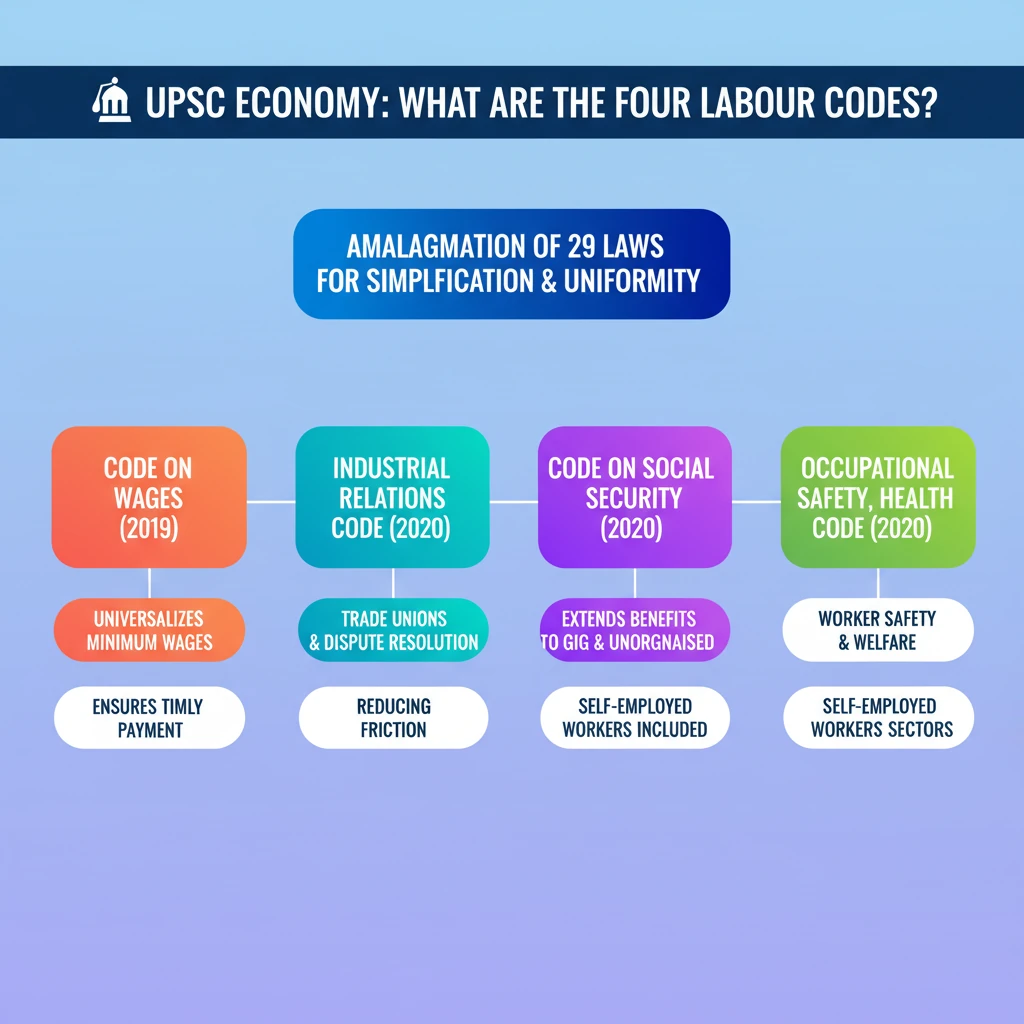
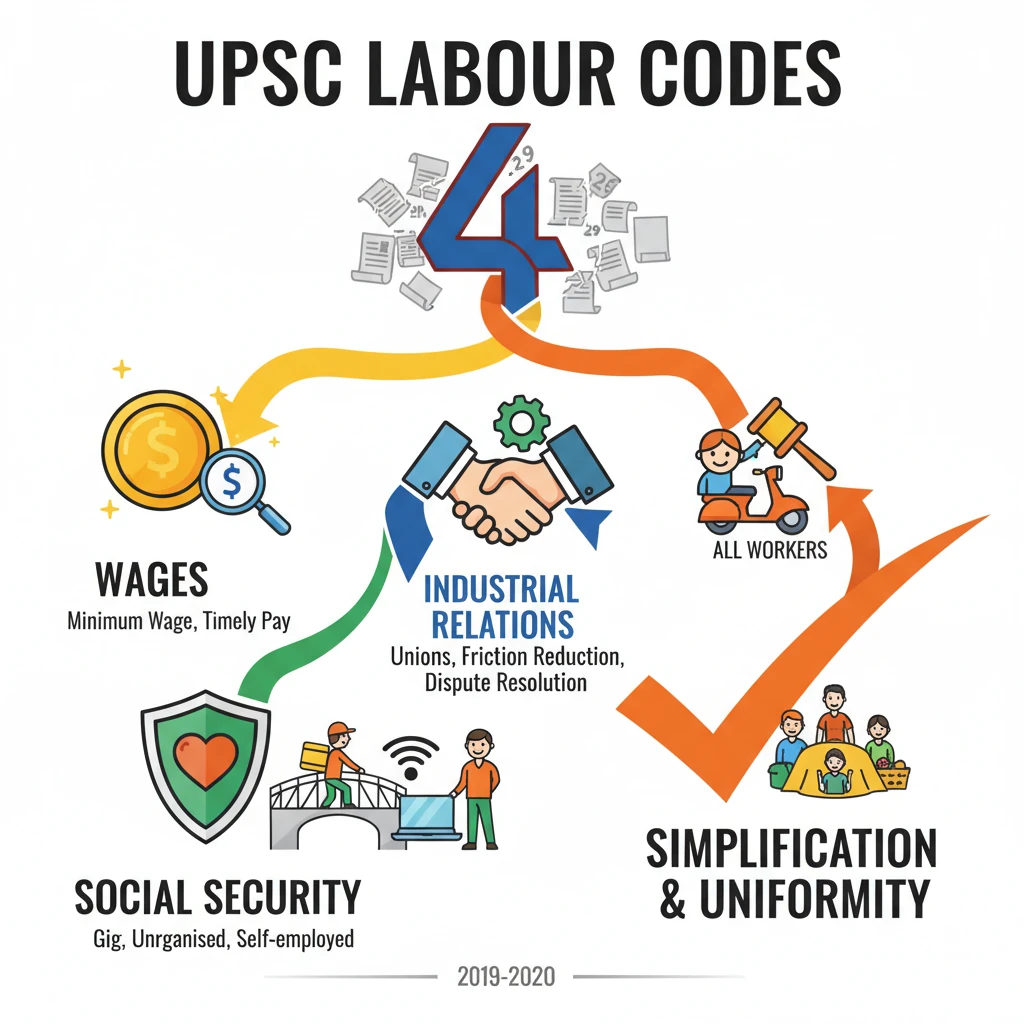
- •Four Labour Codes amalgamate 29 existing labour laws for simplification and uniformity.
- •Code on Wages (2019) universalizes minimum wages and ensures timely payment for all workers.
- •Industrial Relations Code (2020) focuses on trade unions, reducing friction, and efficient dispute resolution.
- •Code on Social Security (2020) extends social security benefits to self-employed, gig, and unorganised sector workers.
- •Occupational Safety, Health and Working Conditions Code (2020) emphasizes worker safety and welfare across various sectors.
- •The codes aim to balance worker protection with promoting ease of doing business and fostering industrial harmony.
🧠 Memory Techniques
95% Verified Content
📚 Reference Sources
•Press Information Bureau (PIB) releases on Labour Reforms
•Ministry of Labour & Employment official documents