Other Major Initiatives for Aviation Sector - Economy | UPSC Learning
Topics
0 topics • 0 completed
🔍
No topics match your search
Other Major Initiatives for Aviation Sector
Medium⏱️ 7 min read
economy
📖 Introduction
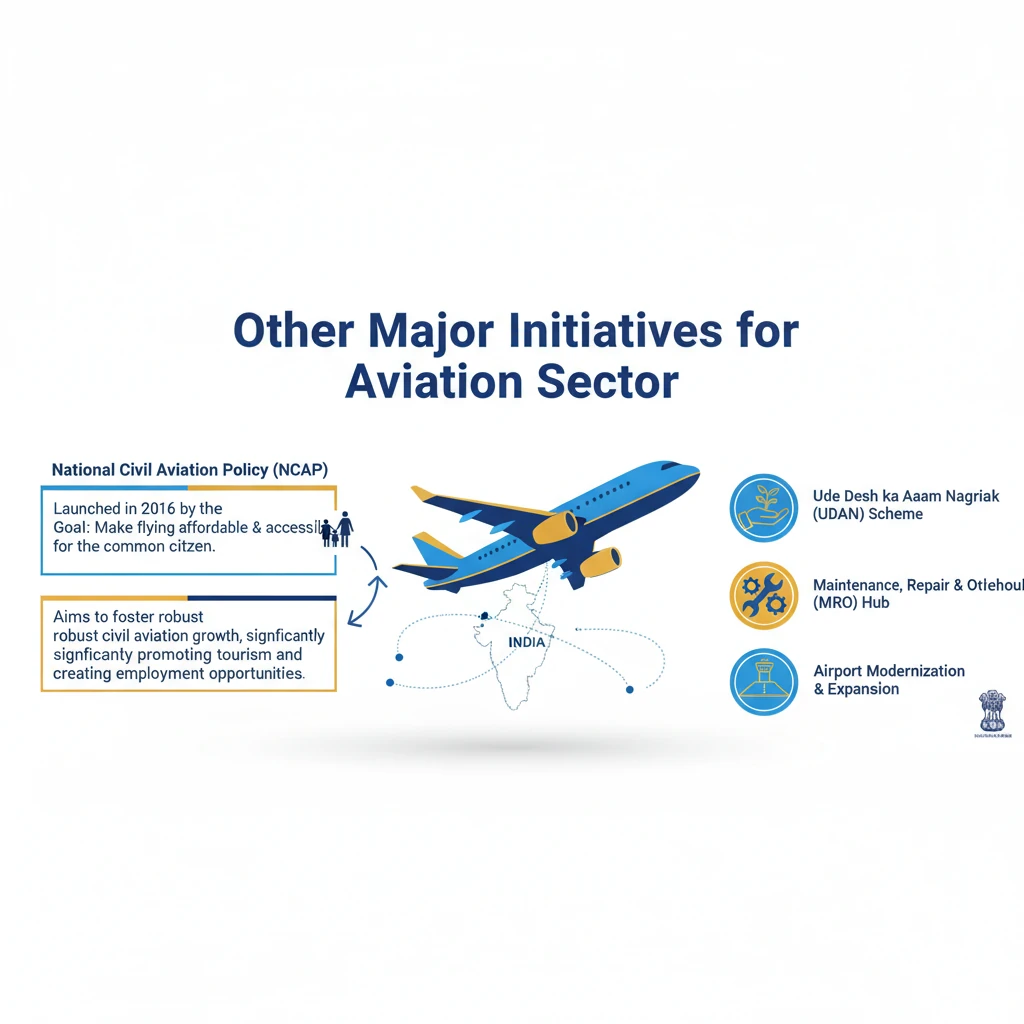
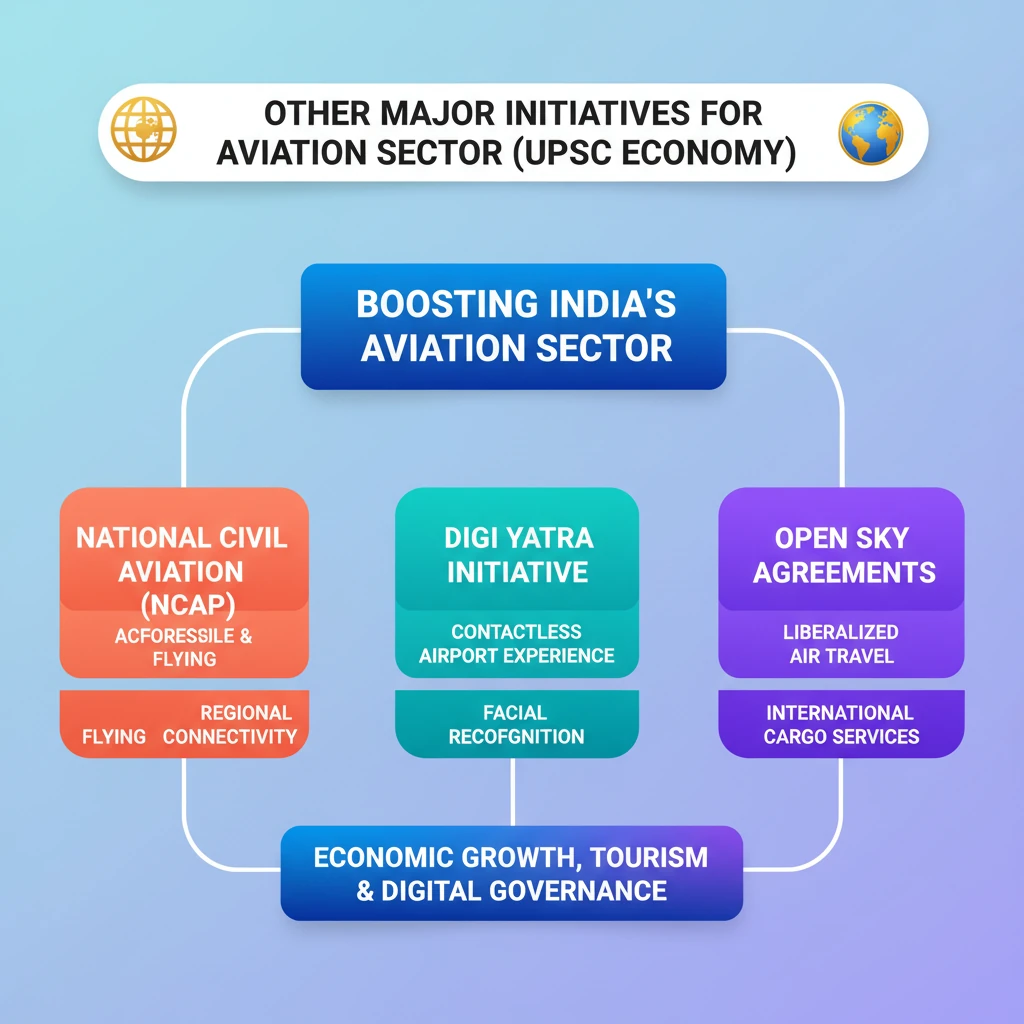
<h4>National Civil Aviation Policy (NCAP)</h4><p>The <strong>National Civil Aviation Policy (NCAP)</strong>, launched in <strong>2016</strong>, is a landmark initiative by the Government of India. Its primary goal is to make <strong>flying affordable</strong> and <strong>accessible</strong> for the common citizen across the nation.</p><div class='key-point-box'><p>NCAP aims to foster robust <strong>civil aviation growth</strong>, significantly promoting <strong>tourism</strong> and creating substantial <strong>employment opportunities</strong> within the sector.</p></div><p>A core objective of NCAP is to enhance <strong>regional connectivity</strong>. This is achieved through various mechanisms, including <strong>fiscal support</strong> and the development of essential <strong>infrastructure</strong> in underserved areas.</p><div class='info-box'><p>The policy also focuses on improving the <strong>ease of doing business</strong> within the aviation sector. This involves strategic <strong>deregulation</strong> and leveraging <strong>e-governance</strong> solutions to streamline processes and reduce bureaucratic hurdles.</p></div><h4>Open Sky Agreement</h4><p>An <strong>Open Sky Agreement</strong> represents a crucial bilateral pact between two sovereign countries. These agreements are pivotal in liberalizing the international aviation market.</p><div class='info-box'><p>Under an <strong>Open Sky Agreement</strong>, the signatory nations negotiate to allow airlines from both sides to operate an unlimited number of flights. This covers both <strong>international passenger</strong> and <strong>cargo services</strong> between their respective territories.</p></div><div class='key-point-box'><p>The fundamental principle is to remove restrictions on capacity, frequency, and routing, thereby fostering greater competition and consumer choice in international air travel and freight.</p></div><h4>Digi Yatra for Seamless Travel</h4><p><strong>Digi Yatra</strong> is a transformative digital platform designed to revolutionize the air travel experience in India. It aims to provide a completely <strong>contactless experience</strong> for air travellers from entry to boarding.</p><div class='info-box'><p>Key features of <strong>Digi Yatra</strong> include advanced <strong>facial recognition technology</strong>. This allows passengers to move through various airport checkpoints without the need for physical documents.</p></div><p>The initiative promotes <strong>paperless check-in</strong> and security procedures. By linking a passenger's identity with their boarding pass, it significantly reduces wait times and enhances operational efficiency at airports.</p><div class='exam-tip-box'><p><strong>UPSC Insight:</strong> These initiatives are crucial for understanding India's economic growth drivers (<strong>GS Paper III</strong>), infrastructure development, and digital governance efforts (<strong>GS Paper II</strong>). Be prepared to discuss their objectives, implementation, and impact on various stakeholders.</p></div>
💡 Key Takeaways
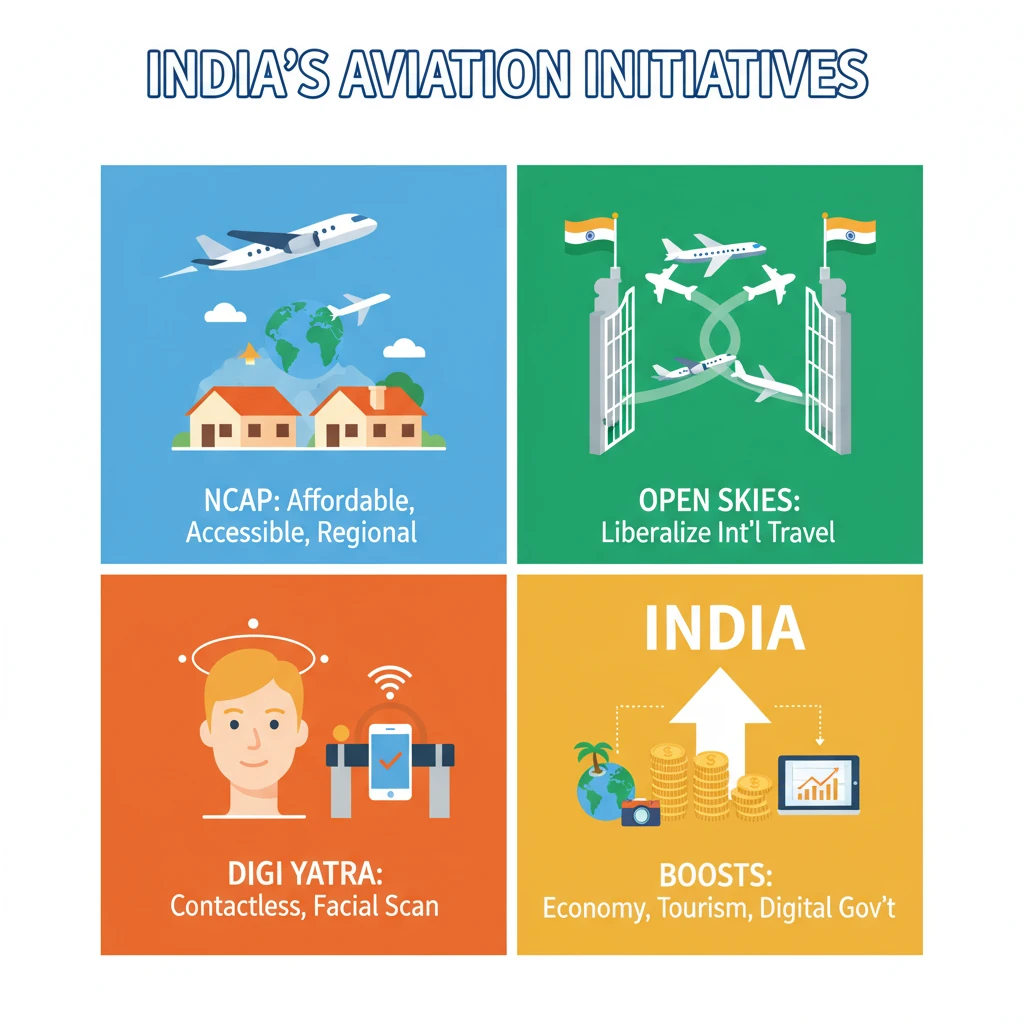
- •NCAP aims for affordable, accessible flying, regional connectivity, and ease of business.
- •Open Sky Agreements liberalize international air travel and cargo services between two nations.
- •Digi Yatra provides a contactless, paperless airport experience using facial recognition.
- •These initiatives collectively boost economic growth, tourism, and digital governance in India.
- •They are crucial for India's infrastructure development and global connectivity.
🧠 Memory Techniques
95% Verified Content
📚 Reference Sources
•Ministry of Civil Aviation (MoCA) - National Civil Aviation Policy 2016 document
•Press Information Bureau (PIB) releases on Digi Yatra and Open Sky Agreements
•Airports Authority of India (AAI) reports