Gross Value Added (GVA) - Economy | UPSC Learning
Topics
0 topics • 0 completed
🔍
No topics match your search
Gross Value Added (GVA)
Medium⏱️ 7 min read
economy
📖 Introduction
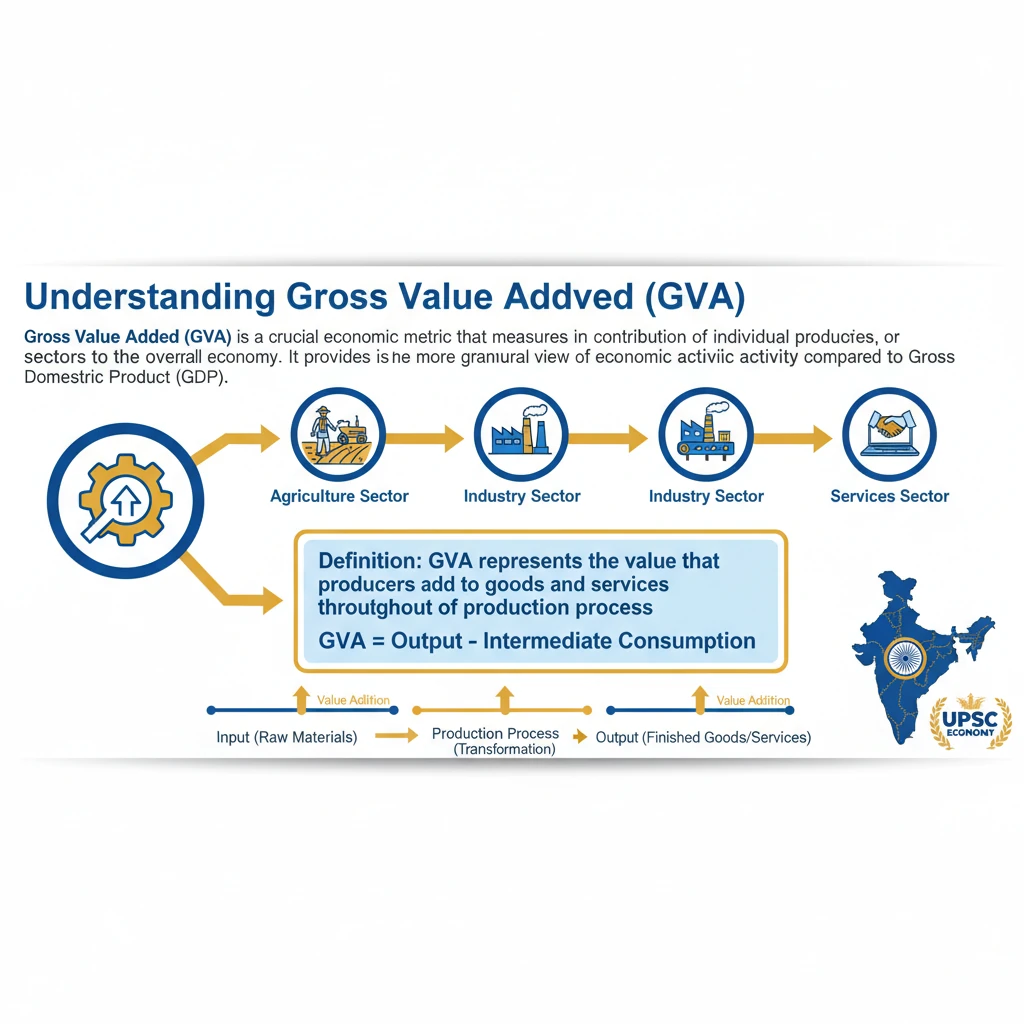
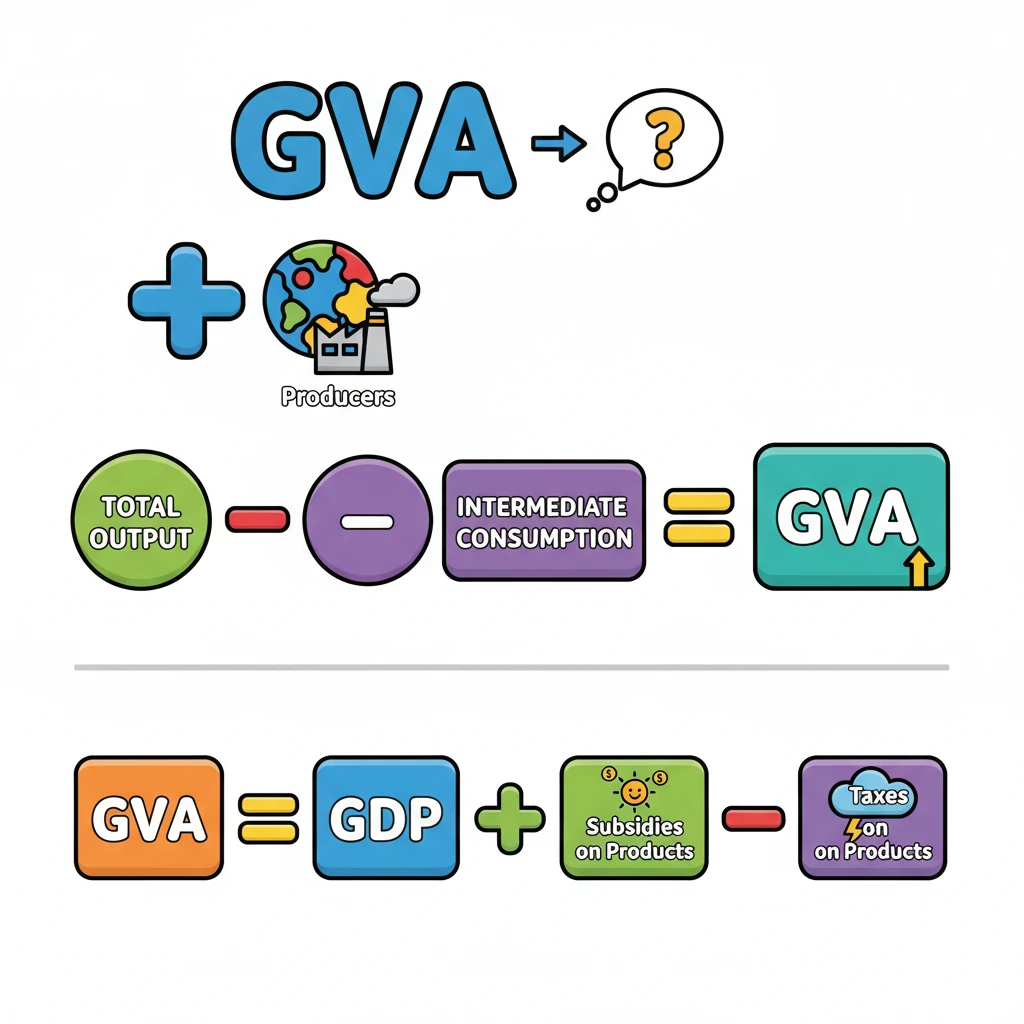
<h4>Understanding Gross Value Added (GVA)</h4><p><strong>Gross Value Added (GVA)</strong> is a crucial economic metric that measures the contribution of individual producers, industries, or sectors to the overall economy. It provides a more granular view of economic activity compared to <strong>Gross Domestic Product (GDP)</strong>.</p><div class='info-box'><p><strong>Definition:</strong> <strong>GVA</strong> represents the value that producers add to goods and services throughout the <strong>production process</strong>. It quantifies the output generated by each sector after deducting the cost of inputs.</p></div><h4>Calculation of GVA</h4><p>The calculation of <strong>GVA</strong> is fundamental to understanding its nature. It focuses on the value created at each stage of production, rather than just the final output price.</p><div class='info-box'><p><strong>Basic Formula:</strong> GVA is calculated by subtracting the <strong>cost of inputs</strong> (also known as <strong>intermediate consumption</strong>) from the <strong>total output</strong> generated by a sector or economy.</p><ul><li><strong>Total Output:</strong> This includes the value of all goods and services produced.</li><li><strong>Intermediate Consumption:</strong> These are goods and services used up in the process of producing other goods and services (e.g., raw materials, fuel).</li></ul></div><h4>GVA and GDP: The Relationship</h4><p><strong>GVA</strong> is intricately linked with <strong>Gross Domestic Product (GDP)</strong>, which is the total monetary value of all finished goods and services produced within a country's borders in a specific time period.</p><div class='key-point-box'><p><strong>Key Relationship:</strong> GVA is a key component of GDP. The difference primarily lies in how indirect taxes and subsidies are treated.</p></div><div class='info-box'><p><strong>GVA-GDP Formula:</strong> The relationship between GVA and GDP can be expressed as:</p><p><strong>GVA = GDP + subsidies on products – taxes on products</strong></p><p>Conversely, <strong>GDP = GVA + taxes on products – subsidies on products</strong>.</p></div><h4>Significance of GVA Growth Rates</h4><p>Monitoring <strong>GVA growth rates</strong> offers invaluable insights into the health and performance of different sectors within an economy. This disaggregated view is essential for informed decision-making.</p><div class='key-point-box'><p><strong>Sectoral Performance:</strong> GVA growth rates provide clear insights into the performance of specific sectors like agriculture, manufacturing, or services. This helps identify which sectors are driving or hindering <strong>economic growth</strong>.</p></div><div class='exam-tip-box'><p><strong>UPSC Insight:</strong> For UPSC Mains (<strong>GS Paper III - Economy</strong>), understanding GVA helps in analyzing economic trends, evaluating government policies, and critically assessing reports from bodies like the <strong>National Statistical Office (NSO)</strong> or the <strong>Reserve Bank of India (RBI)</strong>. It's often used in questions related to national income accounting and economic reforms.</p></div><p>This detailed sectoral analysis aids significantly in <strong>economic analysis</strong> and the formulation of targeted <strong>policymaking</strong>. Governments can use GVA data to direct resources, provide incentives, or address bottlenecks in underperforming sectors.</p>
💡 Key Takeaways
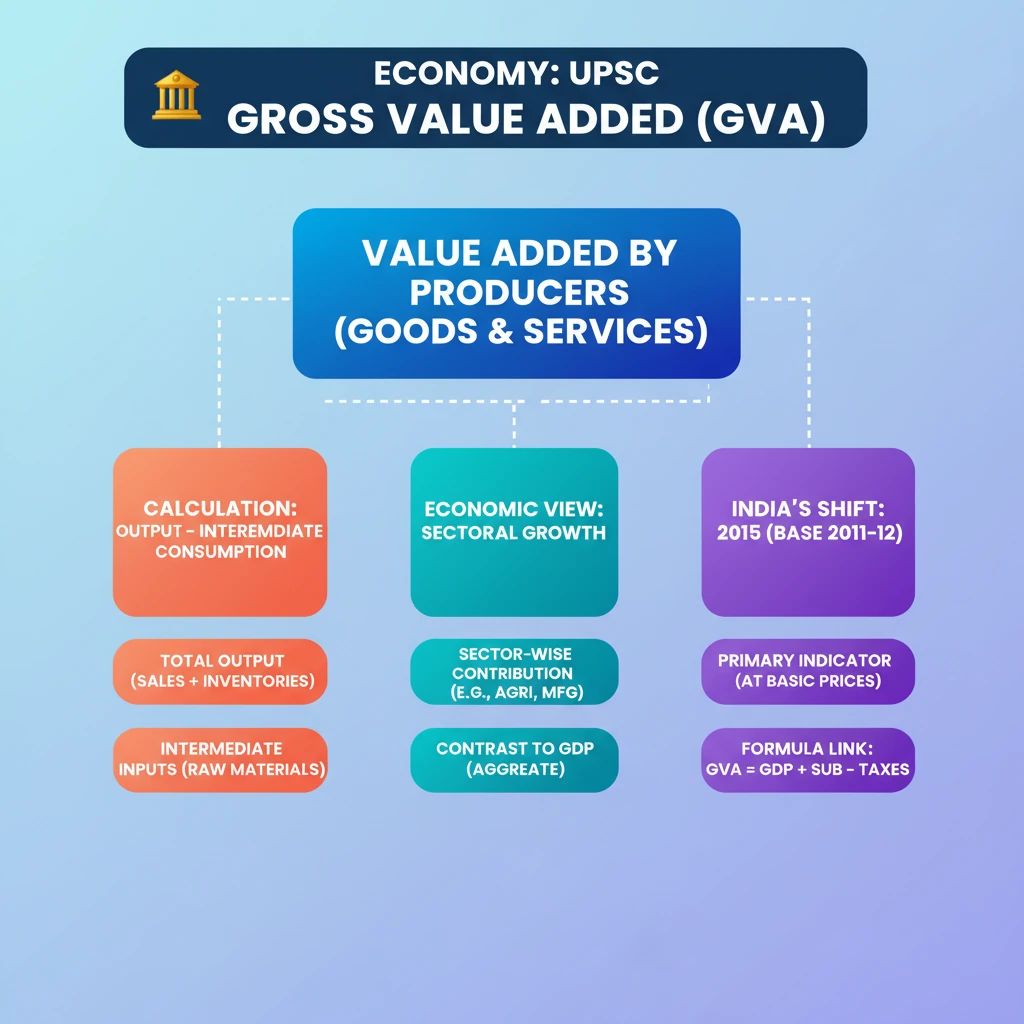
- •GVA measures the value added by producers to goods and services.
- •It is calculated as Total Output minus Intermediate Consumption.
- •GVA provides a sectoral view of economic growth, unlike GDP's aggregate view.
- •The formula linking GVA and GDP is: GVA = GDP + Subsidies on Products – Taxes on Products.
- •India shifted to using GVA at basic prices as a primary economic indicator in 2015 (base year 2011-12).
- •GVA is crucial for policymaking, sectoral analysis, and RBI's monetary policy decisions.
🧠 Memory Techniques
98% Verified Content
📚 Reference Sources
•National Statistical Office (NSO), Ministry of Statistics and Programme Implementation (MoSPI) reports
•Reserve Bank of India (RBI) publications and policy statements
•Economic Survey of India