Periodic Labour Force Survey (PLFS) Report - Economy | UPSC Learning
Topics
0 topics • 0 completed
🔍
No topics match your search
Periodic Labour Force Survey (PLFS) Report
Medium⏱️ 8 min read
economy
📖 Introduction
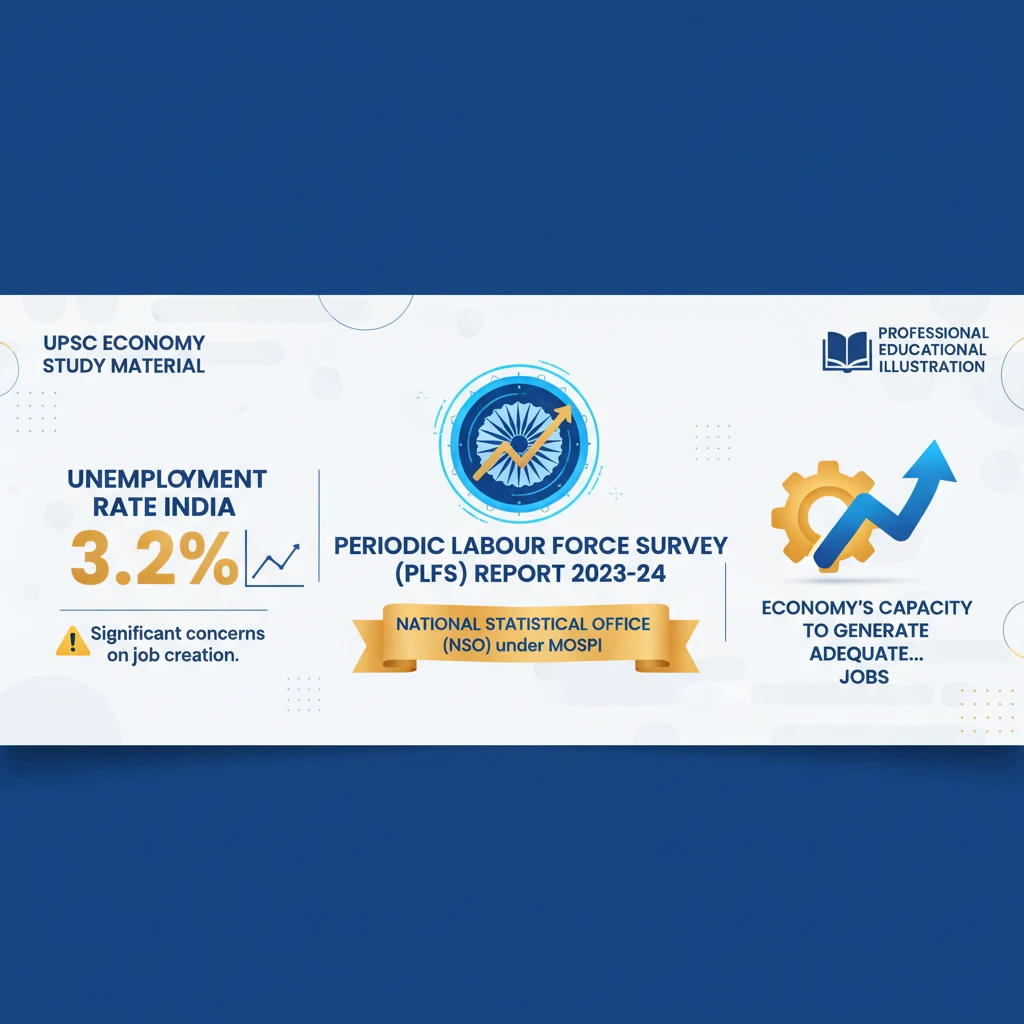
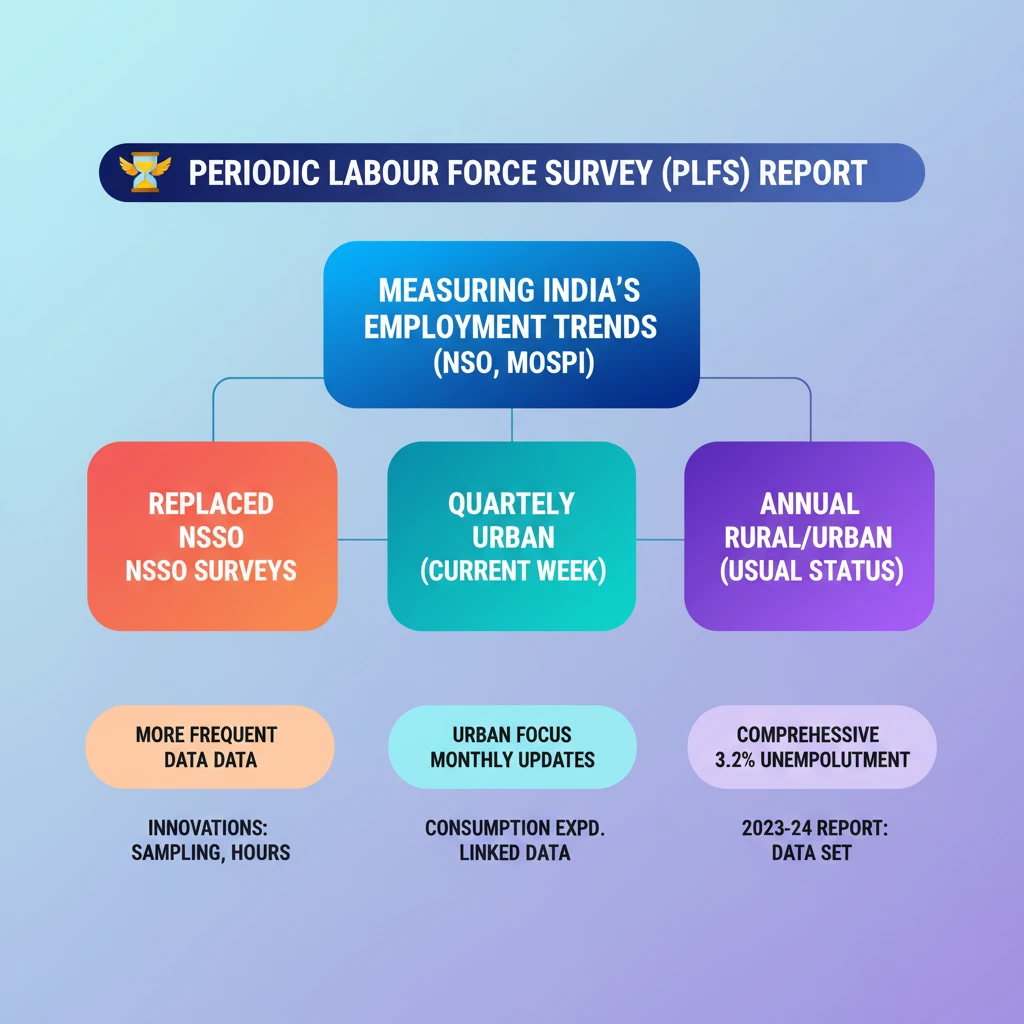
<h4>Introduction to the PLFS Report</h4><p>The <strong>National Statistical Office (NSO)</strong>, under the <strong>Ministry of Statistics and Programme Implementation (MOSPI)</strong>, recently released its annual <strong>Periodic Labour Force Survey (PLFS) report 2023-24</strong>.</p><p>This report indicated that the <strong>unemployment rate</strong> in India has stagnated at <strong>3.2%</strong>. This finding raises significant concerns regarding the economy's capacity to generate an adequate number of <strong>formal jobs</strong>.</p><h4>What is the Periodic Labour Force Survey (PLFS)?</h4><p>The <strong>PLFS</strong> is a crucial survey conducted by the <strong>NSO</strong> to comprehensively measure the <strong>employment and unemployment situation</strong> across India.</p><div class='info-box'><p><strong>Conducted by:</strong> National Statistical Office (NSO)</p><p><strong>Under:</strong> Ministry of Statistics and Programme Implementation (MOSPI)</p><p><strong>Purpose:</strong> To measure employment and unemployment in India.</p></div><p>It was specifically developed to overcome the limitations observed in earlier labour force surveys that were conducted by the erstwhile <strong>National Sample Survey Office (NSSO)</strong>.</p><h4>Primary Objectives of PLFS</h4><p>The <strong>PLFS</strong> was designed with two distinct and major objectives to effectively measure <strong>employment and unemployment dynamics</strong>:</p><ol><li><strong>First Objective:</strong> To measure the dynamics of <strong>labour force participation</strong> and <strong>employment status</strong> at short, frequent intervals (specifically, every three months) for <strong>urban areas</strong>. This is achieved using the <strong>Current Weekly Status (CWS)</strong> approach.</li><li><strong>Second Objective:</strong> To provide comprehensive <strong>labour force estimates</strong> for both <strong>rural and urban areas</strong>. This objective utilizes both the <strong>Usual Status</strong> and <strong>Current Weekly Status (CWS)</strong> parameters.</li></ol><h4>Innovations in PLFS Design and Data Collection</h4><p>The introduction of the <strong>PLFS</strong> brought about several significant innovations compared to previous surveys.</p><div class='key-point-box'><p>The <strong>PLFS</strong> introduced notable changes in its <strong>sampling design</strong> and the overall structure of its <strong>schedule of inquiry</strong>. These were improvements over the quinquennial surveys previously conducted by the <strong>NSSO</strong>.</p></div><p>Furthermore, the <strong>PLFS</strong> expanded the scope of data collection. It began to include additional critical data points, such as the <strong>number of hours worked</strong> by individuals, which was not collected in the earlier quinquennial rounds carried out by the <strong>NSSO</strong>.</p><div class='exam-tip-box'><p>Understanding the <strong>objectives</strong> and <strong>methodological innovations</strong> of <strong>PLFS</strong> is crucial for <strong>UPSC Mains GS Paper III (Indian Economy)</strong>. Questions often test the understanding of key economic indicators and their evolution.</p></div>
💡 Key Takeaways
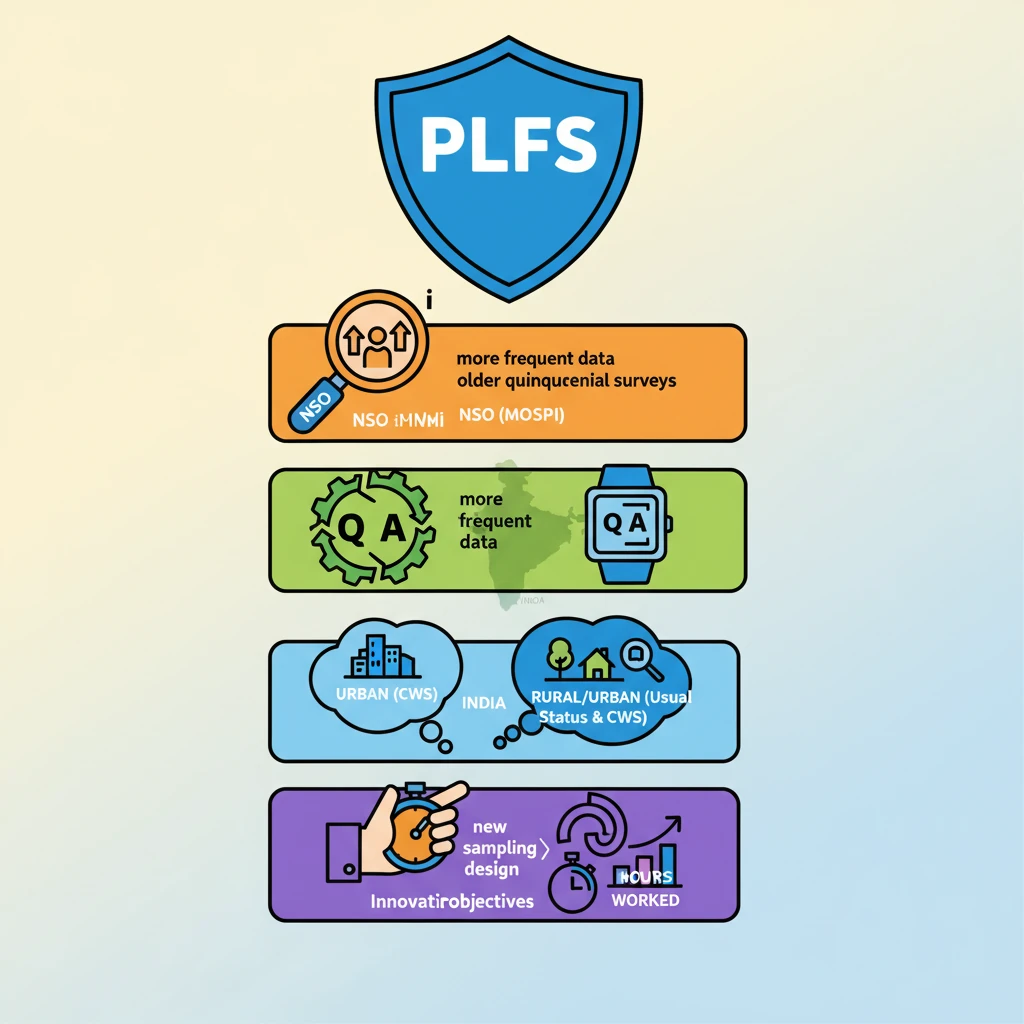
- •PLFS is conducted by NSO (MOSPI) to measure employment/unemployment in India.
- •It replaced older NSSO quinquennial surveys, offering more frequent data.
- •Two main objectives: quarterly urban estimates (CWS) and annual rural/urban estimates (Usual Status & CWS).
- •Innovations include changes in sampling design and collection of 'hours worked' data.
- •The 2023-24 report showed unemployment stagnating at 3.2%, raising concerns about formal job creation.
- •PLFS data is crucial for policy formulation and assessing economic performance.
🧠 Memory Techniques
95% Verified Content
📚 Reference Sources
•Press Information Bureau (PIB) releases on PLFS
•Economic Survey of India (various editions)