What is the Status of India’s Toy Industry? - Economy | UPSC Learning
Topics
0 topics • 0 completed
🔍
No topics match your search
What is the Status of India’s Toy Industry?
Medium⏱️ 6 min read
economy
📖 Introduction
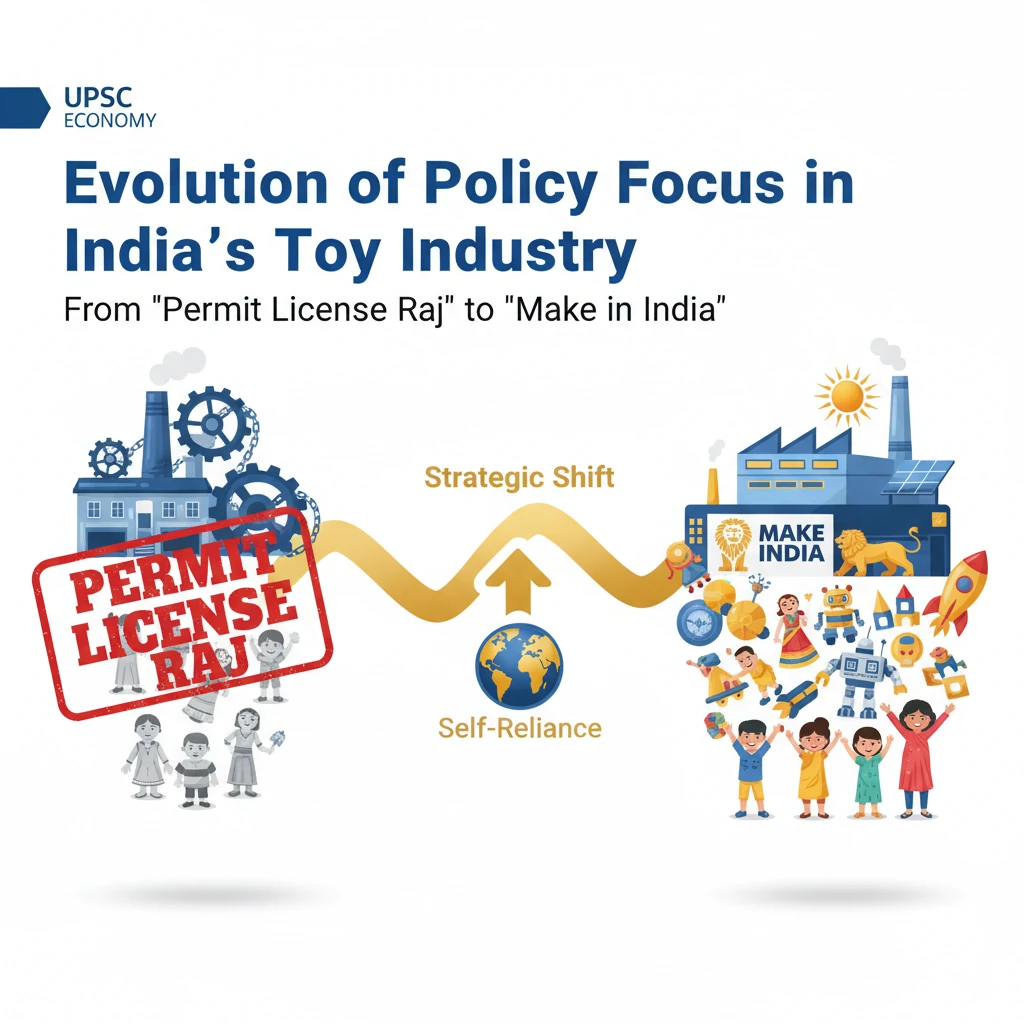
<h4>Evolution of Policy Focus in India's Toy Industry</h4><p>India's policy discussions regarding the toy industry have undergone a significant transformation. Historically, the sector operated under the restrictive <strong>'permit license raj'</strong> era, characterized by stringent regulations and controls.</p><p>Currently, the focus has shifted dramatically towards promoting domestic manufacturing and self-reliance through initiatives like <strong>'Make in India'</strong>. This strategic pivot aims to boost local production and reduce dependence on imports.</p><div class='exam-tip-box'><p><strong>UPSC Insight:</strong> Understanding the transition from 'permit license raj' to 'Make in India' provides crucial context for questions on industrial policy evolution and economic reforms.</p></div><h4>Impact of 'Make in India' Initiative</h4><p>A recent study highlights the positive impact of <strong>'Make in India'</strong> initiatives on the toy industry. These policies have been instrumental in fostering a more conducive environment for domestic manufacturers.</p><div class='key-point-box'><p>The success of the industry in recent years is directly attributed to the strategic interventions and support provided under the <strong>'Make in India'</strong> framework.</p></div><h4>Positive Shift in Trade Balance</h4><p>A remarkable change has been observed in India's toy industry <strong>trade balance</strong>. In <strong>2014-15</strong>, the sector recorded a negative trade balance of <strong>Rs. 1,500 crore</strong>, indicating higher imports than exports.</p><p>However, from <strong>2020-21</strong> onwards, the trade balance turned positive, signifying a reversal of this trend. This shift demonstrates growing domestic production and reduced reliance on foreign toys.</p><div class='info-box'><p><strong>Trade Balance Evolution:</strong><ul><li><strong>2014-15:</strong> Negative <strong>Rs. 1,500 crore</strong></li><li><strong>2020-21 onwards:</strong> Positive Trade Balance</li></ul></p></div><h4>Factors Driving Positive Trade Balance</h4><p>Several key measures contributed to this positive shift in the trade balance:</p><ul><li><strong>Increased Import Duty:</strong> In <strong>February 2020</strong>, the import duty on toys was significantly raised from <strong>20% to 60%</strong>, making imported toys more expensive and less competitive.</li><li><strong>Non-Tariff Barriers:</strong> Implementation of non-tariff barriers, such as the <strong>Quality Control Order (QCO)</strong> and mandatory sample testing, ensured that imported toys met specific quality and safety standards.</li><li><strong>COVID-19 Disruptions:</strong> Global supply chain disruptions caused by the <strong>COVID-19 pandemic</strong> also impacted toy imports worldwide, indirectly benefiting domestic production.</li></ul><h4>Decline in Net Exports (2022-23)</h4><p>Despite the protective measures like high import duty, India's <strong>net exports</strong> of toys witnessed a decline in <strong>2022-23</strong>. The net exports fell from <strong>Rs. 1,614 crore</strong> to <strong>Rs. 1,319 crore</strong>.</p><p>This reduction was more pronounced for specific categories of toys, showing a <strong>31% decline</strong>, compared to an <strong>18% decline</strong> for all toys collectively. This indicates persistent challenges in boosting export competitiveness.</p><div class='info-box'><p><strong>Net Exports Decline (2022-23):</strong><ul><li><strong>Previous Net Exports:</strong> <strong>Rs. 1,614 crore</strong></li><li><strong>Current Net Exports:</strong> <strong>Rs. 1,319 crore</strong></li><li><strong>Decline for Specific Toys:</strong> <strong>31%</strong></li><li><strong>Decline for All Toys:</strong> <strong>18%</strong></li></ul></p></div>
💡 Key Takeaways
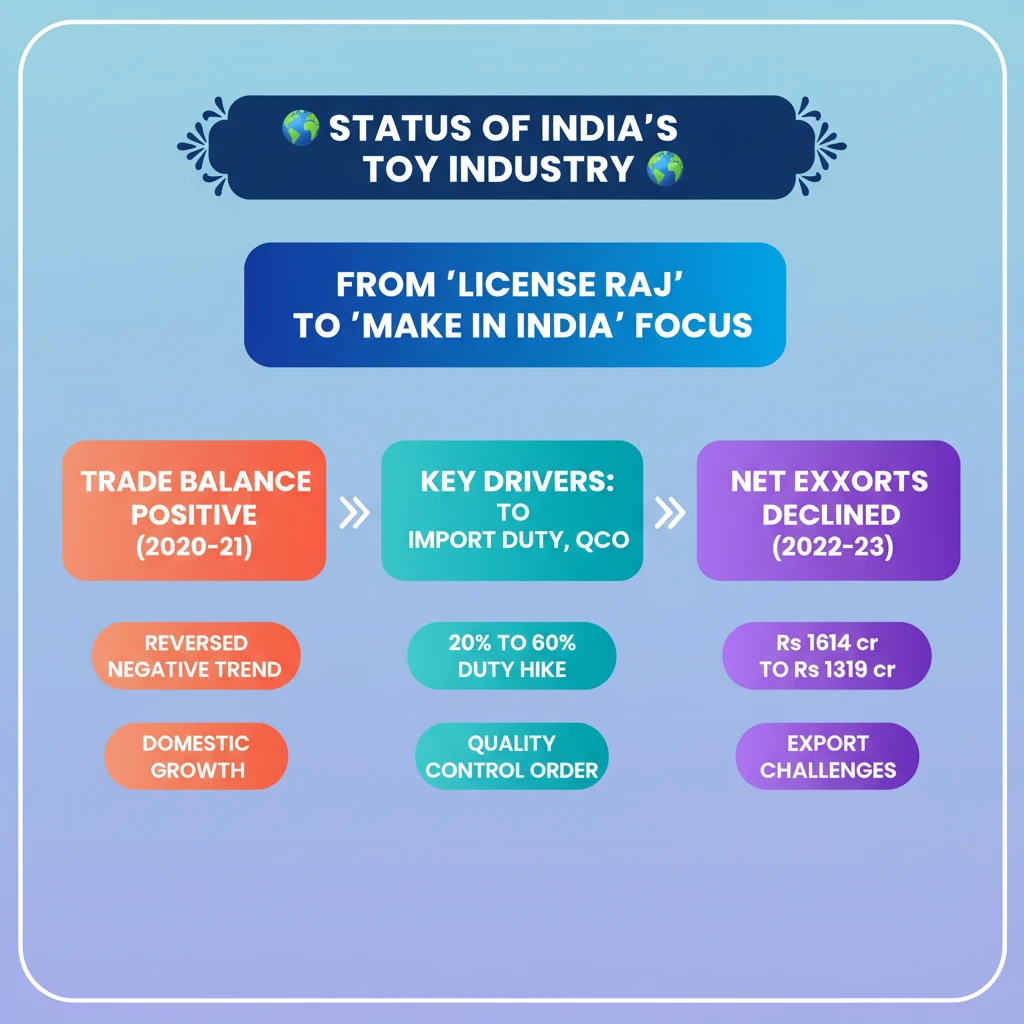
- •India's toy industry has transitioned from 'permit license raj' to 'Make in India' focus.
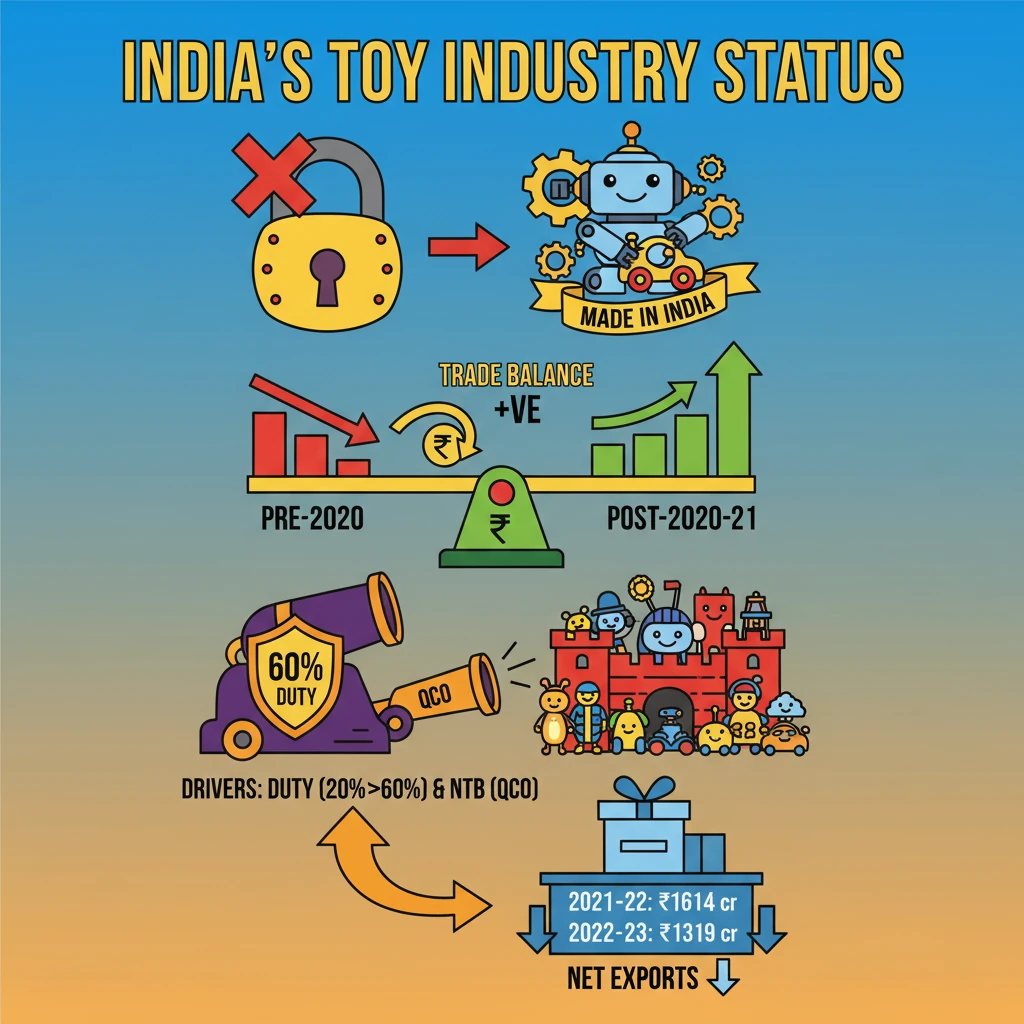
- •Trade balance for toys turned positive from 2020-21, reversing a negative trend.
- •Key drivers for positive trade balance include increased import duty (20% to 60%) and Non-Tariff Barriers (QCO).
- •Despite protective measures, net exports of toys declined in 2022-23 (from Rs. 1,614 cr to Rs. 1,319 cr).
- •The decline in net exports highlights persistent challenges in export competitiveness despite domestic growth.
🧠 Memory Techniques
98% Verified Content