What are Union Budget Announcements in the Renewable Energy Sector? - Economy | UPSC Learning
Topics
0 topics • 0 completed
🔍
No topics match your search
What are Union Budget Announcements in the Renewable Energy Sector?
Medium⏱️ 10 min read
economy
📖 Introduction
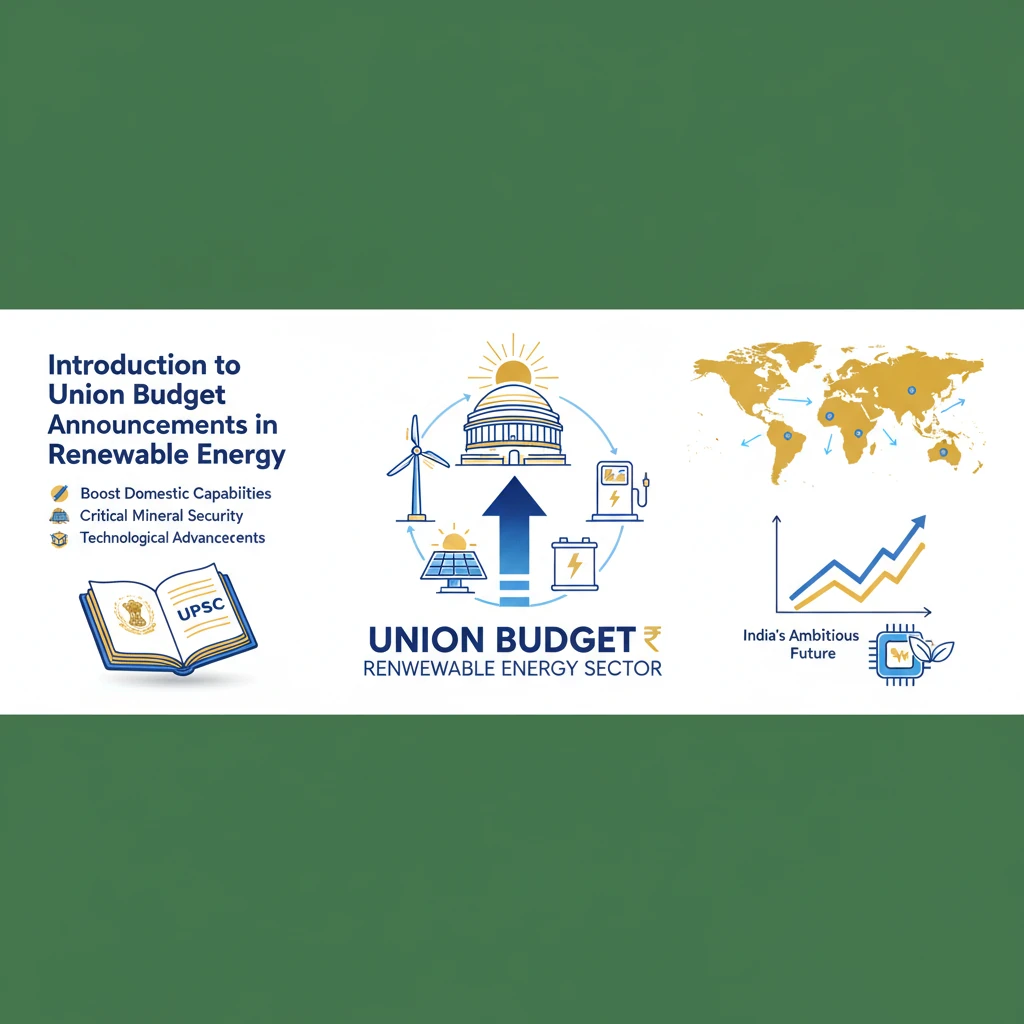
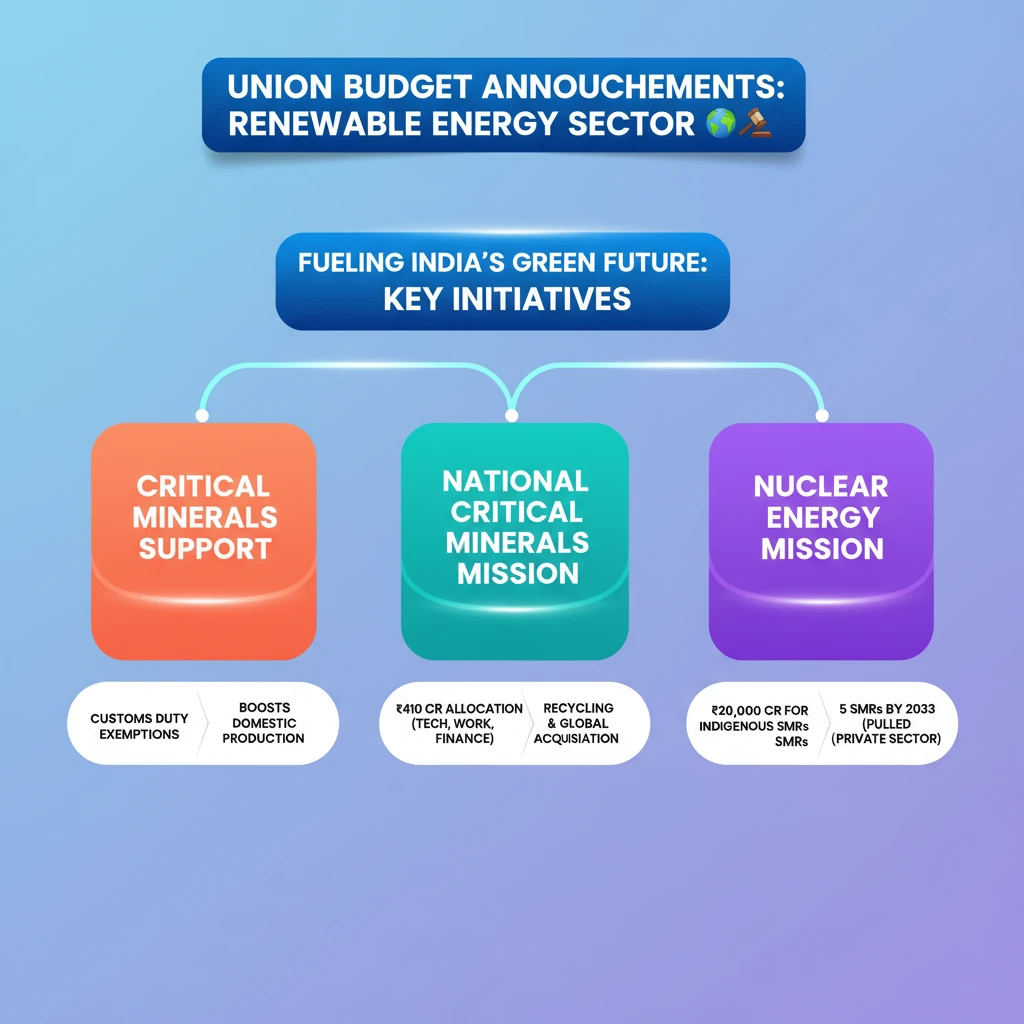
<h4>Introduction to Union Budget Announcements in Renewable Energy</h4><p>The <strong>Union Budget</strong> plays a pivotal role in shaping India's economic landscape, including its transition towards a sustainable future. Recent budget announcements have specifically targeted the <strong>renewable energy sector</strong>, aiming to boost domestic capabilities, ensure critical mineral security, and foster technological advancements.</p><p>These initiatives are crucial for achieving India's ambitious climate goals and reducing reliance on fossil fuels. The focus is on creating an enabling environment for both traditional and emerging clean energy technologies.</p><h4>Customs Duty Exemption for Critical Minerals</h4><p>The Union Budget has announced significant relief for the <strong>renewable energy manufacturing sector</strong> through customs duty exemptions. This measure is designed to reduce input costs for critical components and materials.</p><div class='info-box'><p><strong>Key Exemptions:</strong></p><ul><li><strong>Cobalt powder</strong></li><li><strong>Lithium-ion battery scraps</strong></li><li><strong>Lead</strong></li><li><strong>Zinc</strong></li><li>Additionally, <strong>12 other critical minerals</strong> have been exempted from basic customs duty.</li></ul></div><p>This exemption aims to encourage domestic manufacturing of clean energy technologies, particularly in the electric vehicle and battery storage segments.</p><div class='info-box'><p><strong>Further Exemptions in July 2023:</strong></p><p>In <strong>July 2023</strong>, customs duties were also exempted for <strong>25 critical minerals</strong> that are available domestically. This indicates a sustained government focus on securing raw materials for green industries.</p></div><h4>National Critical Minerals Mission (NCMM)</h4><p>The <strong>National Critical Minerals Mission (NCMM)</strong> has received a substantial financial allocation in the Union Budget, underscoring its importance for India's strategic autonomy in mineral resources.</p><div class='info-box'><p><strong>NCMM Allocation:</strong></p><p>A budget of <strong>Rs 410 crore</strong> has been allocated to the <strong>NCMM</strong> for the financial year <strong>2025-26</strong>.</p></div><p>This allocation is earmarked for various strategic objectives crucial for the mission's success. It supports a holistic approach to mineral security.</p><div class='key-point-box'><p><strong>Objectives of NCMM Allocation:</strong></p><ul><li><strong>Technology development</strong> in critical mineral extraction and processing.</li><li><strong>Skilled workforce creation</strong> to support the critical minerals value chain.</li><li>Developing <strong>financing mechanisms</strong> for clean energy projects reliant on these minerals.</li></ul></div><p>The <strong>NCMM</strong> operates under the aegis of the <strong>Ministry of Mines</strong>. Its broader mandate is to strengthen India's position in the global critical minerals supply chain.</p><div class='key-point-box'><p><strong>Overall Aims of NCMM:</strong></p><ul><li>Enhance <strong>domestic production</strong> of critical minerals.</li><li>Promote <strong>recycling</strong> of critical minerals from waste streams.</li><li>Facilitate the <strong>acquisition of global mineral assets</strong> to ensure supply security.</li></ul></div><h4>Nuclear Energy Mission and Small Modular Reactors (SMRs)</h4><p>The Union Budget has also allocated significant funds to bolster India's <strong>nuclear energy capabilities</strong>, with a particular focus on advanced reactor technologies.</p><div class='info-box'><p><strong>Nuclear Energy Mission Allocation:</strong></p><p>A budget of <strong>Rs 20,000 crore</strong> has been allocated for the <strong>Nuclear Energy Mission</strong>.</p></div><p>The primary goal of this mission is the development and deployment of <strong>indigenous Small Modular Reactors (SMRs)</strong>. SMRs offer flexibility and scalability compared to traditional large-scale nuclear power plants.</p><div class='info-box'><p><strong>SMR Operational Goal:</strong></p><p>The ambitious target is to operationalize at least <strong>five SMR reactors by 2033</strong>, significantly boosting India's clean energy capacity.</p></div><p>The government is actively involving the <strong>private sector</strong> in this strategic initiative, recognizing its potential to accelerate development and deployment.</p><div class='key-point-box'><p><strong>Private Sector Involvement:</strong></p><p>The private sector will play a crucial role in the development of both <strong>Bharat Small Reactors (BSR)</strong> and <strong>Bharat Small Modular Reactors (BSMR)</strong>.</p></div><p>It is important to understand the distinction between these two indigenous reactor types being developed.</p><div class='key-point-box'><p><strong>BSR vs. BSMR:</strong></p><ul><li><strong>Bharat Small Reactors (BSR):</strong> These refer to incrementally modified forms of India’s existing <strong>Pressurized Heavy Water Reactors (PHWR)</strong>, leveraging established technology.</li><li><strong>Bharat Small Modular Reactors (BSMR):</strong> This represents a nascent technology, currently being researched globally, indicating India's pursuit of cutting-edge nuclear innovations.</li></ul></div><div class='exam-tip-box'><p><strong>UPSC Insight:</strong> Questions on <strong>energy security</strong>, <strong>green economy initiatives</strong>, and <strong>critical mineral policies</strong> are frequently asked in <strong>GS Paper III (Economy, Environment, Science & Technology)</strong>. Understanding these budget announcements provides concrete examples for answer writing.</p></div>
💡 Key Takeaways
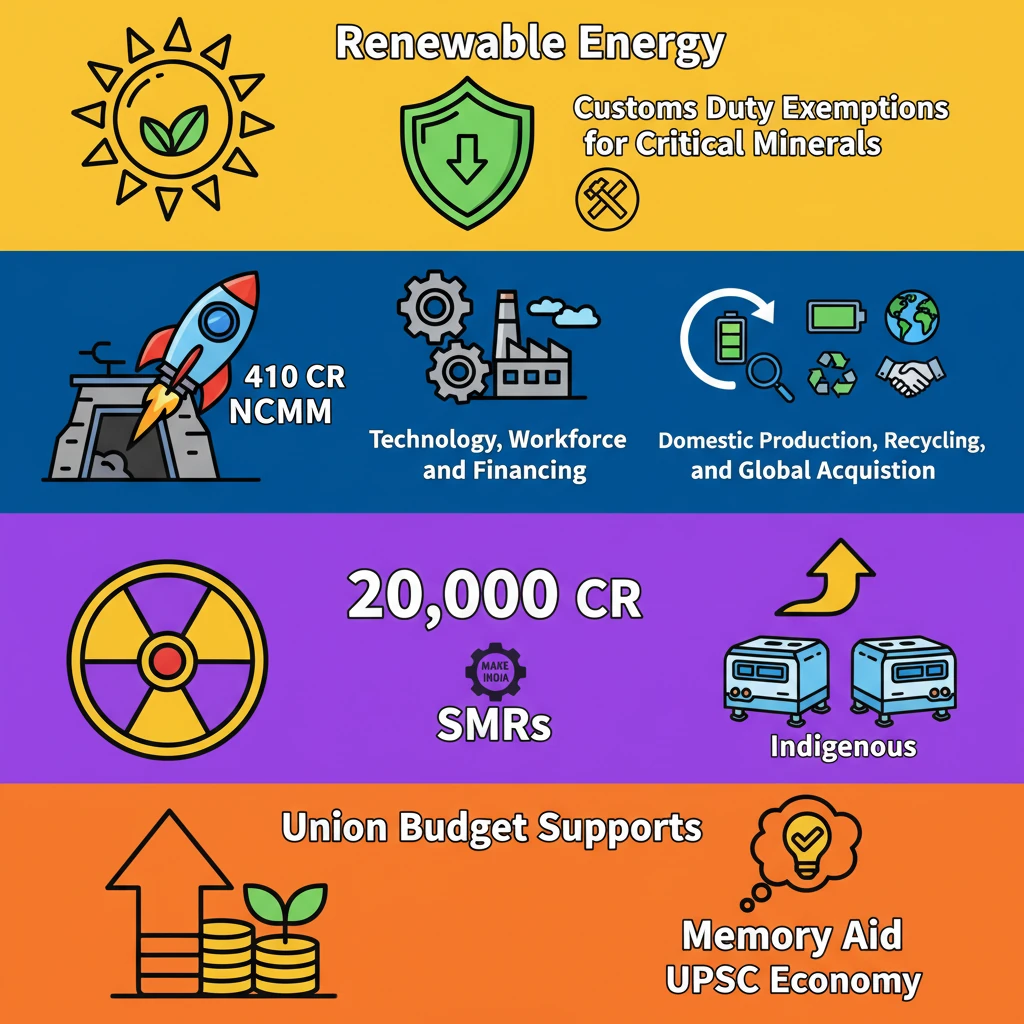
- •Union Budget supports renewable energy through customs duty exemptions for critical minerals.
- •National Critical Minerals Mission (NCMM) allocated Rs 410 crore for technology, workforce, and financing.
- •NCMM aims to boost domestic production, recycling, and global acquisition of critical minerals.
- •Nuclear Energy Mission receives Rs 20,000 crore for indigenous Small Modular Reactors (SMRs).
- •Goal to operationalize five SMRs by 2033, with private sector involvement in BSR and BSMR development.
🧠 Memory Techniques
95% Verified Content
📚 Reference Sources
•Press Information Bureau (PIB) releases on Union Budget
•Ministry of Mines documents on National Critical Minerals Mission
•Department of Atomic Energy (DAE) statements on SMRs