Developments on Inland Waterways - Economy | UPSC Learning
Topics
0 topics • 0 completed
🔍
No topics match your search
Developments on Inland Waterways
Medium⏱️ 7 min read
economy
📖 Introduction
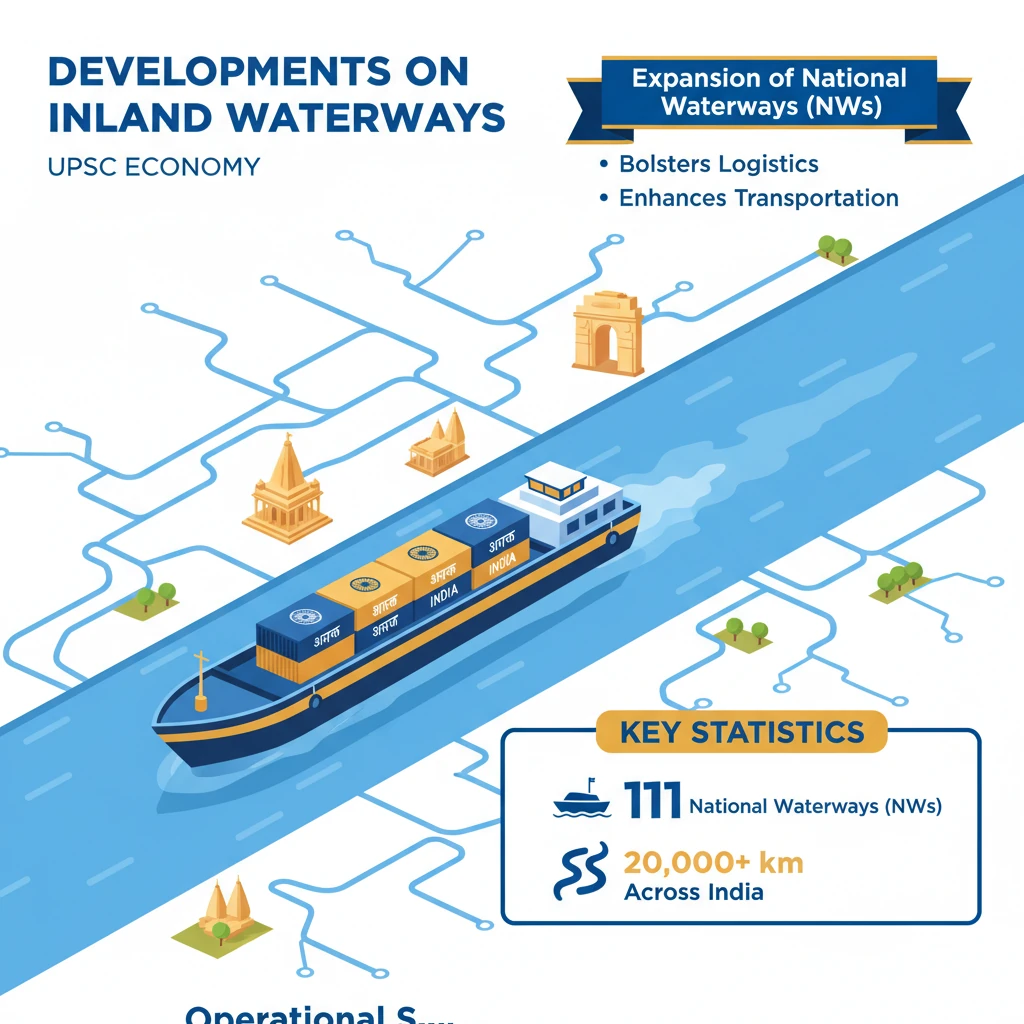
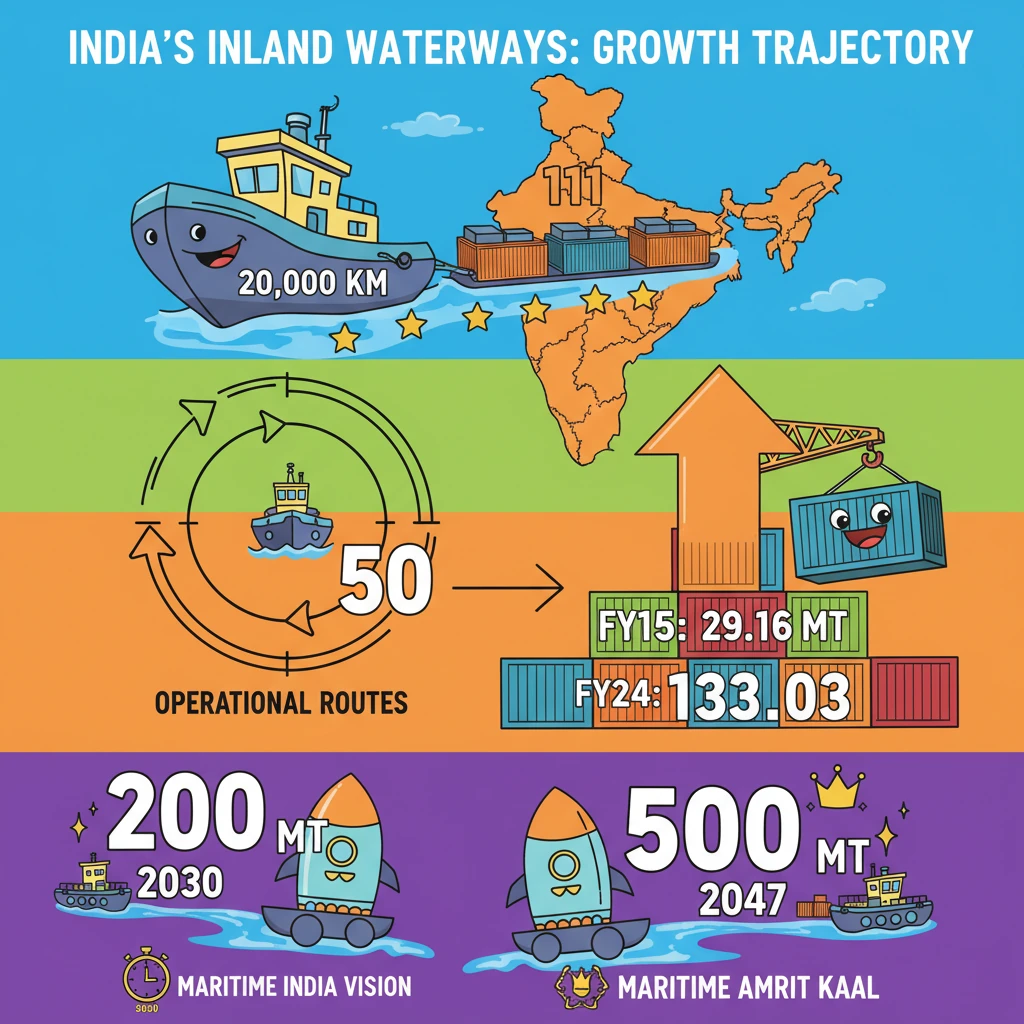
<h4>Expansion of National Waterways (NWs)</h4><p>India is actively pursuing the development of its <strong>inland waterways network</strong>. This initiative aims to bolster the country's logistics and transportation capabilities.</p><div class='info-box'><p>Currently, <strong>111 National Waterways (NWs)</strong> are under various stages of development. These waterways collectively span an impressive length of over <strong>20,000 kilometres</strong> across the nation.</p></div><h4>Operational Status of Inland Water Transport (IWT)</h4><p>The operationalisation of these waterways is a gradual process, with a significant number already facilitating cargo movement.</p><div class='info-box'><p>Approximately <strong>50 Inland Water Transport (IWT)</strong> routes are presently operational, contributing to the country's freight movement.</p></div><h4>Remarkable Cargo Traffic Growth</h4><p>The focus on inland waterways has led to substantial growth in cargo traffic over the past decade, highlighting their increasing importance.</p><div class='info-box'><p>Cargo transported via inland waterways surged from <strong>29.16 million tonnes</strong> in <strong>FY15</strong> to a remarkable <strong>133.03 million tonnes</strong> by <strong>FY24</strong>. This represents a significant increase, underscoring the potential of this mode of transport.</p></div><h4>Ambitious Future Targets for IWT</h4><p>The government has set ambitious targets for further expanding the role of inland waterways in India's logistics framework.</p><div class='key-point-box'><p>Under the <strong>Maritime India Vision 2030</strong>, the goal is to elevate cargo traffic through inland waterways to <strong>200 million tonnes</strong> by <strong>2030</strong>. The long-term vision, <strong>Maritime Amrit Kaal Vision 2047</strong>, aims even higher, targeting <strong>500 million tonnes</strong> by <strong>2047</strong>.</p></div><div class='exam-tip-box'><p>Remember these specific targets and visions (<strong>Maritime India Vision 2030</strong>, <strong>Maritime Amrit Kaal Vision 2047</strong>) as they are crucial for Mains answers, especially in <strong>GS Paper 3 (Economy)</strong> and <strong>GS Paper 1 (Geography/Infrastructure)</strong>.</p></div>
💡 Key Takeaways
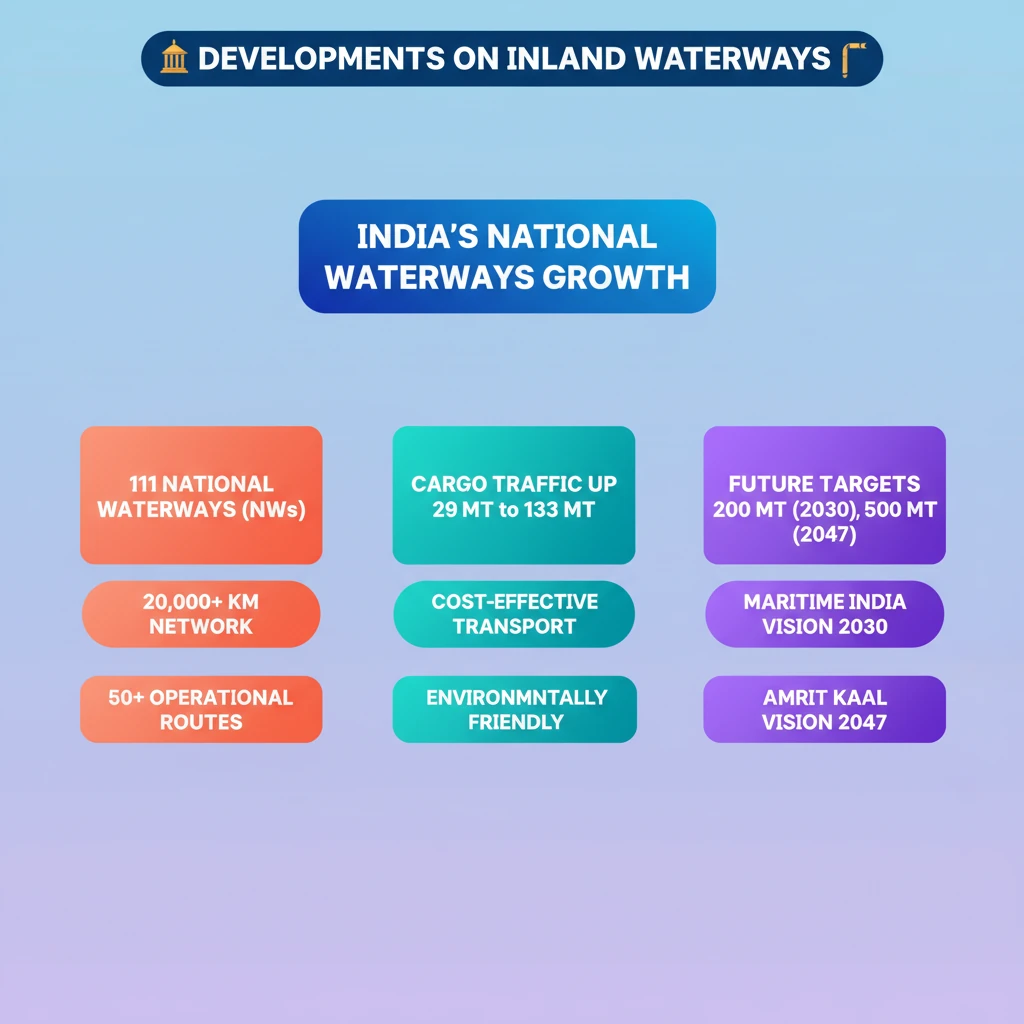
- •India is developing 111 National Waterways (NWs) spanning over 20,000 km.
- •Around 50 Inland Water Transport (IWT) routes are currently operational.
- •Cargo traffic via IWTs increased significantly from 29.16 MT (FY15) to 133.03 MT (FY24).
- •Future targets aim for 200 MT by 2030 (Maritime India Vision 2030) and 500 MT by 2047 (Maritime Amrit Kaal Vision 2047).
- •IWTs offer cost-effective, environmentally friendly, and congestion-reducing transport solutions.
🧠 Memory Techniques
95% Verified Content
📚 Reference Sources
•Ministry of Ports, Shipping and Waterways, Government of India Annual Reports
•Inland Waterways Authority of India (IWAI) Official Website