Jan Poshan Kendras - Economy | UPSC Learning
Topics
0 topics • 0 completed
🔍
No topics match your search
Jan Poshan Kendras
Medium⏱️ 8 min read
economy
📖 Introduction
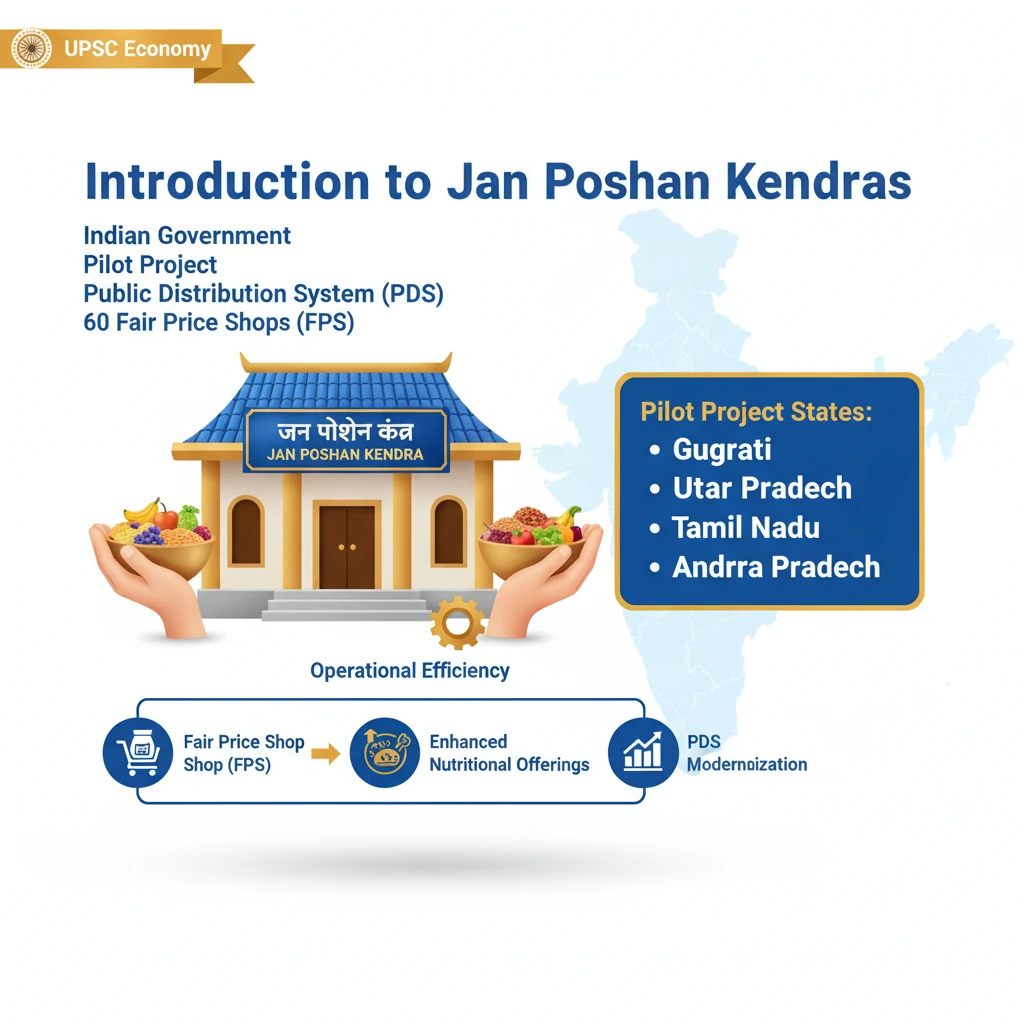
<h4>Introduction to Jan Poshan Kendras</h4><p>The <strong>Indian government</strong> has launched a significant <strong>pilot project</strong> aimed at enhancing nutritional offerings and operational efficiency within the <strong>Public Distribution System (PDS)</strong>. This initiative involves the renovation and transformation of <strong>60 Fair Price Shops (FPS)</strong>.</p><div class='info-box'><p>The pilot project is being implemented across four key states:</p><ul><li><strong>Gujarat</strong></li><li><strong>Rajasthan</strong></li><li><strong>Telangana</strong></li><li><strong>Uttar Pradesh</strong></li></ul><p>These selected <strong>FPS</strong> are being converted into "<strong>Jan Poshan Kendras</strong>".</p></div><h4>Dual Objectives of the Initiative</h4><p>The primary goal of transforming <strong>FPS</strong> into <strong>Jan Poshan Kendras</strong> is twofold. Firstly, it seeks to improve the availability of nutritious food items for beneficiaries receiving rations under the <strong>Pradhan Mantri Garib Kalyan Anna Yojana (PMGKAY)</strong>.</p><p>Secondly, the initiative aims to address the income challenges faced by <strong>ration dealers</strong>. By allowing them to sell additional items beyond subsidised grains, it creates new revenue streams for these crucial community touchpoints.</p><div class='key-point-box'><p>The project also incorporates the introduction of several <strong>new digital tools and support systems</strong>. These are designed to significantly enhance both the <strong>transparency</strong> and <strong>operational efficiency</strong> of the revamped <strong>Fair Price Shops</strong>.</p></div><h4>The 'Poshan' Component and Income Generation</h4><p>Under the "<strong>Poshan</strong>" aspect of this initiative, <strong>Fair Price Shops</strong> will expand their inventory. They will begin selling a wider range of items in addition to the standard subsidised grains.</p><p>This expansion directly tackles the income stability of <strong>ration dealers</strong>. Given the high footfall at these outlets, there is substantial scope for generating additional income, benefiting both the dealers and the local economy.</p><div class='info-box'><p>Currently, India has approximately <strong>0.54 million FPSs</strong>. These shops collectively distribute an average of <strong>60-70 million tonnes of food grain annually</strong> under <strong>PMGKAY</strong>.</p><p>This free distribution benefits over <strong>800 million beneficiaries</strong>, highlighting the extensive reach and potential impact of the <strong>FPS network</strong>.</p></div><p>The government has an ambitious long-term vision to further scale this initiative. It aims to convert around <strong>100,000 fair price shops</strong> into "<strong>nutri-hubs</strong>" within the next three years, significantly expanding the reach of nutritional offerings.</p><h4>Key Features of Jan Poshan Kendras</h4><p>The transformed <strong>Jan Poshan Kendras</strong> are designed to offer a more diverse and nutrition-rich selection of food items. This goes beyond the traditional subsidised grains, focusing on holistic dietary improvement.</p><ul><li><strong>Diverse Nutritional Offerings:</strong> These Kendras will provide items such as <strong>pulses</strong> and various <strong>dairy products</strong>, supplementing the basic grain entitlements.</li><li><strong>Space Allocation:</strong> A significant portion, specifically <strong>50% of the space</strong> within these Kendras, will be dedicated to storing and displaying nutritional products. The remaining space will be utilized for other essential household items.</li><li><strong>Financial Support:</strong> To facilitate their transformation and ongoing operations, <strong>FPSs</strong> will receive crucial financial assistance. This includes access to <strong>loans</strong> and <strong>invoice financing</strong> from the <strong>Small Industries Development Bank of India (SIDBI)</strong>.</li><li><strong>Strategic Collaborations:</strong> The initiative involves partnerships with key organizations to ensure a steady supply of quality products. For instance, <strong>AMUL</strong> is collaborating for dairy products.</li><li><strong>B2B eCommerce Integration:</strong> To streamline sourcing and supply chains, the project leverages <strong>Business-to-Business (B2B) eCommerce platforms</strong> such as <strong>Udaan</strong> and <strong>JumboTail</strong>.</li></ul><div class='exam-tip-box'><p>For <strong>UPSC Mains GS-II</strong> (Governance) and <strong>GS-III</strong> (Economy, Food Security), understanding the dual benefits of <strong>Jan Poshan Kendras</strong> – improving nutrition and empowering <strong>FPS dealers</strong> – is crucial. Note the role of <strong>digital tools</strong> and <strong>financial inclusion (SIDBI)</strong> in modernizing the PDS.</p></div>
💡 Key Takeaways
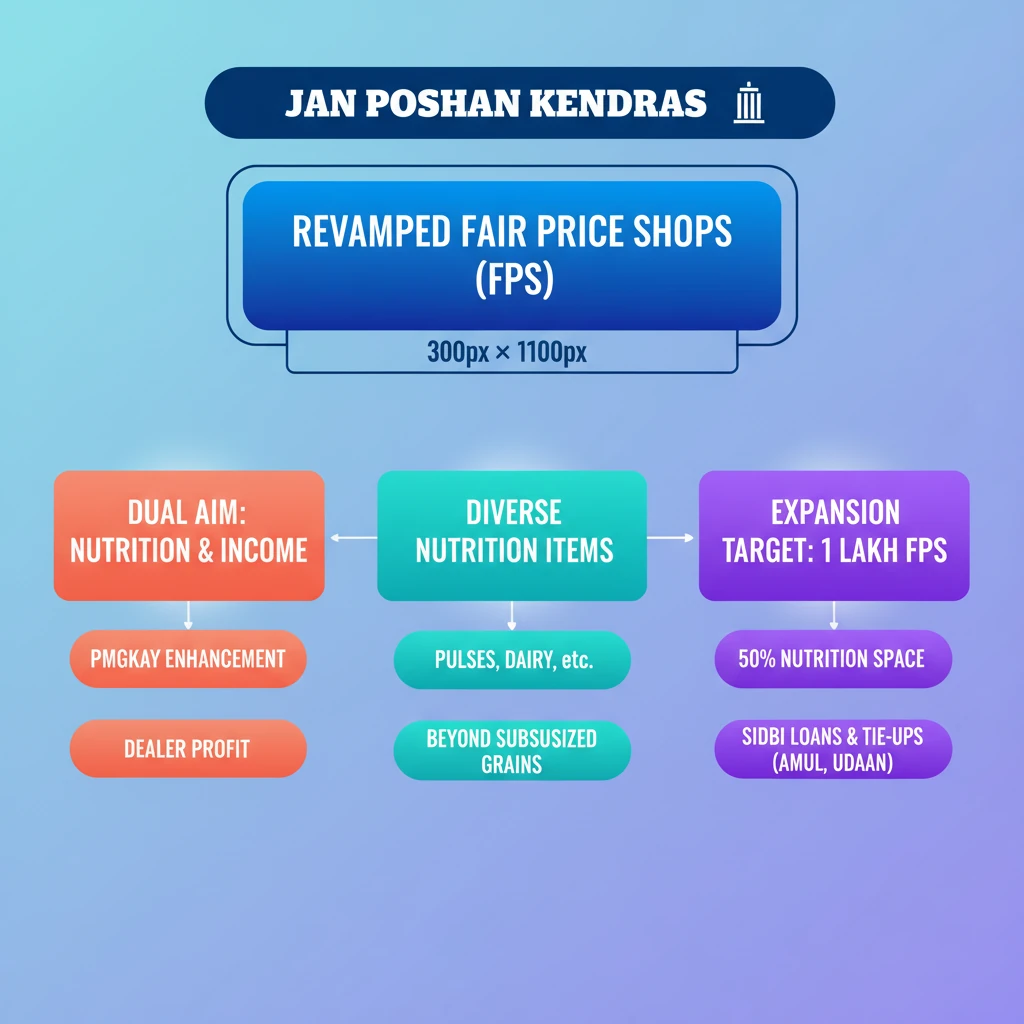
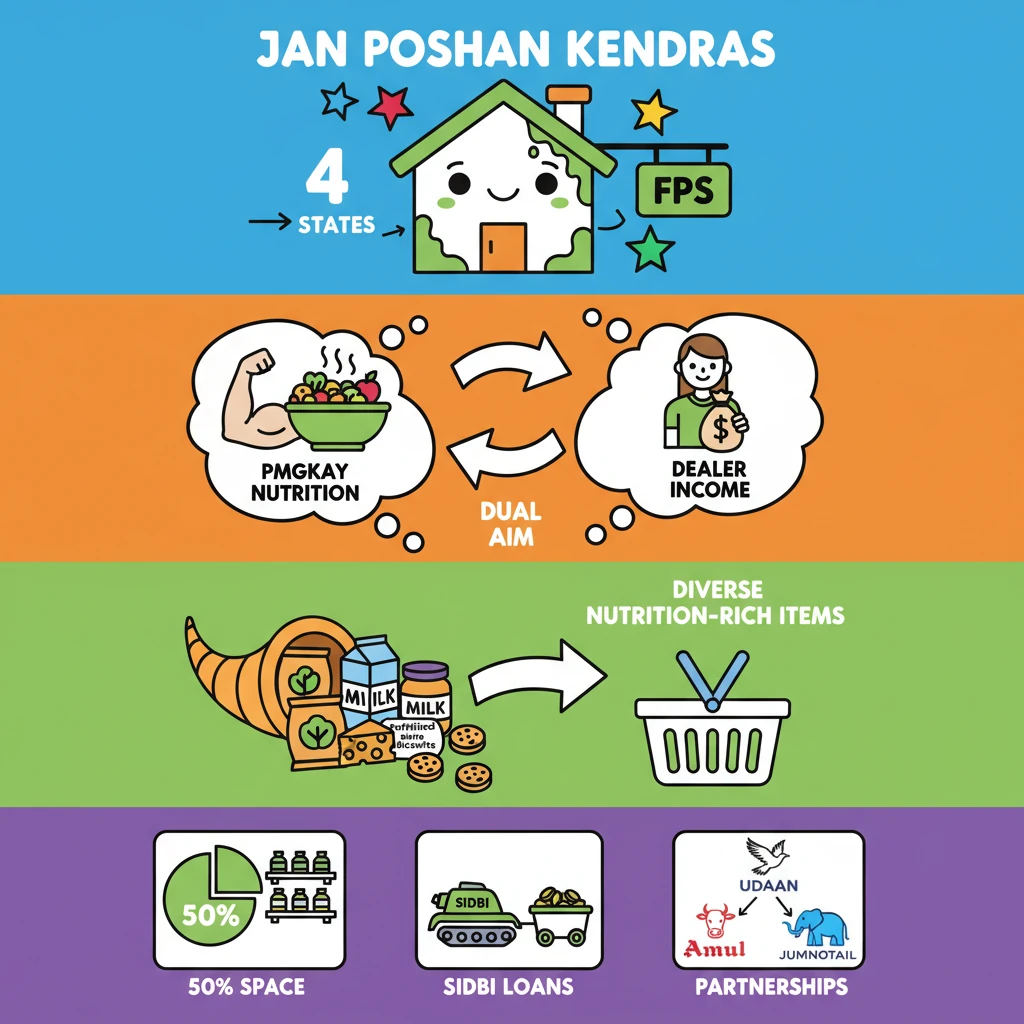
- •Jan Poshan Kendras are renovated Fair Price Shops (FPS) launched as a pilot project in 4 states.
- •Dual aim: enhance nutritional offerings under PMGKAY and improve income for ration dealers.
- •They sell diverse nutrition-rich items like pulses and dairy, beyond subsidised grains.
- •Key features include 50% space for nutritional products, SIDBI loans, and partnerships with AMUL, Udaan, JumboTail.
- •Government plans to convert 100,000 FPS into 'nutri-hubs' in the next three years.
- •Integrates digital tools for transparency and operational efficiency in PDS.
🧠 Memory Techniques
95% Verified Content