Maritime Vision 2047 - Economy | UPSC Learning
Topics
0 topics • 0 completed
🔍
No topics match your search
Maritime Vision 2047
Medium⏱️ 10 min read
economy
📖 Introduction
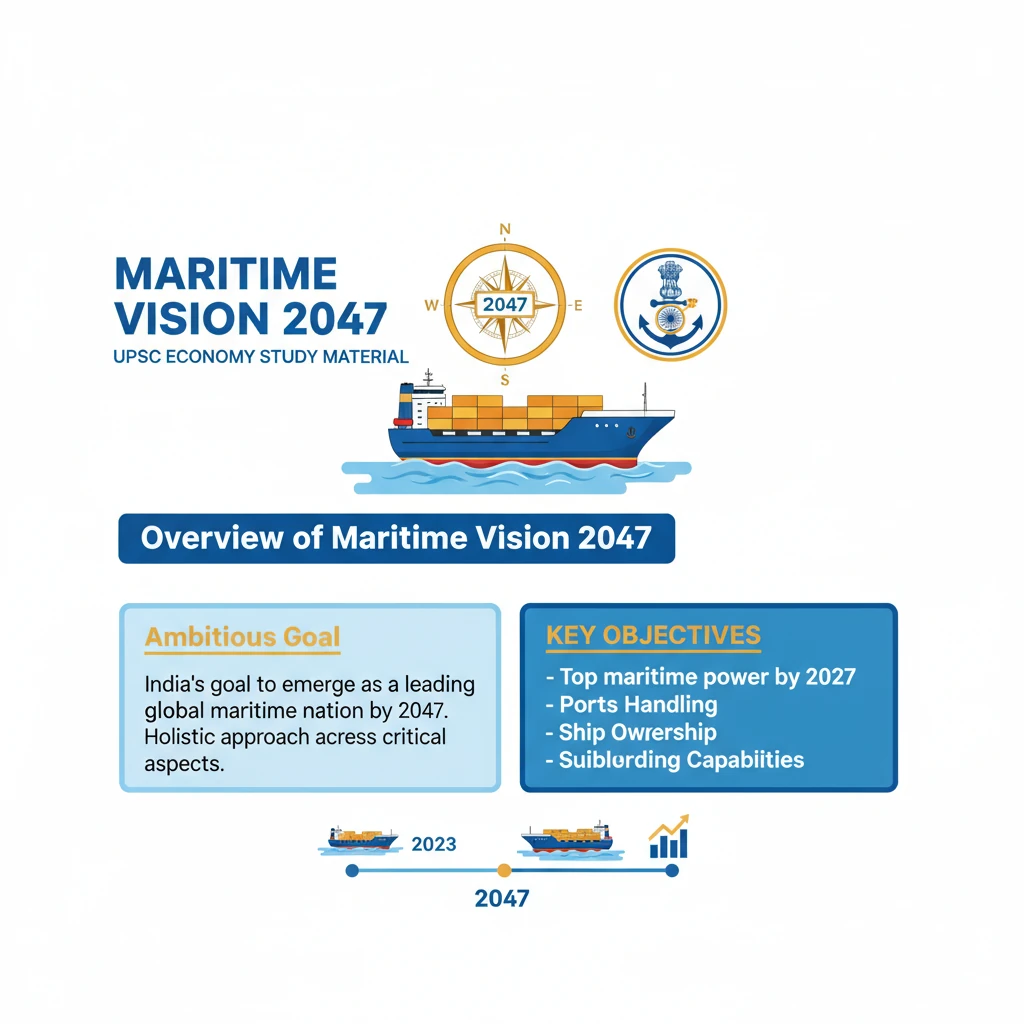
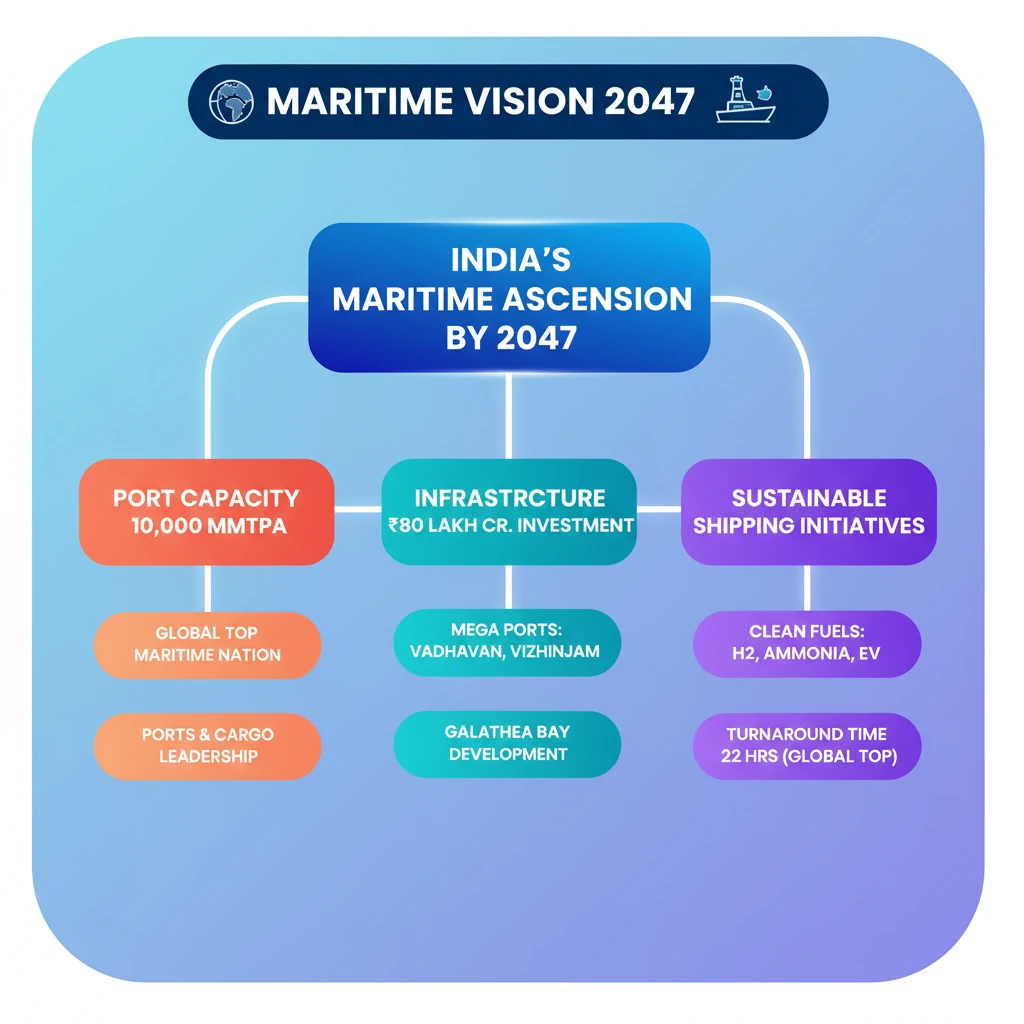
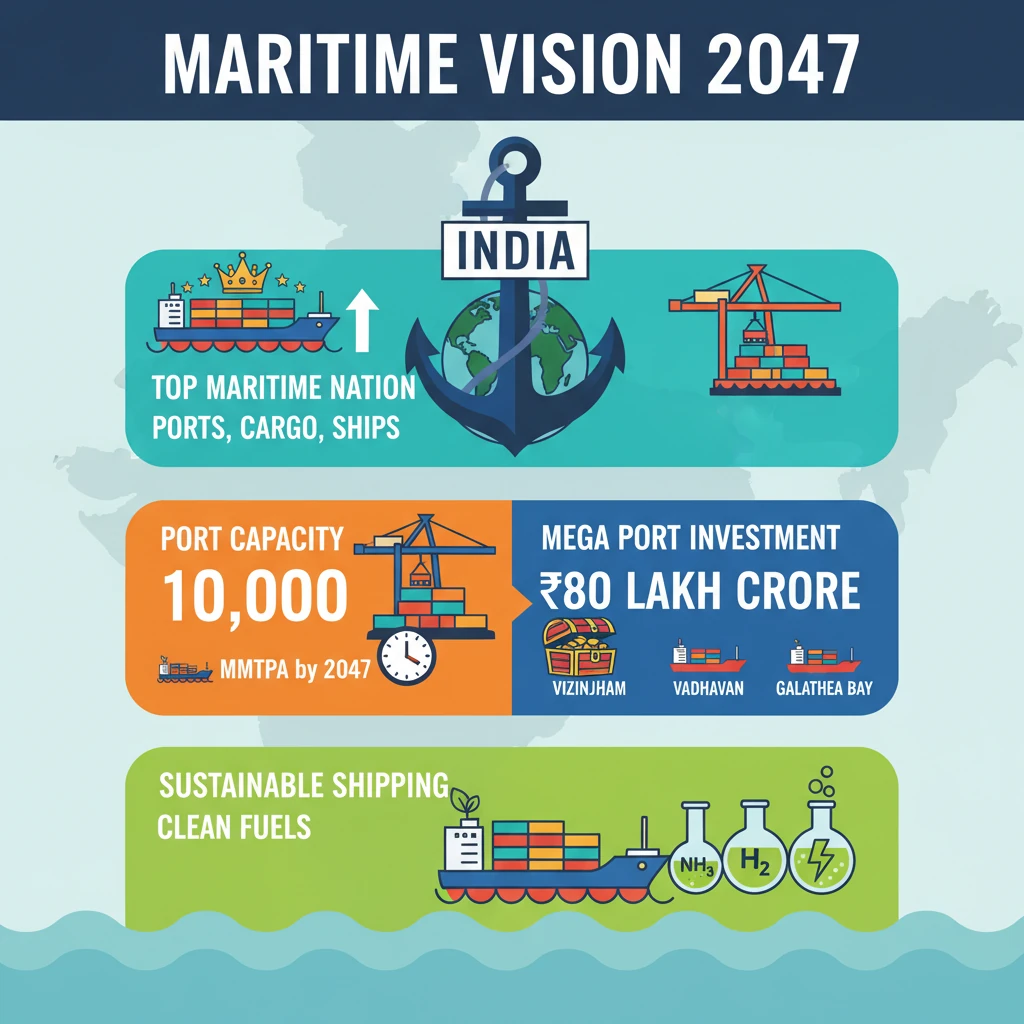
<h4>Overview of Maritime Vision 2047</h4><p>The <strong>Maritime Vision 2047</strong> outlines India's ambitious goal to emerge as a leading global maritime nation by the year <strong>2047</strong>. This vision encompasses a holistic approach, focusing on critical aspects of the maritime sector.</p><div class='key-point-box'><p>The primary objective is to become a top maritime power across key indicators such as <strong>ports, cargo handling, ship ownership, shipbuilding capabilities</strong>, and comprehensive <strong>sectoral reforms</strong>.</p></div><p>A significant target under this vision is to dramatically enhance India's <strong>port handling capacity</strong>. The aim is to achieve a capacity of <strong>10,000 million metric tonnes per annum</strong> by <strong>2047</strong>, reflecting a massive scale-up in infrastructure and operational efficiency.</p><h4>Investment in Maritime Infrastructure</h4><p>To realize these ambitious goals, India has planned substantial investments in its maritime infrastructure. A staggering <strong>Rs 80 lakh crore</strong> is earmarked for key projects across the sector.</p><div class='info-box'><p>Key infrastructure projects include:</p><ul><li>The development of the <strong>Vizhinjam international seaport</strong> in <strong>Kerala</strong>.</li><li>Construction of a new <strong>mega port at Vadhavan</strong> in <strong>Maharashtra</strong>.</li><li>Establishment of another new <strong>mega port at Galathea Bay</strong> in the <strong>Nicobar Islands</strong>.</li></ul></div><h4>Technological Advancements for Sustainability</h4><p>The vision places a strong emphasis on environmental sustainability within the maritime sector. This involves pioneering advancements in ship propulsion technology.</p><p>Efforts are underway to build ships powered by <strong>clean fuels</strong>. These include innovative alternatives such as <strong>ammonia, hydrogen</strong>, and <strong>electricity</strong>, aligning with global efforts to reduce carbon emissions from shipping.</p><h4>Operational Efficiency: Port Turnaround Time</h4><p>Significant improvements have already been made in the operational efficiency of Indian ports, particularly in reducing <strong>Port Turnaround Time</strong>. This metric is crucial for global competitiveness and trade flow.</p><div class='info-box'><p><strong>Port Turnaround Time</strong> has improved dramatically:</p><ul><li>Reduced from over <strong>40 hours</strong> to just <strong>22 hours</strong>.</li><li>This improvement positions India favorably, surpassing countries like the <strong>US</strong> and <strong>Singapore</strong> in this specific aspect.</li></ul></div><p>A <strong>Port Turnaround Time</strong> represents the total duration a ship spends in port, encompassing unloading, loading, performing other necessary operations, and preparing for its subsequent voyage.</p><h4>Revamped Legislative Framework</h4><p>A robust and modern legislative framework is vital for accelerating growth in the maritime sector. Several key acts have already been implemented to streamline operations and encourage development.</p><div class='info-box'><p>Existing legislative reforms include:</p><ul><li>The <strong>Major Port Authority Act, 2021</strong>, enhancing governance and autonomy of major ports.</li><li>The <strong>Inland Vessels Act, 2021</strong>, modernizing regulations for inland waterways.</li><li>The <strong>Recycling of Ships Act, 2019</strong>, promoting environmentally sound ship recycling practices.</li></ul></div><p>Further legislative advancements are anticipated with the upcoming <strong>Coastal Shipping Bill, 2024</strong>, and the <strong>Merchant Shipping Bill, 2024</strong>. These bills are expected to further boost <strong>coastal shipping, shipbuilding</strong>, and <strong>ship recycling</strong> activities in India.</p><h4>Preserving Maritime Legacy</h4><p>The <strong>Maritime Vision 2047</strong> also acknowledges and seeks to revive India's rich maritime history and shipbuilding heritage. This is being achieved through dedicated cultural and historical initiatives.</p><p>The <strong>National Maritime Heritage Complex</strong> is currently under construction at <strong>Lothal</strong>. This complex aims to celebrate and revive India's ancient and illustrious shipbuilding legacy, connecting the past with future aspirations.
💡 Key Takeaways
- •Maritime Vision 2047 aims for India to be a top maritime nation by 2047, targeting ports, cargo, ship ownership, and shipbuilding.
- •India plans to achieve a port handling capacity of 10,000 million metric tonnes per annum by 2047.
- •Significant investment of Rs 80 lakh crore is planned for projects like Vizhinjam, Vadhavan, and Galathea Bay mega ports.
- •Focus on sustainable shipping with clean fuels like ammonia, hydrogen, and electricity.
- •Port Turnaround Time has drastically improved from over 40 hours to 22 hours, surpassing the US and Singapore.
- •Key legislative reforms (Major Port Authority Act, Inland Vessels Act, Recycling of Ships Act) are driving growth, with new bills (Coastal Shipping, Merchant Shipping) upcoming.
- •National Maritime Heritage Complex at Lothal is being built to revive India's ancient shipbuilding legacy.
🧠 Memory Techniques
95% Verified Content
📚 Reference Sources
•Ministry of Ports, Shipping and Waterways, Government of India (Official documents and press releases)
•Press Information Bureau (PIB) releases regarding Maritime Vision 2047 and related projects