Angel Tax and Capital Gain Tax - Economy | UPSC Learning
Topics
0 topics • 0 completed
🔍
No topics match your search
Angel Tax and Capital Gain Tax
Medium⏱️ 7 min read
economy
📖 Introduction
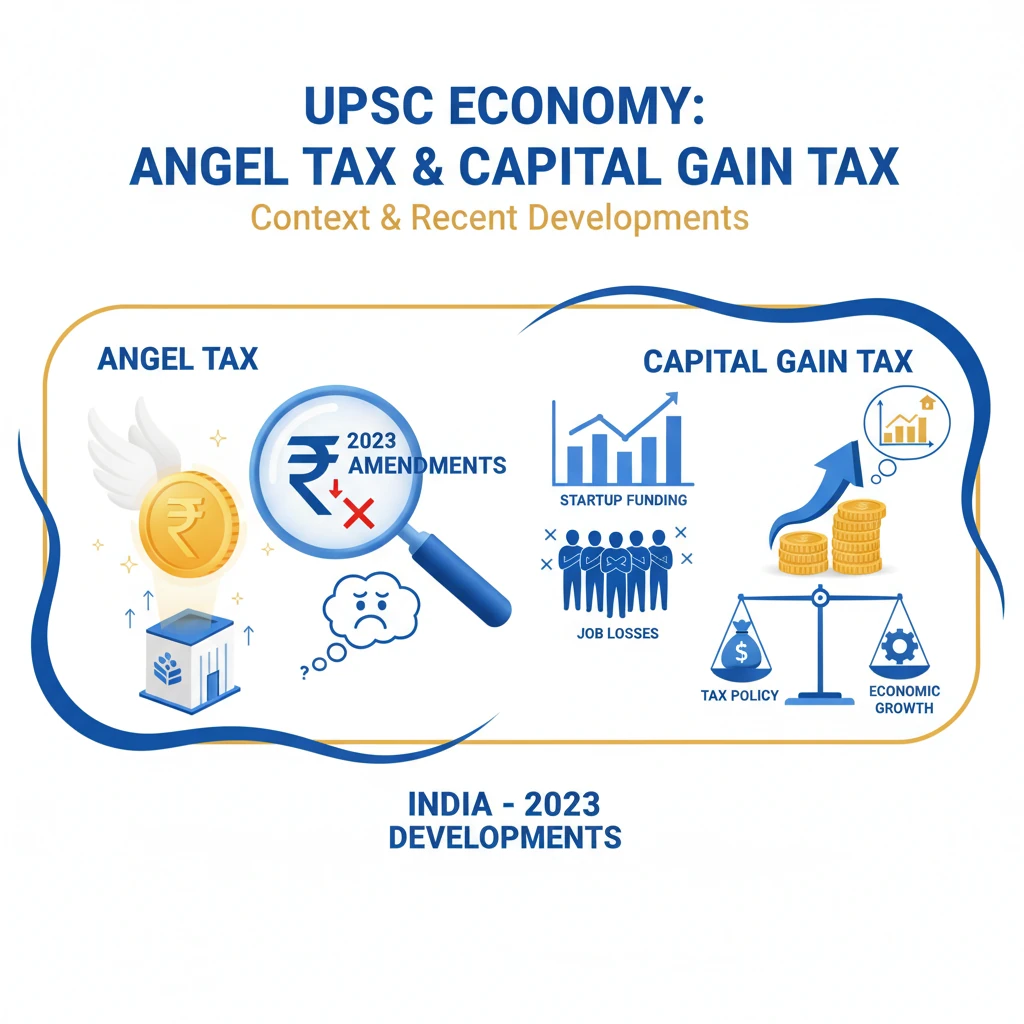
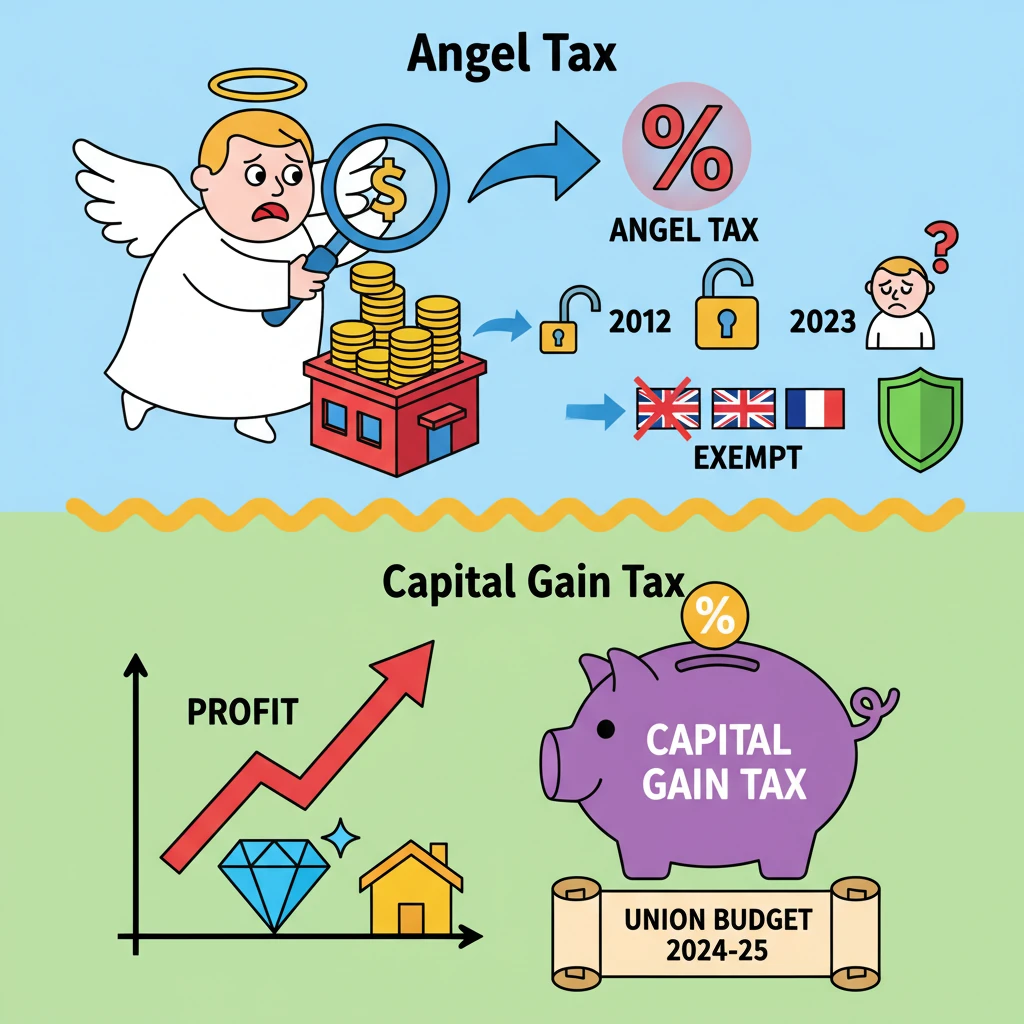
<h4>Context and Recent Developments</h4><p>The <strong>Angel Tax</strong> and <strong>Capital Gain Tax</strong> have recently garnered significant attention in India. Amendments made in <strong>2023</strong> broadened the scope of the Angel Tax, leading to criticism.</p><p>This criticism arose amid a notable downturn in <strong>startup funding</strong> and subsequent <strong>job losses</strong> in the sector. These developments highlight the complex interplay between taxation policy and economic growth.</p><div class='exam-tip-box'><p><strong>UPSC Insight:</strong> Understanding the recent amendments and their economic impact is crucial for <strong>GS Paper 3 (Economy)</strong>. Be prepared to analyze the pros and cons of such tax policies on the startup ecosystem.</p></div><p>Separately, <strong>Capital Gains Tax</strong> has also become a focal point, especially with the anticipation of the <strong>Union Budget for 2024-25</strong>. Its implications for investors and the market are under close scrutiny.</p><h4>What is Angel Tax?</h4><div class='info-box'><p><strong>Definition:</strong> <strong>Angel Tax</strong> is a tax levied on the funds raised by <strong>unlisted companies</strong> through the issuance of shares in <strong>off-market transactions</strong> if the issue price exceeds the <strong>fair market value (FMV)</strong> of the company.</p></div><p>It was initially introduced in <strong>2012</strong>. The primary objective behind its introduction was to discourage the generation and utilization of <strong>unaccounted money</strong> (black money) through investments in closely held companies.</p><div class='key-point-box'><p><strong>Core Concept:</strong> The tax essentially targets the premium received by unlisted companies on share issuance, treating any excess over <strong>FMV</strong> as taxable income.</p></div><div class='info-box'><p><strong>Fair Market Value (FMV):</strong> This refers to the price of an asset where both the buyer and seller possess reasonable knowledge of its value and are willing to trade without undue pressure or compulsion.</p></div><h4>Expansion Under Finance Act, 2023</h4><p>The <strong>Finance Act, 2023</strong>, brought significant changes to the <strong>Angel Tax</strong> provisions. A relevant section of the <strong>Income-tax Act</strong> was amended to expand its ambit.</p><p>Crucially, this expansion included <strong>foreign investors</strong> within the scope of the <strong>Angel Tax</strong> provision. This move initially raised concerns among international investors and the startup community.</p><h4>Exemptions and Industry Pushback</h4><p>Initially, <strong>startups recognized by the Department for Promotion of Industry and Internal Trade (DPIIT)</strong> were explicitly excluded from the purview of this provision. This was a measure to support legitimate startups.</p><p>However, the inclusion of foreign investors led to considerable industry pushback. Concerns were raised regarding declining foreign direct investment and its potential adverse effects on the Indian startup ecosystem.</p><p>Responding to these concerns, the <strong>Finance Ministry</strong> subsequently announced exemptions. Investors from <strong>21 countries</strong> were exempted from the <strong>Angel Tax</strong> levy for their investments in Indian startups.</p><ul><li>These exempted countries include major global economies such as the <strong>United States (US)</strong>, the <strong>United Kingdom (UK)</strong>, and <strong>France</strong>.</li><li>This exemption aims to alleviate funding concerns and encourage foreign investment into Indian startups.</li></ul>
💡 Key Takeaways
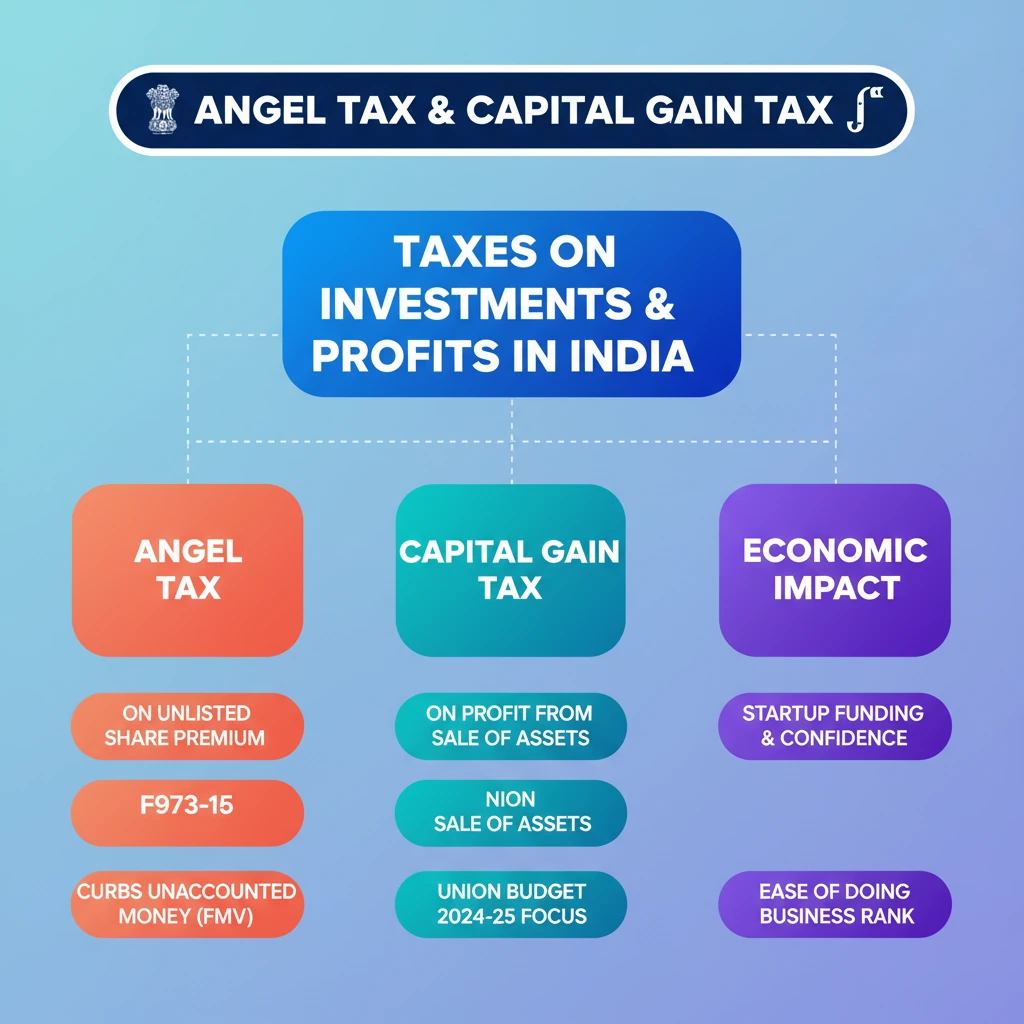
- •Angel Tax is levied on unlisted companies' share premiums exceeding Fair Market Value (FMV), aiming to curb unaccounted money.
- •Introduced in 2012, its scope was expanded in 2023 to include foreign investors, causing criticism.
- •DPIIT-recognized startups and investors from 21 specific countries (e.g., US, UK, France) are exempted from Angel Tax.
- •Capital Gain Tax is a tax on profits from selling capital assets, gaining attention for the Union Budget 2024-25.
- •These taxes significantly impact startup funding, investor confidence, and India's 'Ease of Doing Business' ranking.
🧠 Memory Techniques
98% Verified Content
📚 Reference Sources
•Income-tax Act, 1961 (Section 56(2)(viib))
•Finance Act, 2023
•Notifications from the Ministry of Finance and DPIIT regarding Angel Tax exemptions