What is the Current Status of the National Monetisation Pipeline? - Economy | UPSC Learning
Topics
0 topics • 0 completed
🔍
No topics match your search
What is the Current Status of the National Monetisation Pipeline?
Medium⏱️ 8 min read
economy
📖 Introduction
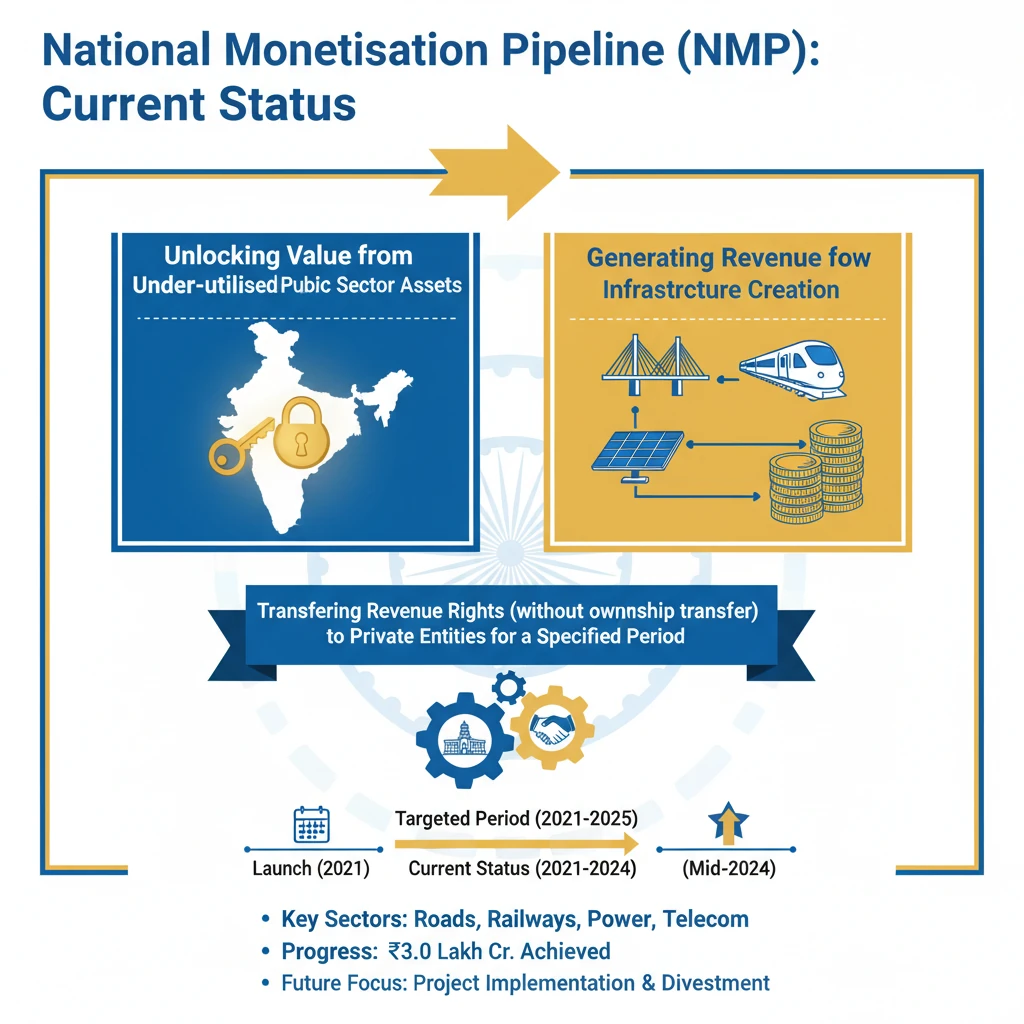
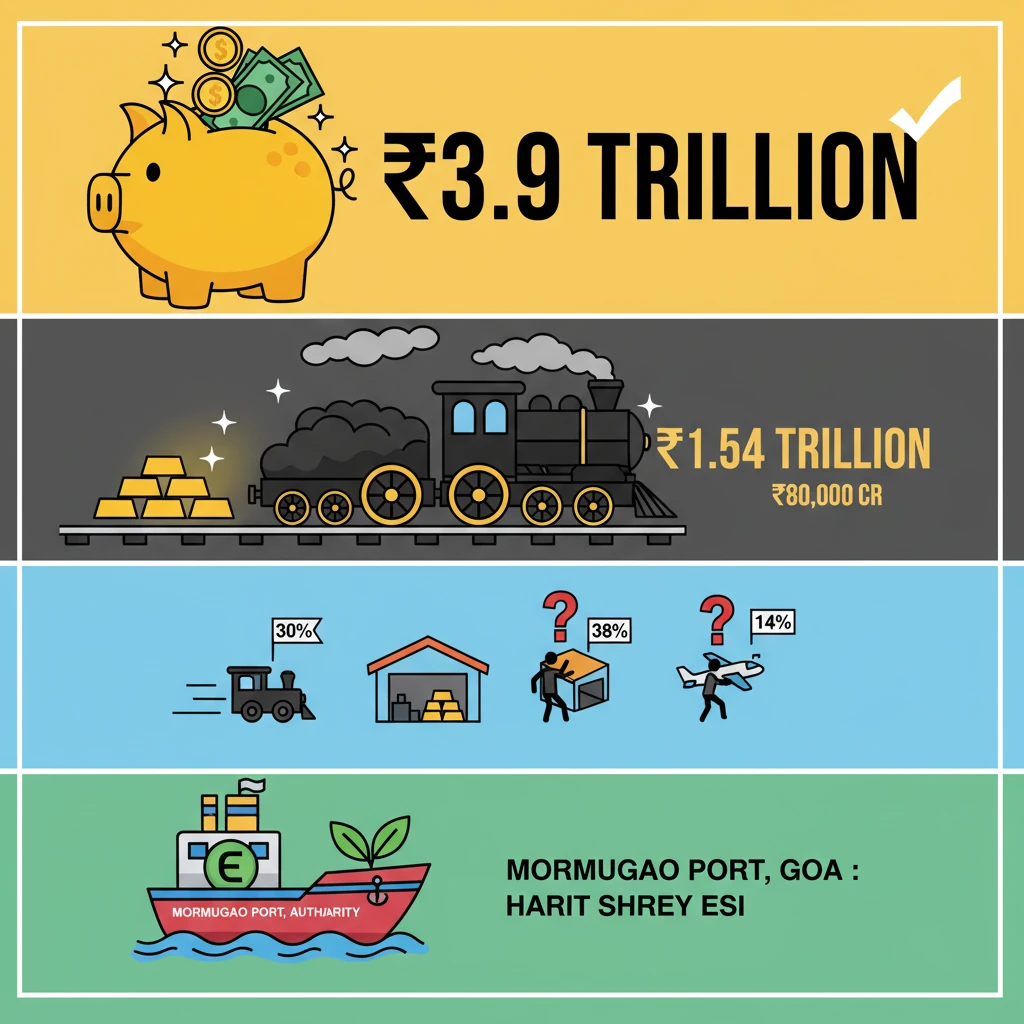
<h4>National Monetisation Pipeline (NMP): Current Status</h4><p>The <strong>National Monetisation Pipeline (NMP)</strong> is a strategic initiative by the Government of India aimed at unlocking value from under-utilised public sector assets. Its primary goal is to generate revenue for creating new infrastructure across various sectors.</p><p>This approach involves transferring revenue rights of government-owned assets to private entities for a specified period, critically without transferring the underlying ownership of these assets.</p><div class='info-box'><p><strong>Revenue Generation:</strong></p><ul><li>Generated <strong>Rs 3.9 trillion</strong> in the first three years (up to <strong>FY24</strong>).</li><li>Achieved most of its adjusted targets, against an original target of <strong>Rs 4.3 trillion</strong> for this period.</li></ul></div><h4>Successful Monetisation Sectors</h4><p>Several sectors have demonstrated exceptional performance under the <strong>NMP</strong>, significantly exceeding their initial monetisation targets. This success underscores the potential for effective value creation from public assets.</p><div class='info-box'><p><strong>Ministry of Coal:</strong></p><ul><li>Raised an impressive <strong>Rs 1.54 trillion</strong>, far exceeding its four-year target of <strong>Rs 80,000 crore</strong>.</li><li>Additionally, mines have been monetised to the tune of <strong>Rs 42,000 crore</strong>, surpassing the revised target of <strong>Rs 7,500 crore</strong>.</li></ul></div><h4>Lagging Sectors in NMP</h4><p>Despite overall progress in the <strong>NMP</strong>, some key sectors have fallen short of their monetisation goals. These areas require focused attention and strategic interventions to improve performance.</p><ul><li><strong>Railways:</strong> Monetised assets worth only <strong>Rs 20,417 crore</strong> over the past three years, meeting just <strong>30%</strong> of its revised target.</li><li><strong>Warehousing:</strong> Achieved <strong>38%</strong> of its target, amounting to <strong>Rs 8,000 crore</strong>.</li><li><strong>Civil Aviation:</strong> Lagged significantly, having monetised only <strong>14%</strong> of its targeted <strong>Rs 2,600 crore</strong> asset base.</li></ul><div class='exam-tip-box'><p><strong>UPSC Insight:</strong> Understanding both successful and lagging sectors provides a balanced perspective for Mains answers on economic reforms and infrastructure development. Citing specific figures enhances the credibility of your arguments.</p></div><h4>Mormugao Port and Environmental Ship Index (ESI)</h4><p>The <strong>Mormugao Port Authority (MPA)</strong> in <strong>Goa</strong> has achieved a significant environmental milestone. It became the first Indian port to be listed on the <strong>Environmental Ship Index (ESI)</strong> portal.</p><p>This notable recognition is specifically for <strong>MPA’s Harit Shrey programme</strong> and has been acknowledged by the <strong>International Association of Ports and Harbours (IAPH)</strong>.</p><div class='info-box'><p><strong>Related Development:</strong> The government also plans to limit the development of <strong>inland waterway terminals (IWTs)</strong> near major ports. This measure aims to safeguard the economic interests of these established ports.</p></div><h4>What is the Environmental Ship Index (ESI)?</h4><p>The <strong>Environmental Ship Index (ESI)</strong> is a crucial system designed to evaluate and reward ships based on their environmental performance. It particularly focuses on their efforts in reducing air emissions.</p><div class='key-point-box'><p><strong>Core Function:</strong> <strong>ESI</strong> quantifies seagoing ships that demonstrate superior performance in reducing <strong>air emissions</strong> compared to the current emission standards set by the <strong>International Maritime Organization (IMO)</strong>.</p></div><p>The <strong>2023 IMO greenhouse gas (GHG) Strategy</strong> sets an ambitious target: a reduction in the <strong>carbon intensity</strong> of international shipping by at least <strong>40% by 2030</strong>.</p><div class='info-box'><p><strong>Origin and Administration:</strong></p><ul><li>The <strong>ESI Initiative</strong> commenced on <strong>1st January 2011</strong>.</li><li>Its database is administered under the authority of the <strong>International Association of Ports and Harbours (IAPH)</strong>.</li></ul></div><h4>ESI Evaluation Criteria and Characteristics</h4><p>The <strong>ESI</strong> employs specific criteria to assess environmental performance and includes broader reporting mechanisms for vessel emissions.</p><ul><li><strong>Evaluation Criteria:</strong> It primarily assesses the emissions of <strong>nitrogen oxides (NOx)</strong> and <strong>sulphur oxides (SOx)</strong> released by ships.</li><li><strong>Additional Reporting:</strong> The index also includes a reporting scheme for <strong>greenhouse gas emissions</strong> from vessels.</li></ul><div class='key-point-box'><p><strong>Main Characteristics of ESI:</strong></p><ul><li><strong>Port-Centric System:</strong> Designed specifically as a system from ports to ports, facilitating direct engagement.</li><li><strong>Voluntary Participation:</strong> Allows shipowners to voluntarily demonstrate the environmental performance of their vessels.</li><li><strong>Applicability:</strong> Can be applied universally to all types of seagoing ships, regardless of their size or specific function.</li><li><strong>Automated Calculation:</strong> The index scores are automatically calculated and continuously maintained.</li><li><strong>Incentives:</strong> Ports and authorities often offer incentives, such as reduced port fees or priority berthing, to ships with higher <strong>ESI scores</strong>.</li></ul></div>

💡 Key Takeaways
- •NMP generated Rs 3.9 trillion in 3 years (up to FY24), meeting most adjusted targets.
- •Coal Ministry significantly exceeded NMP targets, raising Rs 1.54 trillion against Rs 80,000 crore target.
- •Railways (30%), Warehousing (38%), and Civil Aviation (14%) are lagging sectors in NMP asset monetisation.
- •Mormugao Port Authority (Goa) is India's first port listed on the Environmental Ship Index (ESI) portal for its Harit Shrey programme.
- •ESI evaluates ships on NOx/SOx emissions and GHG reporting, administered by IAPH, promoting voluntary green shipping.
- •Mormugao Port, a Major Port since 1964, is now focused on green transition with initiatives like Harit Shrey.
🧠 Memory Techniques
95% Verified Content