Government Initiatives for Rubber Production: Schemes & Policy - Economy | UPSC Learning
Topics
0 topics • 0 completed
🔍
No topics match your search
Government Initiatives for Rubber Production: Schemes & Policy
Medium⏱️ 8 min read
economy
📖 Introduction
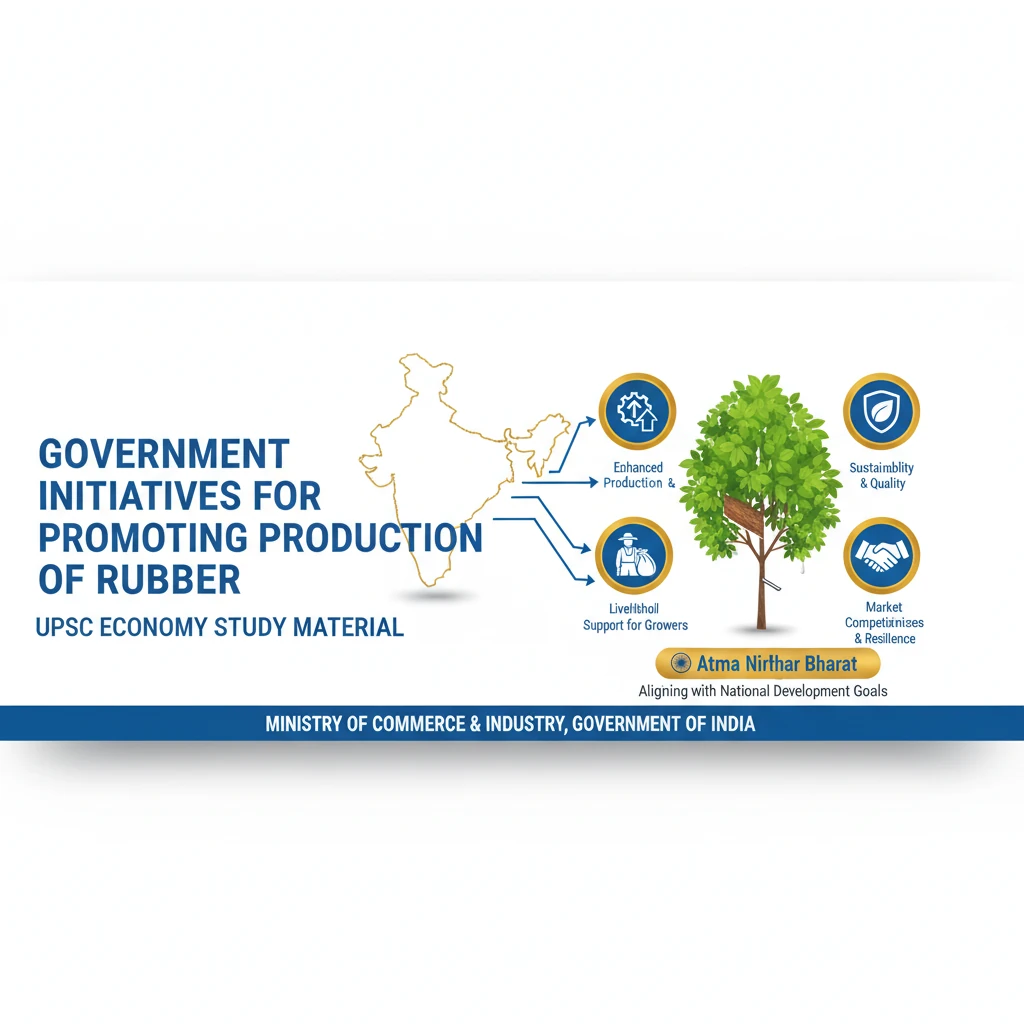
<h4>Overview of Government Initiatives for Rubber Production</h4><p>The <strong>Government of India</strong> has implemented several key initiatives to bolster the <strong>natural rubber sector</strong>. These measures aim to enhance production, improve productivity, ensure sustainability, and support the livelihoods of rubber growers across the nation.</p><p>The focus is on making the sector more competitive and resilient, aligning with broader agricultural and economic development goals. These initiatives address various aspects from plantation development to policy frameworks.</p><h4>Sustainable & Inclusive Development of Natural Rubber Sector (SIDNRs)</h4><p>The <strong>Sustainable & Inclusive Development of Natural Rubber Sector (SIDNRs)</strong> is a comprehensive program designed to promote the sustainable growth of rubber plantations. It emphasizes both ecological balance and socio-economic upliftment of farmers.</p><div class='info-box'><p><strong>SIDNRs</strong> typically includes components like providing financial assistance for planting and replanting, promoting scientific cultivation practices, and supporting research and development in rubber technology.</p></div><div class='key-point-box'><p>The core objective of <strong>SIDNRs</strong> is to ensure the long-term viability of the natural rubber industry while integrating marginalized farmers into the value chain.</p></div><h4>Rubber Plantation Development Scheme</h4><p>The <strong>Rubber Plantation Development Scheme</strong> is a targeted initiative aimed at expanding the area under rubber cultivation and improving the yield of existing plantations. It is crucial for meeting the increasing domestic demand for natural rubber.</p><ul><li>It often involves providing subsidies for planting new rubber saplings.</li><li>Support for adopting modern cultivation techniques is also a key feature.</li><li>The scheme helps in replacing old, unproductive trees with high-yielding varieties.</li></ul><h4>Rubber Group Planting Scheme</h4><p>The <strong>Rubber Group Planting Scheme</strong> encourages collective farming and resource sharing among small and marginal rubber growers. This approach helps in achieving economies of scale and better management of plantations.</p><div class='info-box'><p>Under this scheme, groups of farmers pool their land or resources to undertake rubber cultivation. This facilitates access to technical support, quality planting material, and collective marketing opportunities.</p></div><div class='exam-tip-box'><p>Understanding schemes like <strong>Rubber Group Planting</strong> is vital for <strong>UPSC GS Paper III (Agriculture)</strong>, especially when discussing farmer collectives and cooperative farming models.</p></div><h4>100% Foreign Direct Investment (FDI) in Rubber Plantations</h4><p>The government permits <strong>100% Foreign Direct Investment (FDI)</strong> in the plantation sector, including rubber. This policy aims to attract capital, technology, and expertise from abroad to boost the industry.</p><p>This liberalization of FDI policy is expected to enhance processing capabilities, improve infrastructure, and create more employment opportunities within the rubber value chain.</p><div class='key-point-box'><p>Allowing <strong>100% FDI</strong> signifies the government's commitment to integrating the Indian rubber sector with global markets and attracting significant private investment.</p></div><h4>National Rubber Policy 2019</h4><p>The <strong>National Rubber Policy 2019</strong> provides a comprehensive framework for the overall development of the natural rubber sector. It addresses various aspects from production to consumption and export.</p><div class='info-box'><p>Key objectives of the <strong>National Rubber Policy 2019</strong> include increasing productivity, enhancing quality, promoting sustainable practices, and ensuring price stability for growers. It also focuses on value addition and export promotion.</p></div><div class='exam-tip-box'><p>Policies like the <strong>National Rubber Policy 2019</strong> are crucial for <strong>UPSC Mains GS Paper III (Economy and Agriculture)</strong>. Candidates should be able to discuss their objectives, provisions, and potential impact.</p></div>
💡 Key Takeaways
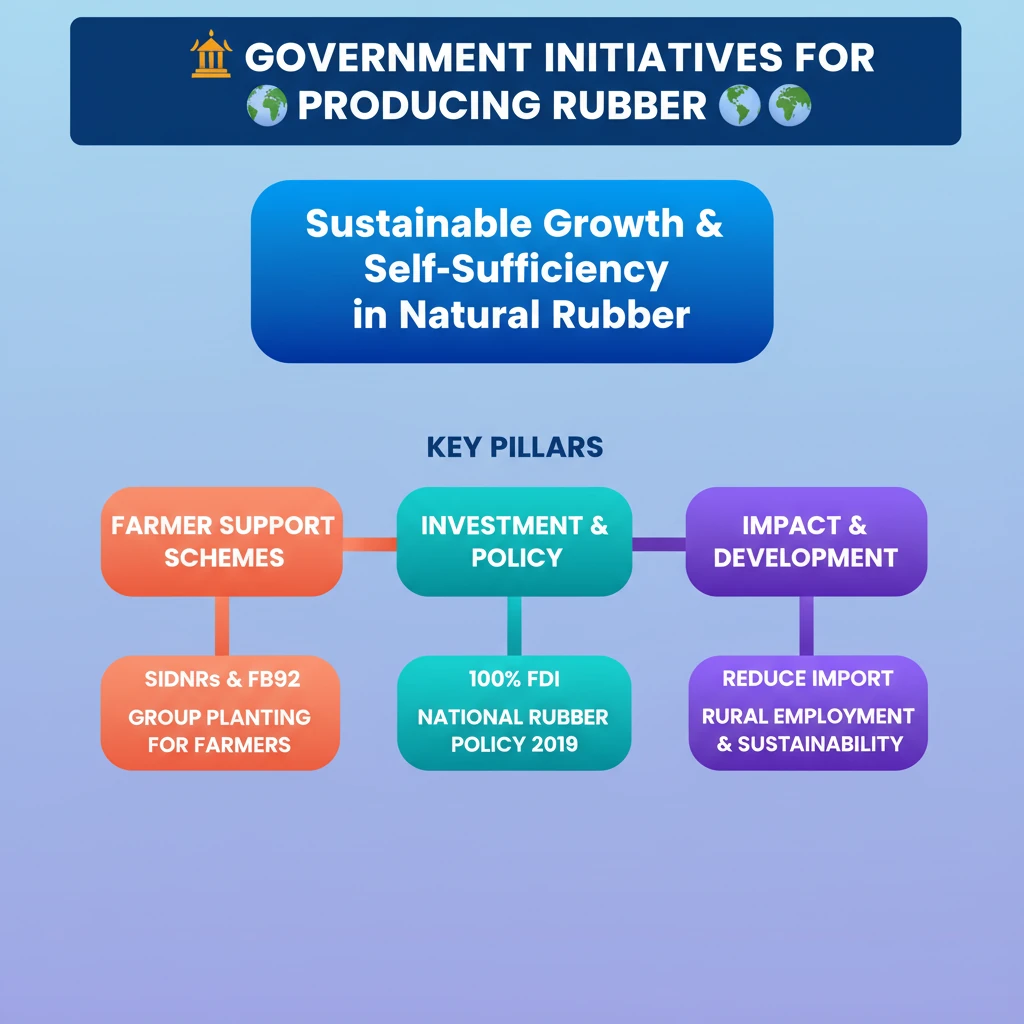
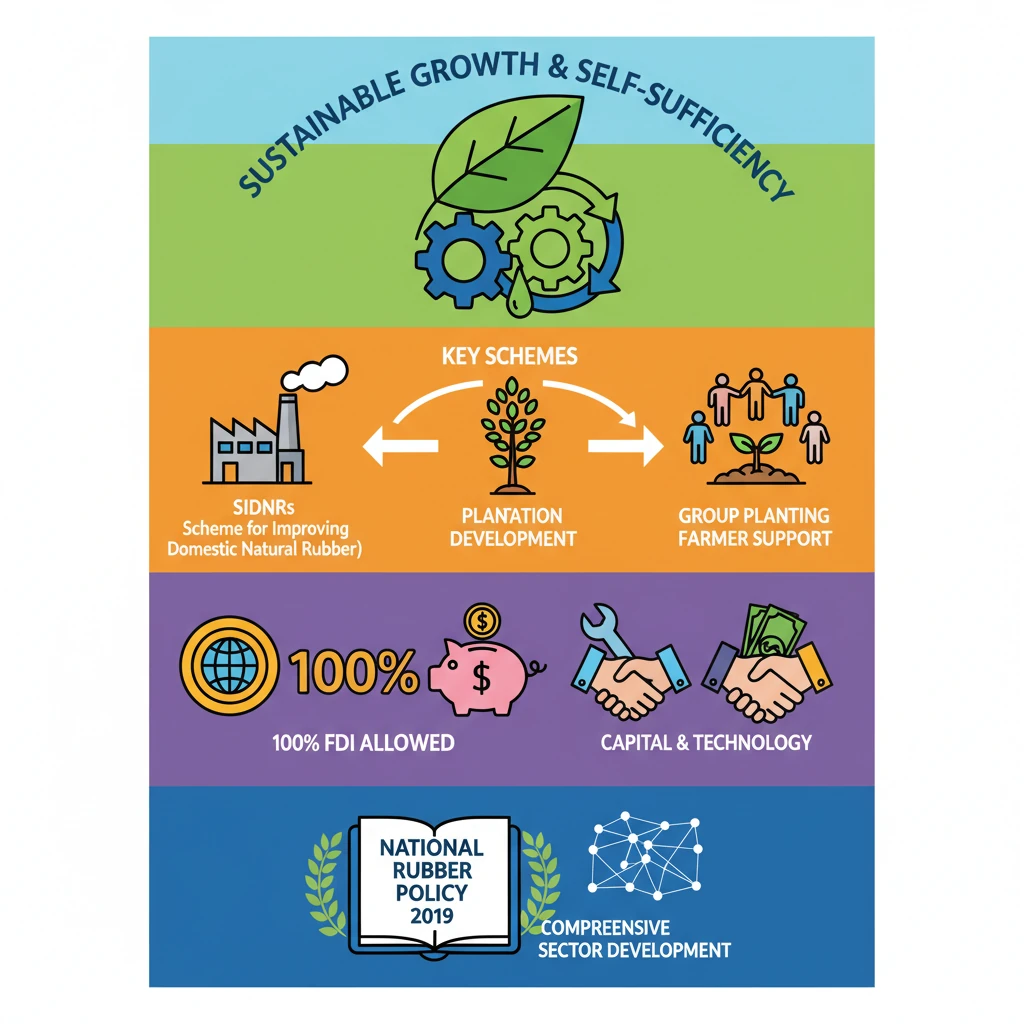
- •Government initiatives aim for sustainable growth and self-sufficiency in natural rubber.
- •Key schemes include SIDNRs, Plantation Development, and Group Planting for farmer support.
- •100% FDI is allowed in rubber plantations to attract capital and technology.
- •The National Rubber Policy 2019 provides a comprehensive framework for sector development.
- •Initiatives reduce import dependency, generate rural employment, and promote sustainable practices.
🧠 Memory Techniques
95% Verified Content
📚 Reference Sources
•Ministry of Commerce and Industry, Government of India reports
•Rubber Board of India official website
•Press Information Bureau (PIB) releases