What is the Status of Infrastructure Development in India? - Economy | UPSC Learning
Topics
0 topics • 0 completed
🔍
No topics match your search
What is the Status of Infrastructure Development in India?
Medium⏱️ 10 min read
economy
📖 Introduction
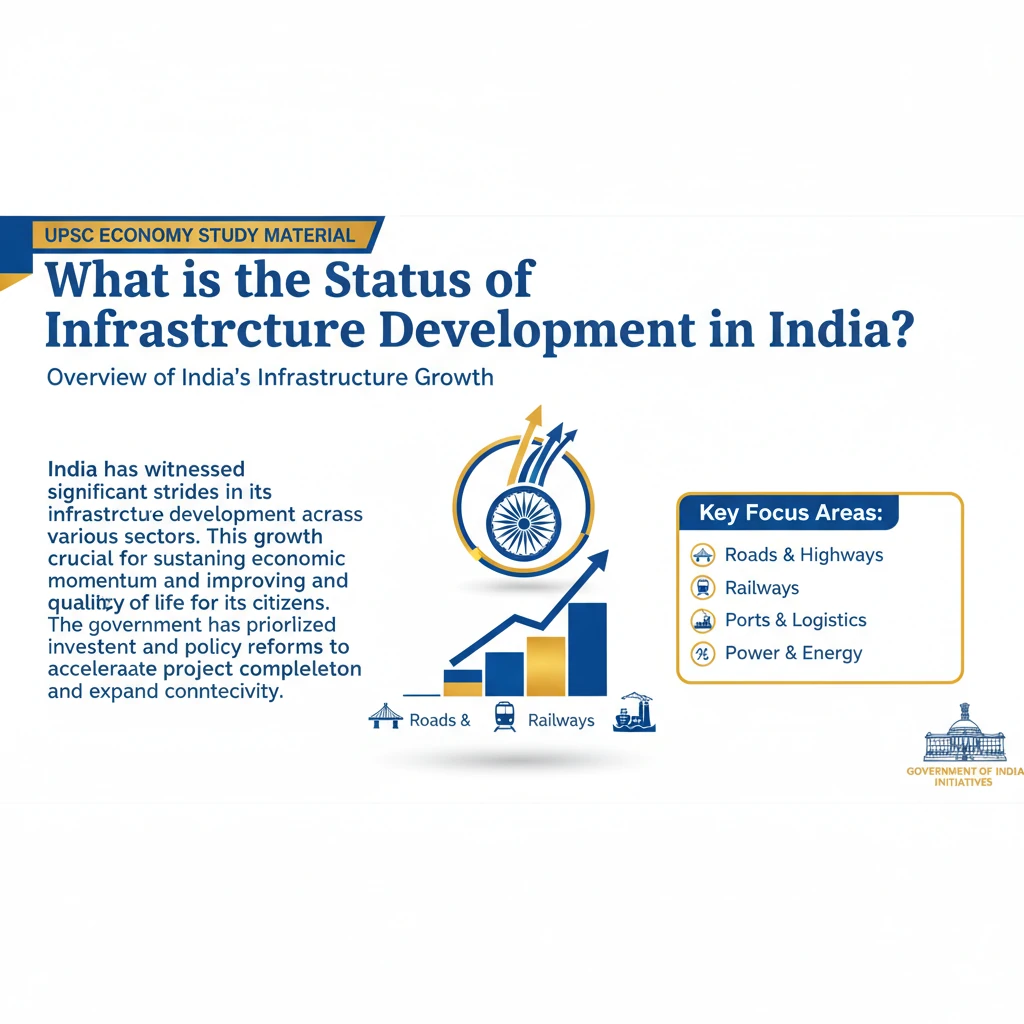
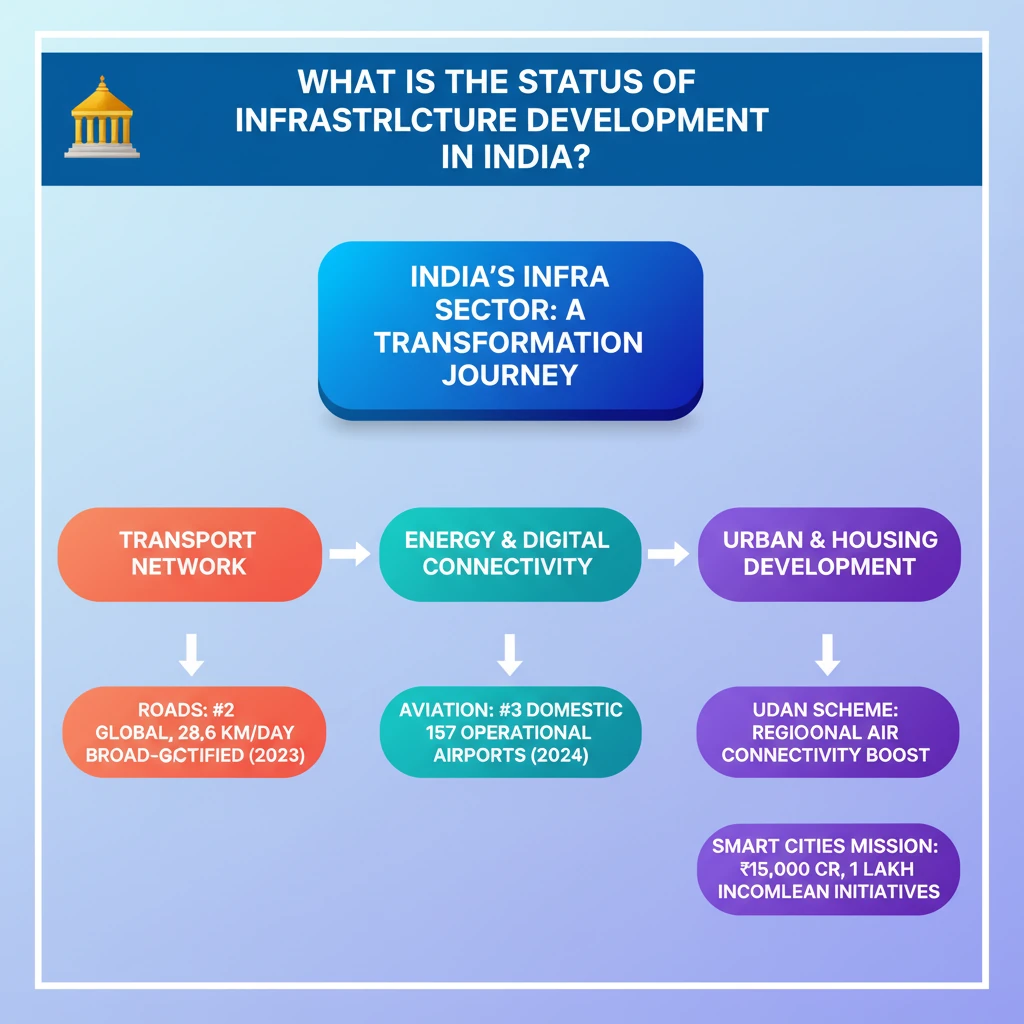
<h4>Overview of India's Infrastructure Growth</h4><p>India has witnessed significant strides in its <strong>infrastructure development</strong> across various sectors. This growth is crucial for sustaining economic momentum and improving the quality of life for its citizens. The government has prioritized investment and policy reforms to accelerate project completion and expand connectivity.</p><div class='key-point-box'><p><strong>Key Focus Areas:</strong> The primary sectors driving this growth include <strong>Highways and Roads</strong>, <strong>Railways</strong>, <strong>Civil Aviation</strong>, and <strong>Housing</strong>, alongside initiatives for the <strong>Local Economy</strong>.</p></div><h4>Highways and Roads Sector</h4><p>India boasts the <strong>second-largest road network globally</strong>, trailing only the United States. This extensive network is a lifeline for trade, commerce, and passenger movement across the country.</p><div class='info-box'><p><strong>National Highways (NH) Length:</strong> As of <strong>2024</strong>, the total length of National Highways stands at <strong>1,46,145 km</strong>.</p></div><p>The development of high-speed corridors is a key focus, significantly reducing travel times and improving logistics efficiency. The pace of NH construction has seen a remarkable increase over the past decade.</p><div class='info-box'><p><strong>Operational High-Speed Corridors:</strong> The length has increased to <strong>2,138 km</strong> in <strong>2024</strong>.</p><p><strong>NH Construction Pace:</strong> Increased from <strong>12.1 km/day</strong> in <strong>FY 2014-15</strong> to <strong>33.8 km/day</strong> in <strong>FY 2023-24</strong>, averaging <strong>28.6 km/day</strong>.</p><p><strong>Capital Expenditure:</strong> A significant <strong>5.7 times increase</strong> in capital expenditure between <strong>2013-24</strong> underscores the government's commitment.</p></div><h4>Railways Sector Development</h4><p>The Indian Railways, one of the largest networks in the world, is undergoing massive modernization and electrification efforts. Electrification enhances efficiency, reduces carbon footprint, and lowers operational costs.</p><div class='info-box'><p><strong>Broad-Gauge Track Electrification:</strong> As of <strong>December 2023</strong>, <strong>93.83%</strong> of broad-gauge tracks were electrified. This is a substantial increase from <strong>41,881 km</strong> in <strong>2014</strong>.</p><p><strong>Definition:</strong> A <strong>broad-gauge track</strong> is also known as a <strong>large line</strong>, with a distance of <strong>5 feet 6 inches</strong> between the two tracks.</p></div><p>Beyond electrification, passenger amenities are also being upgraded, with a focus on hygiene and environmental sustainability, such as the provision of bio-toilets.</p><div class='info-box'><p><strong>Bio-toilets in Coaches:</strong> Between <strong>2014-2023</strong>, <strong>80,478 coaches</strong> were equipped with bio-toilets.</p></div><h4>Civil Aviation Sector Expansion</h4><p>India's civil aviation sector has emerged as a global powerhouse, driven by increasing air travel demand and government initiatives to enhance regional connectivity. It plays a vital role in connecting remote areas and boosting tourism.</p><div class='info-box'><p><strong>Domestic Aviation Market:</strong> India is the <strong>3rd-largest domestic aviation market globally</strong>.</p><p><strong>Operational Airports:</strong> The number of operational airports has more than doubled, from <strong>74</strong> in <strong>2014</strong> to <strong>157</strong> in <strong>2024</strong>.</p></div><p>The <strong>Regional Connectivity Scheme (RCS) - UDAN</strong> has been instrumental in making air travel affordable and accessible to the common person. This scheme has significantly boosted passenger numbers in previously underserved regions.</p><div class='info-box'><p><strong>UDAN Scheme Beneficiaries:</strong> As of <strong>December 2024</strong>, <strong>147 lakh passengers</strong> have benefited from the UDAN scheme.</p></div><p>Looking ahead, the UDAN scheme is set for further expansion, aiming to connect even more destinations and serve a larger passenger base.</p><div class='info-box'><p><strong>UDAN Scheme Extension:</strong> The scheme has been extended for another <strong>10 years</strong>.</p><p><strong>Revamped UDAN:</strong> A revamped scheme aims to connect <strong>120 new destinations</strong>, serving an additional <strong>40 million passengers</strong>.</p></div><p>New infrastructure projects, such as greenfield airports, are being planned to support this expansion and complement existing facilities.</p><div class='info-box'><p><strong>Greenfield Airports in Bihar:</strong> New greenfield airports will complement expansions at <strong>Patna</strong> and <strong>Bihta (in Patna) airports</strong> in Bihar.</p></div><h4>Housing Sector Initiatives</h4><p>Addressing the housing deficit remains a critical area of focus, with specific funds allocated to accelerate the completion of stalled projects and ensure housing for all. Government and private sector collaboration is key to achieving these goals.</p><div class='info-box'><p><strong>SWAMITV Fund 2:</strong> A fund of <strong>Rs 15,000 crore</strong> will be established to expedite the completion of <strong>1 lakh incomplete housing units</strong>.</p><p><strong>Funding Model:</strong> Contributions will come from the <strong>government</strong>, <strong>banks</strong>, and <strong>private investors</strong>.</p></div><h4>Support for Local Economy</h4><p>Government schemes are also being revamped to provide greater financial support and digital integration for street vendors and small businesses, strengthening the local economy.</p><div class='info-box'><p><strong>PM SVANidhi Revamp:</strong> The scheme will be revamped to offer <strong>enhanced loans</strong> from banks.</p><p><strong>Digital Integration:</strong> It will include <strong>UPI-linked credit cards</strong> with a <strong>Rs 30,000 limit</strong>, promoting digital transactions among street vendors.</p></div><h4>Related Economic Tools and Maritime Sector</h4><p>While not directly tied to the primary infrastructure categories mentioned, certain economic tools have relevance in broader infrastructure and industrial contexts, such as shipbuilding and material recycling.</p><div class='info-box'><p><strong>Credit Notes:</strong> Commonly used when a buyer returns goods. In the context of infrastructure, they can assist <strong>shipbuilding companies</strong> in returning or recycling materials like <strong>steel</strong>, <strong>copper</strong>, and <strong>aluminum</strong> obtained from dismantled ships.</p></div>
💡 Key Takeaways
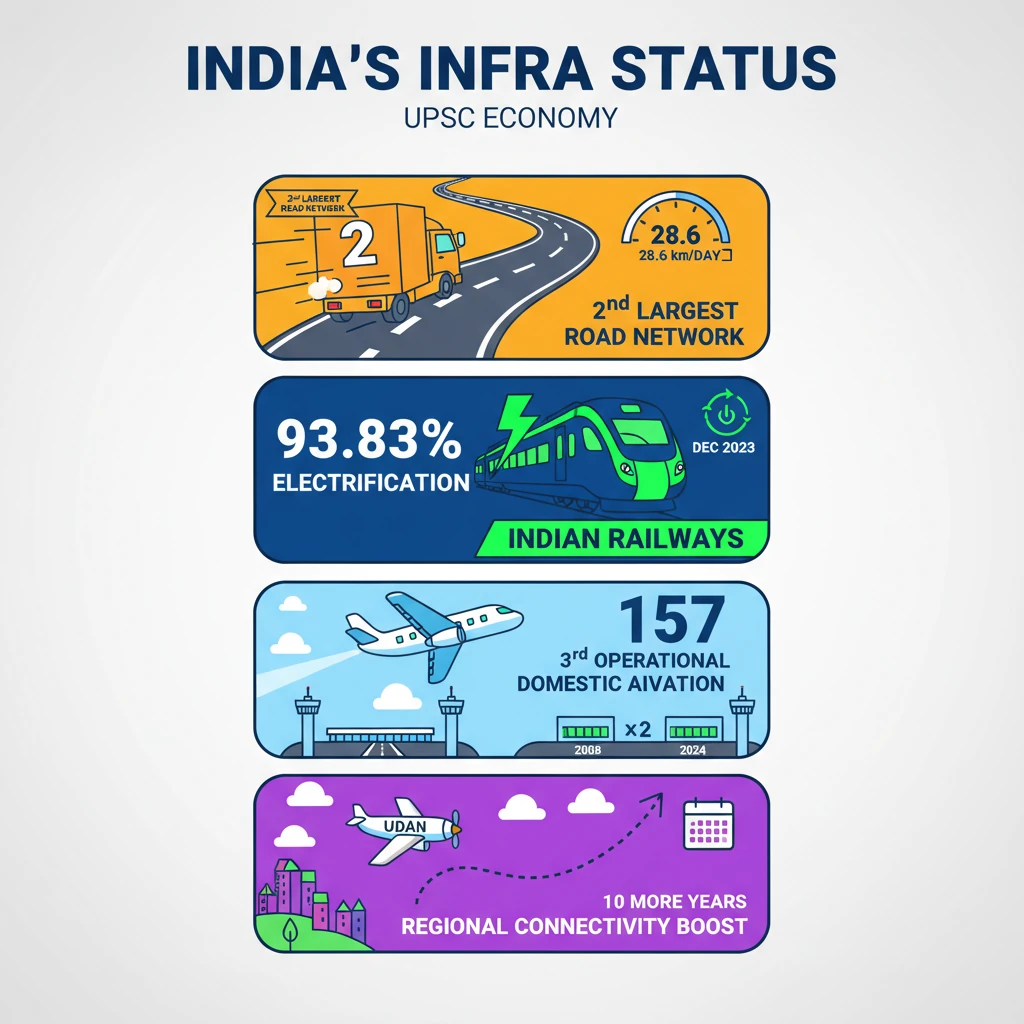
- •India has the 2nd-largest road network globally, with rapid NH construction (28.6 km/day).
- •Indian Railways has achieved 93.83% broad-gauge electrification by Dec 2023.
- •Civil Aviation is the 3rd-largest domestic market, with operational airports doubling to 157 (2024).
- •UDAN scheme has significantly boosted regional air connectivity and is extended for 10 more years.
- •SWAMITV Fund 2 (₹15,000 Cr) aims to complete 1 lakh incomplete housing units.
- •PM SVANidhi is revamped to provide enhanced loans and UPI-linked credit cards (₹30,000 limit) for local economies.
🧠 Memory Techniques
98% Verified Content
📚 Reference Sources
•Ministry of Road Transport and Highways (implied source for road data)
•Indian Railways (implied source for railway data)
•Ministry of Civil Aviation (implied source for aviation data)
•Ministry of Finance (implied source for fund details)