What are Recent Government Initiatives in India’s Maritime Sector? - Economy | UPSC Learning
Topics
0 topics • 0 completed
🔍
No topics match your search
What are Recent Government Initiatives in India’s Maritime Sector?
Medium⏱️ 12 min read
economy
📖 Introduction
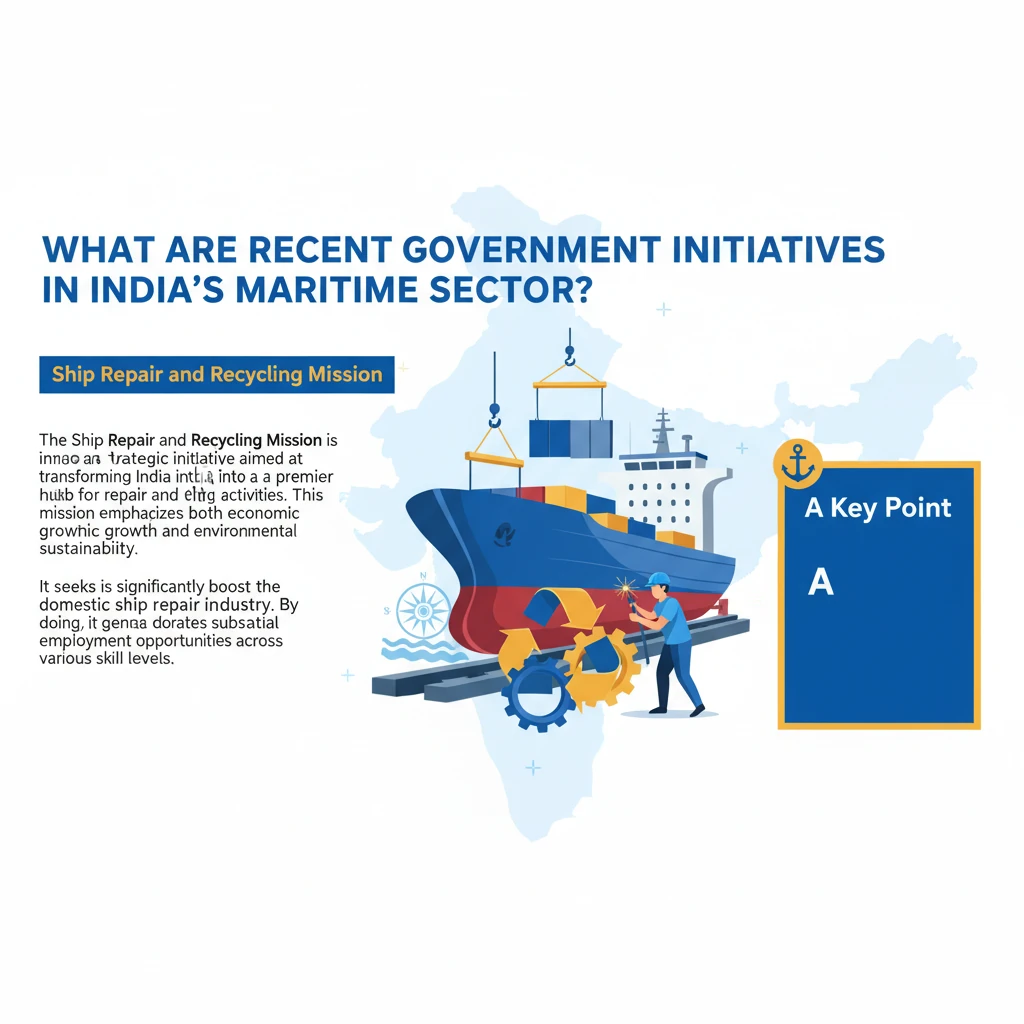
<h4>Ship Repair and Recycling Mission</h4><p>The <strong>Ship Repair and Recycling Mission</strong> is a strategic initiative aimed at transforming India into a premier global hub for ship repair and recycling activities. This mission emphasizes both economic growth and environmental sustainability.</p><p>It seeks to significantly boost the domestic ship repair industry. By doing so, it generates substantial employment opportunities across various skill levels.</p><div class='key-point-box'><p>A core aspect is the adherence to international environmental norms, particularly the <strong>Hong Kong International Convention for the Safe and Environmentally Sound Recycling of Ships</strong>. This ensures responsible and sustainable practices.</p></div><h4>International Maritime Dispute Resolution Centre (IMDRC)</h4><p>The <strong>International Maritime Dispute Resolution Centre (IMDRC)</strong> is a pioneering initiative designed to establish an institutional framework for resolving maritime and shipping-related disputes within India. This aims to reduce reliance on foreign arbitration.</p><p>It offers a cost-effective and efficient alternative to international litigation. This significantly enhances the ease of doing business for maritime stakeholders in India.</p><div class='info-box'><p>The IMDRC is proposed to be established at the <strong>Gujarat Maritime Board (GMB)</strong> within <strong>GIFT City, Gandhinagar</strong>. This strategic location leverages India's growing financial and maritime infrastructure.</p></div><h4>Security and Growth for All in the Region (SAGAR)</h4><p><strong>Security and Growth for All in the Region (SAGAR)</strong> is India's overarching strategic vision for the <strong>Indian Ocean Region (IOR)</strong>. It encapsulates India's approach to maritime cooperation and regional security.</p><p>The policy is built on several key pillars, including enhanced <strong>maritime security</strong>, fostering <strong>economic cooperation</strong>, promoting <strong>sustainable development</strong>, and strengthening capabilities for <strong>disaster management</strong> among littoral states.</p><div class='exam-tip-box'><p>SAGAR is crucial for understanding India's proactive foreign policy and its role as a net security provider in the <strong>Indian Ocean</strong>. It often appears in questions related to international relations and India's strategic interests (<strong>GS Paper 2</strong>).</p></div><h4>Sagar Mala Program</h4><p>The <strong>Sagar Mala Program</strong>, launched in <strong>2015</strong>, is a flagship national initiative focused on port-led development. Its primary objective is to reduce logistics costs for EXIM (Export-Import) and domestic trade.</p><p>It aims to achieve this through comprehensive infrastructure development. This includes modernizing existing ports, developing new ones, and enhancing connectivity to these ports.</p><div class='info-box'><p>The program has four main components: <ul><li><strong>Port Modernization & New Port Development</strong></li><li><strong>Port Connectivity Enhancement</strong></li><li><strong>Port-linked Industrialization</strong></li><li><strong>Coastal Community Development</strong></li></ul></p></div><h4>Maritime India Vision 2030</h4><p>The <strong>Maritime India Vision 2030 (MIV 2030)</strong> is a comprehensive roadmap outlining the strategic initiatives and goals for the Indian maritime sector over the next decade. It was unveiled at the <strong>Maritime India Summit 2021</strong>.</p><p>Its ambition is to position India as a leading maritime nation globally. This involves significant advancements in port infrastructure, shipping, shipbuilding, and maritime education.</p><div class='key-point-box'><p>Key focus areas include promoting <strong>sustainable development</strong>, rapid <strong>technological adoption</strong>, and improving the <strong>ease of doing business</strong> across the entire maritime value chain.</p></div><h4>Maritime AmritKaal Vision 2047</h4><p>The <strong>Maritime AmritKaal Vision 2047</strong> extends the aspirations of MIV 2030, setting a long-term trajectory for India's maritime sector towards the 100th year of its independence. It was launched in <strong>August 2023</strong>.</p><p>This ambitious vision aims to transform India into a <strong>global maritime superpower</strong>. It envisages a future where India's maritime capabilities are world-class and environmentally sustainable.</p><div class='highlight-box'><p>Major goals include achieving <strong>zero-emission shipping</strong>, significant <strong>digitalization</strong> of port operations, increasing port capacity to over <strong>3000+ MTPA</strong>, and becoming a <strong>top 5 shipbuilding nation</strong> globally.</p></div>
💡 Key Takeaways
- •India's maritime sector is undergoing significant transformation through government initiatives.
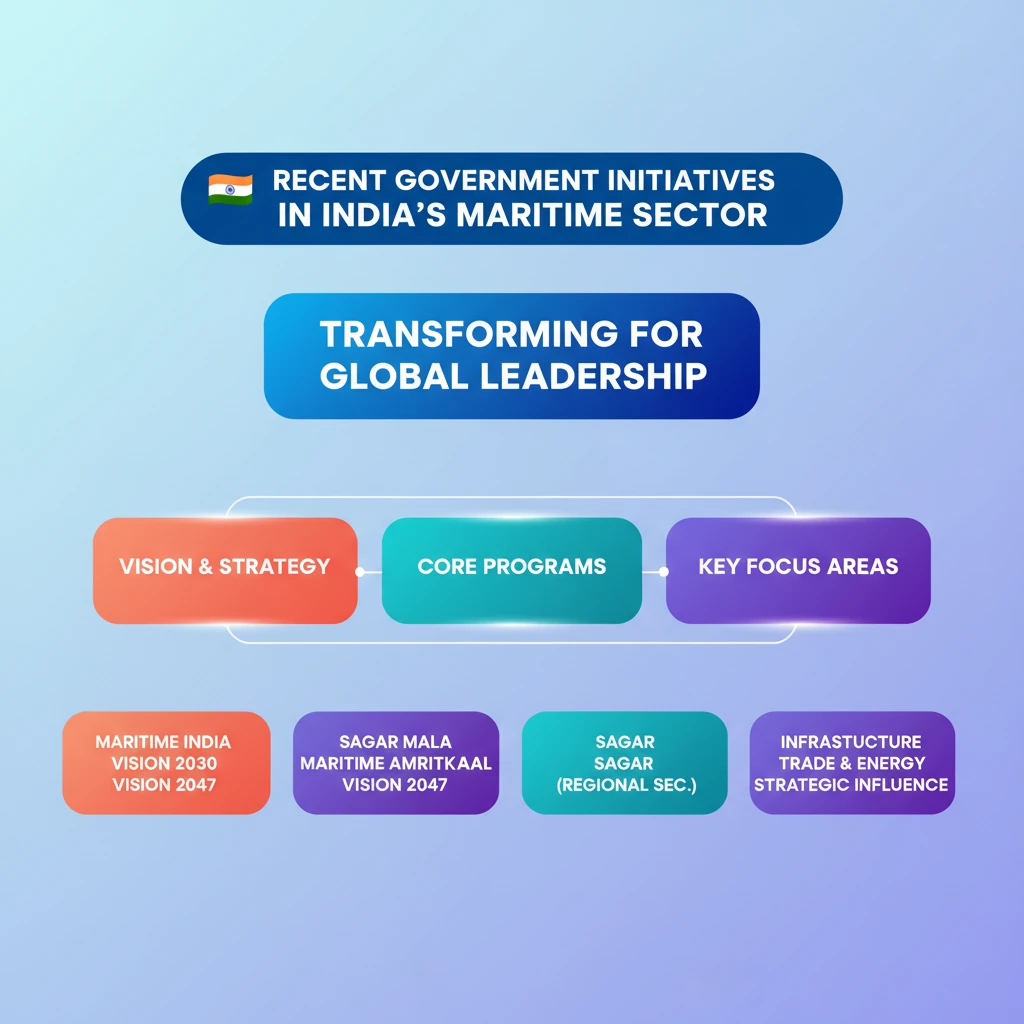
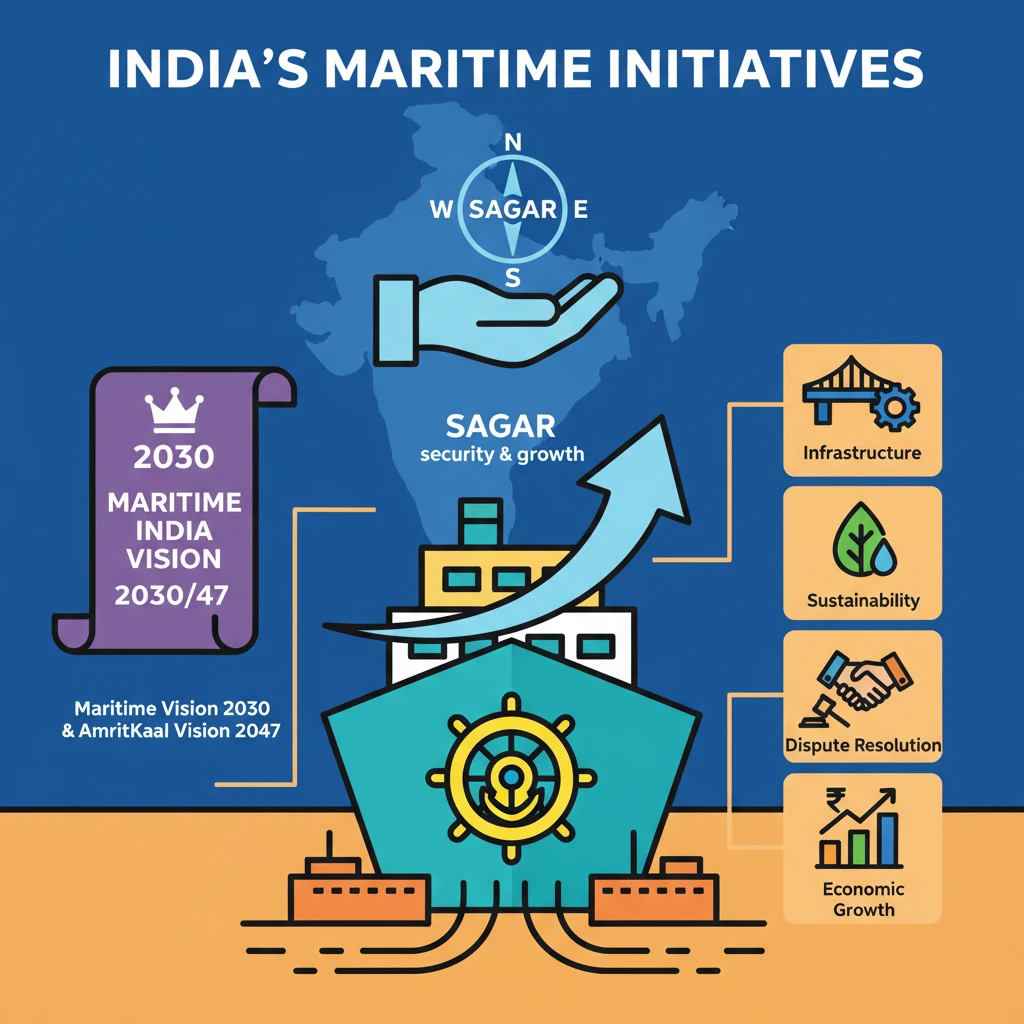
- •Key programs include Sagar Mala (port-led development) and SAGAR (regional security & growth).
- •New visions like Maritime India Vision 2030 and Maritime AmritKaal Vision 2047 aim for global maritime leadership.
- •Focus areas are infrastructure, sustainability, dispute resolution, and economic growth.
- •These initiatives are crucial for India's trade, energy security, and strategic influence.
🧠 Memory Techniques
95% Verified Content
📚 Reference Sources
•Press Information Bureau (PIB) releases on maritime initiatives
•NITI Aayog documents on Blue Economy
•Drishti IAS Economy Notes (provided summary)