ULI & Digital Infrastructure: Integration with JAM & UPI for Financial Inclusion - Economy | UPSC Learning
Topics
0 topics • 0 completed
🔍
No topics match your search
ULI & Digital Infrastructure: Integration with JAM & UPI for Financial Inclusion
Medium⏱️ 8 min read
economy
📖 Introduction
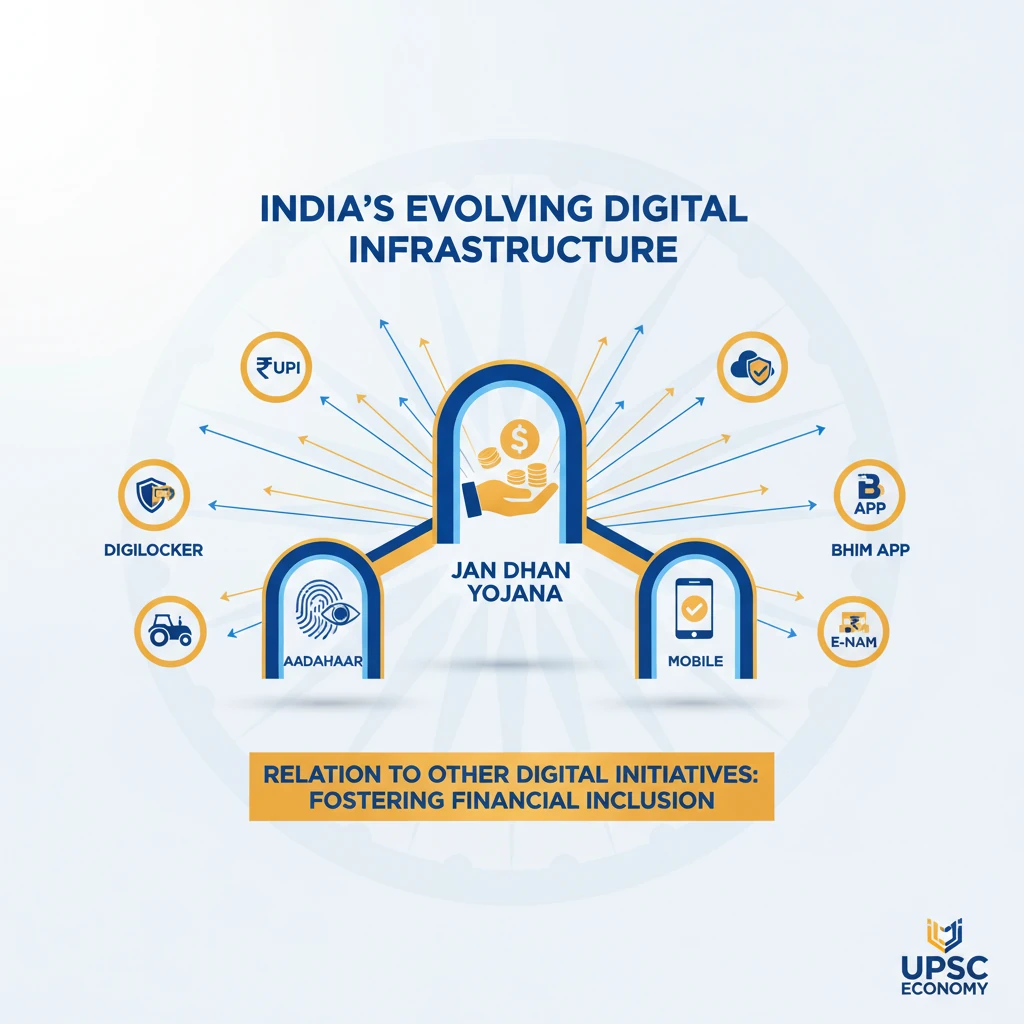
<h4>Introduction to India's Evolving Digital Infrastructure</h4><p>India's digital landscape is undergoing a significant transformation, driven by a series of interconnected initiatives. These initiatives aim to leverage technology to foster greater <strong>financial inclusion</strong> and address critical economic challenges.</p><p>The concept of a 'new trinity' highlights the strategic integration of these powerful digital platforms, promising a more robust and accessible financial ecosystem for all citizens.</p><h4>Understanding the Components: JAM Trinity</h4><p>The <strong>JAM Trinity</strong> refers to the convergence of three foundational government initiatives: <strong>Jan Dhan accounts</strong>, <strong>Aadhaar</strong>, and <strong>Mobile phones</strong>.</p><div class='info-box'><p><ul><li><strong>Jan Dhan Yojana:</strong> Provides universal access to banking facilities, ensuring every household has a bank account.</li><li><strong>Aadhaar:</strong> A unique 12-digit identification number that provides a verifiable identity for residents.</li><li><strong>Mobile Phones:</strong> Facilitate digital transactions and access to banking services, especially in remote areas.</li></ul></p></div><p>This trinity has been instrumental in direct benefit transfers (DBT) and expanding the reach of formal financial services across the country.</p><h4>Understanding the Components: UPI</h4><p>The <strong>Unified Payments Interface (UPI)</strong> is a real-time payment system developed by the <strong>National Payments Corporation of India (NPCI)</strong>.</p><div class='key-point-box'><p>UPI enables instant fund transfers between bank accounts using a single mobile application. It has revolutionized digital payments in India, making transactions seamless and interoperable across various banks and payment service providers.</p></div><p>Its ease of use and widespread adoption have made it a cornerstone of India's digital economy, facilitating millions of transactions daily.</p><h4>Understanding the Components: ULI</h4><p><strong>ULI</strong>, or the <strong>Unsecured Lending Initiative</strong> (or Infrastructure), is an emerging digital initiative designed to streamline and expand access to credit.</p><div class='info-box'><p>The primary goal of ULI is to facilitate easier and faster access to <strong>unsecured loans</strong> for individuals and small businesses, particularly those underserved by traditional banking channels.</p></div><p>It aims to leverage digital footprints and data to assess creditworthiness, thereby reducing friction in the lending process and increasing credit availability.</p><h4>The Vision of the 'New Trinity': JAM-UPI-ULI</h4><p>The integration of <strong>JAM</strong>, <strong>UPI</strong>, and <strong>ULI</strong> forms a powerful 'new trinity' for India's digital infrastructure.</p><div class='key-point-box'><p>This synergistic integration represents a significant advancement, aiming to create a comprehensive digital ecosystem that not only facilitates payments but also addresses the crucial aspect of credit access.</p></div><p>It signifies a move towards a more holistic digital financial architecture, building upon the successes of previous initiatives to tackle new challenges.</p><h4>Impact on Digital Infrastructure and Financial Inclusion</h4><p>The combined strength of <strong>JAM-UPI-ULI</strong> is expected to significantly bolster India's <strong>digital infrastructure</strong>.</p><p>By integrating these systems, the government aims to deepen <strong>financial inclusion</strong>, ensuring that more people, especially those in rural and semi-urban areas, can access a full spectrum of financial services, from payments to credit.</p><h4>Addressing Unmet Credit Demand</h4><p>A core objective of this 'new trinity' is to cater to the large <strong>unmet demand for credit</strong> in the Indian economy.</p><div class='exam-tip-box'><p>The formal credit system often struggles to reach micro-enterprises, small farmers, and individuals without traditional collateral. ULI, powered by the reach of JAM and the transaction data from UPI, can potentially unlock this segment.</p></div><p>This integration promises to make credit more accessible, affordable, and efficient, fostering economic growth and entrepreneurship at the grassroots level.</p>

💡 Key Takeaways
- •JAM-UPI-ULI forms a 'new trinity' for India's digital infrastructure.
- •JAM (Jan Dhan, Aadhaar, Mobile) provides foundational financial access and identity.
- •UPI (Unified Payments Interface) revolutionized digital payments with instant transactions.
- •ULI (Unsecured Lending Initiative) aims to address unmet credit demand, especially for MSMEs.
- •The integration enhances financial inclusion and leverages digital data for credit assessment.
- •This framework is crucial for inclusive growth and strengthening India's digital economy.
🧠 Memory Techniques

95% Verified Content
📚 Reference Sources
•Reserve Bank of India (RBI) publications on financial inclusion and digital payments
•National Payments Corporation of India (NPCI) reports on UPI statistics
•Ministry of Finance reports on Jan Dhan Yojana