India’s Efforts to Reduce Current Account Deficit - Economy | UPSC Learning
Topics
0 topics • 0 completed
🔍
No topics match your search
India’s Efforts to Reduce Current Account Deficit
Medium⏱️ 8 min read
economy
📖 Introduction
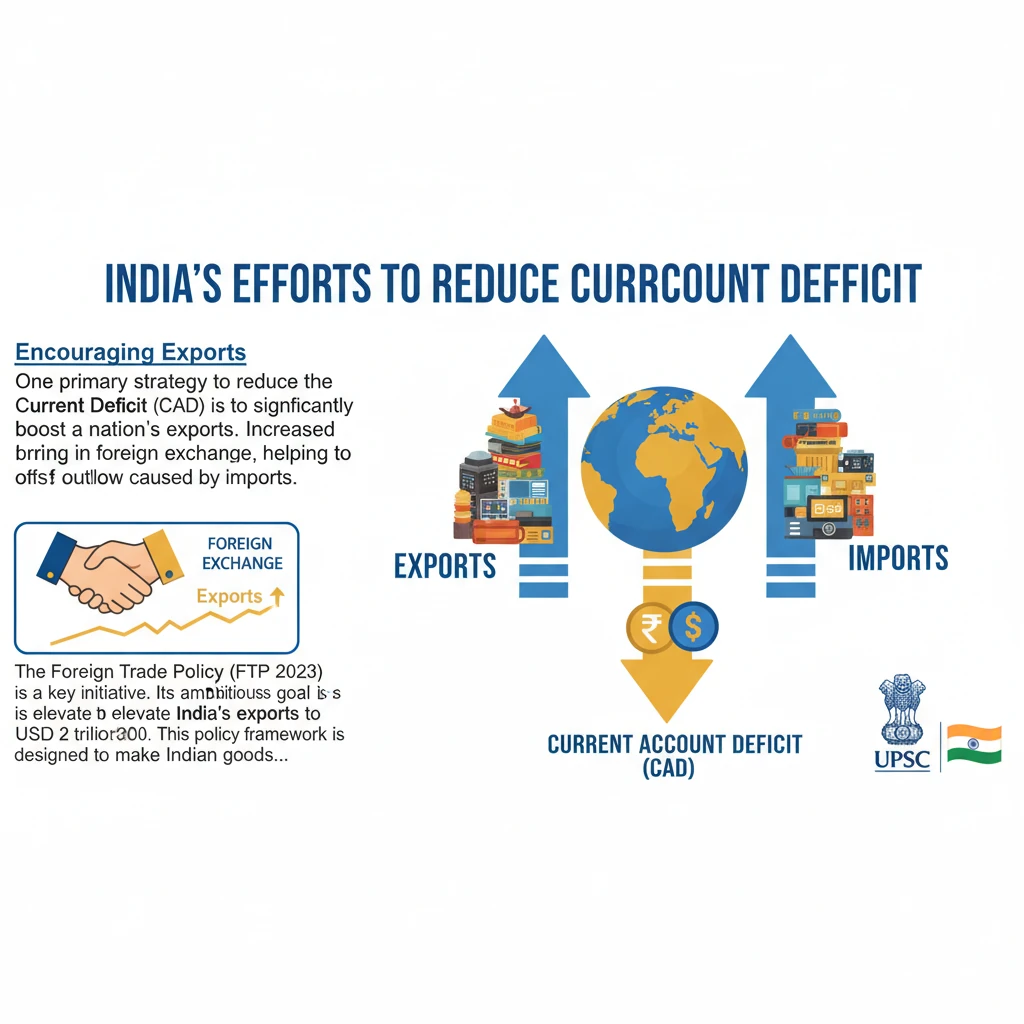
<h4>Encouraging Exports</h4><p>One primary strategy to reduce the <strong>Current Account Deficit (CAD)</strong> is to significantly boost a nation's exports. Increased exports bring in foreign exchange, helping to offset the outflow caused by imports.</p><div class="info-box"><p>The <strong>Foreign Trade Policy (FTP) 2023</strong> is a key initiative. Its ambitious goal is to elevate <strong>India’s exports to USD 2 trillion by 2030</strong>. This policy framework is designed to make Indian goods more competitive globally.</p></div><p>By making exports more competitive and streamlined, India aims to create a positive trade balance. This directly contributes to narrowing the overall current account deficit.</p><h4>Promoting Import Substitution</h4><p>Another crucial approach involves reducing reliance on imports by fostering domestic production. This strategy is known as <strong>import substitution</strong>.</p><div class="key-point-box"><p>The <strong>Atmanirbhar Bharat Abhiyaan</strong> (Self-Reliant India Campaign) is a flagship government initiative vigorously pursuing this objective. It aims to strengthen domestic manufacturing capabilities.</p></div><p>The campaign provides various <strong>incentives to domestic manufacturers</strong>. These incentives encourage the local production of goods that were previously imported, thereby saving foreign exchange.</p><div class="info-box"><p>An excellent example of such an incentive is the <strong>Production Linked Incentive (PLI) Scheme</strong>. This scheme offers financial rewards on incremental sales for products manufactured in India across various sectors.</p></div><h4>Increasing Productivity and Competitiveness</h4><p>Enhancing the overall <strong>productivity</strong> and <strong>competitiveness</strong> of the domestic economy is fundamental. This creates a strong foundation for both increased exports and efficient import substitution.</p><p>Improved productivity means goods can be produced more efficiently and at lower costs. This makes them more attractive in international markets, boosting exports.</p><p>Initiatives like building <strong>'future friendly' skills</strong> and fostering <strong>innovation</strong> are vital. These efforts ensure that India's workforce and industries remain at the cutting edge, contributing to economic growth and trade balance.</p><h4>Carbon Border Adjustment Mechanism (CBAM) and its Implications</h4><p>The <strong>Carbon Border Adjustment Mechanism (CBAM)</strong> is an EU regulation with significant implications for global trade, including India's exports. It aims to prevent <strong>carbon leakage</strong>.</p><div class="info-box"><p><strong>Carbon leakage</strong> occurs when companies move carbon-intensive production to countries with less stringent climate policies to avoid carbon costs.</p></div><p>CBAM ensures that the <strong>carbon price for imports</strong> entering the EU matches the carbon price applied to EU-produced goods. This maintains fair competition and incentivizes cleaner production globally.</p><h5>CBAM’s Functioning Framework</h5><ol><li><strong>Registration and Certification:</strong> <strong>EU importers</strong> of goods covered by CBAM must register with national authorities. They then purchase <strong>CBAM certificates</strong>, which reflect the carbon emissions embedded in their imports.</li><li><strong>Annual Declaration:</strong> Importers are required to declare the <strong>emissions embedded</strong> in their imported goods annually. They must then surrender the corresponding number of purchased certificates.</li><li><strong>Payment of Carbon Price:</strong> Importers can prove that a <strong>carbon price has already been paid</strong> during production in a non-EU country. This amount will be deducted from their overall CBAM payment, avoiding double taxation.</li></ol><h5>Goods Covered by CBAM</h5><p>Initially, CBAM applies to specific sectors identified as having a high risk of <strong>carbon leakage</strong>. These include energy-intensive industries.</p><div class="info-box"><p>The initial list of goods covered includes <strong>cement, iron and steel, aluminium, fertilisers, electricity, and hydrogen</strong>.</p></div><p>Over time, the scope of CBAM is expected to expand. It will eventually capture more than <strong>50% of emissions</strong> from sectors already covered by the <strong>EU Emissions Trading System (ETS)</strong>, such as oil refineries and shipping.</p><div class="exam-tip-box"><p><strong>UPSC Insight:</strong> Understanding <strong>CBAM</strong> is crucial as it impacts India's export strategy, particularly for carbon-intensive industries. Questions may arise on its economic implications and India's response (e.g., carbon taxation, green manufacturing).</p></div>
💡 Key Takeaways
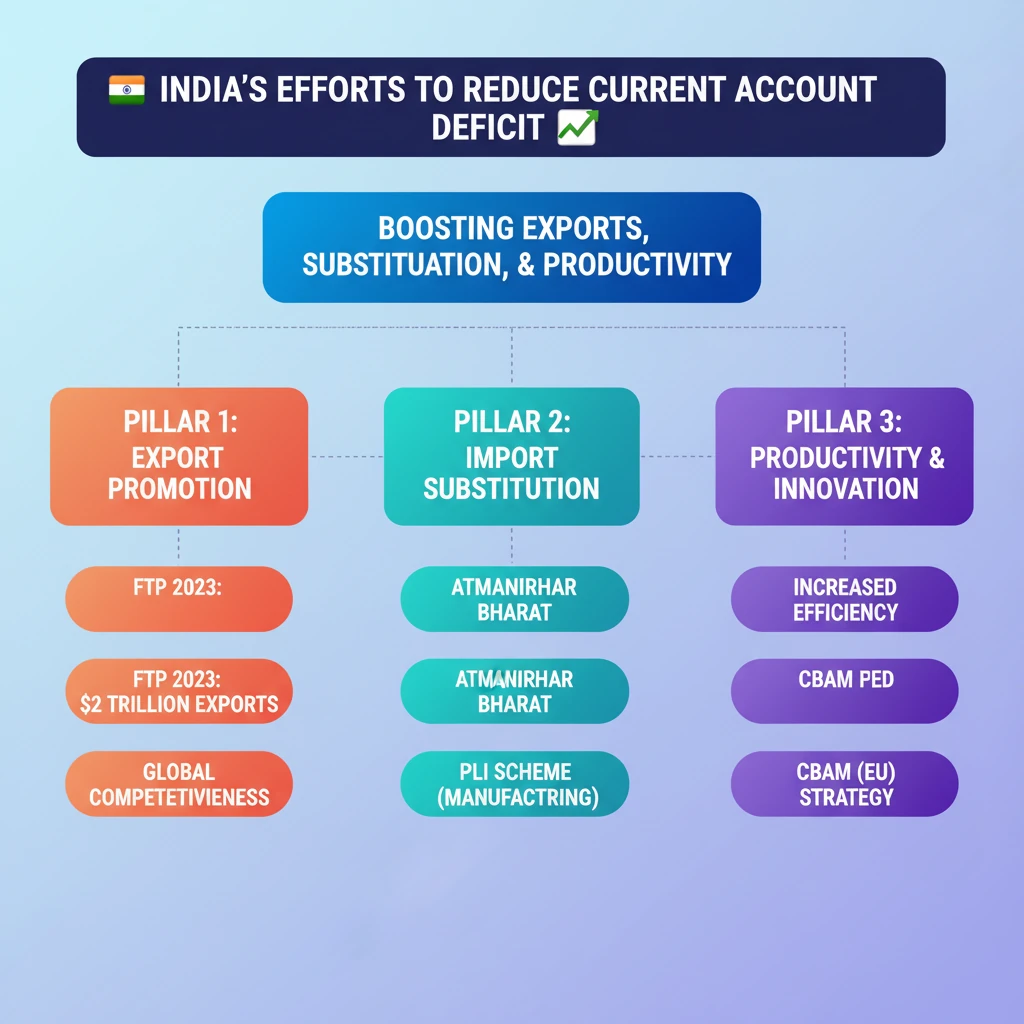
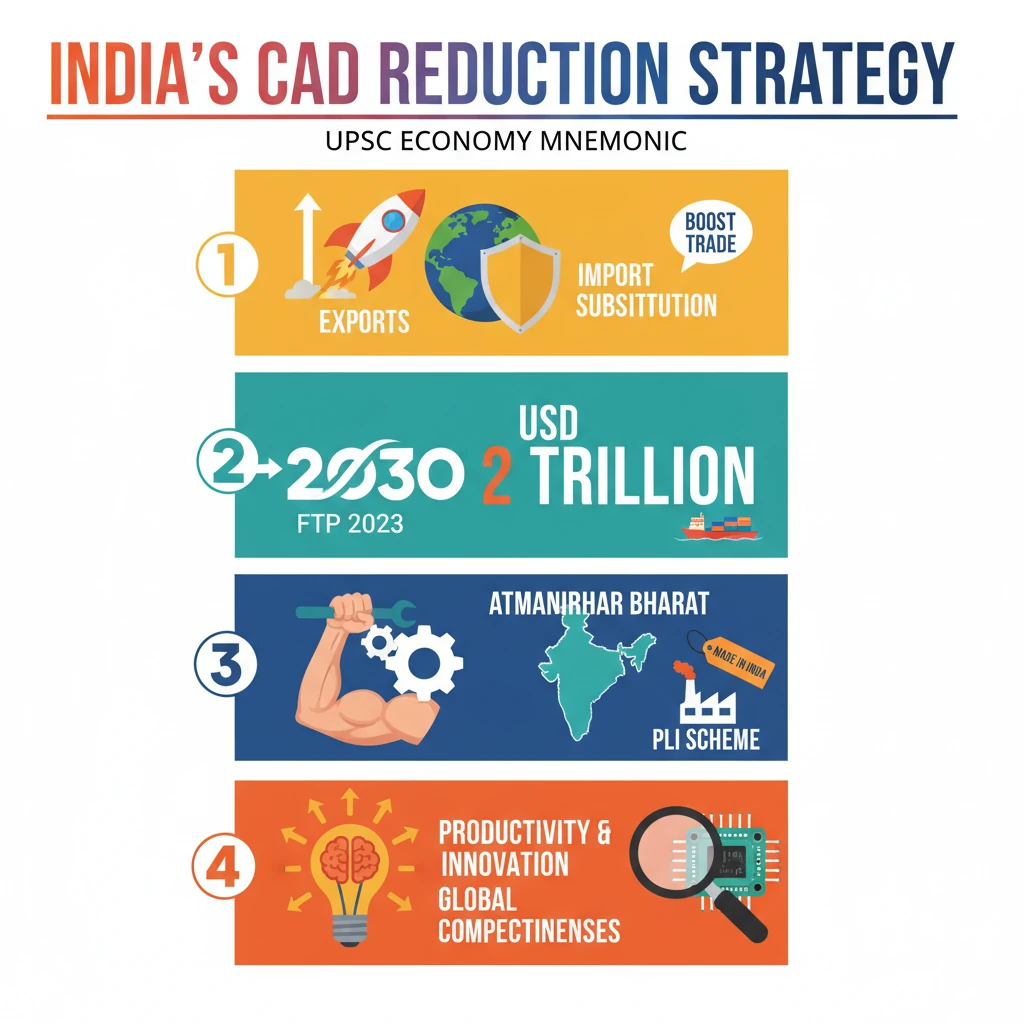
- •India's CAD reduction strategy focuses on boosting exports, promoting import substitution, and enhancing productivity.
- •Foreign Trade Policy (FTP) 2023 aims for USD 2 trillion exports by 2030.
- •Atmanirbhar Bharat and PLI Scheme are key for domestic manufacturing and reducing import dependence.
- •Increased productivity and innovation are crucial for global competitiveness.
- •CBAM is an EU carbon tax on imports, impacting India's carbon-intensive exports and requiring strategic response.
- •Sustainable CAD is vital for macroeconomic stability, currency strength, and investor confidence.
🧠 Memory Techniques
95% Verified Content
📚 Reference Sources
•Ministry of Commerce and Industry (Foreign Trade Policy 2023 document)
•NITI Aayog (Atmanirbhar Bharat Abhiyaan and PLI Scheme reports)
•Reserve Bank of India (Balance of Payments data)
•European Union (CBAM official documentation)