Special Vostro Rupee Accounts - Economy | UPSC Learning
Topics
0 topics • 0 completed
🔍
No topics match your search

Special Vostro Rupee Accounts
Medium⏱️ 6 min read
economy
📖 Introduction
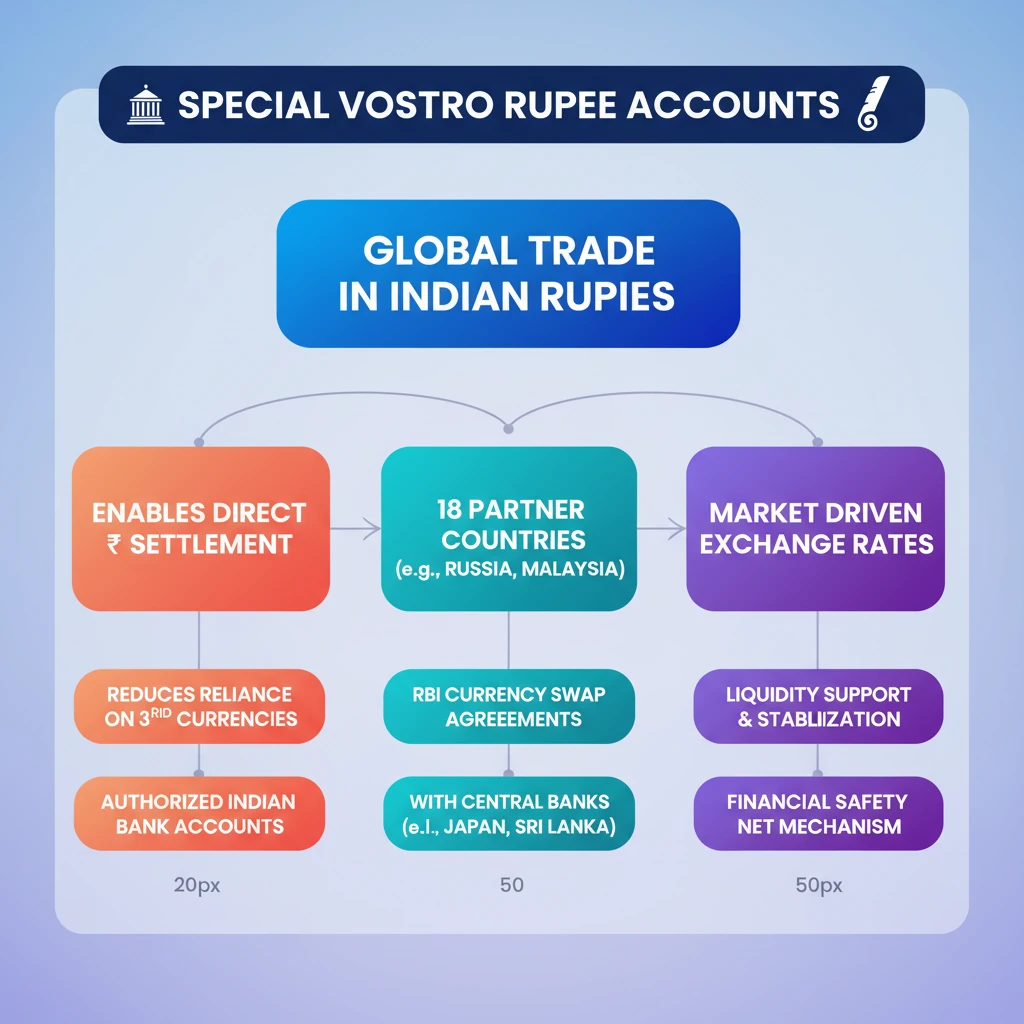
<h4>Special Vostro Rupee Accounts (SVRAs)</h4><p>The <strong>Special Vostro Rupee Accounts (SVRAs)</strong> are a crucial mechanism facilitating international trade settlements in the Indian Rupee. This initiative was introduced by India to promote bilateral trade with various partner countries.</p><p>Under this framework, authorized banks in India are permitted to open and maintain these special accounts. These accounts are designated for banks from specific partner countries, enabling them to settle payments directly in <strong>rupees</strong>.</p><div class='info-box'><p><strong>Key Feature:</strong> Payments through SVRAs are settled at <strong>market-determined exchange rates</strong>, ensuring transparency and fairness in transactions.</p></div><p>Currently, India has extended this facility to authorized banks from <strong>18 countries</strong>. Notable examples of countries utilizing this mechanism include <strong>Russia</strong> and <strong>Malaysia</strong>.</p><h4>Currency Swap Agreements</h4><p><strong>Currency Swap Agreements</strong> represent another significant tool employed by India to manage foreign exchange risks and promote bilateral trade. These agreements are signed by the <strong>Reserve Bank of India (RBI)</strong> with various central banks globally.</p><p>The primary purpose of these agreements is to enable the exchange of <strong>rupee</strong> and <strong>foreign currency</strong> between the participating central banks. This mechanism provides a safety net and liquidity support during times of currency volatility or balance of payments crises.</p><div class='info-box'><p><strong>Mechanism:</strong> Under a currency swap, two countries agree to exchange a specified amount of their currencies at a pre-agreed exchange rate for a certain period, with a commitment to reverse the exchange later.</p></div><p>The <strong>RBI</strong> has entered into such agreements with several nations. Prominent examples include agreements with <strong>Japan</strong>, <strong>Sri Lanka</strong>, and member countries of the <strong>SAARC</strong> bloc.</p><div class='exam-tip-box'><p><strong>UPSC Insight:</strong> Understanding SVRAs and Currency Swap Agreements is vital for Mains GS-III (Economy) and Prelims. Focus on their purpose, operational mechanism, and implications for India's trade and foreign policy.</p></div>
💡 Key Takeaways
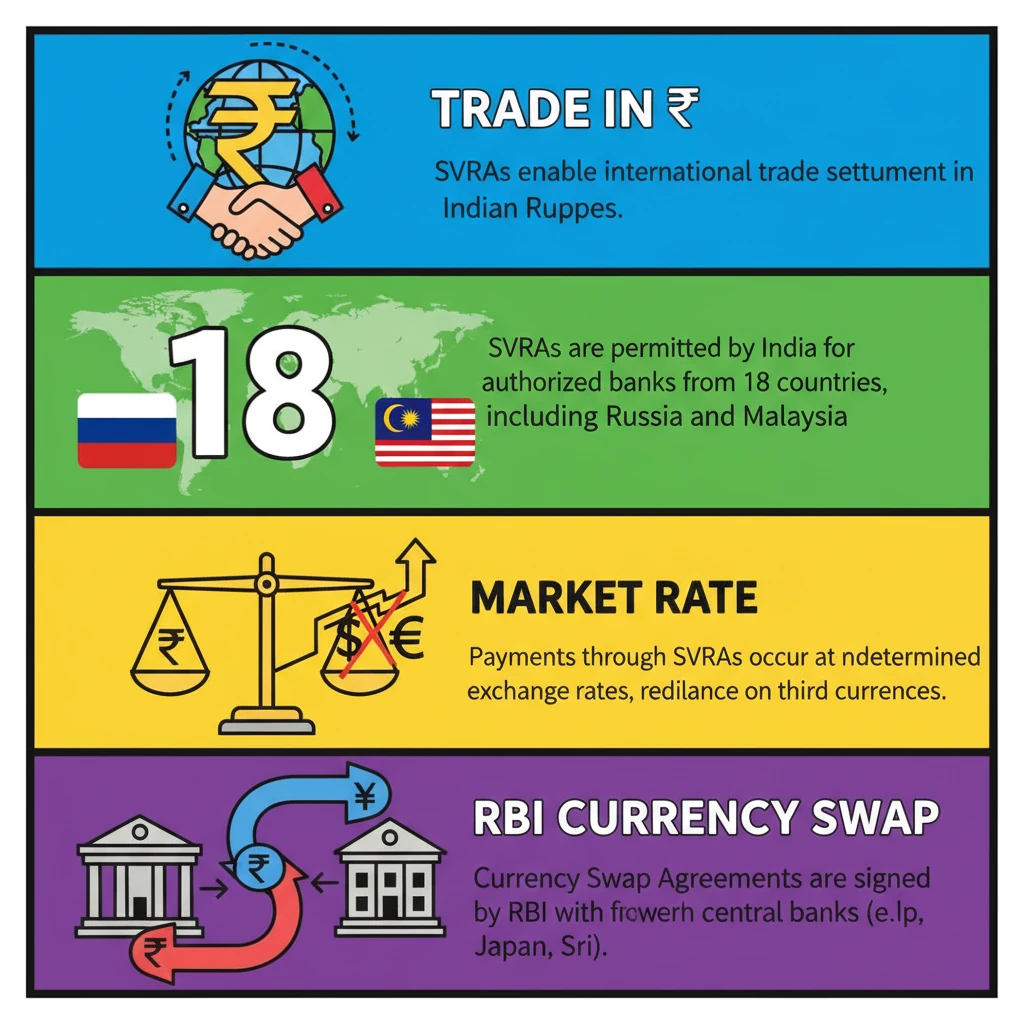
- •Special Vostro Rupee Accounts (SVRAs) enable international trade settlement directly in Indian Rupees.
- •SVRAs are permitted by India for authorized banks from 18 countries, including Russia and Malaysia.
- •Payments through SVRAs occur at market-determined exchange rates, reducing reliance on third currencies.
- •Currency Swap Agreements are signed by RBI with central banks (e.g., Japan, Sri Lanka) to exchange rupee and foreign currency.
- •Swaps provide liquidity support and stabilize exchange rates, acting as a financial safety net.
- •Both mechanisms promote rupee internationalization, reduce transaction costs, and enhance trade diversification.
🧠 Memory Techniques
95% Verified Content
📚 Reference Sources
•Ministry of Finance, Government of India Publications
•Economic Survey of India
•Drishti IAS Economy Summaries