Plug-in Hybrid Electric Vehicle (PHEV) - Economy | UPSC Learning
Topics
0 topics • 0 completed
🔍
No topics match your search
Plug-in Hybrid Electric Vehicle (PHEV)
Medium⏱️ 8 min read
economy
📖 Introduction
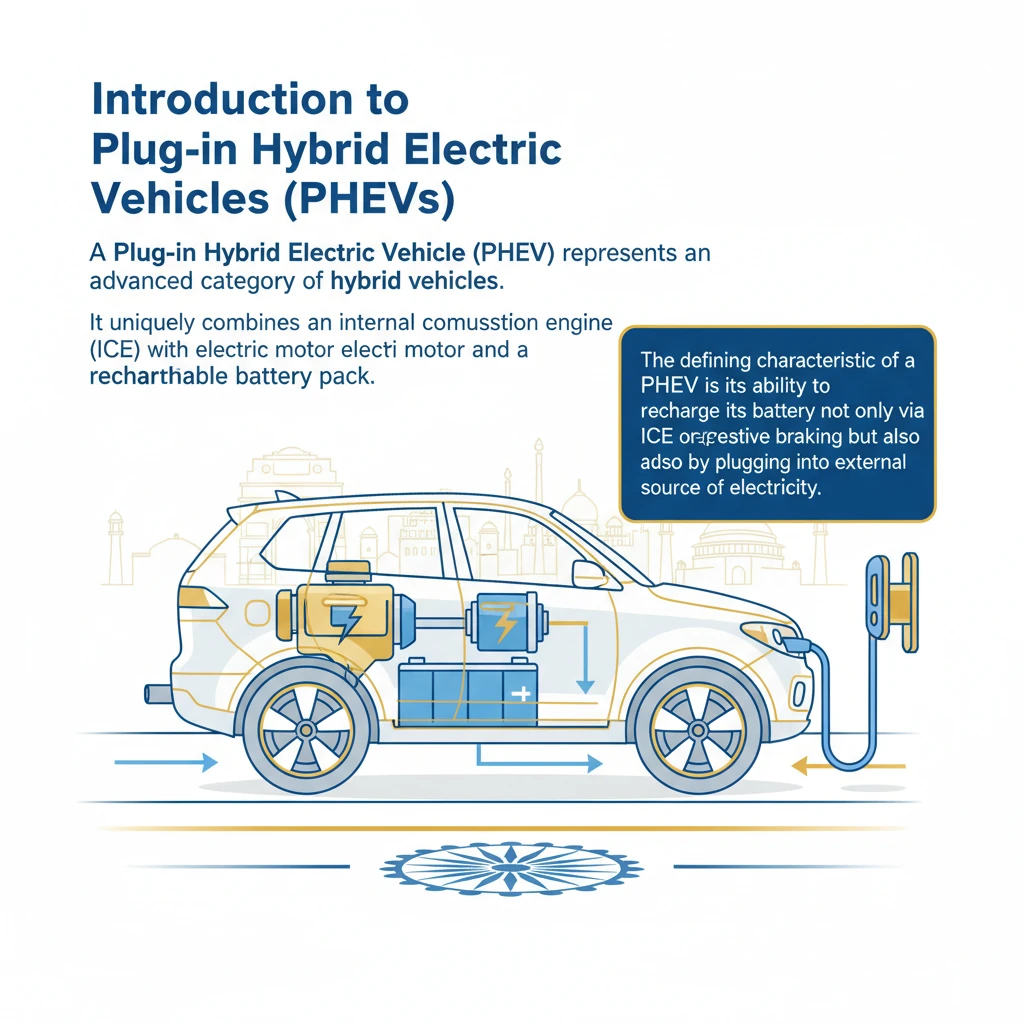
<h4>Introduction to Plug-in Hybrid Electric Vehicles (PHEVs)</h4><p>A <strong>Plug-in Hybrid Electric Vehicle (PHEV)</strong> represents an advanced category of hybrid vehicles.</p><p>It uniquely combines an <strong>internal combustion engine (ICE)</strong> with an <strong>electric motor</strong> and a <strong>rechargeable battery pack</strong>.</p><div class='info-box'><p>The defining characteristic of a PHEV is its ability to recharge its battery not only via the ICE or regenerative braking but primarily from an <strong>external electricity source</strong>, through a dedicated plug.</p></div><h4>Key Features and Charging Mechanism</h4><p>Unlike conventional <strong>Hybrid Electric Vehicles (HEVs)</strong>, PHEVs are equipped with a larger battery capacity.</p><p>This larger battery enables a significant <strong>all-electric range</strong>, allowing the vehicle to travel considerable distances solely on electric power.</p><div class='key-point-box'><p>Crucially, the PHEV's battery <strong>must be charged</strong> using an <strong>external electricity source</strong>, such as a home charging station or public charging point. It cannot be charged by the internal combustion engine alone, unlike some HEVs.</p></div><h4>Operating Modes of a PHEV</h4><p>PHEVs offer drivers flexibility by operating in at least two distinct modes, optimizing for efficiency and range.</p><ul><li><strong>All-electric Mode:</strong> In this mode, the vehicle runs entirely on its <strong>electric motor</strong>, drawing power from the battery. The internal combustion engine remains off, resulting in zero tailpipe emissions and quiet operation. This mode is ideal for shorter commutes.</li><li><strong>Hybrid Mode:</strong> When the battery's charge is depleted or when more power is required (e.g., during acceleration or at higher speeds), the PHEV seamlessly transitions to <strong>Hybrid Mode</strong>. Here, both the <strong>electric motor</strong> and the <strong>internal combustion engine</strong> work in conjunction to power the vehicle, maximizing efficiency and extending range.</li></ul><h4>Efficiency Comparison with Other EV Types</h4><p>When comparing different types of electric vehicles, PHEVs occupy an intermediate position in terms of overall efficiency.</p><div class='info-box'><p><strong>PHEVs are generally more efficient than conventional Hybrid Electric Vehicles (HEVs)</strong> due to their larger battery capacity and ability to run purely on electricity for longer durations.</p></div><div class='info-box'><p>However, <strong>PHEVs are less efficient than Battery Electric Vehicles (BEVs)</strong>. BEVs rely solely on electric power and do not carry the weight or complexity of an internal combustion engine, making them inherently more efficient in electric-only operation.</p></div><div class='exam-tip-box'><p>UPSC often asks comparative questions on different EV technologies. Understanding the distinctions in <strong>charging mechanisms</strong>, <strong>operating modes</strong>, and <strong>efficiency</strong> between HEVs, PHEVs, and BEVs is crucial for <strong>General Studies Paper 3 (Economy & Science & Technology)</strong>.</p></div>
💡 Key Takeaways
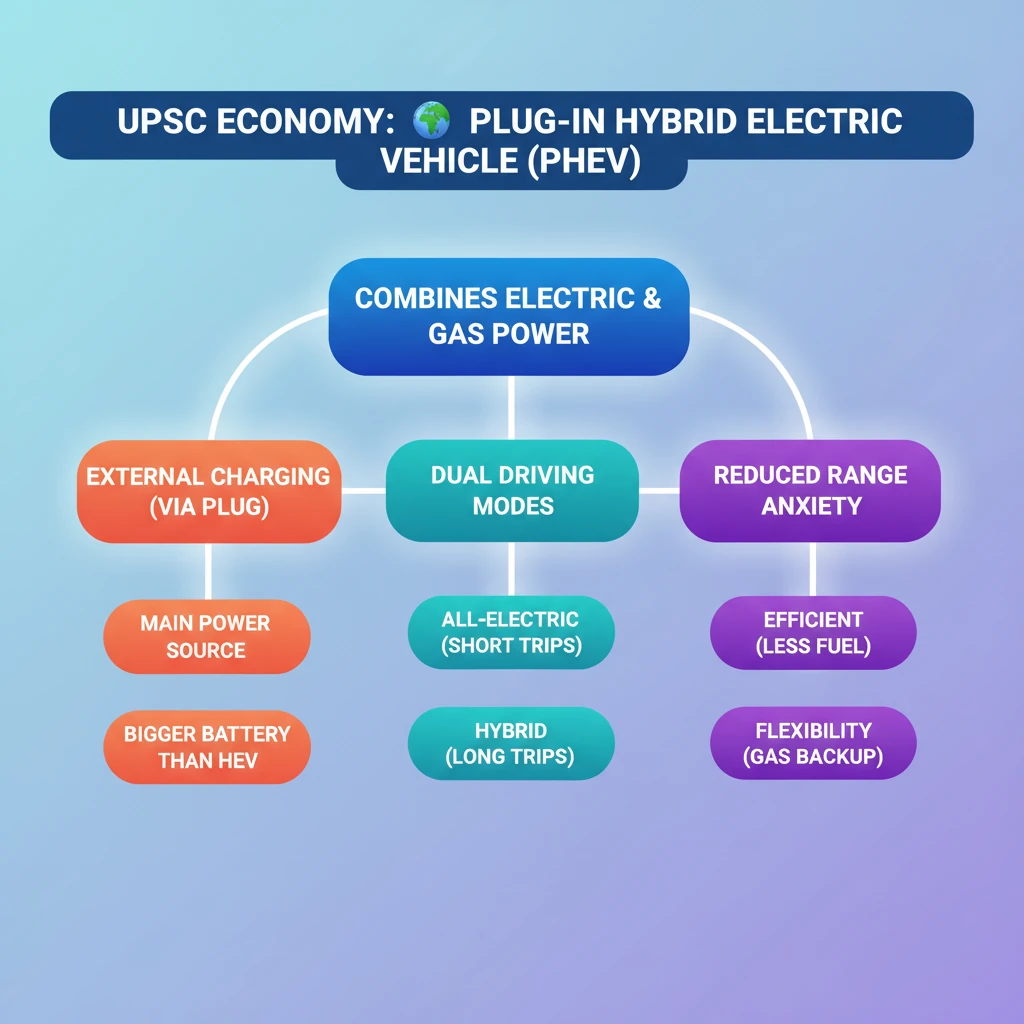
- •PHEVs combine an ICE and an electric motor, with batteries chargeable externally via a plug.
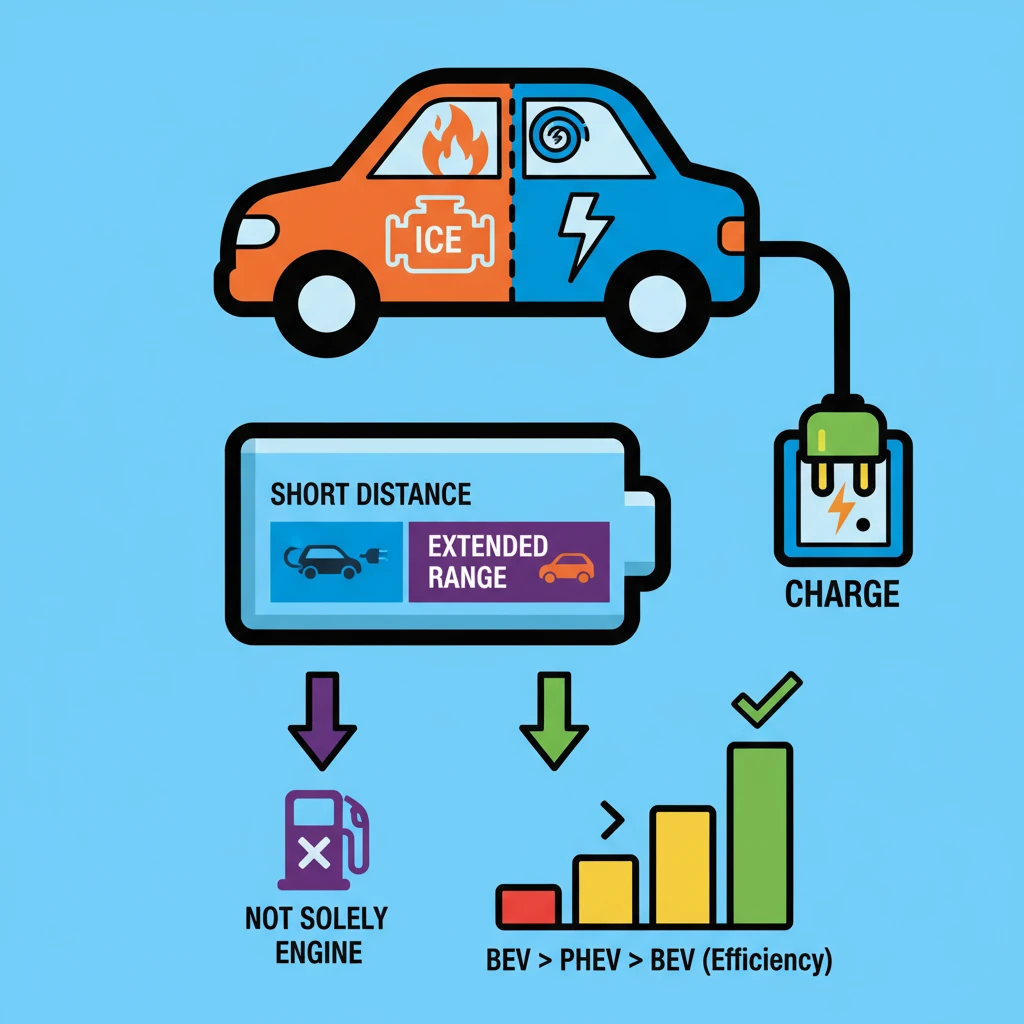
- •They can operate in all-electric mode for short distances or hybrid mode for extended range.
- •Unlike HEVs, PHEV batteries are primarily charged externally, not solely by the engine.
- •PHEVs are more efficient than HEVs but less efficient than pure BEVs.
- •They offer a balance of electric efficiency and conventional fuel range, reducing range anxiety.
🧠 Memory Techniques
95% Verified Content
📚 Reference Sources
•Ministry of Road Transport and Highways (MoRTH) reports on EVs
•FAME India Scheme documents
•International Energy Agency (IEA) reports on EV outlook