What is Cryptocurrency and How does it Work? - Economy | UPSC Learning
Topics
0 topics • 0 completed
🔍
No topics match your search
What is Cryptocurrency and How does it Work?
Medium⏱️ 8 min read
economy
📖 Introduction
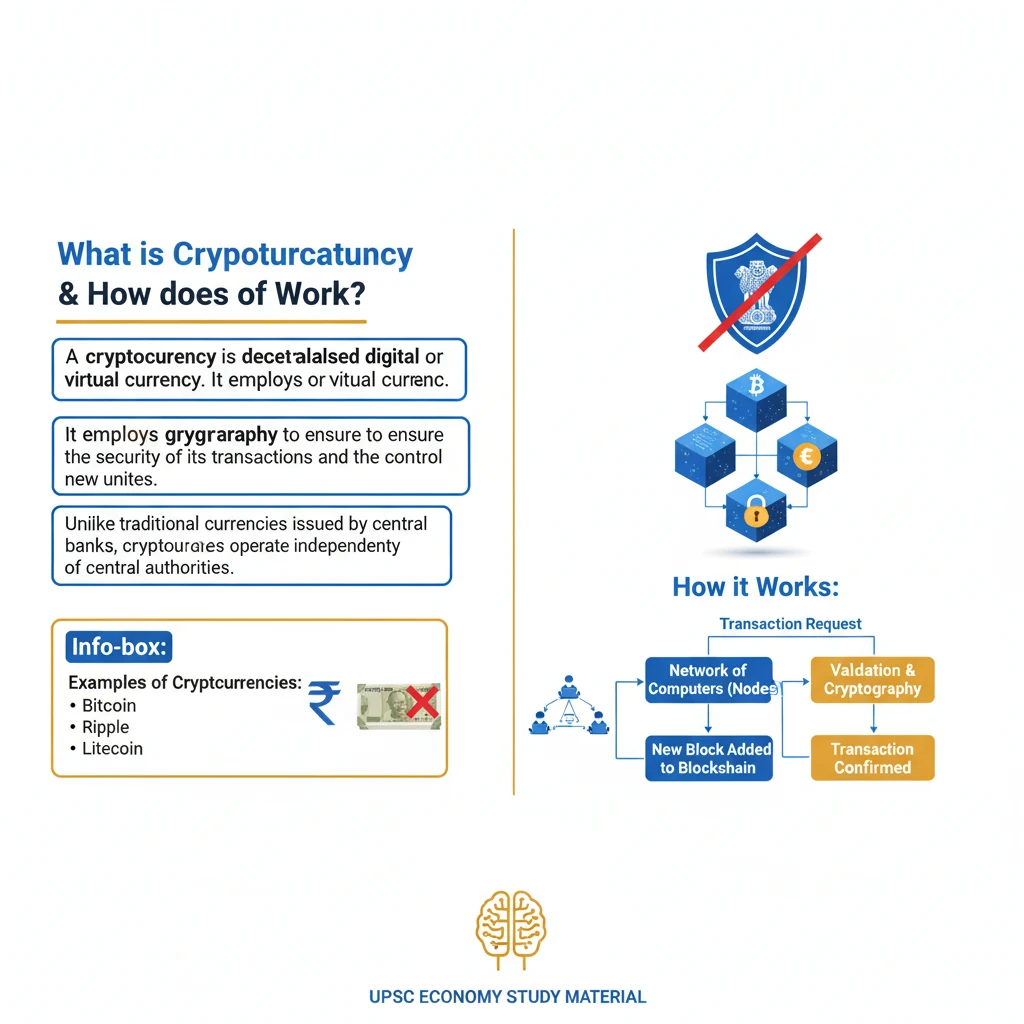
<h4>What is Cryptocurrency?</h4><p>A <strong>cryptocurrency</strong> is a <strong>decentralised digital</strong> or <strong>virtual currency</strong>. It employs <strong>cryptography</strong> to ensure the security of its transactions and to control the creation of new units.</p><p>Unlike traditional currencies issued by central banks, cryptocurrencies operate independently of central authorities.</p><div class='info-box'><p><strong>Examples of Cryptocurrencies:</strong></p><ul><li><strong>Bitcoin (BTC)</strong></li><li><strong>Ethereum (ETH)</strong></li><li><strong>Ripple (XRP)</strong></li><li><strong>Litecoin (LTC)</strong></li></ul></div><h4>How Cryptocurrency Transactions Work: The Blockchain</h4><p>All <strong>cryptocurrency transactions</strong> are recorded on a public digital ledger known as the <strong>blockchain</strong>. This ledger is an immutable and transparent record of every transaction ever made.</p><p>The <strong>blockchain</strong> is maintained by a vast, decentralised network of computers spread globally. These computers work together to verify and add new transactions to the chain.</p><div class='key-point-box'><p>The combination of <strong>decentralisation</strong> and advanced <strong>cryptographic techniques</strong> makes it extremely difficult for any single entity to manipulate the currency or alter transactions once they are recorded on the <strong>blockchain</strong>.</p></div><h4>Digital Wallets: Your Gateway to Crypto</h4><p>To participate in <strong>cryptocurrency transactions</strong>, individuals or businesses need a <strong>digital wallet</strong>. This is a software application designed to securely store a user's <strong>public</strong> and <strong>private keys</strong>.</p><p>These <strong>keys</strong> are fundamental for sending and receiving cryptocurrency. They are also essential for verifying transactions on the <strong>blockchain</strong>, ensuring only the rightful owner can initiate transfers.</p><h4>Cryptocurrency Mining: Creating New Units</h4><p>New cryptocurrencies are typically generated through a process called <strong>mining</strong>. This involves using significant computational power to solve complex mathematical problems.</p><p>The <strong>mining process</strong> serves a dual purpose: it validates and records new transactions onto the <strong>blockchain</strong>, and in return, the successful 'miner' is rewarded with a certain amount of cryptocurrency.</p><div class='exam-tip-box'><p><strong>UPSC Insight:</strong> Understanding <strong>decentralisation</strong>, <strong>blockchain technology</strong>, and <strong>cryptography</strong> is crucial. These concepts have broader implications for digital governance and cybersecurity, often appearing in <strong>GS Paper III</strong>.</p></div>
💡 Key Takeaways
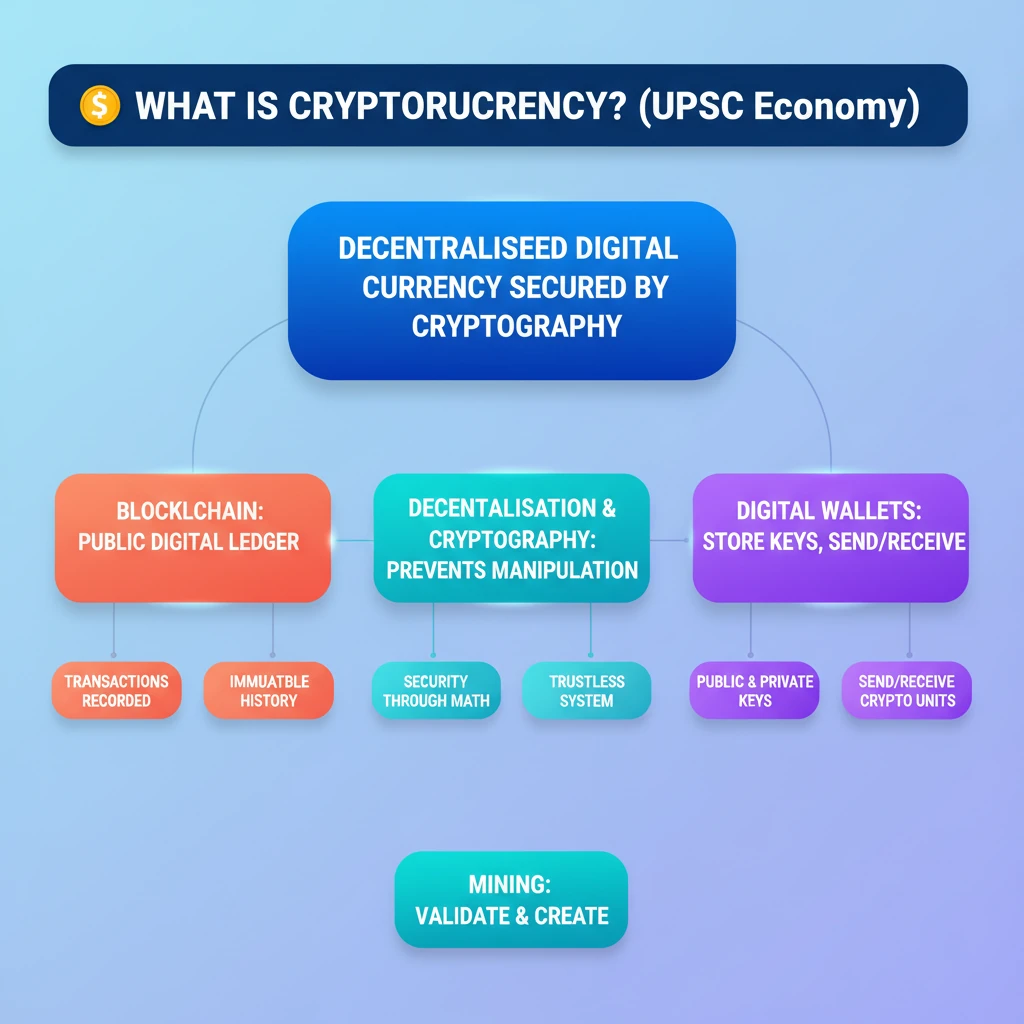
- •Cryptocurrency is a decentralised digital currency secured by cryptography.
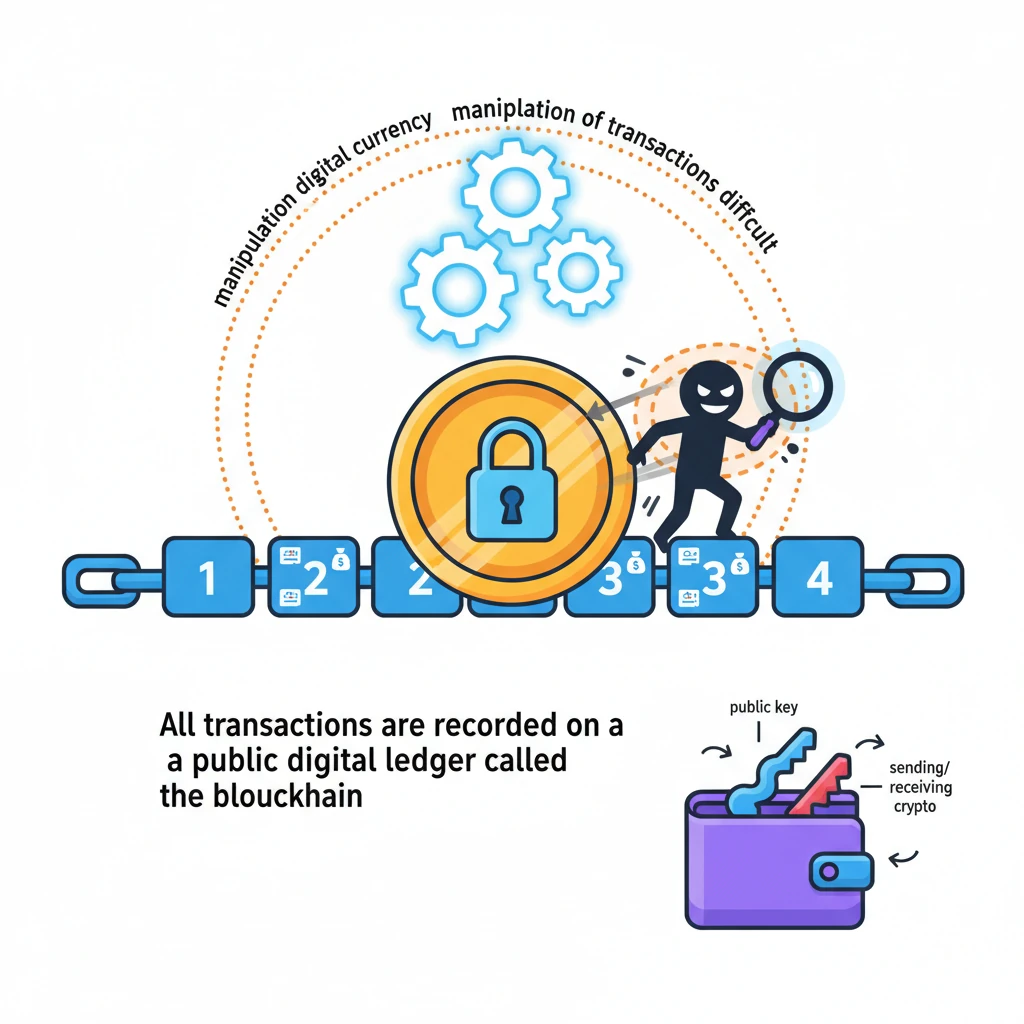
- •All transactions are recorded on a public digital ledger called the blockchain.
- •Decentralisation and cryptography make manipulation or alteration of transactions difficult.
- •Digital wallets store public and private keys for sending/receiving crypto.
- •Mining involves solving complex problems to validate transactions and create new units.
- •Examples include Bitcoin, Ethereum, Ripple, and Litecoin.
🧠 Memory Techniques
95% Verified Content