What are the Recent Developments Related to Critical Minerals? - Economy | UPSC Learning
Topics
0 topics • 0 completed
🔍
No topics match your search
What are the Recent Developments Related to Critical Minerals?
Medium⏱️ 7 min read
economy
📖 Introduction
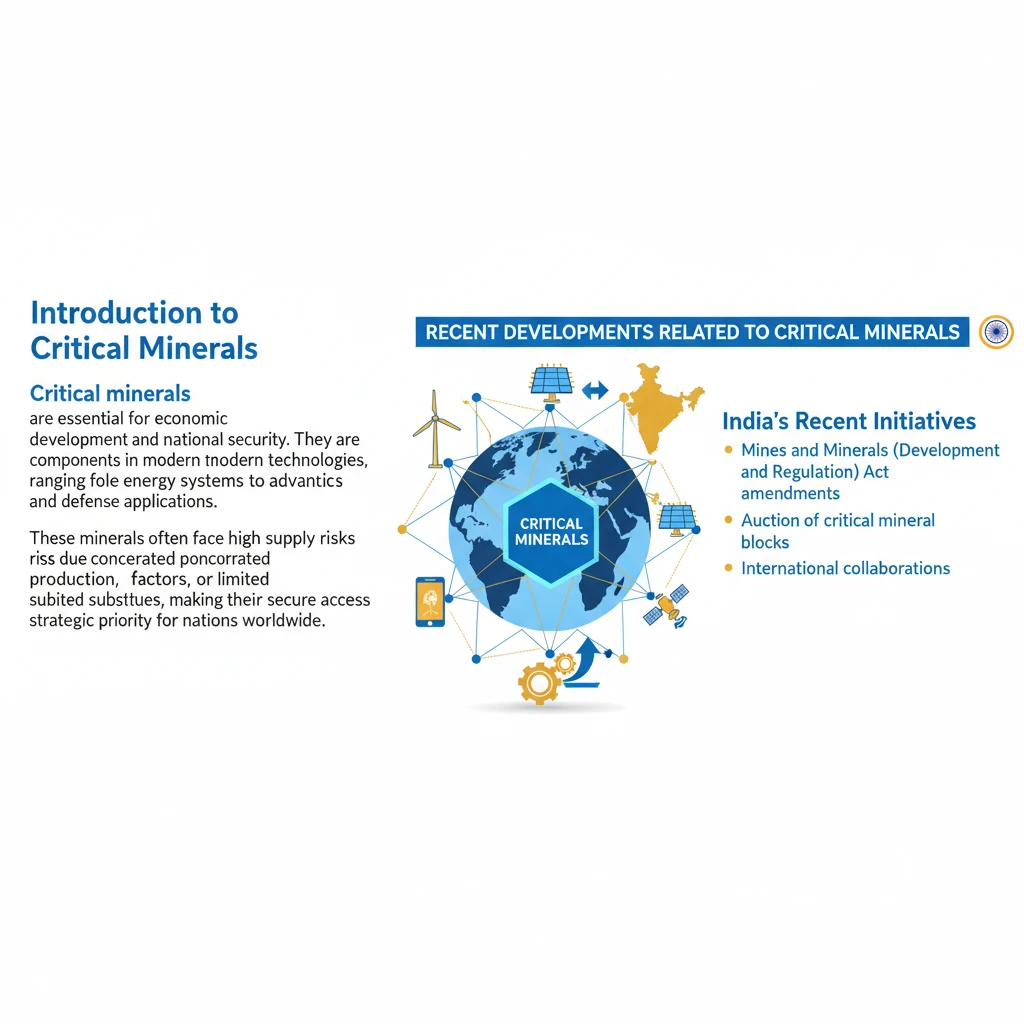
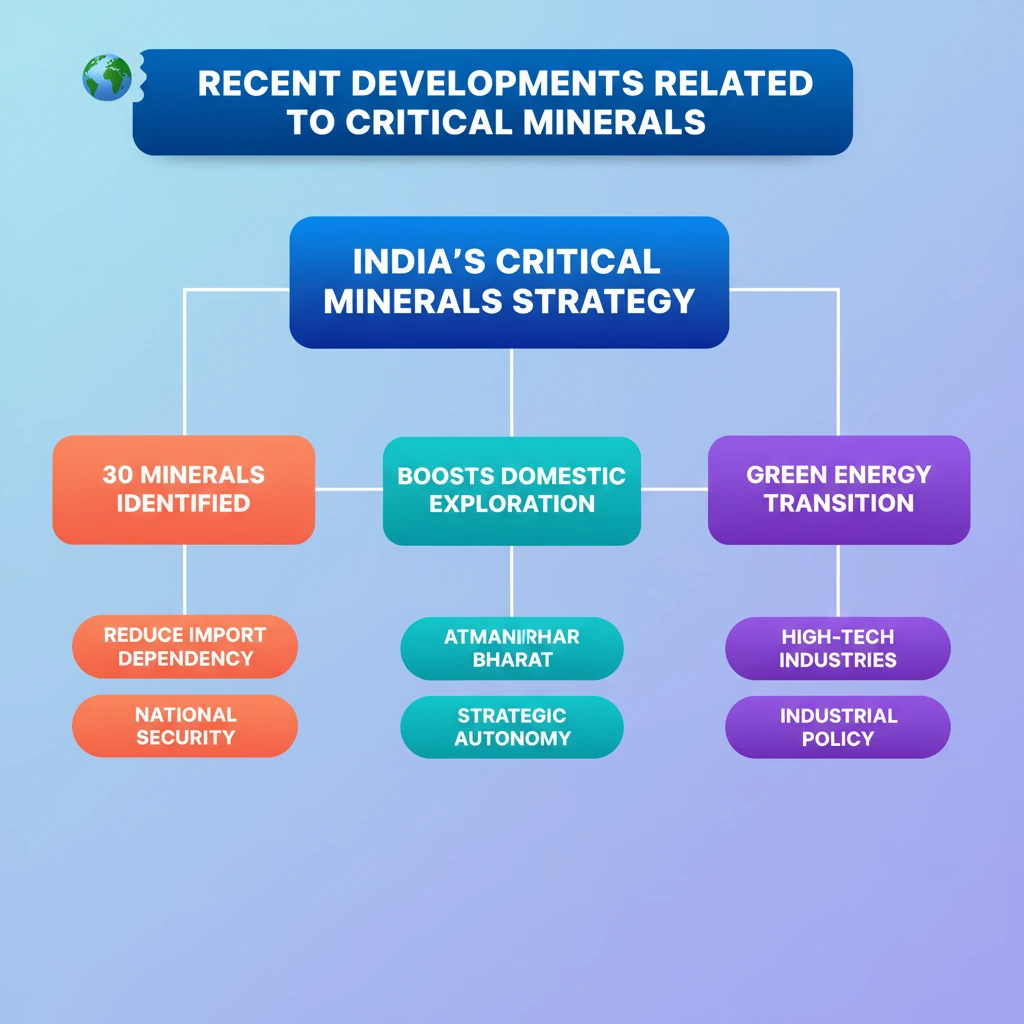
<h4>Introduction to Critical Minerals</h4><p><strong>Critical minerals</strong> are essential for economic development and national security. They are vital components in modern technologies, ranging from renewable energy systems to advanced electronics and defense applications.</p><p>These minerals often face high supply risks due to concentrated production, geopolitical factors, or limited substitutes, making their secure access a strategic priority for nations worldwide.</p><h4>India's Recent Initiative: Critical Minerals List</h4><p>In a significant development, <strong>India</strong> has officially released a comprehensive list of <strong>30 critical minerals</strong>. This initiative underscores the nation's commitment to bolstering its strategic autonomy and securing vital resources for its burgeoning industries.</p><div class='key-point-box'><p>The identification of these minerals is a crucial step towards reducing import dependency and fostering domestic exploration, mining, and processing capabilities.</p></div><h4>The List of 30 Critical Minerals</h4><p>The newly identified list encompasses a diverse range of minerals, each playing a pivotal role in various high-tech and green energy sectors. Securing their supply is paramount for India's future growth trajectory.</p><div class='info-box'><p>The <strong>30 critical minerals</strong> identified by India are:</p><ul><li><strong>Antimony</strong></li><li><strong>Beryllium</strong></li><li><strong>Bismuth</strong></li><li><strong>Cobalt</strong></li><li><strong>Copper</strong></li><li><strong>Gallium</strong></li><li><strong>Germanium</strong></li><li><strong>Graphite</strong></li><li><strong>Hafnium</strong></li><li><strong>Indium</strong></li><li><strong>Lithium</strong></li><li><strong>Molybdenum</strong></li><li><strong>Niobium</strong></li><li><strong>Nickel</strong></li><li><strong>PGE</strong> (Platinum Group Elements)</li><li><strong>Phosphorus</strong></li><li><strong>Potash</strong></li><li><strong>REE</strong> (Rare Earth Elements)</li><li><strong>Selenium</strong></li><li><strong>Silicon</strong></li><li><strong>Strontium</strong></li><li><strong>Tantalum</strong></li><li><strong>Tellurium</strong></li><li><strong>Tin</strong></li><li><strong>Titanium</strong></li><li><strong>Tungsten</strong></li><li><strong>Vanadium</strong></li><li><strong>Zirconium</strong></li><li><strong>Selenium</strong> (listed twice in source, maintained as per instruction)</li><li><strong>Cadmium</strong></li></ul></div><div class='exam-tip-box'><p><strong>UPSC Insight:</strong> Questions on <strong>critical minerals</strong> can appear in <strong>GS-III (Economy, Science & Technology)</strong> and <strong>GS-II (International Relations, Government Policies)</strong>. Be prepared to discuss their economic implications, strategic importance, and India's policy responses.</p></div>
💡 Key Takeaways
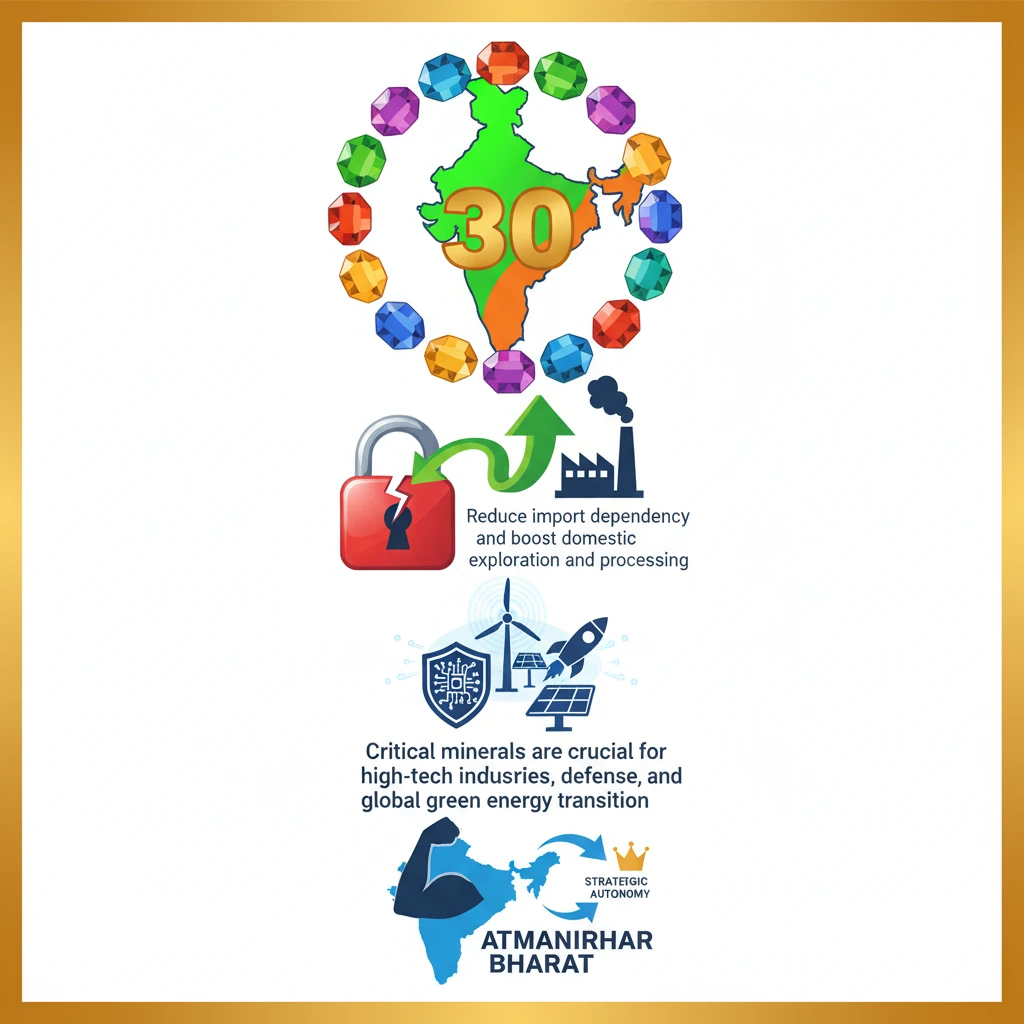
- •India has identified 30 critical minerals vital for its economic growth and national security.
- •The list aims to reduce import dependency and boost domestic exploration and processing.
- •Critical minerals are crucial for high-tech industries, defense, and the global green energy transition.
- •This initiative supports India's 'Atmanirbhar Bharat' vision and strengthens its strategic autonomy.
- •The move will shape India's future industrial policy and resource diplomacy.
🧠 Memory Techniques
95% Verified Content
📚 Reference Sources
•Ministry of Mines, Government of India (for official list and policy context)
•Press Information Bureau (PIB) releases related to critical minerals