What is an Industrial Smart City? - Economy | UPSC Learning
Topics
0 topics • 0 completed
🔍
No topics match your search
What is an Industrial Smart City?
Medium⏱️ 8 min read
economy
📖 Introduction
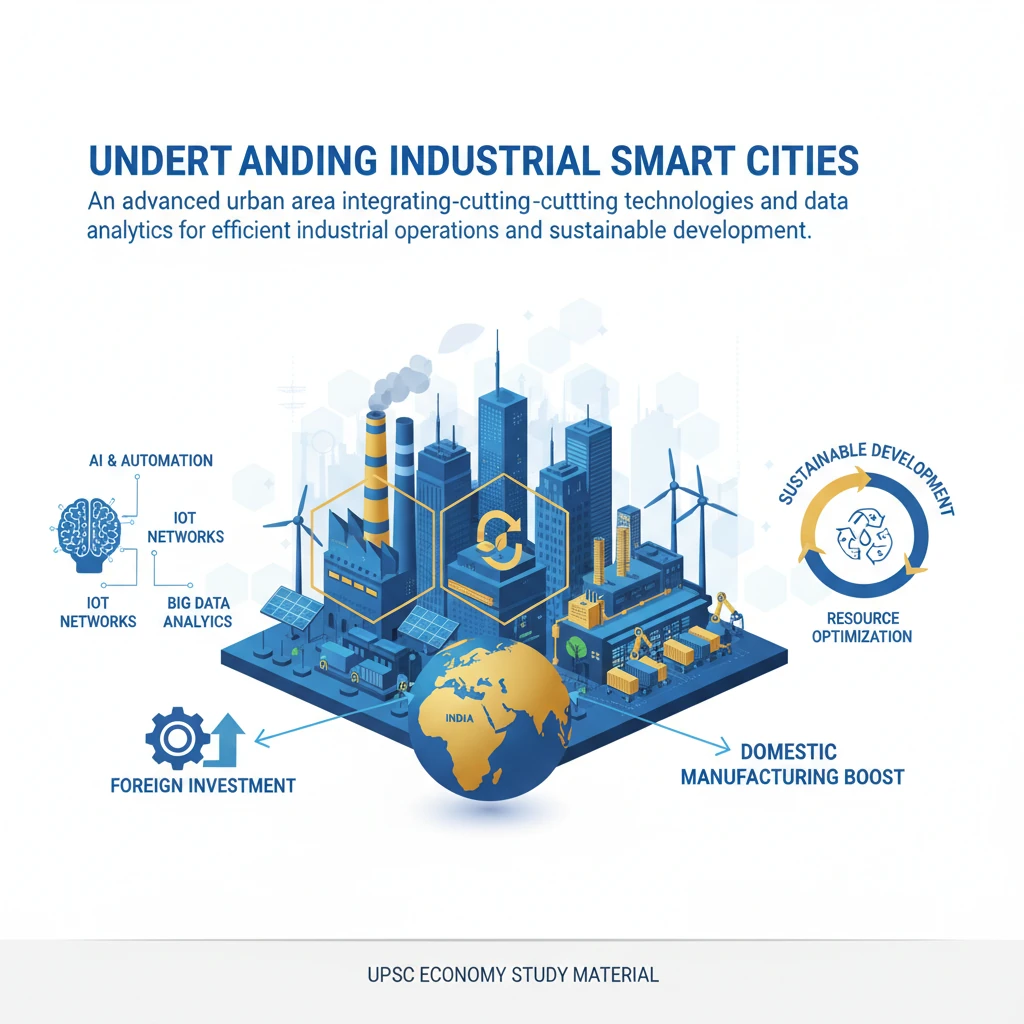
<h4>Understanding Industrial Smart Cities</h4><p>An <strong>Industrial Smart City</strong> is an advanced urban area designed to integrate cutting-edge technologies and data analytics. Its primary goal is to significantly enhance the efficiency of industrial operations while simultaneously promoting <strong>sustainable development</strong>.</p><p>These innovative cities are strategically developed to attract substantial <strong>foreign investment</strong>, bolster <strong>domestic manufacturing capabilities</strong>, and generate significant <strong>employment opportunities</strong> across various sectors.</p><div class='info-box'><p><strong>Core Definition:</strong> An <strong>Industrial Smart City</strong> leverages technology and data to optimize industrial processes and foster sustainable growth within an urban environment.</p></div><h4>Key Objectives of Industrial Smart Cities</h4><p>The development of new industrial cities in India is aimed at strengthening the nation's position within <strong>global value chains</strong>. This is achieved by offering investors ready-to-allot land, streamlining the setup process for businesses.</p><p>A crucial objective is to integrate advanced urban planning concepts such as <strong>'plug-and-play'</strong> and <strong>'walk-to-work'</strong>, which are central to modern, efficient urban ecosystems.</p><div class='key-point-box'><p><strong>Plug-and-Play Industrial Parks:</strong> These parks provide businesses with <strong>ready-to-use infrastructure</strong>, including utilities, connectivity, and pre-approved clearances, enabling immediate operational commencement.</p></div><div class='key-point-box'><p><strong>Walk-to-Work Urban Strategy:</strong> This planning approach encourages residents to live in close proximity to their workplaces. It aims to reduce reliance on private vehicles, thereby promoting <strong>walking</strong>, decreasing traffic congestion, and enhancing environmental sustainability.</p></div><h4>Roadmap for Development: The NICDP</h4><p>The development of these industrial smart cities is meticulously planned and executed under the overarching <strong>National Industrial Corridor Development Programme (NICDP)</strong>. This programme is a cornerstone of India's industrial policy.</p><p>The <strong>NICDP</strong> is designed to create advanced industrial cities that are globally competitive. Its ambition is to rival the world's leading manufacturing and investment destinations by providing a superior operational environment.</p><p>The programme actively fosters a vibrant industrial ecosystem. It achieves this by facilitating investments from both large-scale <strong>anchor industries</strong> and a multitude of <strong>Micro, Small, and Medium Enterprises (MSMEs)</strong>, ensuring balanced growth.</p><h4>Implementation and Structure</h4><p>The first significant industrial corridor under this initiative, the <strong>Delhi Mumbai Industrial Corridor (DMIC)</strong>, received approval in <strong>2007</strong>, marking a pivotal step in India's industrial infrastructure development.</p><p>The implementation of the <strong>NICDP</strong> is managed by two key entities: the <strong>National Industrial Corridor Development and Implementation Trust (NICDIT)</strong> and the <strong>National Industrial Corridor Development Corporation Limited (NICDC)</strong>.</p><p>These industrial nodes are designed to be self-sustaining urban environments. They integrate residential and commercial setups seamlessly, ensuring that living, working, and leisure facilities are all part of a cohesive plan.</p><div class='exam-tip-box'><p><strong>UPSC Insight:</strong> Understanding the difference between 'Smart City' and 'Industrial Smart City' is crucial. While both leverage technology, the latter specifically focuses on optimizing industrial output and logistics within a designated urban area, often under programs like <strong>NICDP</strong>. Questions may test the objectives and implementation bodies.</p></div>
💡 Key Takeaways
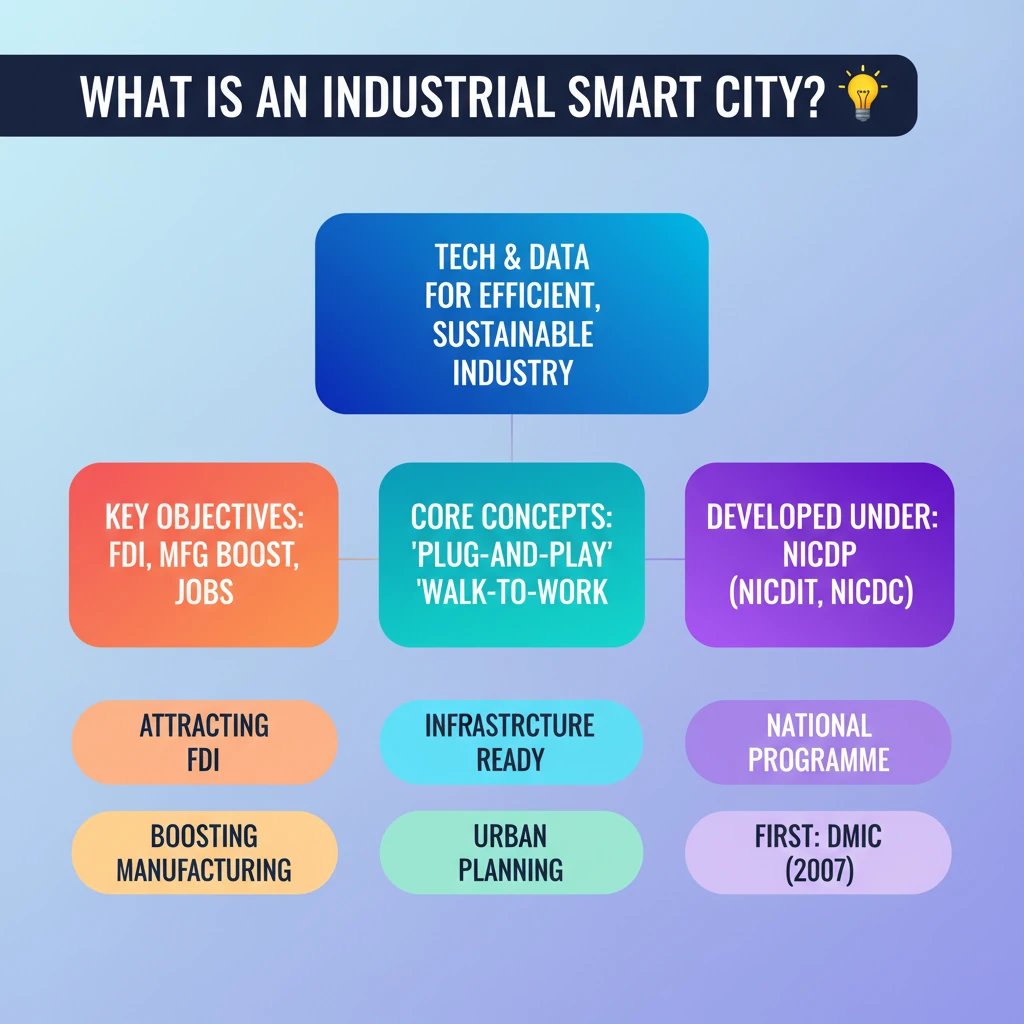
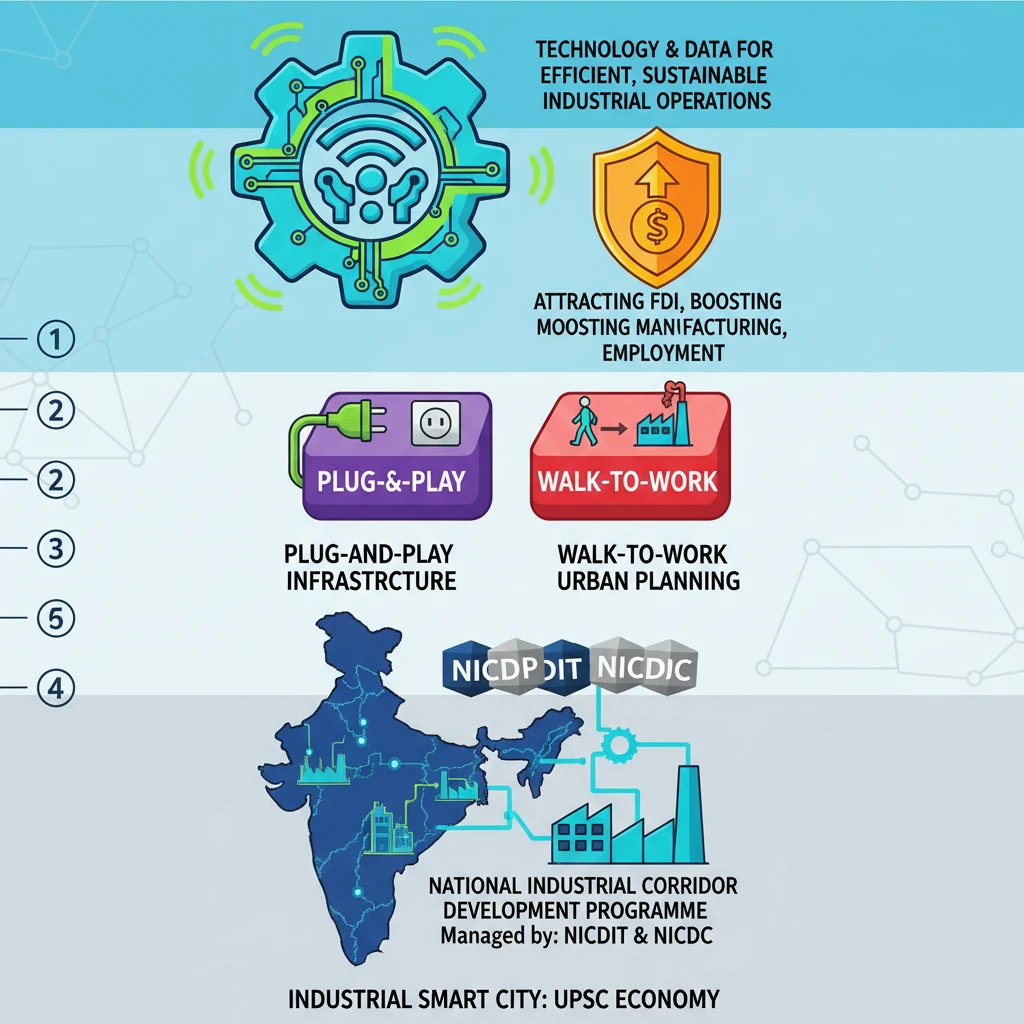
- •Industrial Smart Cities integrate technology and data for efficient, sustainable industrial operations.
- •Objectives include attracting FDI, boosting manufacturing, and creating employment.
- •Key concepts are 'plug-and-play' infrastructure and 'walk-to-work' urban planning.
- •Developed under the National Industrial Corridor Development Programme (NICDP), managed by NICDIT and NICDC.
- •The Delhi Mumbai Industrial Corridor (DMIC) approved in 2007, was the first major initiative.
🧠 Memory Techniques
98% Verified Content