India Grants Record Patents - Economy | UPSC Learning
Topics
0 topics • 0 completed
🔍
No topics match your search

India Grants Record Patents
Medium⏱️ 8 min read
economy
📖 Introduction
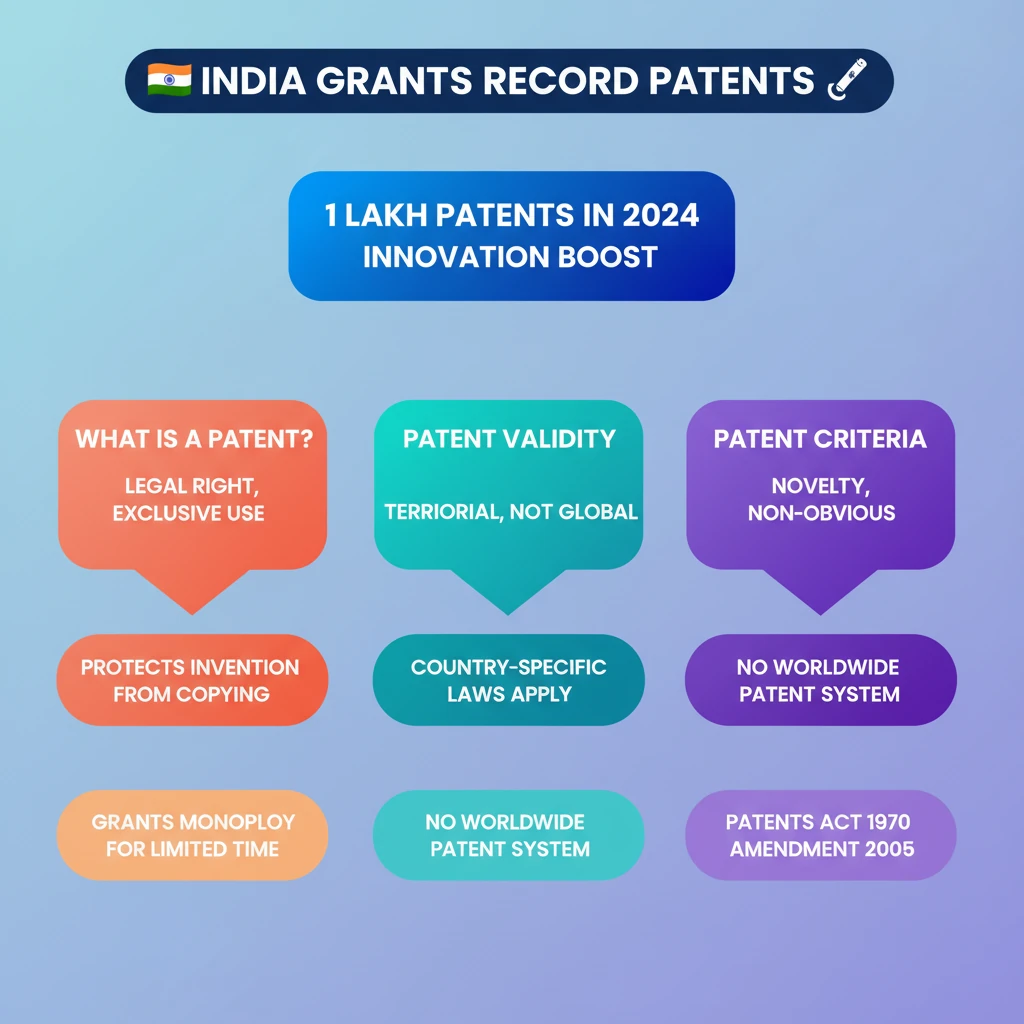
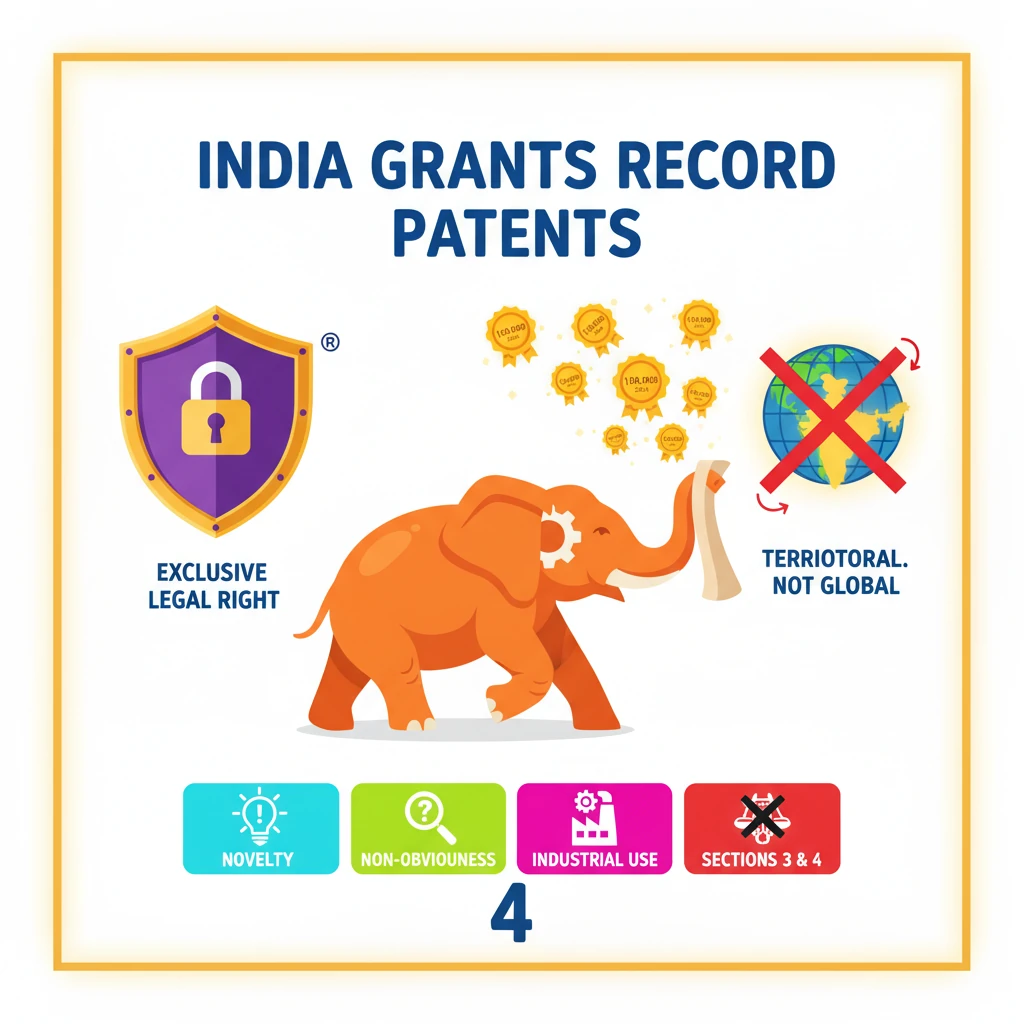
<h4>India Grants Record Patents: A Milestone in Innovation</h4><p>The <strong>Union Minister of Commerce and Industry</strong> recently announced a significant achievement: <strong>India issued approximately one lakh patents in 2024</strong>. This figure reflects a substantial increase in the rate of patent approvals, underscoring the nation's growing focus on innovation and intellectual property protection.</p><div class='key-point-box'><p>This record-breaking number of patents highlights <strong>India's evolving innovation ecosystem</strong> and its commitment to fostering research and development across various sectors.</p></div><h4>Understanding a Patent</h4><p>A <strong>patent</strong> is a crucial legal instrument designed to protect inventions. It grants exclusive rights to an inventor or entity, preventing others from making, using, selling, or importing the invention without permission.</p><div class='info-box'><p><strong>Definition:</strong> A <strong>patent</strong> is a legal right granted for an invention, which is a product or process that provides a new way of doing something, or offers a new technical solution to a problem.</p></div><p>It is important to note that <strong>patent protection is a territorial right</strong>. This means a patent granted in India is only effective within the geographical boundaries of India. There is <strong>no concept of a global patent</strong>; protection must be sought individually in each country where it is desired.</p><h4>Governing Law: The Patents Act, 1970</h4><p>The framework for the patent system in India is primarily governed by the <strong>Patents Act, 1970</strong>. This principal legislation has been instrumental in shaping India's intellectual property landscape.</p><p>The Act is complemented by various <strong>Patent Rules</strong>, which are regularly amended to adapt to the changing technological and economic environment. The most recent update includes the <strong>Patents (Amendment) Rules, 2024</strong>.</p><h4>Criteria for Patentability</h4><p>For an invention to be eligible for a patent in India, it must meet specific criteria. These criteria ensure that only genuine innovations receive legal protection.</p><ul><li><strong>Novelty:</strong> The invention must be new and not part of the prior art. It should not have been published or publicly used anywhere in the world before the patent application was filed.</li><li><strong>Non-obviousness (Inventive Step):</strong> The invention must involve an inventive step, meaning it should not be obvious to a person skilled in the art. It must demonstrate a technical advance as compared to existing knowledge or have economic significance.</li><li><strong>Industrial Application (Utility):</strong> The invention must be capable of industrial application, meaning it can be made or used in an industry.</li></ul><p>Additionally, an invention must not fall under the categories specified in <strong>Section 3 and Section 4 of the Patents Act, 1970</strong>, which list non-patentable subject matter (e.g., frivolous inventions, methods of agriculture, business methods, mere discovery of a scientific principle).</p><div class='exam-tip-box'><p><strong>UPSC Insight:</strong> Understanding the <strong>criteria for patentability</strong> and the <strong>non-patentable subject matter (Sections 3 & 4)</strong> is crucial for GS-III (Economy/Science & Technology) questions related to Intellectual Property Rights (IPR) and innovation policy.</p></div><h4>Key Amendments to the Patents Act</h4><p>The <strong>Patents Act, 1970</strong> has undergone several significant amendments to keep pace with global developments and national priorities.</p><div class='info-box'><p>The <strong>Patents Act, 1970</strong> came into force in <strong>1972</strong>, replacing the older <strong>Indian Patents and Designs Act, 1911</strong>.</p></div><p>A pivotal amendment was the <strong>Patents (Amendment) Act, 2005</strong>. This amendment was particularly significant as it extended <strong>product patent protection to all fields of technology</strong>. This included critical sectors such as <strong>food, drugs, chemicals, and microorganisms</strong>, aligning India's patent regime with international standards like the TRIPS Agreement.</p>
💡 Key Takeaways
- •India granted a record one lakh patents in 2024, indicating a significant boost in innovation.
- •A patent is a legal right protecting an invention, granting exclusive rights to the inventor.
- •Patent protection is territorial; there is no global patent.
- •Key patentability criteria include novelty, non-obviousness, and industrial application, along with not falling under Sections 3 & 4 of the Act.
- •The Patents Act, 1970, governs India's patent system, with the 2005 amendment extending product patents to all fields.
- •Recent updates like the Patents (Amendment) Rules, 2024, aim to streamline the system.
🧠 Memory Techniques
98% Verified Content
📚 Reference Sources
•The Patents Act, 1970 (as amended)
•Press Information Bureau (PIB) releases on Intellectual Property