Fuel Cell Electric Vehicle (FCEV) - Economy | UPSC Learning
Topics
0 topics • 0 completed
🔍
No topics match your search
Fuel Cell Electric Vehicle (FCEV)
Medium⏱️ 8 min read
economy
📖 Introduction
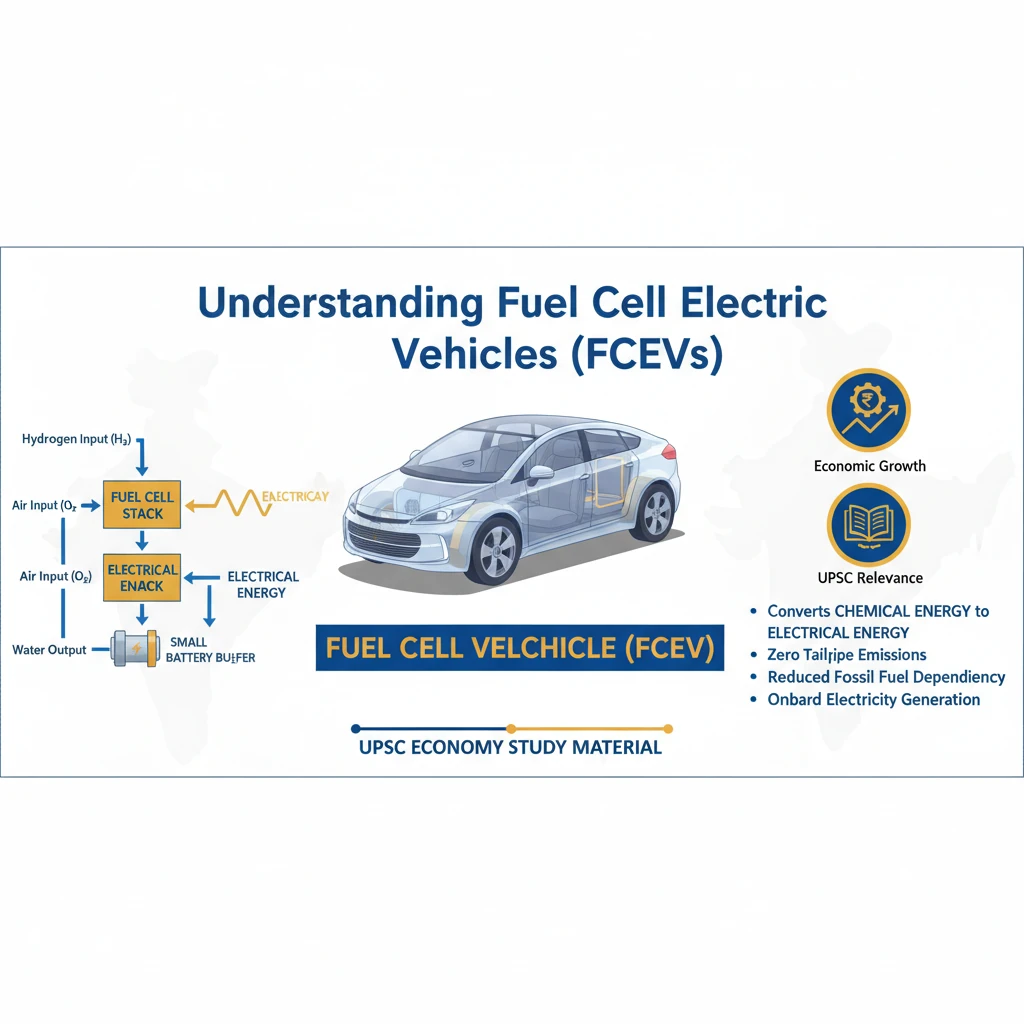
<h4>Understanding Fuel Cell Electric Vehicles (FCEVs)</h4><p>A <strong>Fuel Cell Electric Vehicle (FCEV)</strong> represents a cutting-edge category of electric vehicles that generates its own electricity onboard. Unlike conventional battery electric vehicles (BEVs) that store electricity in large battery packs, FCEVs produce electricity through an electrochemical reaction.</p><p>The fundamental principle involves converting <strong>chemical energy</strong> directly into <strong>electrical energy</strong>. This process occurs within a device called a <strong>fuel cell stack</strong>, eliminating the need for combustion and thus producing zero tailpipe emissions, primarily water vapor.</p><div class='info-box'><p><strong>Key Differentiator:</strong> In FCEVs, <strong>electric energy</strong> for propulsion is produced from <strong>chemical energy</strong> stored in a fuel, typically <strong>hydrogen</strong>. This contrasts with BEVs which draw electricity from an external charging source.</p></div><h4>How a Hydrogen FCEV Works</h4><p>The most common type of FCEV uses <strong>hydrogen</strong> as its fuel. Hydrogen gas is stored in high-pressure tanks within the vehicle. When the vehicle is in operation, hydrogen is fed into the fuel cell stack.</p><p>Within the fuel cell, hydrogen (H2) reacts with oxygen (O2) from the air. This reaction generates electricity, which powers an electric motor to drive the wheels. The only by-products of this process are heat and pure water (H2O).</p><div class='key-point-box'><p><strong>Electrochemical Reaction:</strong> At the anode, <strong>hydrogen atoms</strong> lose electrons, becoming protons. These electrons travel through an external circuit, generating electricity. At the cathode, <strong>oxygen atoms</strong> combine with the protons and electrons to form water.</p></div><h4>Key Components of an FCEV</h4><p>FCEVs comprise several essential components that enable their unique operation:</p><ul><li><strong>Fuel Cell Stack:</strong> The heart of the FCEV, where hydrogen and oxygen react to produce electricity.</li><li><strong>Hydrogen Storage Tanks:</strong> High-pressure tanks designed to safely store hydrogen fuel.</li><li><strong>Electric Motor:</strong> Powers the vehicle's wheels, similar to a Battery Electric Vehicle (BEV).</li><li><strong>Small Battery/Supercapacitor:</strong> Stores regenerative braking energy and provides auxiliary power for sudden acceleration.</li><li><strong>Power Control Unit:</strong> Manages the flow of electricity from the fuel cell, battery, and to the electric motor.</li></ul><h4>Advantages of FCEVs</h4><p>FCEVs offer several compelling advantages, positioning them as a promising solution for sustainable mobility:</p><ul><li><strong>Zero Tailpipe Emissions:</strong> The only by-product is water vapor, contributing to improved air quality.</li><li><strong>Quick Refueling:</strong> Refueling an FCEV with hydrogen takes only 3-5 minutes, comparable to gasoline vehicles, unlike the longer charging times of BEVs.</li><li><strong>Longer Range:</strong> FCEVs typically offer a longer driving range on a single fill compared to many BEVs.</li><li><strong>Reduced Weight:</strong> Hydrogen tanks can be lighter than large battery packs required for similar ranges in BEVs.</li></ul><h4>Challenges and Future Outlook</h4><p>Despite their advantages, FCEVs face challenges, primarily related to <strong>hydrogen production</strong>, <strong>storage</strong>, and <strong>refueling infrastructure</strong>. The cost of hydrogen production, especially green hydrogen, and the limited availability of refueling stations are significant hurdles.</p><div class='exam-tip-box'><p><strong>UPSC Insight:</strong> While FCEVs offer significant environmental benefits, their widespread adoption in India depends on the development of a robust <strong>hydrogen ecosystem</strong>, including production, storage, and distribution infrastructure. Questions often focus on comparative analysis with BEVs and the policy support needed.</p></div>
💡 Key Takeaways
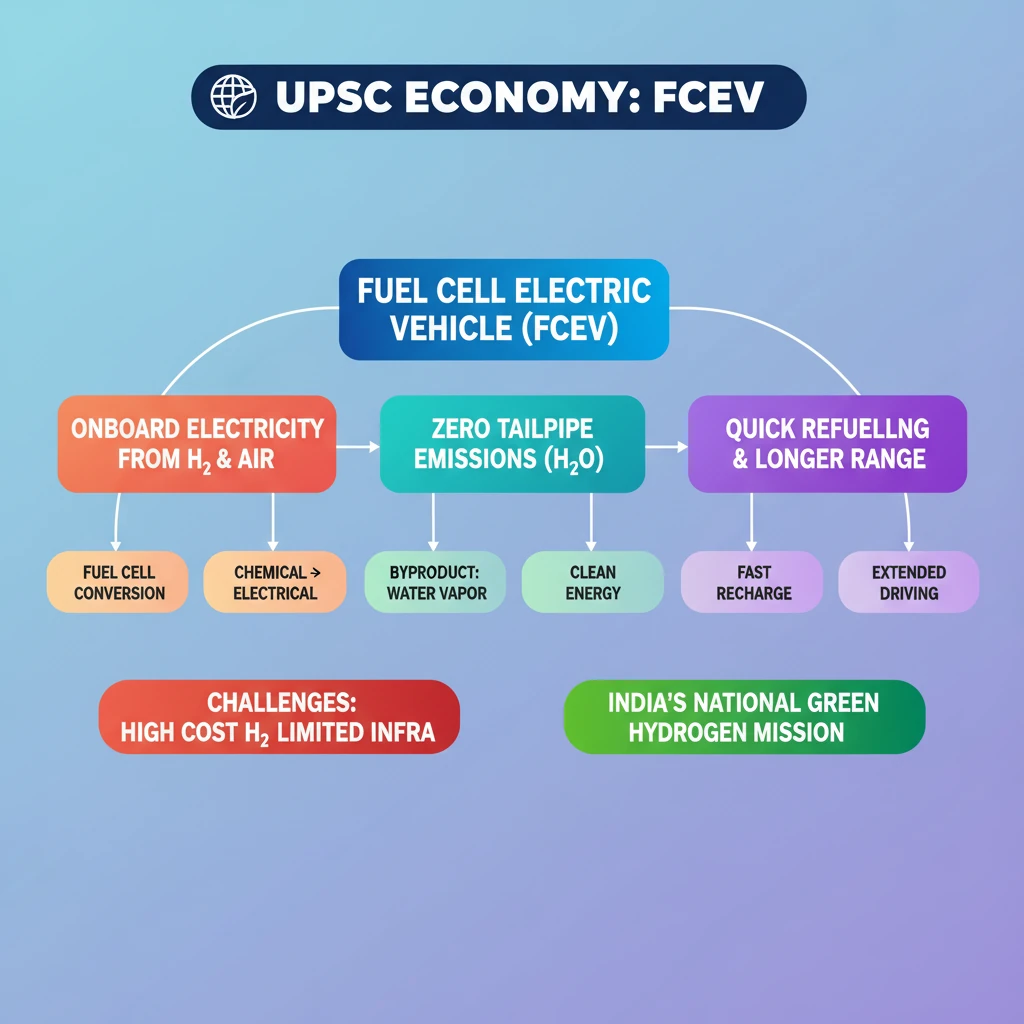
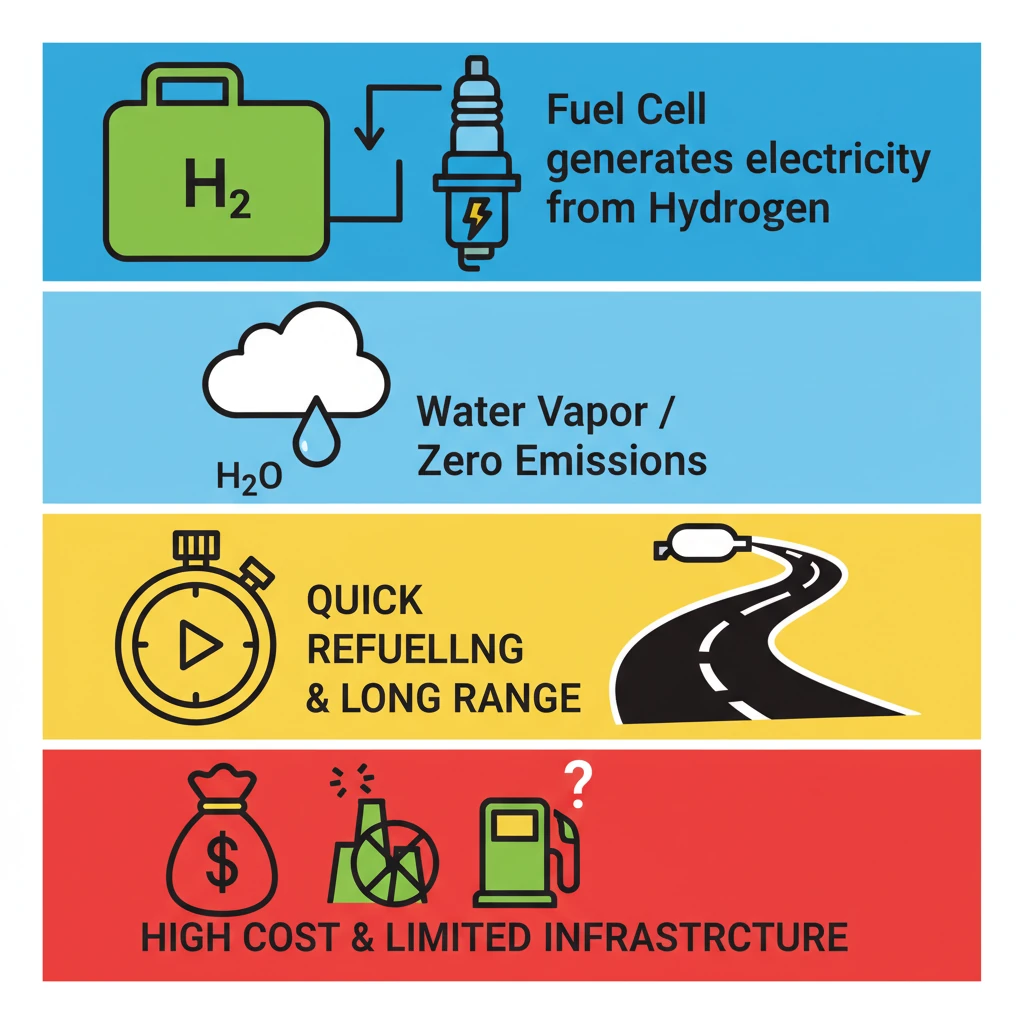
- •FCEVs generate electricity onboard from chemical energy (typically hydrogen) via a fuel cell.
- •The primary by-product is water vapor, resulting in zero tailpipe emissions.
- •Key advantages include quick refueling times and longer ranges compared to many BEVs.
- •Challenges involve high cost of green hydrogen production and limited refueling infrastructure.
- •India's National Green Hydrogen Mission aims to boost FCEV adoption and hydrogen economy.
🧠 Memory Techniques
95% Verified Content
📚 Reference Sources
•Ministry of New and Renewable Energy (MNRE) documents on National Green Hydrogen Mission
•International Energy Agency (IEA) reports on Hydrogen and Fuel Cells
•Automotive industry publications (e.g., Toyota, Hyundai official websites for FCEV specs)
•Council on Energy, Environment and Water (CEEW) analyses on India's energy transition